

Air Ambulance Bill After an Accident: Who Pays and What to Do
If an air ambulance took you from a crash scene, the bill that arrives weeks later is often the largest single line item of your medical costs, and it is not necessarily yours to pay in full. Which rules apply depends on three things: whether you have health insurance, whether that coverage is federally protected, and who caused the crash. Don’t pay, don’t ignore it, and don’t sign anything until you have matched the bill against your insurer’s paperwork.
This guide explains what these flights typically cost, how the federal No Surprises Act limits what you can be charged, what Colorado adds, how crash-related bills fit into an injury claim, and the steps to take when the number looks wrong.
Table of Contents
- What an air ambulance bill typically costs
- Who is responsible for paying after a car accident
- How the No Surprises Act protects you
- What Colorado adds
- What to do when the bill arrives
- How the flight fits into your injury claim
- Perspective: why we look at the bill before anyone pays it
- Talk to a Colorado injury attorney
- FAQ
- Sources
What an air ambulance bill typically costs
Air ambulance charges are among the highest in American health care. The National Association of Insurance Commissioners (NAIC) estimates the median cost of a single air ambulance transport at $36,000 to $40,000. The U.S. Government Accountability Office (GAO) reported a median charge of about $36,000 for a helicopter air ambulance ride in 2017.
Other figures are lower, and the gap matters. UnitedHealthcare says rides average about 52 miles and may cost between $12,000 and $25,000. The NAIC’s earlier consumer guidance gives the same $12,000 to $25,000 range per flight. The difference comes down to what is being counted: the amount a provider charges, the amount an insurer typically pays, or the amount a patient is asked to pay.
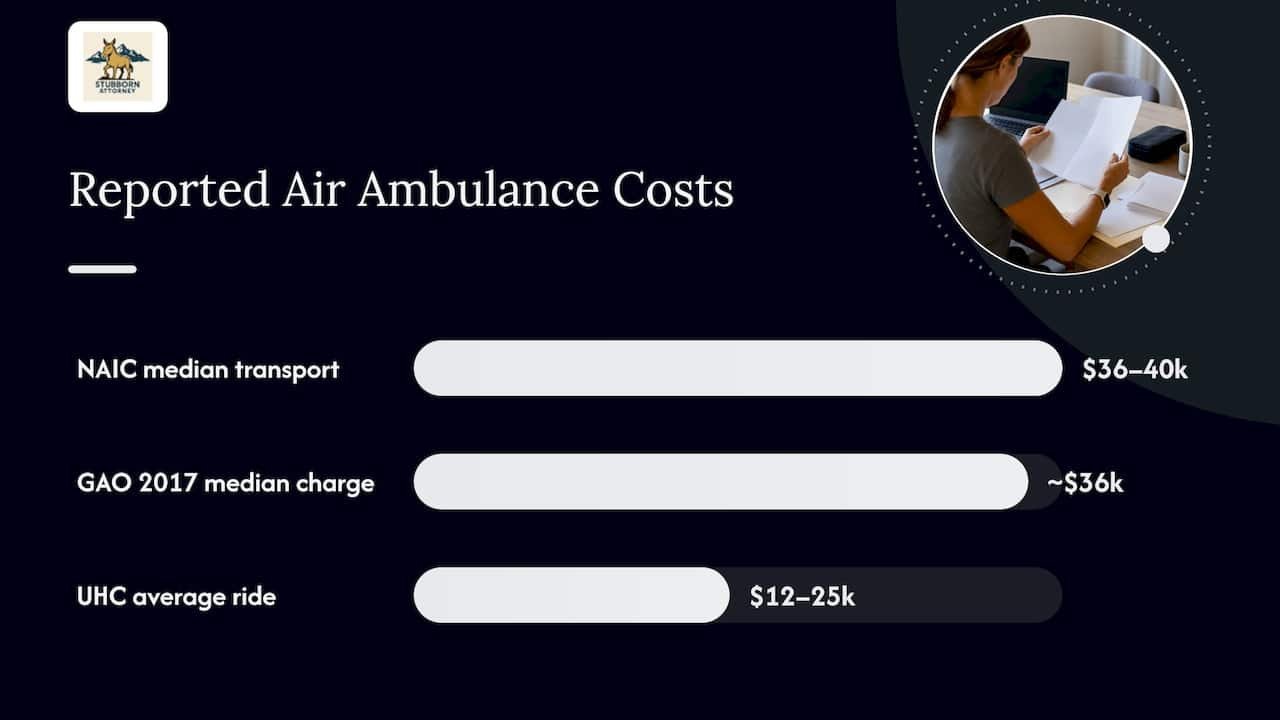
If your bill sits in the tens of thousands of dollars, that is within the normal range of what these providers charge. It does not mean the amount is what you legally owe.
Why the charges run so high
The NAIC points to the cost of running the service: aircraft that can cost up to $6 million at purchase, plus medical equipment, maintenance and round-the-clock staffing of specially qualified medical personnel and pilots. Those costs explain why the charge is high. They say nothing about whether you personally must absorb it, which is a separate legal question.
Who is responsible for paying after a car accident
After a crash, several sources of money can be in play, and they pay in a particular order. Understanding the order keeps you from paying out of pocket for something another policy should cover.
- Your health insurance. If you have a health plan, the air ambulance claim usually goes there first. Federal protections for out-of-network air ambulance bills, covered below, apply to most private plans.
- Medical payments coverage on your own auto policy. Some auto policies include medical payments coverage that can pay crash-related medical transport regardless of who caused the accident. Limits are usually modest compared with an air ambulance bill, so it may cover only part of it. Check your declarations page or ask your agent whether you have it.
- The at-fault driver’s liability insurance. Medical expenses, including the flight, are a recoverable part of an injury claim against the driver who caused the crash. That money typically arrives at settlement, not when the bill is due.
- You. What remains after the above, reduced by whatever protections apply, is what you may owe.
The key point: the crash being someone else’s fault does not make the at-fault driver’s insurer pay the air ambulance company directly. The bill is addressed to you, and you recover it through your claim. We explain how the different coverages interact in our guide to types of insurance in car accidents and our overview of paying for medical treatment after a car accident.
Health insurance should be billed
In Colorado, a hospital that treats a crash victim who has health insurance generally should not simply send the account to the auto claim and wait. We cover that in why hospitals must bill health insurance after an auto accident. The same habit helps with transport bills: give every provider your health insurance information, even when you expect the at-fault driver’s insurer to pay eventually.
How the No Surprises Act protects you
Before 2022, a patient with private insurance could land a bill for whatever the insurer did not pay. The GAO explains that out-of-network providers bill the difference between what they charged and what the insurer paid, a practice called balance billing. The NAIC notes that many states reported air ambulance providers without insurer or hospital affiliations, leaving some patients with no in-network option and enormous bills.
The No Surprises Act changed this. The NAIC states that it took effect January 1, 2022. According to the Centers for Medicare & Medicaid Services (CMS), surprise bills are generally prohibited for covered air ambulance services from out-of-network providers, and your cost-sharing cannot be greater than it would be in-network. CMS training material confirms the ban covers helicopter and airplane transport, including medical supplies and services provided during the flight.
What your share is calculated from
For out-of-network air ambulance services, the Department of Labor says cost-sharing uses the lesser of the billed charge or the qualifying payment amount, which is generally tied to median contracted rates adjusted for inflation. In practice, you should owe the same deductible, copay or coinsurance you would have owed for an in-network flight, not a share of a $50,000 invoice.
An air medical provider describes the effect this way: for plans beginning January 1, 2022 or later, your responsibility is limited to your plan’s cost-sharing, and you are kept out of payment disputes between insurers and providers.
Where the protection stops
Know the edges so you are not caught off guard:
- The Act does not require coverage of non-emergency air ambulance services if your plan covers air ambulance only for emergencies.
- It does not cover ground ambulances.
- It protects against balance billing for covered services. If your plan decides the flight was not covered, for example because it was not medically necessary, you face a coverage dispute, not a billing-limit question.
- Disputes between the provider and your insurer go through an independent dispute resolution process. The NAIC reports that air ambulance organizations prevailed in about 86% of cases resolved through that process in 2023. That fight is between them and your insurer, but it can influence insurer behavior.
If you have Medicare or Medicaid, the GAO notes that providers are prohibited from sending balance bills to patients with federal insurance, while patients with private insurance may receive balance bills when the provider is out-of-network and no other protection applies.
What Colorado adds
Colorado has its own surprise-billing rules, and the state’s Division of Insurance, part of the Department of Regulatory Agencies (DORA), is the place to call. DORA explains that Colorado law protects consumers from certain surprise medical bills, including those from an out-of-network air ambulance provider. It also states that Colorado law and the federal Act ban out-of-network cost-sharing for most emergency and some non-emergency services, and you cannot be charged more than in-network cost-sharing.
Two Colorado-specific points are worth knowing:
- Waivers. DORA says that providers may ask you to waive balance-billing protections, but you must be given advance information about your share and must consent in writing. Nobody should be asking you to sign that on a stretcher. If you later find a signed form among your paperwork, bring it to DORA and to an attorney.
- Air versus ground. An insurer’s Colorado disclosure notes that balance billing claims for air ambulance services are governed by federal law, while ground ambulance services are regulated by Colorado state law. That is why an air ambulance bill and a ground ambulance bill from the same crash may follow different rules.
For questions, DORA’s consumer line is 303-894-7490, or 800-930-3745 outside the Denver metro area, and DORA_Insurance@state.co.us, Monday to Friday, 8:00 a.m. to 5:00 p.m.
What to do when the bill arrives
Work through these steps in order. Keep copies of everything and write down the date and name of every person you speak with.
1. Do not pay yet, and do not ignore it
Paying quickly can make a later correction harder. Ignoring it can send the account to collections. Instead, ask the provider in writing for an itemized bill and confirm the account is on hold while you sort out insurance.
2. Compare the bill with your explanation of benefits
FAIR Health advises that if you use health insurance, you should compare the bill with your explanation of benefits (EOB), contact your provider and health plan if the bill is higher than it should be, and call the CMS No Surprises Help Desk at 1-800-985-3059 if unsure whether the Act applies. Look for these mismatches:
- The amount billed to you exceeds the “patient responsibility” on the EOB.
- The provider billed you for the difference between its charge and the plan’s payment.
- Your share is not what an in-network flight would cost under your plan.
- The claim was processed under the wrong date, wrong plan or wrong diagnosis.
3. Send the right complaint to the right place
The GAO lists the options when you receive a balance bill for an air ambulance: submit an air ambulance complaint through the Department of Transportation, file a complaint with your state’s insurance department, and appeal the balance bill to your insurer or the provider. In Colorado, the state insurance department is DORA, using the contact details above.
4. If the insurer denied the claim, appeal on medical necessity
Denials often turn on whether the flight was medically necessary. A Colorado family fighting a $94,000 air ambulance bill was denied coverage, and an independent reviewer upheld the denial because, without the treating physician’s records, medical necessity could not be determined. The lesson is practical: records from the physicians who made the decision to fly are the heart of an appeal. Request them early and ask the treating doctor to document why ground transport was not appropriate.
Our guides on how to appeal an insurance denial and why accident claims get denied walk through the process and the usual causes.
5. Ask about financial assistance or a payment arrangement
If a balance remains after insurance, the protections, and any appeal, ask the provider in writing about its financial assistance or hardship policy, a reduced settlement amount, and an interest-free monthly payment plan. Get any agreement in writing before you send money, and confirm it will not be reported to credit agencies while in effect. If you have a pending injury claim, tell the provider that, because the bill is likely to be recoverable from the at-fault party’s insurer at settlement and a hold may be reasonable.
How the flight fits into your injury claim
When another driver caused the crash, the air ambulance bill is part of your medical expenses in the injury claim, alongside hospital care, follow-up treatment, lost income, and pain and suffering. Our guide to types of damages in injury claims explains how each category is counted.
A few habits protect the value of that part of the claim:
- Keep the bill, the EOB and any denial letters. The amount actually owed and paid can shape what is recoverable, so the paper trail matters.
- Do not discuss fault or the flight bill with the other driver’s adjuster without understanding what your statement may be used for.
- Follow medical advice. Gaps in treatment are used to argue that injuries were minor. Read why to seek medical treatment after an accident.
- Act on the early steps. Our list of 10 steps to strengthen injury claims after a car accident covers what to do in the first days and weeks, and what to do after an accident covers the immediate aftermath.
If a rideshare vehicle was involved, separate coverage may apply; see our explanation of who pays after a Colorado Uber accident.
Perspective: why we look at the bill before anyone pays it
Before I practiced as an injury lawyer, I worked as a claims adjudicator for the federal government. I know how large insurance companies and agencies evaluate a claim, and I know that a bill is a starting position, not a verdict.
When a client comes to us with an air ambulance invoice, the first thing we do is slow everything down. We want to know who has been billed, what the explanation of benefits says, and whether the provider is allowed to ask for the amount on the page. Many people pay out of fear, because the number is frightening and the collection letters are written to be. Paying first and asking later is the most expensive way to handle it.
Our approach is built on persistence. We have settled hundreds of injury cases, and we represent only injured people. Cases are handled directly by attorneys, and we work on a contingency fee, so you owe nothing unless there is a monetary recovery in your case.
Name changes aside, the commitment is the same: when we take your case, we do not let go. That includes the medical bills sitting on your kitchen table.
Ryan
Talk to a Colorado injury attorney
If your air ambulance bill came from a crash someone else caused, we can review the bill, the insurance paperwork and the claim together. We handle car accident cases, along with motorcycle, semi-truck, bicycle and pedestrian accidents and other personal injuries across Colorado, including Colorado Springs. We work on a contingency fee, so you pay nothing unless we recover money for you. Not sure when to bring in a lawyer? Read when to hire an automobile accident attorney, or see our services page to get started.
FAQ
What is the average air ambulance bill in the U.S.?
The NAIC estimates the median cost of one air ambulance transport at $36,000 to $40,000, and the GAO reported a median charge of about $36,000 for helicopter flights in 2017. Some insurers cite lower averages of $12,000 to $25,000. What you owe depends on your insurance and the protections that apply.
Can an air ambulance company bill me for more than my insurance pays?
For covered air ambulance services under a private plan, the No Surprises Act generally prohibits that kind of balance billing, and your cost-sharing must match in-network levels. The protection has limits, such as services your plan does not cover. Check your EOB and call the CMS No Surprises Help Desk if you are unsure.
Does the at-fault driver’s insurance pay the air ambulance company?
Not directly, in most cases. The bill is usually yours, and you seek the cost back as part of your injury claim against the at-fault driver’s insurer, typically at settlement. Your health insurance and any medical payments coverage on your own auto policy can address the bill in the meantime.
Who can I contact in Colorado about a surprise air ambulance bill?
Contact the Colorado Division of Insurance at DORA. Its consumer line is 303-894-7490, or 800-930-3745 outside the Denver metro area, open Monday to Friday, 8:00 a.m. to 5:00 p.m. You can also file a complaint about air ambulance billing with the U.S. Department of Transportation.
Sources
- NAIC: Air Ambulances
- NAIC: Understanding Air Ambulance Insurance Coverage
- U.S. GAO: The High Cost of a Medical Flight
- UnitedHealthcare: Ambulance cost and coverage
- CMS: Overview of Key Consumer Protections
- CMS: The No Surprises Act’s Prohibitions on Balance Billing
- U.S. Department of Labor: ACA Part 55 FAQs
- PHI Air Medical: No Surprises Act
- Colorado DORA: Out-of-network health care provider reimbursement
- Colorado Division of Insurance: Federal No Surprises Act in Colorado
- Aetna: Colorado surprise bill disclosure
- FAIR Health: Surprise Billing, Your Rights
- Denver7: Colorado family fights $94K air ambulance bill