
Colorado Truck Accident Settlement: What Cases Are Worth
There is no standard Colorado truck accident settlement. Reported outcomes run from tens of thousands of dollars to multiple millions, and where your case lands depends on how badly you were hurt, how long you will need care, who was at fault and how much insurance sits behind the truck. The most recent national review of truck cases found a median settlement of $2.15 million, but that figure comes from serious, well-documented cases, so treat it as a ceiling-style reference point and not a prediction. This guide explains what moves the number, what to protect in the first weeks, and how a claim travels from the crash to a check.
Table of Contents
- What truck accident settlements look like in the numbers
- What drives the value of your case
- What compensation a truck claim can include
- Protect the evidence before it disappears
- A Colorado rule about early settlements
- How a truck claim moves from crash to settlement
- After you agree to settle
- Why trucking cases need a specialist
- Our perspective
- Talk to a Colorado truck accident attorney
- FAQ
- Sources
What truck accident settlements look like in the numbers
Published figures vary a great deal, mostly because each study counts different cases. Here is what the better-documented ones say.
| Source and period | What it measured | Result |
|---|---|---|
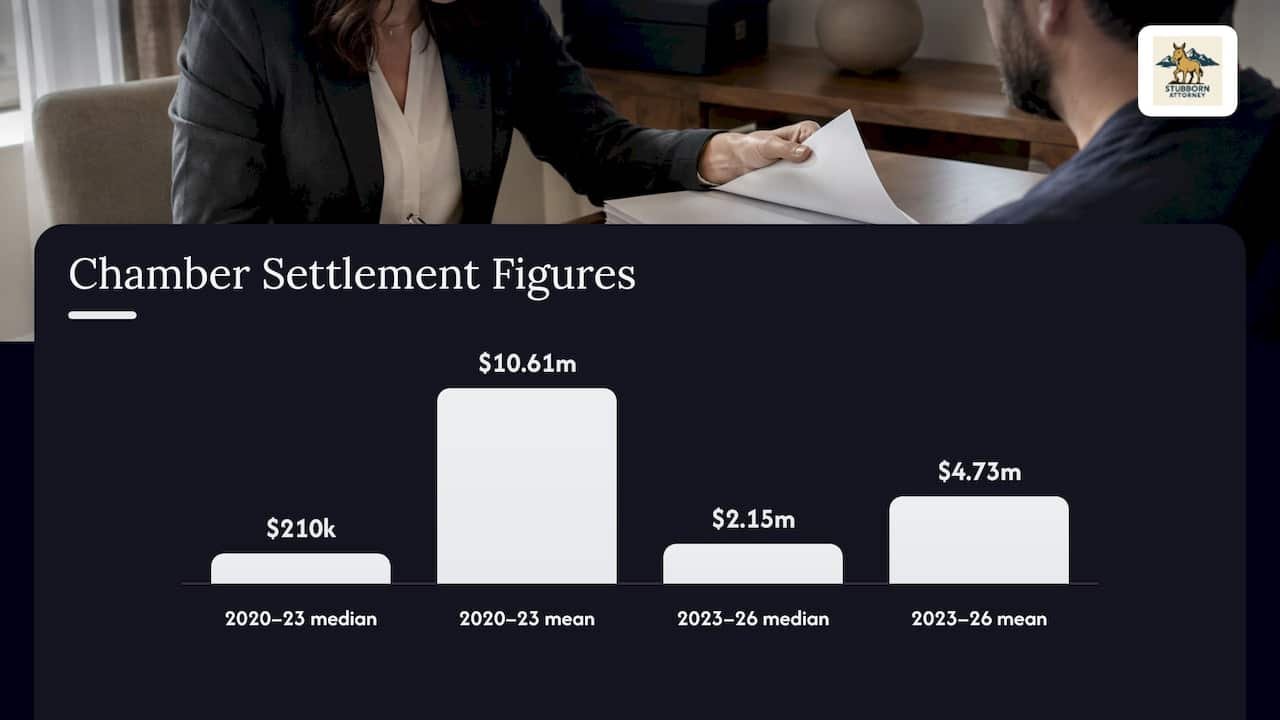
| U.S. Chamber Institute for Legal Reform, June 2020 to April 2023 | 154 trucking verdicts and settlements | Settlements: $210,000 median, $10,608,219 mean |
| ATRI study reported by Transport Topics, November 2021 | Payments in truck-crash cases | About $428,000 average without a fatality, $607,532 with a fatality |
| U.S. Chamber review reported by Truck News, October 2026 | 334 verdicts and settlements, June 2023 to July 2026 | Settlements: $2.15 million median, $4.73 million mean |
Three things are worth noticing.
First, the mean is far above the median in the older Chamber sample. A handful of enormous outcomes pull the average up, so the median says more about what a typical reported case looked like.
Second, these are national numbers. None of them is a Colorado average, and the Truck News report itself cautions that the data are collected case outcomes rather than a representative sample and may leave out confidential settlements. Many truck claims settle quietly for far less than any of these figures, especially when injuries heal fully or insurance coverage is thin.
Third, severity is the thread through all of them. The ATRI findings, as Transport Topics reported them, show that cases involving a fatality produced average payments 41.9% higher than cases without one, and that severe-injury cases were more likely to settle and more likely to produce payments above $600,000.
If you see a website promising an “average Colorado truck settlement” to the dollar, ask what cases it counted. Your own number is built from your own records, not from a headline.
What drives the value of your case
The Chamber’s research points to the same set of factors that decide most claims: injury severity and long-term medical needs, lost earning capacity, emotional damages, liability, and the insurance coverage available. In practice, each works like this.
Injury severity and the road to recovery
A fractured wrist that heals in two months and a spinal injury that ends a construction career are different cases, even if the same truck caused both. The more your injuries require surgery, rehabilitation, injections, home modifications or lifelong care, the more the claim has to account for. A treating physician’s opinion about your future needs carries real weight here, which is why gaps in treatment hurt claims.
Lost income and earning capacity
Missed paychecks are the easy part. The harder part is the career you can no longer pursue. A truck crash that leaves a 35-year-old electrician unable to climb ladders affects decades of earnings. Documenting your work history, job demands and medical restrictions matters more than most people expect.
Pain, suffering and life changes
Emotional damages cover what the injury took from daily life: sleep, mobility, hobbies, time with family, the mountain trails many Coloradans live for. These are the least mechanical part of a settlement, and they are argued with evidence like your medical records, a pain journal and statements from people who know you.
Liability and shared fault
Trucking claims often involve more than the driver. The carrier that employed the driver, the company that loaded the cargo, or the party that maintained the vehicle may share responsibility, and each brings its own insurance. Colorado also looks at whether the injured person bears any fault for the crash, and that share can reduce what you recover. A lawyer should explain how that rule applies to your facts before you answer any adjuster’s question about what happened. For a look at how fault gets sorted out when several vehicles are involved, see our guide to fault in multi-car accidents.
Available insurance
A settlement cannot comfortably exceed the money available to pay it. Commercial carriers usually carry more coverage than a private driver, which is one reason truck cases can be worth more, and it is also why identifying every responsible party early is part of the work.
What compensation a truck claim can include
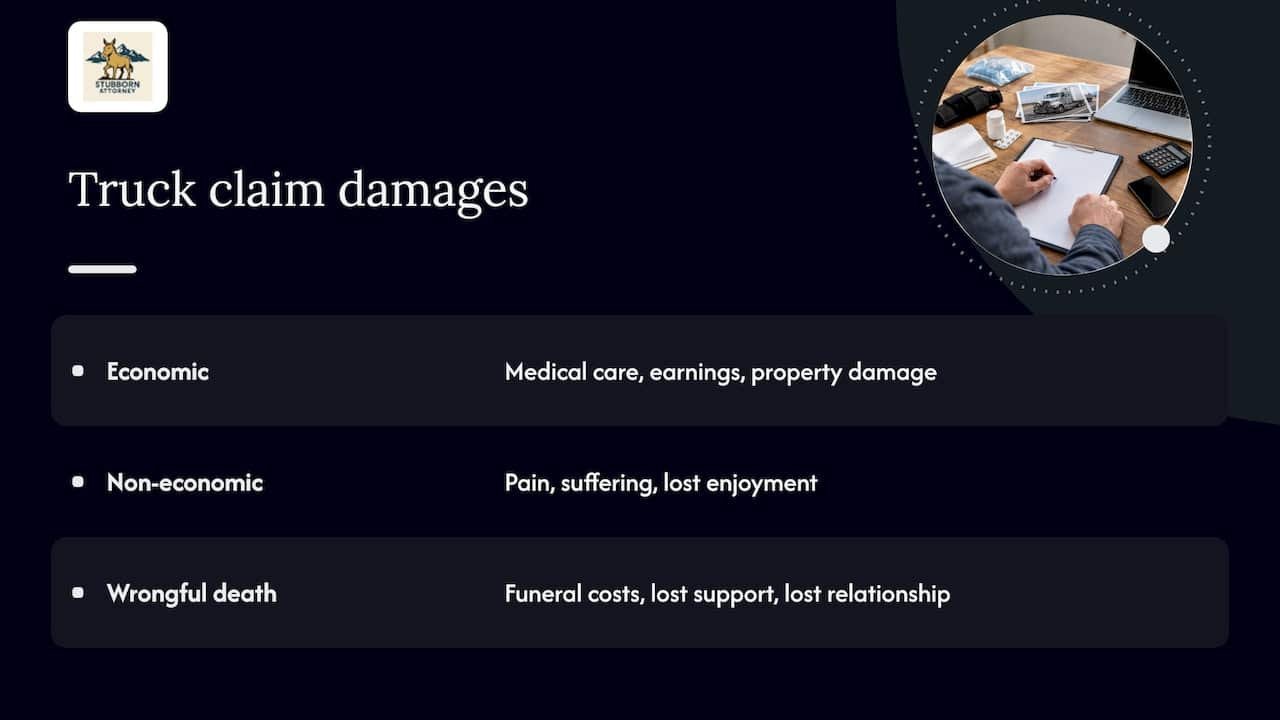
Compensation in a Colorado injury claim generally falls into two groups. Economic damages are the costs with a receipt: emergency care, surgery, therapy, prescriptions, future treatment, lost wages, reduced earning capacity and property damage. Non-economic damages cover pain, suffering, loss of enjoyment of life and similar harms. In a death case, the family’s claim looks at funeral costs, lost financial support and the loss of the relationship.
Colorado places limits on some categories of damages, and those limits have been changing. We keep a plain-English explanation of how caps work in our guide to Colorado car accident settlements and the new $1.5M cap, and a broader breakdown in types of personal injury compensation. Because caps depend on the kind of claim and the date of the injury, ask your attorney which limits apply to your case rather than relying on a general number.
Protect the evidence before it disappears
Truck cases are won or lost on records that live outside your own files. Carriers know a serious crash may lead to a claim, and some of what matters is routinely overwritten.
Federal rules give you a window. According to the Federal Motor Carrier Safety Administration, motor carriers must keep electronic logging device records of duty status and supporting documents for six months, along with a backup copy. That data can show whether a driver was past the legal limit on driving hours. Six months sounds generous until a claim is still in treatment and negotiation. A written preservation request sent early puts the carrier on notice to keep what it has.
Beyond logs, a strong evidence file usually includes:
- The police crash report and the responding agency’s name.
- Photos and video of the scene, vehicle positions, skid marks, road conditions and your injuries.
- The truck’s company name, DOT number and plate, which are printed on the cab or trailer.
- Names and numbers of witnesses.
- Event data, dashcam footage and GPS records held by the carrier, which is why the preservation request matters.
- Every medical record and bill, starting with the ambulance or emergency room visit.
We explain how logbook data is used in proving hours of service violations from ELD files, and our overview of commercial vehicle crashes in Colorado covers what the state’s enforcement numbers mean for injured drivers.
A Colorado rule about early settlements
One protection surprises people. Under Colorado Revised Statutes Section 13-21-301, if you are under a practitioner’s care or hospitalized, a settlement or release obtained within 30 days of the injury-causing occurrence is void, and a statement obtained within 15 days may not be used against you in a civil action.
In plain terms: if an adjuster calls the week after the crash with a quick offer and a form to sign, you are not locked in, and you should not feel pressured to talk. Even so, do not give a recorded statement or sign anything until you have spoken with a lawyer. Early offers are rarely built on your full medical picture. Our page on a lowball insurance settlement in Colorado explains how to recognize one and what to do next.
How a truck claim moves from crash to settlement
Most claims follow the same arc, though the timing varies with injury severity.
- Get medical care and follow it. Treatment protects your health and creates the record your claim depends on.
- Report and preserve. File or obtain the police report, photograph everything and send preservation requests to the carrier.
- Investigate. Your attorney identifies the driver, carrier and any other responsible party, finds the insurance policies and reviews the logs, maintenance records and driver history.
- Reach maximum medical improvement, or close to it. Settling before you know what your recovery will look like is the most common way people undersettle.
- Demand and negotiate. Your lawyer sends a demand package with the records, bills, wage loss and a supported figure for the harm you have suffered. The insurer responds, and offers go back and forth.
- File suit if needed. If the insurer will not make a fair offer, the case moves to litigation, with discovery, depositions and sometimes mediation. Many cases still resolve before trial.
- Settle, release and pay. A settlement is documented in writing, you sign a release, medical liens and fees are resolved, and the net amount is paid to you.
Our step-by-step injury compensation workflow walks through this process in more detail, and the Colorado car accident legal checklist is useful in the first days.
After you agree to settle
Agreeing on a number is not the end. The release you sign usually closes the claim for good, so reading it carefully matters. Before money reaches you, hospital and insurer liens are typically paid out of the settlement, and attorney fees and case costs are deducted according to your agreement. A clear closing statement should show each deduction. If you want to understand how contingency arrangements work in general, this explanation of how contingency fees work is a good starting point.
Why trucking cases need a specialist
A truck crash is not a larger car crash. It involves federal safety regulations, corporate defendants, layered insurance and evidence that sits in someone else’s hands. The defense usually has a rapid-response team at the scene within hours. That is why we recommend reading why you should hire a specialist truck accident lawyer before you decide who will handle your claim, and our guide to truck accident attorneys in Colorado Springs if you were hurt along I-25 or around the Pikes Peak region.
Our perspective
Most people who call us after a truck crash have been told, by someone, what their case is worth. Sometimes it is an adjuster who sounds friendly. Sometimes it is a number found online. Both are guesses, and both tend to be low.
Before I practiced personal injury law I was a claims adjudicator and adjuster for the federal government. I know how large insurance companies and government agencies evaluate a claim, what they look for and what they hope you will not document. That experience is why we focus on the work that makes a number credible: complete medical records, clear proof of lost income, and early evidence requests so key data is not lost.
We represent injured people only. We have settled hundreds of injury cases and recovered millions of dollars for clients, and we work on contingency, so you owe no legal fee unless we recover money in your case. Our cases are handled directly by attorneys, not passed through a volume mill.
The mule is our symbol for a reason. A mule does not rush and does not quit on a hard climb. A truck case is a hard climb. We will carry it with you until it is resolved the right way, not the fast way.
Ryan
Talk to a Colorado truck accident attorney
If you or someone in your family was hurt in a collision with a commercial truck, we can review what happened, explain your options and start the evidence requests that cannot wait. Our semi-truck accident team offers a free case review, and you can see everything else we handle on our services page. Because we work on a contingency basis, you pay no attorney fee unless there is a monetary recovery in your injury case.
FAQ
How much are most truck accident settlements?
It depends on the sample. A U.S. Chamber review of 154 cases from June 2020 to April 2023 found a $210,000 median settlement, while its newer review of 334 cases through July 2026 reported a $2.15 million median. Both come from collected case outcomes that may skip confidential settlements, so they describe serious reported cases and not a guaranteed result for yours.
Do I have to accept the first offer from the trucking company’s insurer?
No. First offers are usually made before your treatment is complete and before your future costs are known. In Colorado, a settlement or release obtained within 30 days of the injury while you are hospitalized or under a practitioner’s care is void under state statute. Speak with an attorney before signing anything.
How long does a truck accident settlement take?
There is no fixed timeline. Cases with minor injuries and clear fault can resolve in months, while serious injuries, disputed fault or a lawsuit can take considerably longer because your lawyer should wait until your medical outlook is clear. Rushing to settle early is the most common reason people recover less than their claim was worth.
What evidence matters most in a Colorado truck accident claim?
Medical records and bills, the police report, scene photos and witness details are the foundation. In truck cases, the carrier’s electronic logging data matters too, and federal rules require carriers to keep those records for six months, so a preservation request should go out quickly.
What does it cost to hire a truck accident lawyer?
We work on contingency, which means you pay no attorney fee unless we recover money for you. Ask any firm you consider to explain, in writing, how fees and case costs are calculated before you sign.
Sources
- Roadblock: The Trucking Litigation Problem and How to Fix It, U.S. Chamber Institute for Legal Reform
- ATRI report offers insights into trucking industry settlements, Transport Topics
- Truck accident verdicts and settlements, U.S. Chamber report, Truck News
- How long must a motor carrier retain electronic logging device records, FMCSA
- Colorado Revised Statutes Section 13-21-301, Justia
- Contingency fee personal injury: how fees work