

Military Car Accident Claims in Colorado: What to Know
Yes, you can bring a car accident claim in Colorado when the other driver was in the military. Who you claim against depends on one question: was the driver doing their job when the crash happened? If so, the claim usually goes to the federal government and starts with a written administrative claim, not a lawsuit. If not, you generally pursue the driver and their insurance like any other at-fault driver. The federal route has a two-year deadline that is shorter than Colorado’s ordinary deadline for car crashes, so the first decision to make is which path you are on.
This guide explains both paths, the paperwork, the evidence that matters, and what is different for people hurt near Fort Carson, Peterson Space Force Base and the other installations around Colorado Springs.
Table of Contents
- The first question: was the driver on duty?
- Two paths, side by side
- Claims against an individual driver
- Claims against the federal government
- Deadlines that matter
- Filing the claim: Standard Form 95
- Evidence to gather in the first weeks
- Does the Feres doctrine affect you?
- Federal benefits and your own coverage
- Why this kind of claim is different
- Our perspective
- Getting help in Colorado Springs
- Frequently asked questions
- Sources
The first question: was the driver on duty?
A service member is a driver first. Off duty, in a personal car, on a personal errand, the crash is an ordinary Colorado car accident. The driver’s auto insurance responds, and you pursue the claim against the driver and their carrier the way you would against any neighbor.
On duty is different. According to a federal General Services Administration presentation on driver liability in government vehicles, when the driver acted within the scope of their employment, the United States is generally the liable party under the Federal Tort Claims Act (FTCA). When the driver was not acting within the scope of employment, even in a government-owned vehicle, the driver may be personally liable.
That means the vehicle alone does not settle the question. A government plate does not automatically make the government your defendant, and a personal pickup does not automatically rule it out.
Scope of employment is often a fact fight
The scope question can be contested. In Fowler v. United States, a civilian injured in Colorado sued an active-duty Air Force driver and the United States. The Tenth Circuit reversed summary judgment for the government because, under Colorado’s rules for traveling employees, whether the driver was acting within the scope of employment turned on facts. The crash happened during a work shift, and the evidence could support an employment-related purpose.
The practical lesson: do not accept the first answer you hear about whether the driver was “on the clock.” Commuting, running a work errand, driving between duty locations and traveling on orders can all land differently. Details such as the driver’s duty status, where they were headed and why are worth pinning down early.
Two paths, side by side
| Driver off duty | Driver on duty (or government vehicle on official business) | |
|---|---|---|
| Who you claim against | The driver and their insurer | The United States, through the responsible agency |
| First step | Notify the insurer, document the crash | File a written administrative claim with the agency |
| Lawsuit possible right away? | Yes, within the Colorado deadline | Generally no, only after the agency denies the claim in writing |
| Key deadline | Colorado statute of limitations | Two years to present the claim to the agency |
| Insurance involved | Driver’s liability policy, your own UM/UIM | Federal claims process, plus your own coverage as backup |
The deadlines are covered in detail below. For now, notice the trap in the table: the same crash can have a long deadline on one path and a short one on the other, and early on you may not know which applies.
Claims against an individual driver
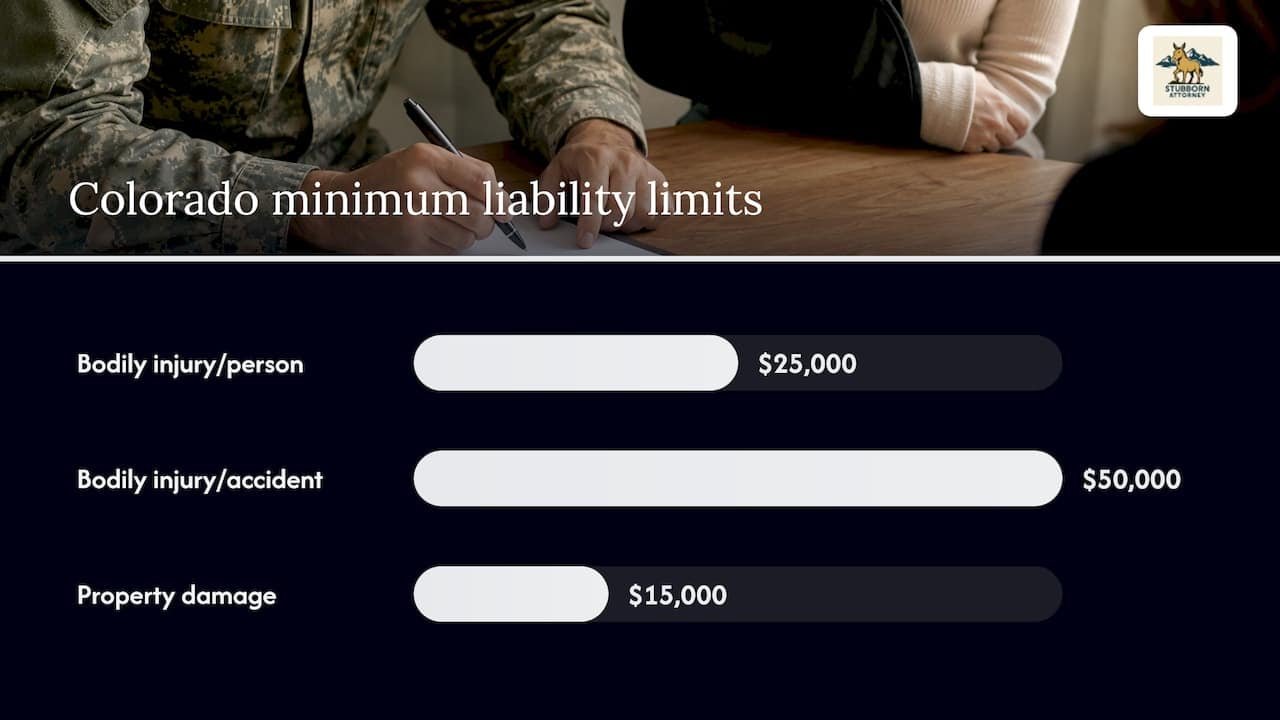
If the driver was off duty, the claim runs through Colorado’s ordinary system. The Colorado Division of Insurance explains that liability insurance pays bodily-injury and property-damage claims caused by an at-fault driver. Required minimums in Colorado are $25,000 per person and $50,000 per accident for bodily injury, and $15,000 for property damage. Those numbers are a floor. Serious injuries can exceed them quickly, which is why your own coverage matters.
The 2024 Colorado Motor Vehicle Handbook notes that uninsured/underinsured motorist coverage can compensate you for bodily-injury losses caused by a hit-and-run, uninsured or underinsured driver. It does not cover damage to your own vehicle. If a service member who caused your crash carried only minimum limits, or none, that coverage may be the next place to look.
For more on what the at-fault driver’s policy does and does not pay, see our explainer on bodily injury liability in Colorado. If you are sorting out which kind of claim fits your situation, our guide to types of car accident claims in Colorado lays out the options.
Does military service pause the case?
Sometimes defendants in uniform ask a court to pause a case because of their service. Federal law gives courts discretion to stay proceedings involving service members. A 1945 Colorado Supreme Court decision, Koons v. Nelson, described the principle under the older Soldiers’ and Sailors’ Civil Relief Act: a stay can be granted unless military service did not materially affect the ability to prosecute or defend. The statute has been modernized since, so treat the case as history, not current law. The point for you is that a deployment can slow a lawsuit, and an attorney should be ready to respond if it comes up.
Claims against the federal government
When the driver was within the scope of their job, the Federal Tort Claims Act applies. The GSA presentation explains that the FTCA is the exclusive remedy for torts by federal employees acting within the scope of their employment, which generally shields the employee from a personal suit by a third party. The FTCA covers third-party claims involving a government-owned vehicle, but not damage to the government vehicle itself.
The U.S. Department of Justice explains that the FTCA can reach negligent acts of federal employees, including motor-vehicle accidents, but an administrative claim generally must be presented to the responsible federal agency before you file suit.
What about Colorado’s government claim rules?
Many people hear about Colorado’s 182-day notice for claims against public entities and assume it applies. That rule comes from the Colorado Governmental Immunity Act, which governs claims against Colorado public bodies such as cities, counties and the state. The Colorado Office of the State Controller’s CGIA summary says claims filed under federal law are not required to meet CGIA criteria. A claim against the U.S. military is a federal claim. The federal clock is the one that governs, and it is not the same clock.
If the crash involved a state or city vehicle instead, such as a Colorado National Guard unit acting under state authority, the analysis can differ. That is exactly the kind of question to put to a lawyer in the first week.
Deadlines that matter
Here is the sequence for a federal claim.
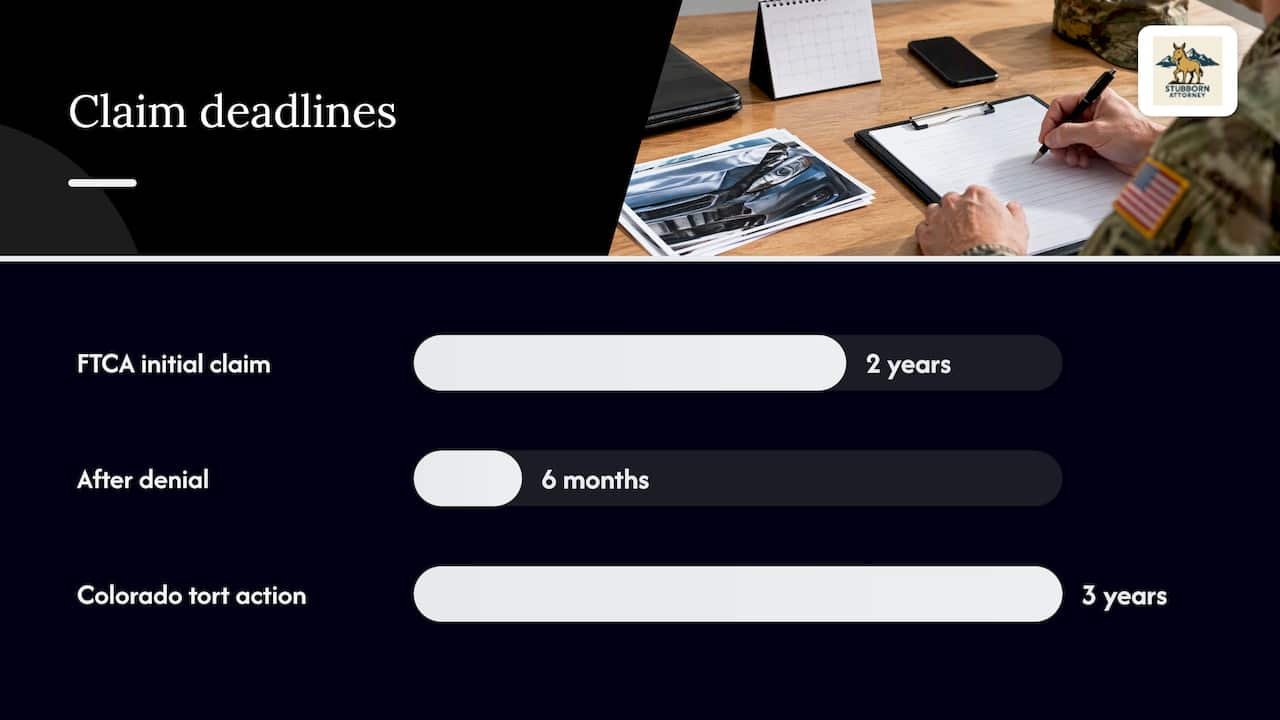
- Present the claim within two years. The Justice Department says an FTCA claim must be presented to the appropriate federal agency within two years after accrual. Standard Form 95 is a convenient format but not mandatory, and the submission must state a specific sum certain for damages.
- Wait for the agency’s decision. The Justice Department states that an FTCA lawsuit generally cannot be filed until the agency has finally denied the claim in writing.
- Sue within six months of the denial letter. The same source says the lawsuit must generally be filed within six months after the agency mails the denial.
When does the clock start? Under the FTCA’s discovery rule, a claim accrues when you know, or reasonably should know, of the injury and its cause, as the Solicitor General’s office described in its brief in Estate of Halloran v. United States. For most crashes, that is the day of the collision.
Compare this with the ordinary Colorado rule. A 1994 Colorado session law shows that tort actions arising from the use or operation of a motor vehicle fall under C.R.S. 13-80-101(1)(n), with three years after the cause of action accrues. The same act ties accrual to when the injury and its cause are known or should have been known, under C.R.S. 13-80-108. Statutes get amended, so confirm the current text before relying on any single number. Our guides on the statute of limitations for car accidents and key deadlines for Colorado injury claims walk through the current rules.
The takeaway is simple. If there is any chance the other driver was on duty, treat two years as your outer limit and aim to act much sooner. Waiting for a medical picture to settle is reasonable. Waiting past the federal deadline is not recoverable.
Filing the claim: Standard Form 95
The federal claim form is the SF-95, “Claim for Damage, Injury, or Death.” Its instructions on the official form ask for support that is specific and itemized:
- Detailed facts of what happened, in the form itself
- A written report from the attending physician for a personal injury claim
- Itemized medical bills
- For property damage, at least two itemized repair estimates, or itemized signed receipts if repairs were already paid
Two details deserve extra care. First, the form asks for a specific dollar amount. A claim with no sum certain can be rejected as incomplete. Second, the amount you write can limit what you later recover in court, so it should reflect your full losses, including future medical care and lost income, not just the bills in hand today.
Where the form goes in Colorado Springs
The form goes to the agency responsible for the driver. The GSA presentation notes that an agency’s legal office is the contact for legal claims against the government, and that for the Air Force, this is the base’s Judge Advocate General (JAG) office. For Army-related crashes at Fort Carson, Fort Carson’s filing instructions say to send the SF-95 to the Office of the Staff Judge Advocate, ATTN: Claims, and to include the circumstances of the accident along with the names and addresses of witnesses.
If you are not sure which branch or unit the driver belonged to, the police report and the driver’s insurance or duty information are the starting points. A wrong guess can cost time, so ask a lawyer to help identify the correct agency before you file.
Evidence to gather in the first weeks
Government claims are paper claims. The better the documents, the less room for the agency to question the value of your case. Start with:
- The police report. Look at whether it notes a military ID, a government vehicle, or an on-duty statement. Request it from the agency that responded, which in Colorado Springs may be the city police department, the sheriff’s office, the State Patrol or military police on base.
- Photos and video. Include vehicle markings, plates, the scene and your injuries. Ask nearby businesses about camera footage quickly, since many systems overwrite within days.
- Witness names and contact details. The Fort Carson instructions specifically ask for these.
- Medical records and bills. Get treatment started promptly, then keep every record, referral and invoice. The SF-95 asks for a physician’s written report.
- Work and income records. Pay stubs, a note from your employer on missed time, and anything showing reduced capacity.
- Your own insurance communications. Report the crash to your insurer on time. Stay factual and avoid guessing about fault.
Our Colorado car accident legal checklist covers the scene-to-first-week sequence in more detail, and the piece on the biggest mistakes after car accidents is worth reading before you speak to any adjuster, military or civilian.
Does the Feres doctrine affect you?
Probably not, if you are a civilian. The Feres doctrine comes from the Supreme Court’s decision in Feres v. United States, which bars FTCA claims by service members for injuries arising out of or in the course of activity incident to service. It limits what military personnel can claim against the government. It does not stop a civilian from making a claim for a crash caused by a service member within the scope of their job.
It can matter in one situation: if you are a service member or a family member and the crash involved military duties, the rules change. Whether Feres reaches your situation depends on the specifics, and a lawyer should answer it for you before you assume you have no claim or that you do.
Federal benefits and your own coverage
Sometimes the federal system interacts with ordinary insurance in unexpected ways. In Allstate Insurance Co. v. United States, a Colorado federal court found that FTCA and FECA benefits supplied coverage equivalent to Colorado’s required automobile coverage in the circumstances presented. The case is old and fact-specific, but it shows that a crash involving a federal driver can raise coverage questions between insurers, not just between you and the government. Keep your own insurer informed, and do not sign releases or accept a payout before understanding what it resolves.
Why this kind of claim is different
The claim itself is not mysterious. The difference is in who you are dealing with and how they decide.
- There may be no adjuster calling you the same week. Federal claims move on the agency’s timeline. Silence is not a denial, and it is not an offer.
- The decision is written and formal. The denial letter starts a six-month filing clock.
- Evidence is reviewed on paper. A strong submission has to anticipate the questions an agency attorney will ask about causation, scope of employment and the amount.
- Multiple parties can be involved. The driver, the agency, your insurer and the driver’s insurer may all have a role, and their interests do not line up.
That last point is where experience matters. Someone who has worked inside a claims system knows how it reads a file.
Our perspective
Most people who call us after a crash with a military driver assume the process will be different in kind. It is different in procedure. The injuries, the medical bills and the fight to be valued fairly are the same.
Before I became a lawyer, I was a claims adjudicator for the federal government. I know how large agencies and insurers evaluate a claim: what they look for, what they discount and what makes a file hard to dismiss. That is the perspective I bring to your case.
We represent only injured people, and we handle cases directly rather than passing them through a volume operation. Our firm works on a contingency fee, so you pay nothing unless we recover money in your case. In the meantime, we work to make sure you can get medical care regardless of your financial situation.
If the other driver was in uniform, do not let anyone talk you out of making a claim, and do not let the clock run while you decide. Get the facts about duty status early, build the file carefully, and let us deal with the agency.
Ryan
Getting help in Colorado Springs
Colorado Springs sits among several major installations, so crashes involving service members are not unusual here. If you were hurt by a driver connected to the military, we can review who the responsible party is, which deadline applies and what your claim may be worth. We handle car, motorcycle, semi-truck, bicycle and pedestrian accidents, among other injury claims, and we work on contingency. See our personal injury services or start with our Colorado Springs personal injury page to request a free case review.
If the crash was serious or fatal, read our page on wrongful death after a car accident in Colorado, since families face their own deadlines. For a broader view of how fault is assigned when more than one party is involved, see our guide to car accident liability factors.
Frequently asked questions
Can I sue a soldier personally for a car accident in Colorado?
It depends on duty status. If the driver was acting within the scope of their federal employment, the FTCA is generally the exclusive remedy, and the claim goes against the United States instead of the individual. If the driver was off duty or outside the scope of their job, the driver may be personally liable, and their auto insurer handles the claim.
How long do I have to file a claim if a military vehicle hit me?
For a federal claim, you must present it to the responsible agency within two years after it accrues, according to the Justice Department. If the agency denies it, a lawsuit generally must follow within six months of the mailing of that denial. Because the deadline for an ordinary Colorado car crash is longer, do not rely on the longer number until you know the driver was off duty.
Do I have to use Form 95?
No, the format is not mandatory, but it is the standard and convenient way to present a claim. What matters is that the submission gives the agency the facts and a specific dollar amount. Most people use the SF-95 and attach itemized medical bills, a physician’s report and repair estimates.
Does the Colorado 182-day notice rule apply to a claim against the military?
No. That notice rule comes from the Colorado Governmental Immunity Act, which covers Colorado public entities. The state’s own guidance says claims under federal law need not meet CGIA criteria. Federal claims follow the FTCA’s process instead.
What if I cannot tell whether the driver was on duty?
Start by collecting the police report and any details about the vehicle, the driver’s unit and where they were going. Then speak with an attorney before you file anything or give a recorded statement. Scope of employment can be decided on facts, as the Tenth Circuit’s Fowler decision shows, so the early evidence matters.
Sources
- Fowler v. United States (10th Cir. 2011), FindLaw
- Auto Insurance, Colorado Division of Insurance
- Colorado Motor Vehicle Handbook (2024)
- Personal liability when driving a GOV, GSA
- CGIA Summary, Colorado Office of the State Controller
- Civil Division, U.S. Attorney’s Office, Western District of Missouri
- Koons v. Nelson (Colo. 1945)
- Allstate Ins. Co. v. United States, 864 F. Supp. 1015
- Colorado 1994 session law, C.R.S. 13-80-101 and 13-80-108
- Civil Division Documents and Forms, U.S. Department of Justice
- Gladden v. United States, opposition brief, U.S. Department of Justice
- Estate of Halloran v. United States, U.S. Department of Justice
- Standard Form 95, Claim for Damage, Injury, or Death
- Filing a tort claim, Fort Carson
- Feres v. United States, Cornell Legal Information Institute