

Delivery Driver Accident Claim in Colorado: What to Do
If a delivery driver hurt you in a Colorado crash, you can bring a claim against the driver and, depending on the facts, against the company behind the delivery. You generally have three years to file for a motor-vehicle injury, your own share of fault can reduce or even bar your recovery, and the evidence that proves who was responsible is often held by someone other than you. This guide walks through what to do first, who may be liable, what the law says about deadlines and fault, how insurance works, and when it makes sense to bring in a lawyer.
The details below apply to Colorado. Other states set different deadlines and fault rules.
Table of Contents
- Why delivery crashes are different from ordinary fender benders
- What to do in the first hours after the crash
- Evidence that wins or loses a delivery driver claim
- Who can be held liable when a delivery driver causes a crash
- Colorado’s 50% rule: how your own fault affects the claim
- How long you have to file
- Insurance: who pays and how much is there
- What compensation you may seek
- Our perspective: why we push on these cases
- Do you need a lawyer for a delivery driver claim?
- Working with us
- Frequently asked questions
- Sources
Why delivery crashes are different from ordinary fender benders
A typical two-driver collision usually involves two people and two insurers. A delivery crash can involve more:
- The driver, who may be rushed, on an unfamiliar route, or working from an app.
- The company whose packages, food or groceries were being moved.
- A staffing or subcontracted delivery company between the driver and the brand on the van.
- The driver’s personal auto insurer, a commercial policy, or both.
- The vehicle owner, if that is someone else.
Each of those parties may have different insurance, different lawyers and a different story about who was responsible. A driver might say they were “just a contractor.” A company might say the driver wasn’t on the clock. Sorting out those answers early is the main reason a delivery claim deserves more care than a routine one.
The injury picture is also familiar to anyone who has handled these cases: rear-end collisions at stop signs and lights, pedestrians struck in crosswalks or driveways, cyclists hit by vans pulling to the curb, and drivers hit by someone backing out or double-parking. Our personal injury services cover each of these, including car, bicycle, pedestrian, motorcycle and semi-truck cases.
What to do in the first hours after the crash
The first steps protect both your health and your claim.
- Get medical care. Call 911 if anyone may be hurt. Adrenaline hides injuries, and whiplash and concussion symptoms can show up days later. A prompt medical record also ties your injuries to the crash.
- Exchange information. Colorado’s Division of Motor Vehicles says to give the other driver your name, telephone number and insurance information, and to get theirs. Per the Colorado DMV crash guidance, that is the baseline. With a delivery driver, also ask for the company name, the name on the vehicle or app, and the vehicle’s plate and any unit number.
- Call the police. If police don’t come, the DMV explains that you may file an online counter report, but that report is for record purposes and is not investigated. A police report with the officer’s findings is stronger evidence.
- Document the scene. Photograph vehicle positions, damage, skid marks, road signs, lighting and weather. Capture the delivery vehicle’s logo, plate and any lettering. Note nearby cameras on storefronts, doorbells and traffic poles.
- Get witnesses. A name and phone number from a bystander can matter a great deal later.
- Be careful what you say. Stick to basic facts. Don’t guess about fault or say you are “fine.”
Colorado also takes reporting seriously. The state’s January 2025 Driver Handbook says drivers can lose driving privileges for leaving the scene without stopping, exchanging information and rendering aid, or for failing to report a crash as the Financial Responsibility Law requires. Our step-by-step guide on how to report a car accident in Colorado covers the mechanics, and the difference between police and accident reports explains why filing deadlines trip people up.
A longer checklist is on our page for a Colorado car accident legal checklist.
Evidence that wins or loses a delivery driver claim
In most crashes, the evidence you collect at the scene is only the start. With delivery vehicles, some of the most useful records sit with the driver or the company and can be overwritten on a routine schedule.
What you can gather yourself
- Scene photos and video, taken before vehicles move when it is safe.
- Photos of your injuries as they change over days and weeks.
- The police report number and the responding agency.
- Contact details for witnesses.
- Your medical records, bills and a log of missed work.
- A short written account of what happened, written the same day.
- Your own dashcam footage, if you have it. Save a copy right away.
What someone else may hold
- Dashcam or in-cab camera video from the delivery vehicle.
- GPS and route data, delivery-app logs and time stamps showing whether the driver was rushing to meet a window.
- Records of the driver’s hiring, training, past crashes and driving history.
- Vehicle maintenance records, if a brake or tire problem may have played a part.
- Phone records, if distraction is suspected.
You usually can’t demand these on your own in the first week. What you can do is have a written preservation request sent promptly, asking the driver and the company to keep these records. A lawyer sends these routinely. If you wait months, the footage and app data may be gone through ordinary retention practices.
One more point: don’t give a recorded statement to the delivery company’s insurer before you understand your options. Adjusters are trained to ask questions that narrow the claim. As a former claims adjudicator, our attorney knows how those questions are built, and we cover this in more detail in our guide to the biggest mistakes after car accidents.
Who can be held liable when a delivery driver causes a crash
This is where delivery claims get interesting. Several parties can be responsible, and the answer turns on the working relationship between the driver and the company.
The driver
A driver who is negligent, for example by speeding, running a signal, texting or backing without looking, is personally responsible for the harm. The driver’s own auto policy is often the first place a claim goes.
The employer
Under the legal doctrine of respondeat superior, an employer can be responsible for the negligence of an employee acting within the scope of the job. Colorado’s civil jury instructions, published by the Colorado Judicial Department, describe the different relationships a court looks at, including employer and employee versus employer and independent contractor. They also note that an agency relationship can make a principal vicariously liable whether or not the agent is labeled an independent contractor. In plain terms: a company calling a driver a “contractor” does not automatically end the question.
Factors that tend to matter include who sets the schedule and routes, who supplies the vehicle or branded gear, how much the company supervises the work, and whether the driver could work for competing companies at the same time.
The delivery company, subcontractor or brand
Many big brands use a layered setup. A package may be carried by a van with one company’s logo, driven by someone paid by a separate local delivery company. Responsibility can potentially reach more than one level, and each level may carry its own insurance. Identifying all of them early is part of the job.
Other possible parties
- The vehicle owner, if a company or individual lent or leased the vehicle.
- A maintenance provider or manufacturer, if a defect or poor repair contributed. Our services include product liability injuries for that reason.
- A property owner or business, in a pedestrian or slip and fall setting, such as a loading zone with a hazard.
- A government entity, if road design played a role. Claims against public bodies have their own special notice rules, so raise this with a lawyer right away.
On our fault in Colorado car accidents page, we walk through how fault is argued in general.
Colorado’s 50% rule: how your own fault affects the claim
Colorado uses modified comparative negligence. The state statute, C.R.S. 13-21-111, says your negligence does not bar recovery when it is less than the defendant’s, but your damages are reduced in proportion to your share of fault. If your negligence is equal to or greater than the defendant’s, the judgment goes to the defendant.
Here is a worked example with made-up numbers, for illustration only:
| Scenario | Your fault | Total damages | What the rule means |
|---|---|---|---|
| Delivery van rear-ends you at a light | 0% | $100,000 | Full amount can be pursued |
| You change lanes without signaling and a van clips you | 20% | $100,000 | Reduced by 20%, so $80,000 |
| You and the driver are equally to blame | 50% | $100,000 | Barred, since your fault is not less than theirs |
The 50% line is why insurers work so hard to move even a small share of blame onto you. A delivery driver’s insurer may say you braked suddenly, crossed outside a crosswalk, or were hard to see. Each percentage point can change the outcome, and at 50% it can end the claim entirely. We explain the rule in depth on our page about the 50% rule and special verdicts. For other factors that tilt fault, see our car accident liability factors guide.
How long you have to file
Deadlines are the part of a claim you can’t talk your way around. Colorado law provides that tort actions for bodily injury or property damage arising from the use or operation of a motor vehicle generally must start within three years after the claim accrues, according to the Colorado General Assembly’s session law. Accrual happens when the injury or damage and its cause are known, or should have been known with reasonable diligence. The same source supplies a two-year general tort period for claims outside the motor-vehicle category, and special timing rules apply to uninsured and underinsured motorist coverage.
What that means for you:
- A delivery vehicle crash is a motor-vehicle claim, so the three-year period will usually be the starting point.
- A slip and fall in a delivery loading area or a claim that isn’t about vehicle use may fall under a shorter period.
- Claims against government bodies and some insurance-contract claims can have much shorter notice windows, so don’t assume three years covers everything.
- Waiting costs you evidence long before the deadline arrives.
Our statute of limitations guide for car accidents explains how to count the time. If you are anywhere near a deadline, speak with a Colorado attorney now rather than later.
Insurance: who pays and how much is there
This is the question that decides how much money is realistically available.
Minimum limits are low
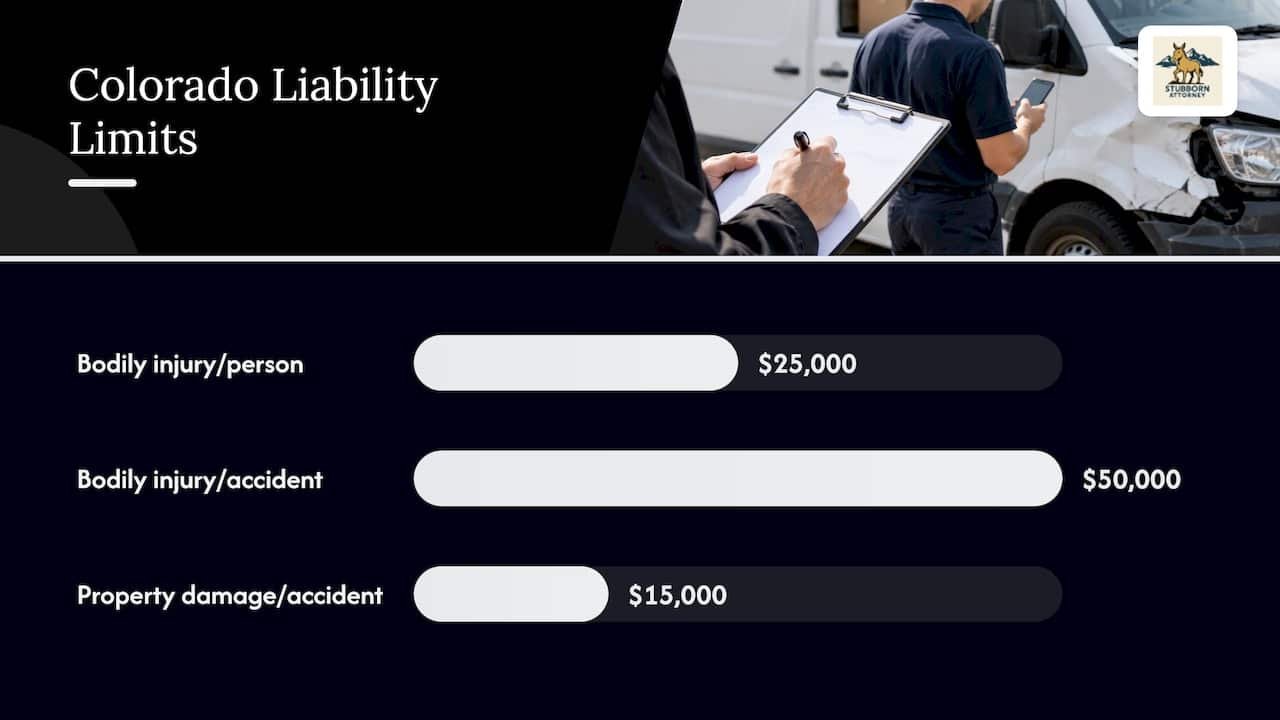
The Colorado Division of Insurance states that required liability limits are $25,000 per person for bodily injury, $50,000 per accident for bodily injury, and $15,000 per accident for property damage. Liability coverage pays third-party bodily-injury and property-damage losses when the policyholder is at fault. A serious injury can easily exceed a $25,000 limit, which is one reason it matters whether the driver was working at the time. A commercial policy held by a company may be higher than a personal one, though that depends on the policy.
If you want to understand how this kind of coverage works from the policyholder’s side, this overview of liability-only car insurance explains what it does and doesn’t cover. It is written about another state, so rely on Colorado’s own limits above.
Your own coverage can help
- Uninsured/underinsured motorist (UM/UIM) coverage is optional but included unless you reject it in writing, per the Division of Insurance. It may cover bodily-injury losses caused by a hit-and-run, uninsured or underinsured driver, subject to your policy. If a delivery driver’s limits are too small, check your own UIM. Our guide to uninsured driver claims goes through the process.
- Medical payments coverage pays reasonable accident-related healthcare expenses and generally pays before health insurance, according to the same Division of Insurance page.
You can ask for policy information
Colorado law gives claimants a useful tool. The 2025 text of C.R.S. 10-3-1117 requires an insurer, within 30 calendar days after a written request from a claimant or attorney sent to the insurer’s registered agent, to provide known relevant policy information, insured names, liability limits and a copy of the policy. Knowing the limits early lets you judge whether other coverage sources, such as the company behind the delivery, need to be pursued.
What compensation you may seek
Colorado civil jury instructions, published by the Colorado Judicial Department, address economic and noneconomic personal-injury damages as well as physical impairment or disfigurement, and explain that comparative-negligence and pro-rata-liability rules can apply in negligence cases. In practical terms, a claim can include:
- Past and future medical bills, including therapy and follow-up care.
- Lost wages and reduced earning ability.
- Pain, suffering and loss of enjoyment of life.
- Physical impairment or scarring.
- Property damage to your vehicle, bike or belongings.
- In the worst cases, wrongful death damages for a family.
No article can tell you what your claim is worth. It depends on medical evidence, fault, available insurance and how well the case is documented. Our page on factors that affect personal injury settlement amounts explains the variables, and a comparison of suing versus settling shows how those choices play out.
Our perspective: why we push on these cases
Delivery cases test whether a firm is willing to keep going. The first offer often arrives fast, usually from an insurer that has already decided what it thinks your claim is worth. The company behind the delivery may point to the driver, the driver to the company, and the company to a subcontractor. It is easy to give up in that loop.
We don’t. Before founding this firm, I worked as a claims adjudicator and adjuster for the federal government, so I know how large insurance companies and agencies evaluate a claim: what they look for, what they discount, and what makes them move. For more than a decade I have used that knowledge only for injured people. Malnar Injury Law, now StubbornAttorney.com, represents only injured victims. The name changed. The team and the commitment did not.
The mule is our symbol for a reason. It is steady, persistent and doesn’t quit halfway up the trail. On a delivery case that means identifying every possible party early, asking for the records before they disappear, not letting a low policy limit end the conversation, and being honest with you about the risks, including the 50% rule. Our cases are handled directly by attorneys, and we have settled hundreds of injury cases for people in your position.
— Ryan
Do you need a lawyer for a delivery driver claim?
Not every crash needs one. If the damage was minor, nobody was hurt and fault is obvious, you may be able to handle it yourself. Our guide on how to handle minor accidents can help.
Talk to a lawyer promptly when any of these apply:
- You were hurt enough to see a doctor, miss work or need ongoing treatment.
- The driver was working, or you aren’t sure who they were working for.
- The company, a subcontractor or its insurer contacts you and asks for a statement.
- The insurer blames you, even partly.
- The driver’s policy limits look too low for your injuries.
- You are a pedestrian, cyclist or motorcyclist. Our pages on bicycle crash fault and Colorado Springs motorcycle accident claims address those cases.
- A family member died. Wrongful death claims have their own rules and need prompt legal attention.
For a broader view of what to expect from this kind of firm, read what Colorado auto accident victims must know.
Working with us
We represent injured people in Colorado, including Colorado Springs, on a contingency basis: you pay nothing unless we recover money in your case. We also help clients get medical care regardless of their financial situation. If a delivery driver hurt you, our Colorado Springs personal injury page explains how a case review works, and you can see everything we handle on our services page. Bring the police report number, photos, medical paperwork and any letters from an insurer, and we will tell you where you stand.
Frequently asked questions
Can I sue the delivery company, or only the driver?
Potentially both. An employer can be responsible for an employee acting within the scope of the job, and Colorado’s jury instructions also recognize that agency relationships can create liability even when a worker is called an independent contractor. Which parties apply depends on the facts, so a lawyer should look at the working arrangement.
How long do I have to file a delivery driver accident claim in Colorado?
For bodily injury from the use or operation of a motor vehicle, the usual period is three years after the claim accrues. Some claims, such as those outside the motor-vehicle category or against government bodies, can have shorter windows. Act early, since evidence fades long before a deadline.
What if I was partly at fault?
You can still recover if your fault is less than the other party’s, but your damages are reduced by your percentage. If your fault is equal to or greater than theirs, Colorado law bars recovery. That makes the fault investigation central to the case.
What if the driver’s insurance is too low or they have none?
Check your own UM/UIM coverage, which Colorado includes unless you reject it in writing. It may cover losses from an uninsured, underinsured or hit-and-run driver, subject to your policy terms. Also ask whether a company or other party may carry additional coverage.
Sources
- Colorado DMV: Report a Crash and Obtain a Crash Record
- Colorado Driver Handbook (DR 2337, January 2025)
- Colorado Judicial Department: agency and respondeat superior jury instructions
- Colo. Rev. Stat. 13-21-111, comparative negligence
- Colorado General Assembly: 1994 session law on limitation periods
- Colorado Division of Insurance: auto insurance requirements
- Colorado Division of Insurance: types of auto insurance
- C.R.S. 10-3-1117, insurer policy disclosure
- Colorado Judicial Department: civil jury instructions on damages
- Liability-only car insurance overview