

Colorado Lost Wages Claim After a Car Accident: How It Works
If a crash in Colorado kept you out of work, you can claim the income you lost from the at-fault driver or their insurer. That includes past pay you missed and, if the injury is lasting, the reduced ability to earn money in the future. You prove it with medical records and payroll documents. The usual deadline to sue over a car crash injury is three years. This guide covers what counts, how the math works for different kinds of workers, what to gather, and where claims go wrong.
One point first, because the search results mix two topics. A lost wages claim after an accident is a personal injury claim. It is not the same as a wage claim against an employer who failed to pay you. That second process runs through the state labor agency and has its own rules. This article is about the first.
Table of Contents
- What counts as lost wages in a Colorado injury claim
- How past lost wages are calculated
- Lost earning capacity: when you cannot go back to the same job
- What evidence proves lost income
- How lost wages fit into a claim against the at-fault driver
- Deadlines that protect your claim
- Mistakes that shrink a lost wages claim
- Our perspective
- Getting help with your claim
- FAQ
- Sources
What counts as lost wages in a Colorado injury claim
Colorado’s civil jury instructions list economic damages as including past loss of earnings and damage to your ability to earn money in the future. They are written for juries, but they show how courts frame the two pieces. You can read them in the Colorado Judicial Branch civil jury instructions.
The two pieces are different in kind:
- Past lost earnings are a loss you have already taken. You missed shifts, used up leave, or lost a paycheck. It is a number you can document.
- Lost earning capacity looks forward. It measures how much the injury has weakened your ability to earn going forward, for example when you can no longer do heavy lifting, drive for a living, or work full-time.
Courts have also shown how broadly or narrowly “wages” can be read in an insurance dispute. In Jones v. USAA Casualty Insurance Co., the Colorado Court of Appeals treated policy “work loss” as income the insured would have received from working but for the injury. The same case held that employer-paid sick leave was not wages for work performed, even though the employee still suffered a work loss during the absence. The court was reading an insurance policy, not setting a tax rule, but the lesson is practical: how your time off was paid, and what your policy says, can change how a loss is characterized. Do not assume that because a paycheck kept coming, nothing was lost. Leave you burned because of the crash is something to raise with your lawyer.
Things people forget to claim
Lost wages are often more than the number on a pay stub. Depending on your job and your records, think about:
- Overtime, shift differentials and tips you regularly earned
- Bonuses and commissions you missed
- Employer contributions to health insurance or retirement plans during your time off
- Paid time off or sick leave you had to use
- Time missed for medical appointments, physical therapy and follow-up care
- Income a family member lost while caring for you, which is a separate question to discuss with an attorney
Whether each item is recoverable depends on your facts and documentation. The way to find out is to list all of it and let a lawyer sort it, rather than trimming the list yourself.
How past lost wages are calculated
The basic formula is simple: what you would have earned during the time you could not work, minus what you actually earned. The hard part is proving the first number, and that depends on how you are paid.
| Type of worker | Typical starting point | What makes it harder |
|---|---|---|
| Hourly, steady schedule | Hourly rate times the hours you normally work, for each missed week | Schedules that change week to week |
| Salaried | Salary divided by pay periods, times the periods missed | Unpaid leave, partial pay, benefits that stopped |
| Tipped or commission | Average of recent months, using payroll and tip records | Cash tips that were never reported |
| Self-employed or gig | Business income you would have generated, from tax returns, invoices and bank records | Irregular months and expenses that kept running |
| Seasonal or variable | Prior seasons and booked work | Proving the work you lost was likely to come |
Hourly and salaried workers
These are the cleanest claims. Your employer can confirm your rate, your normal hours and the dates you missed. A short letter from HR on company letterhead, plus the pay stubs from before and after the crash, usually does most of the work. Count partial weeks too: coming back on reduced hours is still a loss.
Self-employed and variable-income workers
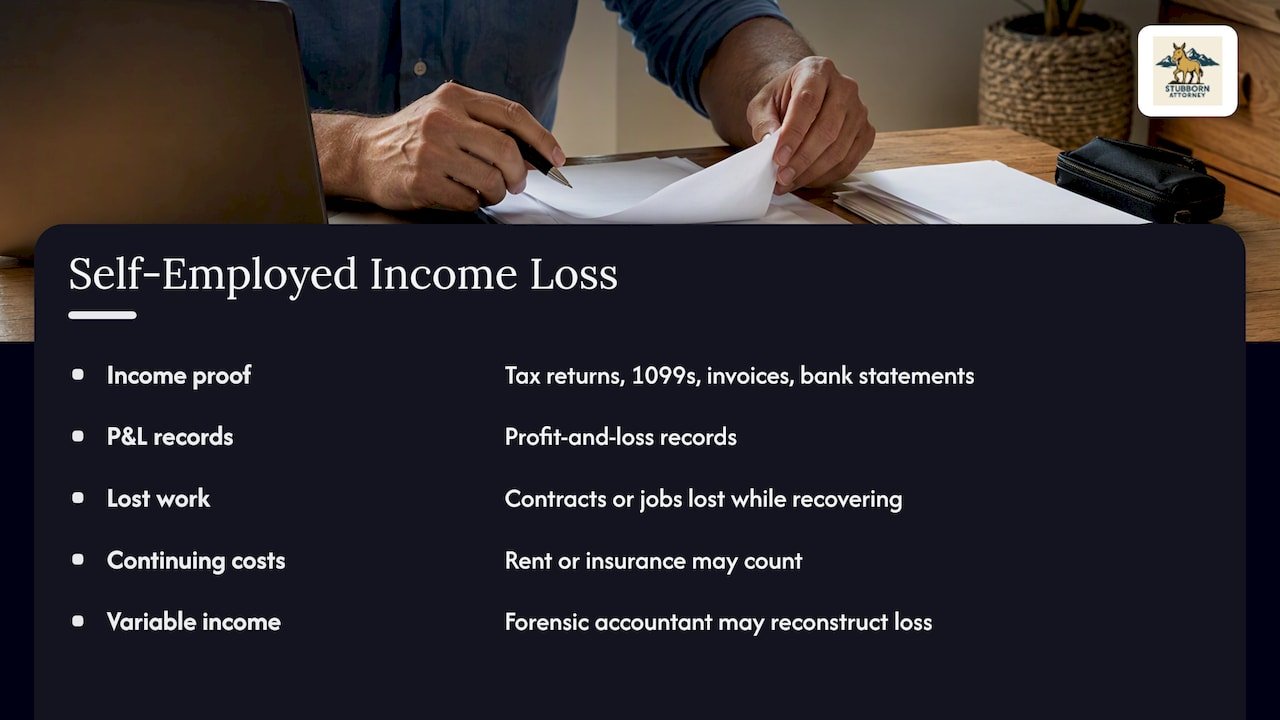
If you work for yourself, an insurer will not take your word for what you would have made. Expect adjusters to ask for tax returns, 1099s, invoices, bank statements and profit-and-loss records. Look for the contracts or jobs you actually lost while recovering, not only a monthly average. Business costs that continued while you could not work, such as rent or insurance, may belong in the analysis. When revenue swings a lot or the business was growing, a forensic accountant may be needed to reconstruct the loss. That is a cost to talk through with your attorney before you commit to it.
If you were between jobs
Colorado’s old no-fault insurance cases are narrower than an injury lawsuit, but they show how courts treat hypothetical income. In Bondi v. Liberty Mutual Insurance Co. (1988), the Court of Appeals held that no-fault personal injury protection wage benefits required actual lost wages, not an unemployed person’s claimed earning capacity or a hypothetical future salary. In practice: if you had a job offer, a start date or a track record of seasonal work, document it. A vague plan to look for work is weak.
Lost earning capacity: when you cannot go back to the same job
This is where a serious injury changes the value of a claim. A back injury that ends a career in construction, a hand injury for a dental hygienist, or a traumatic brain injury that limits concentration can reduce your income for years.
The Colorado jury instructions say that in a personal injury case you do not have to prove you would have earned more money after the accident to be awarded damages for diminished earning capacity, as long as there is evidence of permanent injury. They also say that future earning-capacity damages are compensable even when the amount is uncertain, provided the evidence supports the loss. See the same jury instructions.
That does not mean the number writes itself. Future loss claims are built on evidence, typically:
- Medical opinion on permanent restrictions, such as no lifting over a set weight or no prolonged standing.
- Vocational evidence on what work you can still do and what it pays.
- Economic analysis that compares your likely earnings before and after.
Expect the insurer to push back hardest here, because the figures are larger and less certain than past wages. Our guide to the types of damages in injury claims shows where earning capacity sits among the other categories of compensation.
What evidence proves lost income
Start collecting early. Memory fades, employers change payroll systems and insurers read gaps as doubt. Colorado’s Judicial Legal Help Center describes the kinds of material that courts see as evidence, including medical records and bills in auto-accident cases, and says organized documents and damages summaries can be submitted as exhibits. See its page on evidence, witnesses and subpoenas.
For a lost income claim, a solid file usually includes:
- A doctor’s note or work-restriction letter stating what you could not do and for how long
- Pay stubs or payroll records from before the crash, covering several months
- A letter from your employer confirming your rate, hours, dates missed and any benefits lost
- W-2s and tax returns for the last two or three years
- For self-employed people: 1099s, invoices, bank statements, receipts and profit-and-loss statements
- A simple log of missed shifts, appointments and canceled jobs
- Your health insurance and retirement plan information if your employer contributions stopped
The single most useful item is often the doctor’s note. Without a medical reason you could not work, an adjuster can argue you could have returned sooner. If your doctor has not addressed work in your chart, ask at your next appointment. For more on organizing proof, see what content you need for your injury claim in Colorado and our 10 steps to strengthen injury claims after a car accident.
How lost wages fit into a claim against the at-fault driver
In Colorado, you generally pursue an at-fault driver’s liability insurer, and if that fails, a lawsuit. Lost wages are one line of economic damages inside that claim, next to medical bills and property damage. You do not file a separate wage claim. You present your income loss with your documents in the demand package, and the insurer values it with everything else.
Two features of Colorado law shape what you can actually collect.
Insurance limits
Colorado requires drivers to carry at least $25,000 for bodily injury or death to one person, $50,000 per accident and $15,000 for property damage, according to the Colorado Motor Vehicle Handbook. Those are minimums. A crash with months of missed work plus surgery can exceed them quickly. When that happens, your own underinsured motorist coverage, if you bought it, and other responsible parties may matter. Check your own policy early.
Damage caps and collateral payments
Colorado caps noneconomic damages, such as pain and suffering. For civil actions filed on or after January 1, 2025, HB24-1472 raised that cap from $250,000 to $1.5 million. Lost wages are economic damages, so this cap is not the one that limits them. For how the new cap plays out in real settlements, see our piece on Colorado car accident settlements.
Colorado also has a statute on reduction of damages for collateral source payments. In general terms, it can reduce a verdict by amounts you were compensated from other sources, with exceptions. What that means for sick pay, disability benefits or health insurance is fact-specific, so ask an attorney how it applies before you assume a figure.
Deadlines that protect your claim
The statute of limitations for tort actions over bodily injury from operating a motor vehicle in Colorado is three years, counted from when the injury and its cause are known or should have been known, under C.R.S. 13-80-101(1)(n). Other injury types can have shorter windows, so do not assume three years if your case involves, for example, a fall on someone’s property.

Three years is the outer limit for filing. It is not a target. Wage documentation gets harder to collect with time, and an insurer’s offer made before you know your future restrictions can be too low. Read our guides on the statute of limitations for car accidents and key deadlines for Colorado injury claims. If a family member died in a crash, the clock and the rules are different: see our page on wrongful death after a car accident.
Mistakes that shrink a lost wages claim
- Settling before you know your work restrictions. A quick check may look good while you are still off work and unaware that your injury is permanent.
- Returning too early without telling your doctor. If you push through pain and miss follow-ups, the record can suggest you were fine.
- Missing the employer paperwork. Verification letters take weeks. Ask early.
- Giving a recorded statement without preparation. Offhand comments such as “I’m doing okay” get quoted back against a work restriction.
- Ignoring side income. Gig, cash and freelance earnings count only if you can prove them. Report them accurately on your taxes and keep records.
- Posting online. Photos of activity can be used to question your restrictions.
Our guide on how to avoid claim mistakes goes into more of these.
Our perspective
I worked as a claims adjudicator for the federal government before I practiced injury law, so I know how a claim looks from the other desk. Adjusters do not start with your story. They start with your paperwork. A lost wages claim that arrives with a doctor’s restriction, an employer letter and clean payroll records is hard to wave away. One that arrives as “I missed about six weeks” invites a lowball.
We see the same patterns in injury cases. People under-claim because they feel awkward asking for money for time off. Self-employed clients forget that lost jobs and lost clients are a real loss. And people with lasting injuries focus on this month’s paycheck, when the bigger question is the next twenty years of work.
We do not treat that as a number to guess at. We work from your records, your doctors and, when the case calls for it, outside experts on future earnings. Our cases are handled directly by attorneys, and we take them on a contingency basis: no client payment unless there is a monetary recovery. We call it being stubborn because when we take a case, we do not let go.
— Ryan
Getting help with your claim
If you are in Colorado Springs or elsewhere in Colorado and missed work because of a crash, we can review your records and tell you what your lost income claim may look like. We represent only injured victims and handle car, truck, motorcycle, bicycle and pedestrian cases. See our Colorado Springs personal injury page for a free case review, or browse all of our services. If you are comparing firms first, read how to choose legal representation that wins.
FAQ
Can I claim lost wages if I used sick days or vacation?
Often yes, because you spent leave that you earned and would otherwise have kept. How a court or insurer treats it depends on the claim and the policy language, as the Jones decision shows. Keep records of every day of leave you used and ask your lawyer how to present it.
Do I need a lawyer to recover lost wages?
Not legally, and a simple claim with a short absence can sometimes be handled directly with the insurer. Help matters more when you are self-employed, when the injury is lasting, or when the insurer disputes that you needed to be off work. Our free consultation guide explains what to expect at a first call.
How long do I have to file a lost wages claim after a Colorado car accident?
The general deadline to sue over bodily injury from a motor vehicle accident in Colorado is three years from when the injury and its cause are known or should have been known. Other kinds of injury cases can have different deadlines. Do not wait until the end of the window, since records are easier to get early.
What if I cannot return to my old job?
You may be able to claim lost earning capacity in addition to past wages. Colorado’s jury instructions allow damages for diminished earning capacity where evidence supports a permanent injury, even if the exact amount is uncertain. Medical and vocational evidence usually drives the figure.
Sources
- Colorado Judicial Branch civil jury instructions, Chapter 6
- Jones v. USAA Casualty Insurance Co. (Colo. App. 1997)
- Bondi v. Liberty Mutual Insurance Co. (Colo. App. 1988)
- Colorado Judicial Legal Help Center: evidence, witnesses and subpoenas
- Colorado Motor Vehicle Handbook
- HB24-1472, Raise Damage Limit Tort Actions
- C.R.S. 13-21-111.6, collateral source reduction
- Colorado session law on C.R.S. 13-80-101(1)(n)