
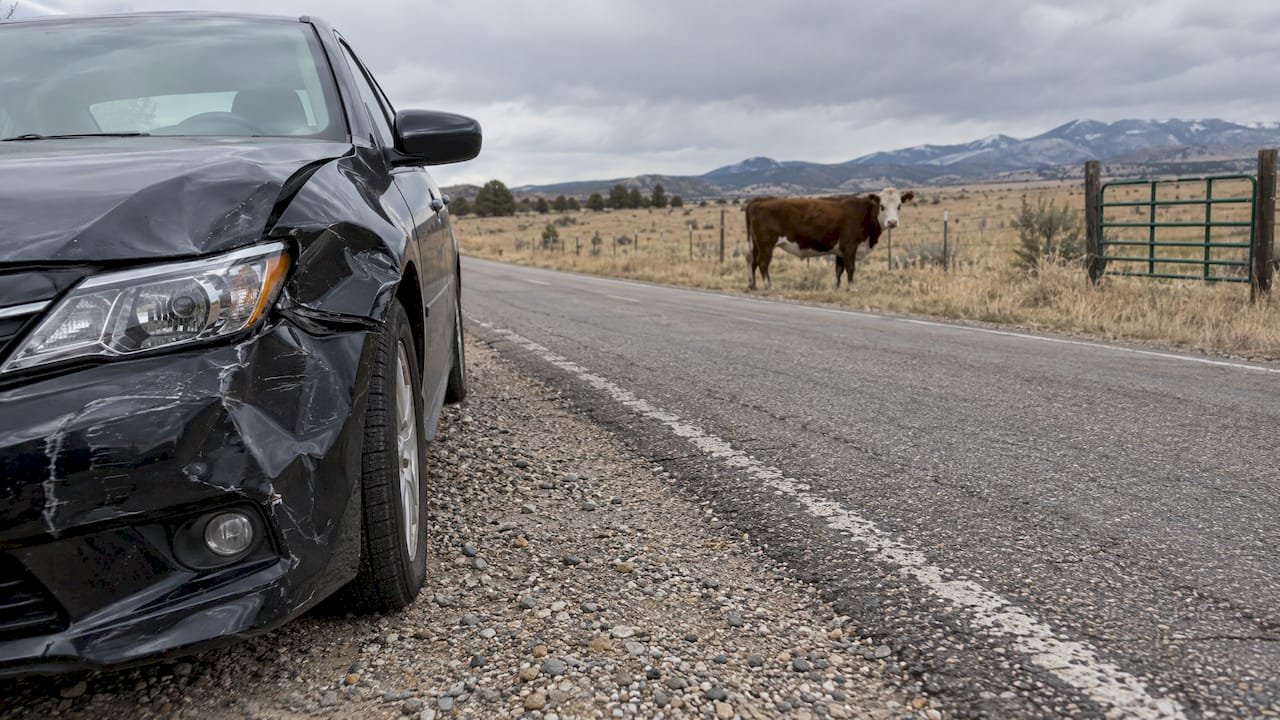
Open Range Car Accidents in Colorado: Who Pays After You Hit Livestock
If you hit a cow or other livestock on a Colorado road, the short answer is this: open range does not mean nobody is responsible, and it does not mean the animal’s owner is automatically responsible either. Colorado courts have held that cattle on a highway do not, by themselves, prove the owner was negligent. You, or your attorney, have to show what the owner did or failed to do. Your own insurance often pays first, and the way you handle the first hours can decide how strong a claim you end up with.
This guide explains what the open-range law actually says, how fault is decided, which insurance coverage responds, and what to do at the scene. It is written for drivers, riders and families dealing with a collision on a rural highway or a ranch-country county road, including those who live in or travel through Colorado Springs and the surrounding region.
Table of Contents
- What open range means on a Colorado road
- Is the livestock owner automatically liable?
- What to do in the first hour after hitting livestock
- How fault is decided: what a livestock claim must show
- Which insurance pays after an open-range crash
- Comparative fault: when both sides share the blame
- Colorado is not a no-fault state
- What compensation can cover
- Our perspective
- How we can help after a livestock collision
- Staying safe on open-range roads
- Frequently asked questions
- Sources
What open range means on a Colorado road
People use “open range” to describe country where livestock are allowed to graze without being fenced in, and where the burden of fencing falls on the person who wants to keep animals out. Drivers see the result on the road: yellow warning signs, cattle guards, and the occasional steer standing on the shoulder at dusk.
The statute most often discussed is C.R.S. § 35-46-105. According to the text of that statute, it is unlawful to knowingly allow livestock to graze or run at large on public roads or in municipalities when those areas are separated from the owner’s range by a sufficient fence or barrier. In plain terms, an owner cannot knowingly let animals roam onto fenced-off roads and towns.
The same statute also protects drivers in one specific way. A driver who kills or injures livestock in a collision is shielded from liability for the animal’s death or injury, as long as the collision was not malicious, willful or wanton. That matters because a frightened driver’s first question is often whether they now owe the rancher for a dead animal. Under the statute as published, an ordinary accident does not create that debt.
Two points follow from this:
- Open-range status is about fencing and roaming. It is not a rule that says the driver always loses.
- Your right to seek compensation for your own injuries and vehicle damage still runs through ordinary negligence law.
Is the livestock owner automatically liable?
No. This is the part that surprises people, and it is where many claims go wrong.
In Barnes v. Frank, the Colorado Court of Appeals held that the presence of cattle on a highway does not itself make the owner liable or raise a presumption of negligence. The court’s opinion says the injured plaintiff must prove the owner’s negligence by a preponderance of the evidence, which means showing it is more likely than not. The reasoning is practical: an animal can reach a road for reasons that have nothing to do with the owner’s carelessness. A gate left open by a stranger, a fence cut by a trespasser or a downed tree across a fence line can all let cattle out without any fault on the owner’s part.
The court reached the same conclusion later in Millard v. Smith. The Court of Appeals confirmed that a driver who strikes cattle on a public highway can pursue a negligence claim against the owner, but must prove that the owner breached a duty through some negligent act or omission.
Put together, the rule has two halves:
- You have a real legal path. Hitting livestock on a Colorado highway does not bar you from recovering.
- The path requires evidence. “The cow was on the road” is where the case starts, not where it ends.
That is why these claims reward early work. The facts that show an owner’s breach, such as the condition of the fence, how the animals got out and whether it had happened before, are easiest to document in the days right after the crash, before a repair crew fixes a fence or a herd is moved.
What to do in the first hour after hitting livestock
The Colorado State Patrol has published guidance on animal collisions. Its message is that a collision with an animal is a crash, and it should be treated like any other crash.
Check people first, then call 911
After hitting an animal, the State Patrol advises checking that everyone is okay. If the animal is large and still on or near the road, call 911 and follow the dispatcher’s instructions. A large animal in a lane is a hazard to the next driver, and a 911 call also creates a time-stamped record that the crash happened where and when you say it did.
Do not swerve
The same guidance covers the moment before impact. If a crash with an animal cannot be avoided, keep control of the vehicle and drive through before pulling over when it is safe. Do not swerve or jerk the wheel. Many of the worst animal-related injuries come from drivers who leave the lane to avoid the animal and then roll the vehicle or hit oncoming traffic. If that happens, the crash may involve another driver, and our guide to fault in multi-car accidents becomes relevant.
Document the scene
Once everyone is safe, use your phone while you are still there:
- Photograph the animal, any ear tag or brand you can see, and its position relative to the road.
- Photograph the nearest fence line, gates and cattle guards, and any open-range or livestock warning signs. Note the mile marker or nearest cross street.
- Photograph vehicle damage from several angles, plus skid marks, debris and the weather and lighting.
- Get names and numbers for witnesses, and for anyone who stops and says whose animals these are.
- Ask the responding officer for the report number.
Get medical care, even if you feel fine
Adrenaline hides injuries. Whiplash, concussion and internal injuries often show up hours or days later. Seeing a doctor creates a medical record linking symptoms to the crash. Our guide to the biggest mistakes after car accidents covers the habits that most often hurt injury claims, including delayed treatment and casual statements to insurers. A full list is also in our Colorado car accident legal checklist.
How fault is decided: what a livestock claim must show
Because there is no automatic presumption against the owner, a claim turns on specific facts. Lawyers and insurers generally look at questions like these:
- How did the animal get onto the road? A broken fence, an open gate or a missing cattle guard points to a maintenance problem. A cut fence or a gate opened by a stranger points away from the owner.
- Was the owner on notice? If the same animals had been seen on the road before, or neighbors had complained, an owner who did nothing looks very different from one who had no warning.
- Where did it happen? A stretch of busy highway with fast traffic carries different risks than a quiet county road, and what counts as reasonable care can reflect that.
- What was the driver doing? Speed, lighting, attention and whether warning signs were posted all feed into what a reasonable driver would have done.
- Who owns the animal? Identifying the owner is sometimes the hardest step. Brands, ear tags, neighboring ranchers and grazing permits can all help trace it.
The broader question of how negligence is weighed is the same one that arises in any crash. Our overview of fault in Colorado car accidents and our guide to car accident liability factors explain how evidence is weighed in practice.
When no owner can be identified, or the evidence shows the owner did nothing wrong, your own insurance becomes the main source of recovery. That is the next piece.
Which insurance pays after an open-range crash
Many drivers assume the livestock owner’s policy will pay. In practice, your own coverage frequently does the first work. The Colorado Division of Insurance explains the structure on its auto insurance page.
Liability coverage
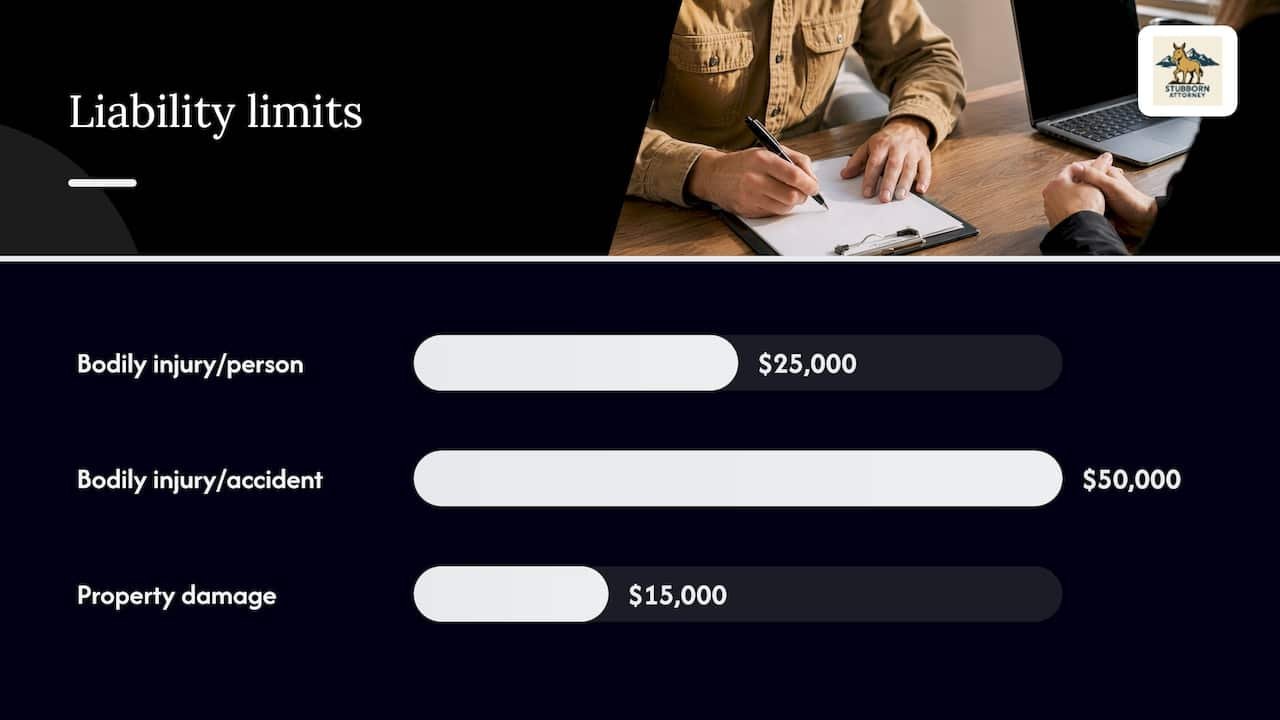
Colorado requires liability coverage of $25,000 per person and $50,000 per accident for bodily injury, and $15,000 for property damage to another person. Liability coverage pays third-party losses when the policyholder is at fault. If you hit a cow and are not found at fault, your liability coverage is not the policy that repairs your own car. If a livestock owner is found negligent, their liability or farm and ranch coverage is the policy that would respond to your claim.
Collision and comprehensive coverage
The Division of Insurance says collision coverage pays to repair or replace the insured vehicle after a collision, generally subject to a deductible. Comprehensive coverage addresses noncollision losses. Policies and insurers can treat an animal strike differently, so read your own policy and ask your insurer in writing which coverage applies to your claim and what your deductible is.
Uninsured-motorist property damage
The Division also notes that an uninsured-motorist-property-damage option may cover a vehicle damaged by an at-fault uninsured motorist when its conditions apply. This matters if a second vehicle was involved, for example a driver who swerved around the animal and struck you.
Why your own insurer’s quick offer is not the end
If your insurer pays for the car, that does not mean you have given up a claim against a negligent owner. Insurers that pay often have their own reimbursement rights. Our guide on Colorado subrogation rules explains what to review before you sign anything, and our article on the collateral source rule after Scholle explains how payments from your own insurance interact with what you can claim from the party responsible.
Comparative fault: when both sides share the blame
Sometimes the answer is neither all the owner nor all the driver. Colorado’s comparative negligence statute, § 13-21-111, applies in negligence cases, and the Colorado Judicial Branch’s model jury instructions direct that comparative-negligence instructions be used alongside damages instructions where that statute applies.
Here is how that can play out in a livestock case. Imagine a rancher whose fence had been down for weeks, and a driver traveling well over the limit at night on a road with posted cattle warnings. A jury could find the owner negligent for the fence and the driver partly at fault for speed. The question then becomes how much fault each side carries, and that percentage affects what the driver can recover.
Because the allocation can change the value of a claim dramatically, it deserves careful attention. Our article on the 50% rule and special verdicts in Colorado comparative negligence walks through how the percentages work and why they matter.
Colorado is not a no-fault state
One of the questions people ask most is whether Colorado is still a no-fault state. It is not. A law review analysis of automobile liability insurance in Colorado describes Colorado as a tort state where fault determines liability. Liability insurance is mandatory to cover bodily injury and property damage for which the driver is at fault, and compensation for injuries is handled through the tort system under negligence principles.
For an open-range crash, that means you are not limited to a fixed no-fault benefit. If someone’s negligence caused the crash, you can pursue compensation from that party. It also means fault is argued and proven, which is why the evidence section above matters so much.
What compensation can cover
The Colorado Judicial Branch’s model jury instructions describe the categories of damages juries are told to consider. For personal injuries, they include economic losses such as reasonable medical expenses and lost earnings, and noneconomic losses such as pain, suffering, inconvenience and emotional stress.
For your vehicle, the same instructions say property damages may be measured by the cost of repair and applicable diminution in value, subject to the vehicle’s pre-loss market value when repair costs exceed it. A large animal strike can easily total an older vehicle, so the market value of your car before the crash becomes a real number in the claim.
A practical way to prepare:
- Keep every medical bill, prescription receipt and mileage record.
- Track missed work in writing, with your employer’s confirmation.
- Save repair estimates, towing and storage invoices and rental car receipts.
- Keep a short daily note on pain, sleep and limits on your activities.
For a wider view of how these claims are built, see our guide to understanding personal injury claims in Colorado and our overview of types of car accident claims.
Our perspective
Livestock cases look simple from the road and turn out to be anything but. A driver sees a dead steer and a wrecked truck and assumes the answer is obvious. It almost never is, because Colorado law asks you to prove what the owner did wrong, and that proof lives in fence lines, gates and the memories of neighbors.
Before I started representing injured people, I worked as a claims adjudicator for the federal government. I know how large insurance companies and agencies evaluate a claim, and I know that the first question is rarely whether you were hurt. It is whether anyone can show who is responsible. So we start building that answer early.
This is also where our name comes from. We chose the mule as a symbol because mules do not quit on a hard trail. When we take a case, we do not let go, and we handle it directly as attorneys, not as a case mill. Our team has settled hundreds of injury cases and recovered millions of dollars for people in the same position you are in.
If you were hurt in an open-range crash, do not let a quick adjuster call decide the outcome. Get the facts documented, get treated and talk to someone who will do the work of finding the cause.
Ryan
How we can help after a livestock collision
Malnar Injury Law, now StubbornAttorney.com, represents injured people in Colorado, including car, truck, motorcycle, bicycle, pedestrian and slip and fall victims, and families in wrongful death cases. We work on a contingency basis, which means you pay no fee unless there is a monetary recovery in your injury case. If a livestock crash left you hurt, our team can look at who owns the animal, how it got out and which insurance applies.
See our car accident and injury services or start from our home page to reach us. If a semi-truck was involved, for example a cattle hauler, read about our semi-truck accident representation.
Staying safe on open-range roads
Prevention is cheaper than any claim. The State Patrol’s guidance on animal collisions supports a few habits for rural driving:
- Slow down where open-range signs are posted, and especially at dawn and dusk when animals are harder to see.
- Use high beams when no traffic is oncoming, and scan the shoulders as well as the lane.
- If you see one animal, expect more. Cattle move in groups.
- If a collision cannot be avoided, brake firmly, hold the wheel straight and avoid swerving into another lane.
- After any impact, move to a safe place if the vehicle can be driven, turn on hazard lights and call 911 for a large animal that remains in the road.
These habits also help if a claim develops, because a driver who was attentive and traveling at a reasonable speed is in a stronger position when fault is shared.
Frequently asked questions
Do I owe the rancher money if I kill their cow?
Under C.R.S. § 35-46-105 as published, a driver who kills or injures livestock in a collision is protected from liability for the animal unless the collision was malicious, willful or wanton. An ordinary accident does not create that debt. Tell your insurer and the responding officer what happened, and avoid agreeing to pay anyone at the scene.
Can I sue a livestock owner after hitting a cow?
Yes, but you must prove negligence. Colorado appellate courts have said the animal’s presence on the road does not by itself make the owner liable. You need evidence of a specific breach, such as a broken fence or prior escapes. An attorney can help identify the owner and gather that evidence while it still exists.
Does my own car insurance cover hitting livestock?
Often collision coverage applies to damage to your vehicle, generally subject to your deductible, according to the Colorado Division of Insurance. The exact answer depends on your policy, so ask your insurer in writing which coverage applies. Keep paying attention to reimbursement rights before you sign any release.
Is Colorado a no-fault state for injury claims?
No. Colorado is a tort state, so fault determines who pays for injuries and damage. Drivers must carry liability insurance, and injured people pursue compensation through negligence claims. That is why documenting how the crash happened is so important.
Sources
- Colorado Revised Statutes § 35-46-105
- Barnes v. Frank, 472 P.2d 745 (Colo. App. 1970)
- Millard v. Smith, 495 P.2d 234 (Colo. App. 1972)
- Colorado State Patrol: A Collision with an Animal is a Crash
- Colorado Division of Insurance: Auto Insurance
- Colorado Judicial Branch: Civil Jury Instructions, Chapter 6
- Denver Law Review Forum: Automobile Liability Insurance