

What Is Pre-Litigation? A Clear Guide for Injury Claims
Pre-litigation is the legal phase between when a dispute arises and when a lawsuit is actually filed in court. During this period, attorneys investigate the claim, gather evidence, send formal demand letters, and negotiate with the opposing party or their insurer. The goal is straightforward: resolve the dispute without going to trial. Roughly 97% of tort cases in the U.S. never reach a courtroom, which tells you how much legal work happens before anyone files anything.
This phase is not passive waiting. It is where cases are won or lost before a judge ever sees them. The core components of pre-litigation include:
- Initial consultation with an attorney to assess the claim
- Investigation and evidence gathering, including medical records, photos, and witness statements
- A formal demand letter sent to the opposing party or insurer
- Negotiation over settlement terms and compensation
- Alternative Dispute Resolution (ADR), such as mediation, when direct negotiation stalls
- Filing a lawsuit if no resolution is reached
What does the pre-litigation process actually look like?
The pre-litigation process follows a recognizable sequence, though the pace varies by case complexity.
- Initial consultation. You meet with an attorney who evaluates the facts, identifies liable parties, and determines whether a viable claim exists. This is where strategy begins.
- Investigation and evidence gathering. Your attorney collects medical and insurance records, employment documents, photographs, and witness statements. The earlier this happens, the better. Memories fade and physical evidence disappears.
- Formal demand letter. Once the evidence is organized, your attorney sends a written demand to the opposing party or their insurance company. This letter outlines the facts, establishes liability, and states the compensation sought.
- Negotiation. The opposing party responds, often with a counteroffer. This back-and-forth can last weeks or months. Most cases settle here.
- Alternative Dispute Resolution. If direct negotiation stalls, mediation or arbitration can break the deadlock. A neutral third party facilitates discussion without the formality or cost of court.
- Filing a lawsuit. When all pre-litigation efforts fail, your attorney files a complaint in court. Pre-litigation ends and formal litigation begins.
Why pre-litigation benefits you more than going straight to court
Skipping pre-litigation and heading directly to court is almost always the wrong move. The financial and personal costs of litigation are steep, and the benefits of resolving a dispute earlier are real.
- Lower costs. Attorney fees, court filing fees, expert witness costs, and deposition expenses add up fast in litigation. Pre-litigation avoids most of them.
- Faster resolution. A negotiated settlement can close in months. A trial can take years.
- Privacy. Court proceedings are public record. Pre-litigation negotiations stay confidential.
- More control. You and your attorney shape the outcome rather than leaving it to a judge or jury.
- Less stress. Informal negotiation is simply less grueling than courtroom proceedings.
- Stronger leverage. A well-documented pre-litigation case signals to insurers that you are prepared to go to trial, which often pushes them toward a fair offer.
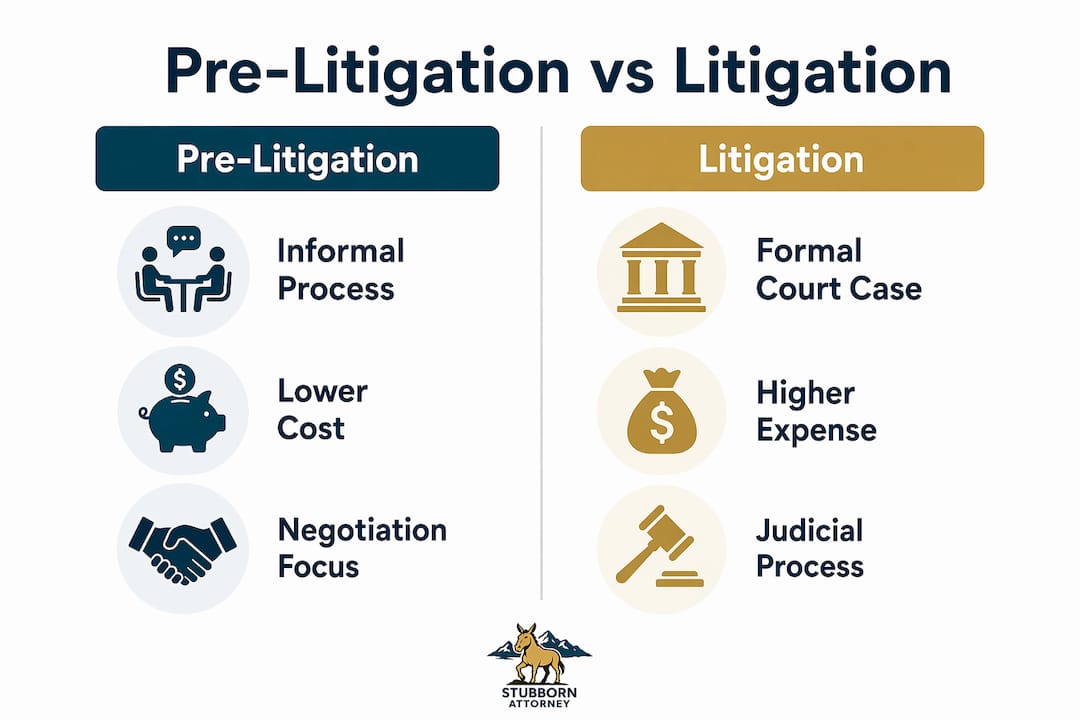
How does pre-litigation differ from formal litigation?
The differences between the two phases go beyond just timing.
| Factor | Pre-Litigation | Formal Litigation |
|---|---|---|
| Formality | Informal negotiation and investigation | Formal court procedures and filings |
| Cost | Significantly lower | High, often tens of thousands of dollars |
| Timeline | Weeks to months | Months to years |
| Control | Parties control the outcome | Judge or jury decides |
| Privacy | Confidential | Public record |
| Stress level | Lower | Substantially higher |
Pre-litigation is less formal and less costly than litigation by design. Litigation locks you into a process governed by court rules, scheduling orders, and judicial discretion. Pre-litigation keeps the power in the room with the people who actually know the facts.
What does your attorney actually do during pre-litigation?
Your attorney is not just a messenger during this phase. They are the architect of your entire case position.
- Preserve evidence. Once litigation is foreseeable, there is a legal obligation to preserve all relevant documents and physical evidence. Failure to do so can result in court sanctions down the line.
- Draft the demand letter. A well-crafted demand letter forces the opposing party to honestly assess their liability exposure. It is often the single most important document in the case.
- Manage all communications. Your attorney handles contact with insurers and opposing counsel, keeping you from saying something that could be used against you.
- Negotiate directly. Experienced attorneys know how insurers think and what arguments move them. That knowledge translates into better offers.
- Evaluate your options. Your attorney weighs the risks of going to trial against the value of a settlement offer, then advises you on which path makes sense.
Early attorney involvement signals to insurers that you are serious and prepared, which often shifts the negotiation dynamic before a single counteroffer is made. You can read more about how this works in settlement negotiations.
Attorney Ryan Malnar’s perspective on getting pre-litigation right

Pre-litigation is where cases are actually built. By the time you reach a negotiating table, the strength of your position depends almost entirely on what happened in the weeks before that meeting.
The most common mistake people make is waiting. They assume the insurance company will do the right thing, or they worry about “escalating” the situation. What actually happens is that evidence goes stale, witnesses become harder to reach, and the insurer reads the delay as a sign that you are not serious. Active, early attorney involvement is what changes that dynamic.
The demand letter matters more than most people realize. A letter backed by organized medical records, documented losses, and a clear liability narrative does not just ask for money. It tells the insurer exactly what a jury would hear if this goes to trial. That is a very different kind of pressure.
Pro Tip: Never post about your injury, your treatment, or your claim on social media. Insurers and opposing counsel routinely monitor public profiles, and a single photo or offhand comment can undermine months of careful case building. Talk to your attorney before talking to anyone else about your claim.
How long does the pre-litigation phase typically take?
There is no fixed clock on pre-litigation. A straightforward car accident claim with clear liability might resolve in three to six months. A complex case involving disputed liability, serious injuries, or multiple parties can stretch to a year or longer before anyone files suit.

The timeline depends on how quickly evidence is gathered, how responsive the opposing party is, and whether ADR is needed. Medical treatment also plays a role. Attorneys generally wait until a client reaches maximum medical improvement before sending a demand letter, because the full extent of damages needs to be documented before any number is put on the table. You can get a clearer picture of what to expect in a Colorado injury timeline.
What types of cases typically go through pre-litigation?
Pre-litigation applies to virtually any civil dispute, but personal injury cases make up the bulk of it in practice.
Common case types include car and truck accidents, slip-and-fall injuries, medical malpractice, workplace injuries, dog bites, and product liability claims. Contract disputes, property damage claims, and employment matters also frequently go through a pre-litigation phase before any complaint is filed. Essentially, any situation where one party believes another owes them compensation and wants to resolve it without a trial will involve some version of this process. See common personal injury examples for a sense of how these cases typically unfold.
What outcomes are possible during pre-litigation?
The most common outcome is a negotiated settlement, where both parties agree on a compensation amount and sign a release. That ends the dispute entirely. Mediation can produce the same result when direct negotiation breaks down.
Sometimes pre-litigation reveals that the claim is weaker than initially thought, and the injured party decides not to pursue it further. Other times, the opposing party refuses any reasonable offer, and filing suit becomes the only path forward. Pre-litigation does not guarantee resolution, but it gives both sides the best opportunity to reach one before the costs and uncertainty of trial take over.
What are the real risks of pre-litigation?
Pre-litigation is not without drawbacks. The biggest risk is the statute of limitations. Every state sets a deadline for filing a lawsuit, and if pre-litigation negotiations drag on past that deadline without a tolling agreement, you lose the right to sue entirely. In Colorado, the general statute of limitations for personal injury claims is two years from the date of injury.
There is also the risk of tipping your hand. Sharing too much information during negotiations can give the opposing party insight into your case strategy before you ever reach court. A skilled attorney manages this carefully, but it is a real consideration. Pre-litigation can also create a false sense of progress. Months of back-and-forth with an insurer who has no intention of settling fairly is time that could have been spent building a litigation-ready case. Knowing when to stop negotiating and file is just as important as knowing how to negotiate.
FAQ
What does pre-litigation mean?
Pre-litigation refers to all legal activity that occurs after a dispute arises but before a formal lawsuit is filed, including investigation, demand letters, and settlement negotiations.
What is a pre-litigation offer?
A pre-litigation offer is a settlement proposal made by the opposing party or their insurer during the negotiation phase, before any court complaint is filed.
Is it better to settle or litigate?
Settlement is usually faster, cheaper, and less stressful than litigation. Most personal injury cases resolve during pre-litigation, and going to trial is generally a last resort when fair settlement is not possible.
How do you prepare for pre-litigation?
Hire an attorney early, preserve all evidence, document your injuries and losses thoroughly, and avoid discussing your claim publicly or with insurers before consulting counsel.