
What Colorado Law Requires After a Hit and Run
If you’re involved in a Colorado hit and run, whether as the driver or the person left standing on the pavement, the law is not vague. Colorado Revised Statutes require every driver in a crash involving injury or death to stop immediately, exchange information, and help the injured. For property damage alone, you still have to stop and leave your details. Leaving does not just risk a criminal charge. It triggers a separate license revocation through the Colorado Department of Revenue, and it can gut your defense in the civil case that usually follows.
Here’s what to do right now, depending on where you stand:
- If you’re the driver and you’re still at the scene: stay put, call 911, exchange your name, address, insurance, and registration, and render aid if anyone is hurt.
- If you left the scene: stop making decisions alone. Preserve any evidence you have (dashcam, receipts, texts) and talk to a lawyer before you talk to police.
- If you’re a victim or witness: call 911, photograph everything, get contact information from anyone who saw it happen, and watch for a Medina Alert if a vehicle description gets released.
Table of Contents
- What Does Colorado Law Require at the Scene of a Crash?
- How Does Colorado Classify Hit-and-Run Charges?
- Will a Hit-and-Run Conviction Cost You Your License?
- What Defenses Exist in a Colorado Hit-and-Run Case?
- Can You Sue for Damages Even Without a Criminal Conviction?
- What Should You Do Right Now After a Hit and Run?
- Why Early Legal Advice Changes the Outcome
- Get a Free Case Evaluation From Stubbornattorney
- Sources
- FAQ
What Does Colorado Law Require at the Scene of a Crash?
Colorado splits hit-and-run duties into two statutes, and which one applies changes everything about your exposure.
CRS §42-4-1601 governs accidents involving injury, serious bodily injury, or death. It requires the driver to stop at the scene, or as close to it as safely possible, and stay there until specific duties are met: exchanging name, address, registration, and insurance information, showing a driver’s license on request, and rendering “reasonable assistance” to anyone hurt, which can mean calling for medical help or arranging transport to a hospital.
CRS §42-4-1602 covers accidents involving only property damage. The duty is narrower but still mandatory: stop, move the vehicle out of traveled lanes if it’s safe to do so, and locate the owner of the damaged property (or leave a written note with your information if you can’t).
In practice, meeting these duties looks like this:
- Pull over as soon as you can safely do so, ideally onto a shoulder or side street rather than blocking a lane.
- Turn on hazard lights and check for injuries before doing anything else.
- Exchange information verbally and in writing, don’t just say your name; write it down.
- Call 911 if anyone is hurt, property damage looks serious, or you’re unsure whether you’re required to.
- Wait for police or an officer’s release before leaving, even in a fender bender.
The law does not care whether you thought the damage was minor. It cares whether you stopped.
How Does Colorado Classify Hit-and-Run Charges?
Colorado grades hit-and-run offenses by outcome, and the gap between the lightest and harshest charge is enormous. A hit and run colorado case involving only property damage is typically a class 2 misdemeanor traffic offense. Add injury, and prosecutors can charge a class 1 misdemeanor. Serious bodily injury pushes the case into felony territory as a class 4 felony. A fatality makes it a class 3 felony, one of the most serious driving-related charges on the books.
Penalties scale accordingly:
- Class 2 misdemeanor (property damage): fines and limited jail exposure, plus points on your driving record.
- Class 1 misdemeanor (injury): higher fines and up to a year in jail.
- Class 4 felony (serious bodily injury): multiple years in prison and steep fines.
- Class 3 felony (death): among the longest sentences in Colorado traffic law, with prison time measured in years, not months.
Colorado law treats leaving the scene as a serious escalation of an ordinary crash, according to LegalClarity’s breakdown of hit-and-run penalties, and the consequences stack: criminal record, license action, and civil exposure all run independently.
These aren’t abstract numbers. In 2026, CBS Colorado reported an arrest after a fatal hit-and-run killed a bicyclist in Aurora, and Denver7 covered a related arrest in the same case, both illustrating how quickly public tips and investigators close in once a description circulates.
Will a Hit-and-Run Conviction Cost You Your License?
Yes, and this happens separately from whatever a judge decides in your criminal case. The Colorado Department of Revenue holds independent authority to revoke your driver’s license following a hit-and-run conviction, and that revocation runs on its own timeline.
A few practical points matter here:
- The administrative revocation can run concurrently with a criminal sentence, but it’s a distinct process with its own hearing rights.
- Missing the deadline to request a DMV hearing can mean losing your chance to contest the revocation entirely.
- Reinstating a license after revocation often involves fees, proof of insurance, and sometimes an ignition interlock requirement.
If you’re facing both a criminal case and a DMV letter, don’t treat them as the same fight. Talk to a lawyer about both fronts before responding to either one.
What Defenses Exist in a Colorado Hit-and-Run Case?
The strongest and most common defense in these cases is the “innocent actor” defense: genuinely not knowing a collision happened. Colorado treats leaving the scene as close to strict liability in many contexts, so the real battleground often becomes whether the driver had any reason to know they hit something, not whether they left, according to LegalClarity’s analysis.
A driver who clips a mirror in a crowded parking lot at night, or who strikes debris that turns out to have been a person, may have a legitimate claim they never realized a collision occurred. Whether that claim holds up depends entirely on evidence: dashcam footage, witness accounts, surveillance video from nearby businesses, weather and lighting conditions, and the physical damage pattern on both vehicles.

Pro Tip: If you’re a driver who left the scene believing nothing happened, don’t wait for police to find you. Document everything you remember, including the time, location, and conditions, and get that information to an attorney immediately. Memory fades fast, and cases are often won or lost on details preserved in the first 48 hours.
Can You Sue for Damages Even Without a Criminal Conviction?
Yes. A criminal conviction and a civil claim run on completely separate tracks, and one doesn’t depend on the other.
Victims can pursue a civil lawsuit for medical bills, lost wages, and pain and suffering by proving negligence “by a preponderance of the evidence,” a lower bar than criminal court requires, regardless of whether the driver was ever criminally convicted. That matters enormously for victims whose case never results in an arrest.
There’s a catch on the driver’s side, though. Insurance companies routinely invoke criminal-act exclusions to deny coverage once a hit-and-run conviction is on record, which can leave the at-fault driver personally exposed for a judgment that would otherwise have been covered, per LegalClarity’s coverage of insurance consequences.
If you’re a victim, protect your claim by:
- Notifying your own insurer promptly, even if the other driver fled.
- Keeping every medical record, receipt, and bill tied to the crash.
- Getting a personal injury claim evaluated early, before evidence disappears or memories fade.
What Should You Do Right Now After a Hit and Run?
- If you stopped at the scene: call 911, exchange information, photograph the vehicles and surroundings, get medical attention even if you feel fine, notify your insurer, and contact an attorney before giving a detailed statement.
- If you left, or fear you might be charged: stop and preserve whatever evidence exists. Don’t talk to investigators without counsel present, and call a lawyer immediately rather than waiting to see if anyone comes looking.
- If you’re a victim or witness: call 911, document the scene with photos and notes, gather names and phone numbers from anyone who saw it, and check local news or Medina Alerts for a suspect vehicle description.
Working through a car accident legal checklist in the moments after a crash keeps you from missing a step that matters later. If you need a broader walkthrough, the immediate post-accident guide covers what to do beyond the first hour.
Why Early Legal Advice Changes the Outcome
Cases like these get decided in the first week, not the first court date. Evidence disappears, witnesses forget details, and insurers start building their denial before you’ve even filed a claim. Ryan Malnar built his practice on that reality, having settled hundreds of injury cases and recovered millions in settlements for Colorado clients, often stepping in before the criminal and civil pieces of a case start working against each other.
His background as a former federal claims adjudicator means he’s seen how insurers evaluate these cases from the inside. That’s the same steadiness he talks about riding mules through the Colorado mountains: sure-footed, patient, and completely unwilling to back off a case once he’s committed to it.
— Ryan
Get a Free Case Evaluation From Stubbornattorney
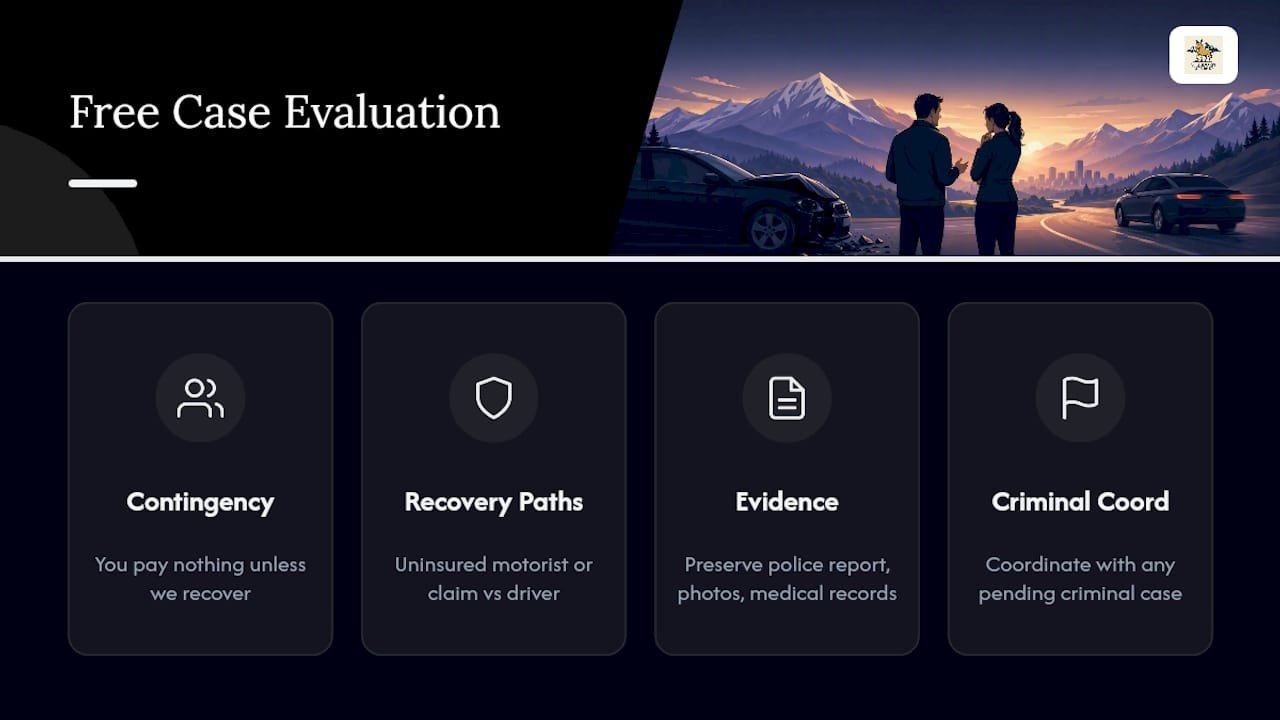
Stubbornattorney works on contingency, so you pay nothing unless we recover money for you. That matters most in hit-and-run cases, where the driver responsible may still be unidentified, uninsured, or facing criminal charges that complicate your civil claim. Our team knows how to pursue compensation through your own insurer’s uninsured motorist coverage, coordinate with any pending criminal case, and preserve evidence before it disappears.
To prepare for your free case evaluation, gather your police report, photos from the scene, medical records, and any insurance correspondence. We’ll review what happened and lay out your realistic options, whether that means a claim against an identified driver or a path through your own policy.
Start with a free case review through our personal injury services page and find out where your case stands.
This article is general information, not a substitute for advice from a qualified lawyer. Consult a qualified legal professional about your own circumstances before acting on anything here.
Sources
- Hit and Run in Colorado: Penalties, Fines, and License Loss – LegalClarity
- Deadly hit-and-run suspect in custody after crash that killed Colorado bicyclist – CBS Colorado
FAQ
What Should I Do Immediately After a Hit and Run in Colorado?
Call 911, document the scene with photos, collect witness contact information, and avoid giving a detailed statement to anyone but police until you’ve spoken with an attorney.
Is Colorado Hit-and-Run a Felony or Misdemeanor?
It depends on the outcome: property damage is typically a misdemeanor, while serious bodily injury is a class 4 felony and a fatality is a class 3 felony, according to LegalClarity.
How Long Do Prosecutors Have to File Hit-and-Run Charges in Colorado?
Statutes of limitation vary by severity: fatal hit-and-run cases commonly carry a five-year limit, serious bodily injury felonies often follow a three-year limit, and misdemeanor traffic offenses typically have one year.
Can I Still Sue if the Other Driver Was Never Caught or Convicted?
Yes. Civil claims require proving negligence by a preponderance of the evidence, a separate and lower standard than a criminal conviction, so you can pursue compensation even without an arrest.
Will My License Be Revoked After a Hit-and-Run Conviction?
The Colorado Department of Revenue can revoke your license administratively following a conviction, independent of any jail time or fines ordered in the criminal case.