

Questions to Ask Your Lawyer Before You Sign Anything
Six categories cover almost everything you need to know at a first meeting: experience, case strength and strategy, timeline and deadlines, fees and costs, team and communication, and documents/next steps. Ask something from each category before you leave the room. Skip one, and you’re guessing where it matters most.
That single sentence works as a mental checklist. Say it to yourself in the parking lot before you walk in, or write it on a sticky note stuck to your phone.
- Experience: has this attorney handled cases like mine, and how many?
- Case strength: what are the weaknesses, not just the strengths?
- Timeline: how long will this take, and is there a deadline I’m missing?
- Fees: what’s the arrangement, and what’s in writing?
- Team: who actually works my file day to day?
- Next steps: what do I bring, and what happens after this meeting?
Pro Tip: If your consultation is short or the clock is ticking on a deadline, ask about the statute of limitations and case strategy first. Fee structure and communication style matter, but they don’t help you if your claim is already time-barred.
Table of Contents
- Questions to Ask Your Lawyer About Experience and Fit
- Fees, Billing, and What This Will Actually Cost You
- Who Handles Your Case and How Often You’ll Hear From Them
- Asking About Case Strength, Weaknesses, and Strategy
- Timeline, Deadlines, and What Happens If You Wait
- How to Prepare for the Meeting Itself
- Red Flags to Watch for During the Consultation
- Why You Should Ask About Conflicts of Interest
- How the Lawyer Handles Disagreement and Client Collaboration
- Ending the Relationship if It’s Not Working
- Confidentiality and What Attorney-Client Privilege Actually Protects
- Does This Lawyer Understand Cases Like Yours?
- What Happens When Your Case Takes an Unexpected Turn
- What I Ask Every Client and Why It Matters
- If You’re Ready to Talk to Someone, Here’s What Happens Next
- Where to Verify These Answers Yourself
- Sources
- FAQ
Questions to Ask Your Lawyer About Experience and Fit
Years in practice tell you almost nothing on their own. A lawyer with 20 years of general practice may have handled five cases like yours. A lawyer with six years of focused work might have handled five hundred. What matters is the percentage of their caseload devoted to your specific issue, not the number on their bar card.
The American Bar Association points out that specialization and volume often signal more real expertise than tenure alone. A personal injury lawyer who settles car accident claims every week understands insurance adjuster tactics in a way a generalist simply doesn’t.
Here’s what to actually ask:
- What percentage of your practice involves cases like mine?
- How many cases similar to mine have you handled in the last two years?
- What were the typical outcomes, and can you describe a few (without naming clients)?
- Have you taken a case like mine to trial, or do most settle?
- Who in your office has courtroom experience if this doesn’t settle?
- Are you currently in good standing with the state bar?
- Can I see anonymized examples of past results or settlements?
Push past the first answer. If a lawyer says “I’ve done plenty of these,” follow up with “How many exactly, and what happened?” A strong answer sounds like: “I’ve handled many car accident claims in recent years, most settled with significant recoveries, and I have taken a few to trial.” A weak answer sounds like: “Oh, I’ve done a bunch, don’t worry about it.” Vague confidence is a stall tactic, not proof of skill.
The most useful consult questions fall into four buckets: fit, case strength, process and timeline, and cost. A capable attorney should walk you through strengths and weaknesses honestly, lay out possible strategies, and give you a realistic range of outcomes rather than a rosy guess, according to LegalClarity.
Ask to confirm state bar membership directly, and don’t be shy about requesting references or a summary of comparable settlements. A lawyer confident in their record will hand these over without hesitation. One who deflects is telling you something important.
Fees, Billing, and What This Will Actually Cost You
Fee structures fall into three buckets: hourly (you pay for time regardless of outcome), flat fee (one price for a defined task), and contingency (the lawyer only gets paid if you win, typically a percentage of the recovery). Each shifts risk differently. Hourly billing can balloon if a case drags on. Contingency shifts financial risk to the attorney, which is why it’s standard in personal injury work.
Ask these directly:
- Is my initial consultation free, or is there a charge?
- What’s your fee structure for a case like mine, and what percentage or rate?
- Is there a retainer, and how is it applied?
- What are costs versus fees, and are costs deducted from my recovery or billed separately?
- Who bills at what rate if paralegals or associates work my file?
A clear answer sounds like: “This is contingency at 33% before litigation, 40% after we file suit, and case costs like filing fees and expert witnesses come out of the settlement before you get paid.” A vague answer sounds like: “We’ll figure out costs as we go.” The Illinois State Bar Association recommends asking upfront whether there’s any charge for the first meeting and confirming the lawyer has checked for conflicts before you share sensitive details.
Whatever arrangement you agree to, get it in writing before signing anything. A verbal promise about fees means nothing if a dispute arises later. Check current lawyer cost structures before your meeting so you can spot a fair offer versus an inflated one.
Who Handles Your Case and How Often You’ll Hear From Them
The attorney who impresses you in the consultation may not be the person drafting your filings. Many firms hand routine work to associates or paralegals, which isn’t necessarily bad. It’s often more efficient. But you need to know upfront who’s doing what.
Ask:
- Will you personally handle my case, or will it be passed to an associate?
- If paralegals or junior attorneys work on my file, what’s their role and billing rate?
- Who do I call if I have an urgent question?
Then pin down how communication will actually work:
- How often should I expect updates: weekly, monthly, or only at major milestones?
- What’s your typical response time for phone calls or emails?
- Do you use a client portal, text, or email as the main channel?
- Is there an emergency contact if something urgent comes up outside business hours?
Write the answers down. Comparing three lawyers’ responses side by side on a simple sheet, name, response time, main contact, makes the differences obvious fast.
Asking About Case Strength, Weaknesses, and Strategy
A lawyer who only tells you good news either hasn’t looked closely at your case or is selling you something. Ask directly what could go wrong, and expect a real answer, not reassurance.
- What’s the best-case outcome, and how likely is it?
- What’s the worst-case outcome, realistically?
- What’s the most probable result given cases like mine?
- What are the three biggest weaknesses in my case?
- Would you recommend settlement, mediation, arbitration, or litigation, and why?
- How would you define success for someone in my situation?
Pro Tip: Ask the lawyer to name the three biggest vulnerabilities in your case and how they’d address each one. This single question separates attorneys who’ve actually reviewed your facts from ones running a generic pitch.
An honest lawyer explains both sides of the ledger. If they only pitch strengths, that’s worth noting. Explore how settlement negotiations typically play out before deciding whether litigation is even the right path.
Timeline, Deadlines, and What Happens If You Wait
Every legal claim runs against a clock. Miss the statute of limitations for your matter and you can lose your right to recover anything, no matter how strong the case is. Deadlines vary by jurisdiction and case type, so don’t assume the timeline you read online applies to you.
Ask this exact question: “What is the statute of limitations for my specific matter, and when does it expire?” The American Bar Association flags this as one of the most consequential questions a client can ask, since filing deadlines differ by state and claim type and can permanently bar a claim once passed.
If a deadline might be close:
- Preserve physical evidence and photos now, before anything changes.
- Stop discussing fault or details with insurance adjusters until you’ve talked to counsel.
- Gather documents and records immediately rather than waiting for the “right” moment.
Watch for lawyers who guarantee a specific settlement number or promise a fast resolution with certainty. No honest attorney can promise that. A reputable attorney gives you a realistic range and walks through pros and cons of settling versus going to trial, not a guaranteed number.
How to Prepare for the Meeting Itself
A consultation is often 30 to 60 minutes. Walking in organized means you spend that time getting answers instead of explaining basics.
Bring copies (not originals) of:
- Medical records and bills, if your case involves an injury
- Any contracts, correspondence, or accident reports
- Photos or video related to the incident
- A written timeline of events in order
The State Bar of California recommends jotting down key facts and contact information for everyone involved so the lawyer can evaluate your case quickly rather than reconstructing it live.
Build a one-page consultation sheet: top three facts, a short timeline, any deadline you know about, your budget ceiling, and your top three questions. Then practice a 30 to 60 second summary: “I was rear-ended on I-25 in March, I’ve had two months of physical therapy, the other driver’s insurer offered $8,000, and I want to know if that’s fair and what my options are.” That framing gets you a useful answer fast. For matter-specific prep, a car accident consultation checklist can help you tailor the list further.
Pro Tip: Rehearse your summary out loud once before the meeting. Thirty seconds feels short until you’re actually saying it under pressure.
Red Flags to Watch for During the Consultation
- Guaranteed outcomes. No one can promise a result, and any lawyer who does is overselling.
- Vague staffing answers. If they can’t tell you who works your file, expect confusion later.
- Refusal to put fees in writing. Verbal promises about money aren’t enforceable.
- No communication plan. Silence after signing is one of the most common client complaints.
- Skipping the conflict check. It’s an ethical requirement, not a formality.
Why You Should Ask About Conflicts of Interest
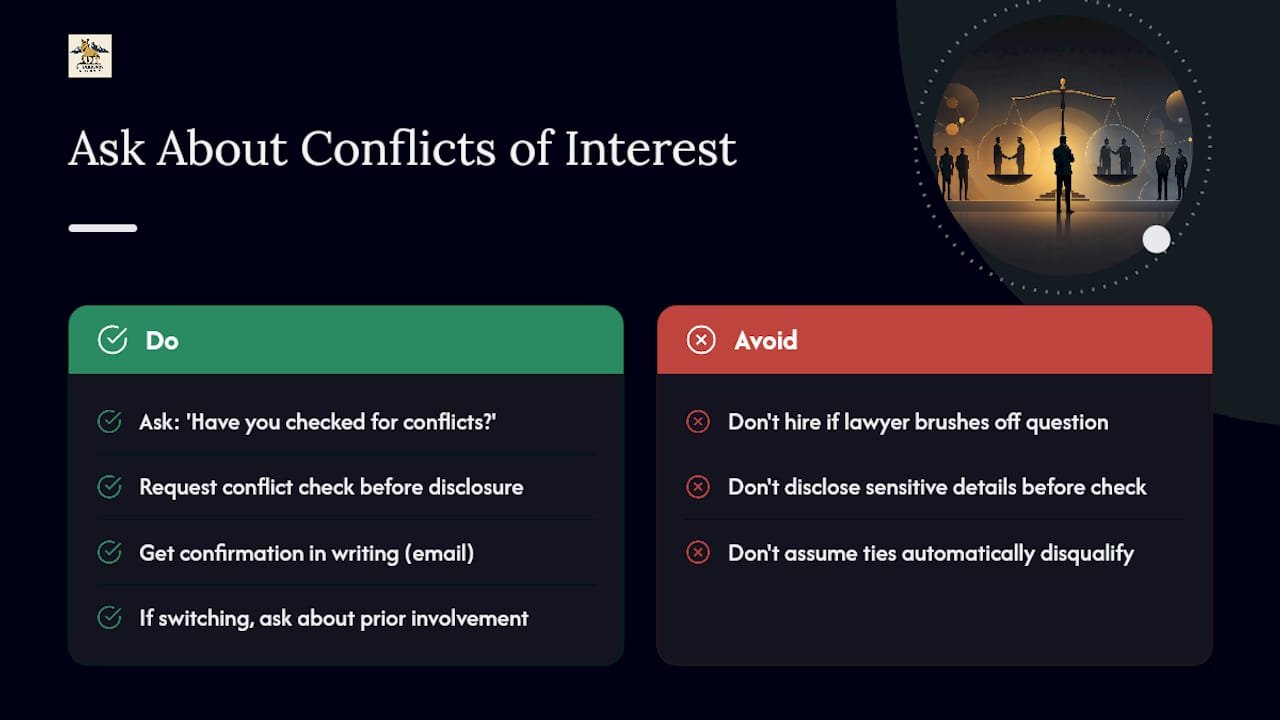
A conflict of interest arises when a lawyer’s other clients, past relationships, or financial interests could compromise their ability to represent you fully. This isn’t a bureaucratic footnote. It’s a core ethical obligation attorneys carry into every new case.
Ask plainly: “Have you checked for conflicts of interest with my case?” A responsible attorney runs this check before the consultation goes deep, often even before scheduling the meeting, especially if the opposing party or company is one they’ve represented before.
The Illinois State Bar Association specifically recommends asking about conflict checks during the intake process, before you disclose sensitive details. If a lawyer brushes off the question or seems unsure whether they’ve represented the other party, treat that as a reason to pause.
Conflicts can be subtle. A firm might have represented the insurance company defending your claim on an unrelated matter last year. That relationship doesn’t automatically disqualify them, but it needs to be disclosed and addressed, often through what’s called an ethical wall or informed written consent from both parties.
If you’re switching attorneys mid case, this question matters even more. Ask your new lawyer directly whether they’ve reviewed the case for any prior involvement with the opposing party, witnesses, or even the insurance adjuster assigned to your file. Getting this answer in writing, even a short email confirmation, protects you if a conflict surfaces later and threatens to derail your case at a critical stage.
How the Lawyer Handles Disagreement and Client Collaboration
Every case eventually hits a moment of disagreement, whether it’s over accepting a settlement offer, pursuing a costly discovery request, or deciding whether to go to trial. How a lawyer handles that friction tells you a lot about what working with them will actually feel like.

Ask: “If we disagree about strategy, how do we work through that?” A collaborative attorney explains their reasoning, walks you through the tradeoffs, and ultimately respects that major decisions, like accepting or rejecting a settlement, belong to you, not them. That’s not just good practice. In most jurisdictions, the client retains final authority over settlement decisions regardless of what the attorney recommends.
Watch for lawyers who dismiss questions or push back defensively when you ask them to explain their reasoning twice. You’re not being difficult by asking for clarity. You’re the one whose case outcome and, often, whose money is on the line.
A useful follow-up question, drawn from practical client advice rather than any bar guideline: “If you were in my position, what would you do, and why?” This forces the lawyer to apply their experience to your actual risk tolerance and financial situation instead of giving a generic answer. Their response reveals whether they’ve been listening to your priorities or just running through a standard script. Pay attention to whether they ask about your goals before offering an opinion. That order matters more than people realize.
Ending the Relationship if It’s Not Working
Hiring a lawyer isn’t a permanent commitment. If the relationship isn’t working, whether due to poor communication, a strategy you disagree with, or a simple loss of trust, you generally have the right to terminate and hire someone else.
Ask upfront: “What’s the process if I want to end our working relationship?” A transparent attorney explains this without defensiveness. In contingency-fee arrangements, this often involves a lien for work already performed, meaning your new attorney’s firm may need to negotiate with the old one over how fees get divided once your case resolves. Ask specifically how that would be handled in your case type.
Get the termination process in writing as part of your engagement agreement, not as an afterthought. It should spell out how outstanding costs get settled, how your file gets transferred, and what timeline applies. Reasonable attorneys build this into the fee agreement without you having to push for it.
If you’re currently unhappy with representation and considering a switch, don’t wait until a deadline is imminent. Filing deadlines don’t pause while you sort out a change in counsel, and a rushed transition under time pressure benefits no one, least of all you.
Confidentiality and What Attorney-Client Privilege Actually Protects
Attorney-client privilege means what you tell your lawyer in confidence, for the purpose of getting legal advice, generally can’t be disclosed to third parties or used against you, with narrow exceptions like ongoing or future crimes. This protection starts the moment you begin a consultation aimed at hiring the attorney, even if you never formally sign an engagement letter.
Ask: “Is what I tell you today protected even if I don’t hire you?” Most jurisdictions extend privilege to prospective client communications made in good faith during a consultation. That protection is precisely why it’s safe to be candid about weaknesses in your case, prior incidents, or details that feel embarrassing. Your lawyer needs the full picture to build an accurate strategy, and privilege exists so you can give them that without fear it becomes public.
Confidentiality is broader than privilege. It covers the general duty lawyers owe clients to keep case information private, separate from the narrower evidentiary rule that governs what’s protected in court. Ask how the firm handles sensitive documents, whether they use a secure client portal, and who internally has access to your file. If your case involves particularly sensitive material, like medical records or financial disclosures, it’s reasonable to ask about specific safeguards.
Does This Lawyer Understand Cases Like Yours?
General practice knowledge doesn’t always translate across case types. A lawyer who’s spent years on contract disputes may not know the specific tactics insurance adjusters use in motorcycle accident claims, or how liability gets apportioned differently for pedestrian accidents versus rear-end collisions.
Ask: “Have you handled cases involving clients or situations similar to mine specifically, not just personal injury broadly?” Practical guides on hiring an attorney point out that a reusable, case-type-specific checklist helps you quickly gauge whether a lawyer’s actual experience lines up with your situation, since different practice areas hinge on very different facts and documentation.
For example, a semi-truck accident claim often involves federal trucking regulations and multiple potentially liable parties, the driver, the trucking company, sometimes a cargo loader, that a standard car accident claim doesn’t. A slip-and-fall case hinges on premises liability standards that differ meaningfully from a rear-end collision claim. If your case involves a specific industry, construction, rideshare, medical malpractice, ask the attorney directly what related matters they’ve handled and what made those cases different from a routine claim.
What Happens When Your Case Takes an Unexpected Turn
Cases rarely go exactly as planned. Insurance companies delay. Opposing counsel files unexpected motions. New evidence surfaces that changes the calculus entirely. How a lawyer handles these curveballs, and whether it costs you more, matters as much as their opening pitch.
Ask directly: “If something unexpected comes up, like new costs or a delay, how will you let me know, and who decides what happens next?” A trustworthy attorney commits to notifying you before costs increase meaningfully, not after the bill arrives. They should also explain whether major strategic pivots, like switching from settlement talks to filing suit, require your sign-off or happen automatically as part of their process.
Ask specifically about costs that might not be obvious upfront: expert witness fees, deposition costs, or the expense of additional investigation if the case gets more complicated than expected. Whether those costs come out of your eventual recovery or get billed separately as they occur should be spelled out, not discovered later. A firm that’s upfront about “this could add $2,000 to $5,000 in expert costs if we go this route, and here’s why” is treating you like a partner in the decision rather than a passenger.
What I Ask Every Client and Why It Matters
When someone sits down with me for a first consultation, I’m listening for three things: how solid the evidence is, what deadlines we’re racing against, and what this person actually needs to move forward with their life. Experience tells you which questions to ask, but it also tells you which answers to trust. I’d rather tell a client their case has real weaknesses on day one than let them find out the hard way six months in.
One thing I recommend to nearly every personal injury client early on: get your medical treatment documented consistently, even if you feel like you’re recovering fine. Gaps in treatment records are one of the most common things insurance adjusters use to undercut a claim’s value, and it’s almost always avoidable with the right guidance from the start.
If You’re Ready to Talk to Someone, Here’s What Happens Next
Stubbornattorney offers a free consultation for personal injury cases, and we work on contingency, meaning you owe nothing unless we recover money for you. That structure removes the financial risk of just picking up the phone to find out where you stand.
Before you call, jot down a short timeline of what happened, gather any medical records or accident reports you already have, and write down your top questions. During the consult, we’ll walk through your case’s strengths and weaknesses honestly, explain realistic outcome ranges, and tell you exactly who on our team will handle your file day to day.
If you’ve been hurt in a car accident, a fall, or another incident in Colorado, schedule your free case review and get straight answers instead of guesswork about your options.
Where to Verify These Answers Yourself
- American Bar Association: is a lawyer right for you? — statute-of-limitations and red-flag guidance.
- Consumer — consultation prep and fee-transparency tips.
- State Bar of California: selecting an attorney — document checklist for consults.
- Stubbornattorney: personal injury services — free case review for Colorado claims.
This article is general information, not a substitute for advice from a qualified lawyer. Consult a qualified legal professional about your own circumstances before acting on anything here.
Sources
A lawyer confident in their track record won’t flinch when you ask for proof. That doesn’t mean they’ll hand over a client’s phone number, confidentiality often prevents that, but they should be able to describe anonymized examples of past cases and outcomes in enough detail that you can judge their competence.
Ask: “Can you share examples of past results for cases like mine, even without client names?” A strong answer includes specifics: case type, general outcome range, and what made the case challenging. A weak answer stays vague, “we’ve had lots of successful cases,” without any texture.
Client testimonials are useful but limited. Reviews on Google or a firm’s website tell you about client experience and communication style, but they rarely reveal legal strategy or case outcomes in detail. Ask if the firm can walk you through a comparable case’s arc: how it started, what obstacles came up, and how it resolved. That narrative tells you more than a five-star review ever will.
If the firm can’t or won’t discuss any past results, even in general terms, that’s worth noting. Confidentiality explains some limits, but total silence on track record usually means there isn’t much of one to share.
- How do I know if a lawyer is right for me? — American Bar Association
- Consumer
- How do I find a lawyer? — American Bar Association
- What questions should I ask my lawyer? — LegalClarity
- Before selecting an attorney — State Bar of California
FAQ
What’s the single most important question to ask a lawyer?
Ask about the statute of limitations for your specific matter first. Missing a filing deadline can bar your claim entirely, regardless of how strong the underlying case is.
Should I bring documents to the first consultation?
Yes. Bring medical records, bills, contracts, photos, and a written timeline of events so the attorney can evaluate your case efficiently during a limited meeting.
Is it normal for a first consultation to be free?
Many personal injury firms, including Stubbornattorney, offer free initial consultations and work on contingency, so you pay nothing unless you recover compensation.
What if a lawyer guarantees I’ll win my case?
Treat that as a warning sign. No ethical attorney can guarantee a specific outcome, and a reputable one will explain realistic best, worst, and likely case scenarios instead.
How do I know if there’s a conflict of interest?
Ask directly whether the lawyer has checked for conflicts with your case before you share sensitive details. A responsible attorney runs this check early and discloses any prior involvement with the opposing party.