

You Can Appeal an Insurance Denial: What to Do First
Yes, you can appeal a denied health insurance claim, and most people have far more leverage than the denial letter implies. The path runs in two stages: file an internal appeal with your insurer first, then move to an external review by an independent third party if the plan still says no. If care is urgent, you can request expedited handling at either stage and get an answer in as little as 72 hours instead of waiting weeks.
Before anything else, do this in the next 24 to 72 hours:
- Save the denial notice and Explanation of Benefits (EOB). Do not discard either one.
- Write down the claim number, denial reason code, and the appeal deadline printed on the letter.
- Call your insurer’s member services line and confirm the appeal address, fax number, and whether they received any prior documentation.
- If a doctor believes delay would harm your health, ask them to state that in writing and mark every submission “Expedited appeal” or “Urgent request.”
Pro Tip: Insurers won’t fast-track a request just because you write “urgent” on the envelope. You need a provider statement confirming that standard timelines would jeopardize your life or your ability to regain function, and it needs to sit on the first page of your packet.
Table of Contents
- How to File an Internal Appeal Step by Step
- When Can You Request an External Review?
- Timelines and Deadlines You Cannot Afford to Miss
- What Evidence Actually Moves the Needle on an Appeal
- When to Bring in Outside Help
- Why Was Your Claim Denied in the First Place?
- How to Write an Appeal Letter That Gets Read
- How to Talk to Adjusters Without Hurting Your Case
- What Happens If the Insurer Denies Your Appeal Again
- What Winning an Appeal Actually Changes
- Persistence Beats a Perfect First Draft
- How Stubbornattorney Handles Denied Insurance Claims
- Sources
- FAQ
How to File an Internal Appeal Step by Step
The denial letter itself is the roadmap. Federal rules require insurers to spell out the specific reason for denial, the deadline to appeal (commonly up to 180 days from the date you received the notice), and where to send your request. Read that section twice before you do anything else, because missing the address or the format the insurer wants can add weeks to your timeline.
- Confirm the deadline and method. Some insurers require their own appeal form; others accept a written letter as long as it includes your claim ID, dates of service, policy number, and a clear statement of what you want reversed.
- Request a provider letter. Ask the treating physician to address the exact denial reason: if the insurer claims a treatment wasn’t “medically necessary,” the letter should explain the diagnosis, why the treatment was chosen, what was tried first, and cite clinical guidelines if relevant.
- Assemble supporting records. Gather test results, prior-authorization approvals, and any billing documentation that contradicts the insurer’s stated reason.
- Submit through a traceable channel. Use certified mail, the insurer’s appeal portal, or fax with a confirmation page. Never rely on a phone call alone to file an appeal.
- Log every contact. Keep a simple running record: date, time, representative’s name, and what was said. You will need this if the insurer claims it never received something.
Once submitted, insurers typically confirm receipt and may request additional records before issuing a decision. If you haven’t heard back within the timeframe on your denial letter, call and ask for a case status by claim number, not just your name.
When Can You Request an External Review?
External review becomes available once the insurer issues a “final adverse benefit determination,” meaning you’ve exhausted the internal appeal levels your plan requires. At that point, you’re no longer negotiating with the company that denied you. An independent reviewer takes over, and that reviewer’s decision is binding on the insurer under the HHS-administered federal external review process.
Whether you use a state process or the federal one depends on where you live. Some states run their own certified external review programs; where a state hasn’t set one up, or the plan is federally regulated (self-funded employer plans, for example), the request routes through the federal system administered by MAXIMUS on behalf of HHS.
Practical filing points:
- The federal request window is commonly several months from the date you receive the final internal denial.
- A standard external review decision is due within 45 days; an expedited one, when medical urgency is documented, comes back within 72 hours.
- MAXIMUS must secure your insurer’s claim file within five business days of accepting the case, so submit a complete, well-organized packet from the start rather than trickling in documents later.
- Include a short summary letter stating what was denied and why you disagree, your complete medical records, and a copy of the insurer’s final determination letter.
Timelines and Deadlines You Cannot Afford to Miss
Every stage of an appeal runs on a clock, and missing one can end your case regardless of how strong the medical evidence is. The table below reflects the standard federal windows; always double-check your denial letter, since some state-regulated plans set shorter or longer deadlines.
| Stage | Standard timeline | Expedited timeline |
|---|---|---|
| File internal appeal | Up to 180 days from denial notice | Same, but request expedited review immediately |
| Insurer decision on internal appeal | Commonly several months | 72 hours |
| File external review request | Commonly 4 months from final internal denial | Same window, marked urgent |
| External review decision (IRO/MAXIMUS) | 45 days | 72 hours |
To trigger expedited handling at any stage, you need a treating provider’s written statement confirming that the standard timeline would jeopardize your life, health, or ability to regain maximum function. Label the cover page “Expedited Internal Appeal” or “Expedited External Review” so it doesn’t get processed on the standard track by mistake. Always cross-check these windows against your own denial letter, since plan-specific and state variations exist.
What Evidence Actually Moves the Needle on an Appeal
Reviewers see hundreds of appeals. The ones that succeed usually share the same core documents, assembled in a way that makes the reviewer’s job easy rather than making them dig.
- The denial notice and EOB. These establish exactly what was denied and why, in the insurer’s own words.
- Itemized billing and prior authorizations. These show what was actually provided and whether it was pre-approved.
- Complete medical records and test results. Request these directly from your provider’s records department; our step-by-step guide to requesting medical records walks through exactly how to do this without delay.
- A provider letter targeting the specific denial reason. A vague “this patient needs treatment” letter rarely moves a reviewer. A letter that names the diagnosis, explains why the requested treatment fits the clinical picture, states what was tried first, and references relevant clinical guidelines does the work.
- A short cover letter and annotated evidence list. State plainly what you want the insurer or reviewer to do, and list what’s attached and why.
Pro Tip: Number every page of your packet and reference those numbers in your cover letter (“see Exhibit 3, page 2”). Reviewers move faster through organized packets, and speed matters when a decision clock is running.
When to Bring in Outside Help
Not every denial needs a lawyer. A coding error a provider can fix with one phone call doesn’t. But some situations call for more firepower than a well-written letter.
- State insurance departments and consumer assistance programs can help you understand your rights, confirm whether your state runs its own external review process, and file a formal complaint against an insurer that isn’t following the rules.
- Contact an attorney if you’re facing repeated denials despite strong medical evidence, a large unpaid claim, urgent care on the line, or signs the insurer is acting in bad faith.
- A lawyer’s role typically includes packaging the appeal, communicating directly with the insurer’s legal or claims department, and preparing for external review or litigation, often on a contingency-fee basis so you owe nothing upfront.
Insurance companies evaluate claims the same way regardless of who’s asking. Having spent years on the other side of that process as a federal claims adjudicator, I’ve seen how a well-documented, correctly timed appeal changes the outcome far more often than people expect.
Why Was Your Claim Denied in the First Place?
Knowing the denial reason shapes the entire appeal strategy, and insurers are required to state it. Common categories include:
- Administrative or coding errors. A mismatched diagnosis code, an expired authorization number, or a typo in the claim can trigger an automatic denial that has nothing to do with medical necessity.
- “Not medically necessary” determinations. The insurer’s reviewer decided the treatment didn’t meet its internal criteria, even if your doctor disagrees.
- Out-of-network services. The provider or facility fell outside your plan’s network, sometimes without your knowledge at the time of treatment.
- Missing prior authorization. The service required pre-approval that either wasn’t requested or wasn’t properly documented.
- Experimental or investigational treatment classification. The insurer categorizes the treatment as unproven, even when clinical guidelines support it.
- Policy exclusions or lapsed coverage. The claim falls under an exclusion, or coverage had lapsed at the time of service.
Consumer guidance from the NAIC notes that many denials are simple billing or coding mistakes a quick call to the provider’s billing department can resolve, no formal appeal required. Others, particularly medical necessity denials, require the documented clinical case an internal appeal is built for. Our breakdown of why insurance denies claims covers these categories in more depth if you want to match your specific denial code to the right response.
How to Write an Appeal Letter That Gets Read
A good appeal letter is short, specific, and unemotional. Reviewers process high volumes of these; a letter that rambles or leads with frustration gets skimmed, not studied.
Structure it in four parts. Open with the facts: your name, policy number, claim number, date of service, and the exact denial reason as stated in the letter. Second, state your position in one or two sentences: what you’re asking the insurer to reverse and why. Third, walk through the evidence that supports your position, referencing attached documents by name (“see attached letter from Dr. Ramirez dated March 3, 2026”). Fourth, close with a clear, specific request: full coverage of the claim, partial reconsideration, or whatever outcome you’re seeking.
Keep the tone factual, not adversarial. Avoid phrases like “this is outrageous” or “you clearly don’t care about patients.” Reviewers respond to clinical and contractual arguments, not emotional appeals. Write as though you’re presenting evidence to someone who has never met you and only has the paper in front of them, because that’s usually exactly the situation.
One structural habit separates strong letters from weak ones: address the insurer’s stated denial reason directly, point by point, rather than making a general case for why you need the treatment. If they denied for “lack of medical necessity,” your letter needs the word “necessity” answered head-on, ideally in the attached provider letter’s own language.
How to Talk to Adjusters Without Hurting Your Case
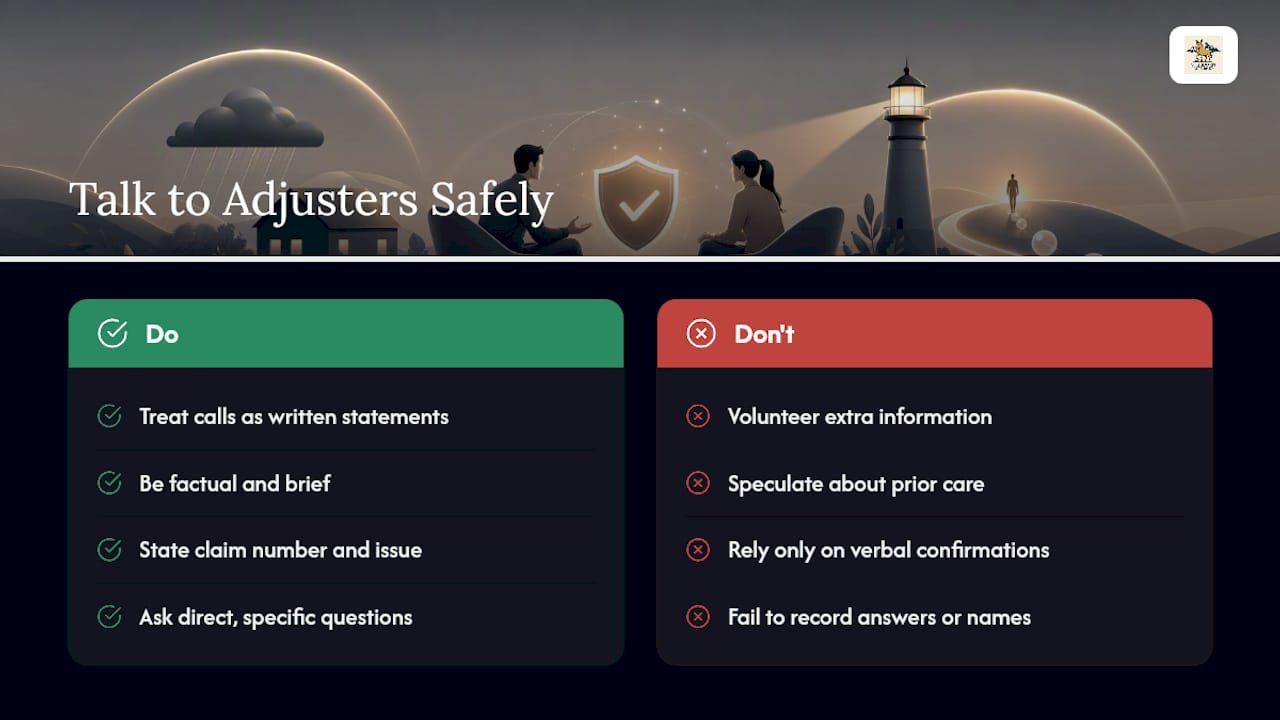
Every conversation with an adjuster becomes part of your file, whether or not you realize it. Treat phone calls the same way you’d treat a written statement.
Stay factual and brief. State your claim number and the specific issue before launching into an explanation. Ask direct questions: “What specific documentation would change this determination?” or “Can you confirm the deadline for my external review request?” Write down the answer along with the date and the representative’s name.
Avoid volunteering information beyond what’s asked. Adjusters aren’t adversaries by design, but their job includes controlling costs, and casual comments (“I guess I could have tried physical therapy first”) can end up in claim notes and used against you later.
Follow up every substantive call with a short email or letter summarizing what was discussed: “Per our call on [date], you confirmed the appeal deadline is [date] and that additional records should be sent to [address].” This creates a written record the insurer can’t later dispute and often prompts them to correct any misunderstanding in writing.
If an adjuster becomes difficult to reach or gives inconsistent answers across calls, that pattern itself is worth documenting. It becomes relevant if you later need to escalate to a state insurance department or an attorney.
What Happens If the Insurer Denies Your Appeal Again
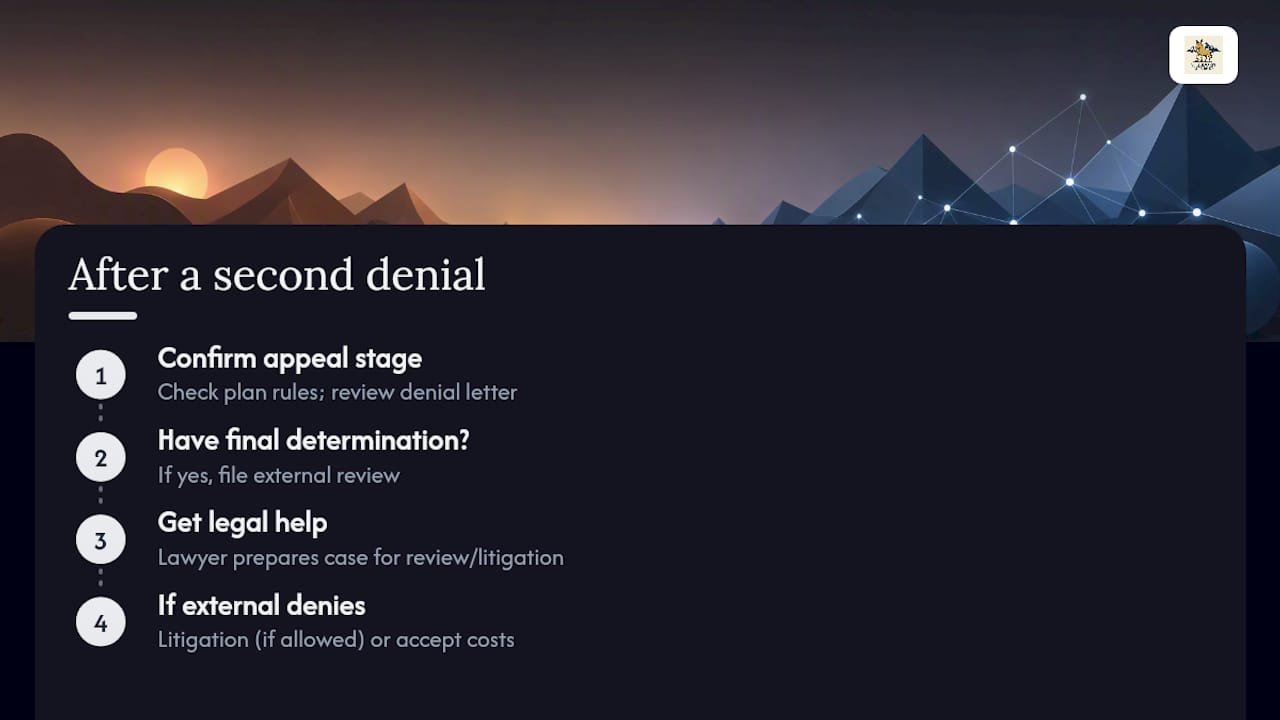
A second denial isn’t the end of the process, and reacting with the same letter won’t change the outcome. First, confirm exactly what stage you’re at: many plans only require one internal appeal level before you’re eligible for external review, while others (particularly some employer self-funded plans) allow a second internal level first. Check your denial letter for the phrase “final adverse benefit determination,” which signals you’ve reached the point where external review becomes available.
Once you have that final determination, move directly to external review rather than repeating the same internal argument a second time. This is also the point where legal representation tends to add the most value, since packaging a case for an independent reviewer or for litigation requires a different set of skills than writing a persuasive letter. If the external reviewer also upholds the denial, your realistic options narrow to litigation (where state law allows) or accepting the financial responsibility, which is exactly why getting the appeal right the first time matters so much.
Our guide on why accident claims get denied covers parallel scenarios in the personal injury context, where a second denial often signals it’s time to bring in counsel rather than resubmit the same paperwork.
What Winning an Appeal Actually Changes
A successful appeal isn’t just a paperwork victory. It directly changes what you owe. If the insurer reverses a denial, the claim gets reprocessed under your normal coverage terms, meaning your out-of-pocket exposure drops from the full billed amount (often thousands of dollars for a single procedure) down to your plan’s copay, coinsurance, or deductible responsibility.
There’s a compounding effect too: successful appeals sometimes prompt insurers to reprocess related claims from the same episode of care without a separate fight, particularly when the reversal hinges on a coverage determination rather than a one-off coding issue. On the flip side, an unsuccessful appeal at both the internal and external stages typically means the full bill becomes your responsibility, which is often when patients start negotiating payment plans directly with providers or hospital billing departments.
The stakes go beyond the immediate bill. A pattern of denials for the same diagnosis or treatment type can affect future authorization requests, which is one more reason a well-documented first appeal is worth the time it takes to do right.
Persistence Beats a Perfect First Draft
Insurance denials aren’t usually final answers. They’re often opening positions, shaped by internal review criteria that don’t always reflect the full clinical picture. Having spent years evaluating claims from inside a federal agency before advocating for people on the other side of that table, I’ve watched the same pattern repeat: claims that get reversed almost always share a documented, specific rebuttal to the exact denial reason, not a general complaint that the decision feels unfair.
The mule standard we build our practice around, steady under pressure, sure-footed on rough terrain, and stubborn once committed, applies just as much to insurance appeals as it does to litigation. Insurers are betting that most people give up after the first no. Don’t be most people.
How Stubbornattorney Handles Denied Insurance Claims
If you’d rather not manage deadlines, provider letters, and adjuster calls yourself, Stubbornattorney takes that entire process off your plate on a contingency-fee basis, meaning you owe nothing unless we recover money for you. We review your denial, draft and file the internal appeal, prepare the external review packet if it comes to that, and handle every conversation with the insurer directly, including litigation if the claim warrants it.
Self-help works fine for straightforward coding errors or a single missing document. It gets harder when you’re facing a large unpaid claim, a pattern of denials, or care you can’t afford to wait on. Before a consultation, have your denial letter, EOB, and any provider notes ready. Start with a free case evaluation on our personal injury services page and let us build the appeal while you focus on getting better.
This article is general information, not a substitute for advice from a qualified financial advisor. Consult a qualified financial professional about your own circumstances before acting on anything here.
Sources
- Appealing a health plan decision (CMS fact sheet)
- Healthcare
- Health insurance claim denied? How to appeal the denial (NAIC consumer insight)
FAQ
How Long Do I Have to Appeal a Denied Insurance Claim?
Most plans give you up to 180 days from the date you receive the denial notice to file an internal appeal, though your specific plan document sets the exact deadline.
What’s the Difference Between Internal Appeal and External Review?
An internal appeal asks your own insurer to reconsider the denial, while external review sends the case to an independent reviewer (an IRO or the federal MAXIMUS process) whose decision is binding on the insurer.
How Fast Can an Expedited Appeal Be Decided?
Expedited internal appeals and expedited external reviews can both be decided within 72 hours when a provider certifies that delay would jeopardize your life or ability to regain function.
Can Someone Else File an Appeal for Me?
Yes, you can designate an authorized representative, including a family member, provider, or attorney, to file and manage the appeal on your behalf; most insurers require a signed authorization form for this.
Do I Need a Lawyer to Appeal an Insurance Denial?
Not always. Many appeals succeed with a well-documented letter and provider support, but a lawyer becomes valuable when you face repeated denials, large unpaid bills, or urgent care at stake, and firms like Stubbornattorney handle these cases on contingency so there’s no upfront cost.