

10 Traits of Trusted Attorneys You Can Actually Verify
The most trusted attorneys share ten identifiable traits: clear communication, honesty about outcomes, real competence in the relevant practice area, responsiveness, confidentiality, genuine empathy, attention to detail, transparent fees, a clean disciplinary record, and a habit of continuing legal education. None of these are personality guesses. Each one shows up in observable behavior, paperwork, and how an attorney answers your questions during the first call.
- Clear communication — explains your options in plain language, not jargon.
- Honesty and ethics — never promises a specific result before reviewing your case.
- Competence — has handled cases like yours, not just cases near yours.
- Responsiveness — returns calls within a business day or two.
- Confidentiality — treats your case details as privileged, always.
- Empathy — listens before advising.
- Attention to detail — catches deadlines and paperwork errors before they cost you.
- Transparent fees — puts the fee structure in writing, upfront.
- Clean reputation — verifiable through your state bar and disciplinary records.
- Ongoing learning — stays current on changes in the law that affect your claim.
Every one of these traits ties back to a standard the American Bar Association and state bar associations expect of practicing attorneys. A firm like Stubbornattorney builds its process around exactly these checkpoints. Keep reading for the concrete signals that separate a trustworthy attorney from one who just sounds confident.
Table of Contents
- Traits Of Trusted Attorneys: What Each One Looks Like In Practice
- How To Verify These Traits Before You Sign Anything
- Red Flags That Undermine Trust
- A Practitioner Snapshot: How These Traits Play Out In A Real Case
- Emotional Intelligence And Interpersonal Skills
- Trustworthiness Shown Through Past Client Outcomes
- Honest Talk About Legal Risk And Case Strength
- How To Recognize A Good Lawyer In Practice
- Why We Built Our Practice Around These Traits
- Where To Verify Attorney Credentials Yourself
- Get A Straight Answer About Your Case
- Sources
- FAQ
Traits Of Trusted Attorneys: What Each One Looks Like In Practice
Knowing the list is one thing. Spotting these traits in a 20-minute consultation is another. Here’s what each trait actually looks like when you’re sitting across from (or on the phone with) a real attorney.
Clear, two-way communication
A trustworthy attorney listens before they talk. Iowa’s Chief Justice Susan Christensen has pointed to active listening, promptness, and thoroughness as the practical markers of a lawyer judges and clients both trust, and that pattern holds outside the courtroom too. Watch for these signals:
- They ask follow-up questions instead of jumping straight to advice.
- They summarize what you told them before responding.
- They explain legal terms without being asked.
- They set a clear expectation for when they’ll follow up.
Pro Tip: During your first call, mention one small, seemingly irrelevant detail about your accident or situation. A lawyer who circles back to that detail later in the conversation, or in a follow-up email, is actually listening. One who never mentions it again probably wasn’t.
Honesty and professional ethics
No attorney can guarantee a specific settlement number or trial outcome, and any attorney who does is telling you what you want to hear, not the truth. Best Lawyers flags outcome guarantees as one of the clearest signs to walk away. Honest attorneys talk in ranges and probabilities, and they’ll tell you the weak points in your case as readily as the strong ones.
Competence: knowledge, experience, and judgment
Competence isn’t a law degree. It’s whether this specific attorney has handled cases like yours recently. Ask directly: how many cases similar to mine have you resolved in the past two years? A confident, specific answer beats a vague “many years of experience” every time.
Responsiveness and reliability
Attorneys who attract steady referrals share a habit: they return calls, hit deadlines, and file accurate paperwork. That reliability compounds. One late filing can jeopardize an entire claim, so responsiveness isn’t a courtesy, it’s operational risk management.
Confidentiality
Attorney-client privilege is a legal obligation, not a courtesy. A trustworthy attorney never discusses your case details with anyone outside the legal team without your permission, and they’ll say so plainly if you ask.
Practical empathy and client focus
Empathy shows up in small choices: slowing down to explain a form, checking in after a hard doctor’s appointment, adjusting a call time around your work schedule. It should never come at the cost of straight talk. The strongest attorneys pair warmth with candor, not one instead of the other, as our client-focused approach after a car accident piece lays out in more detail.
Attention to detail and organization
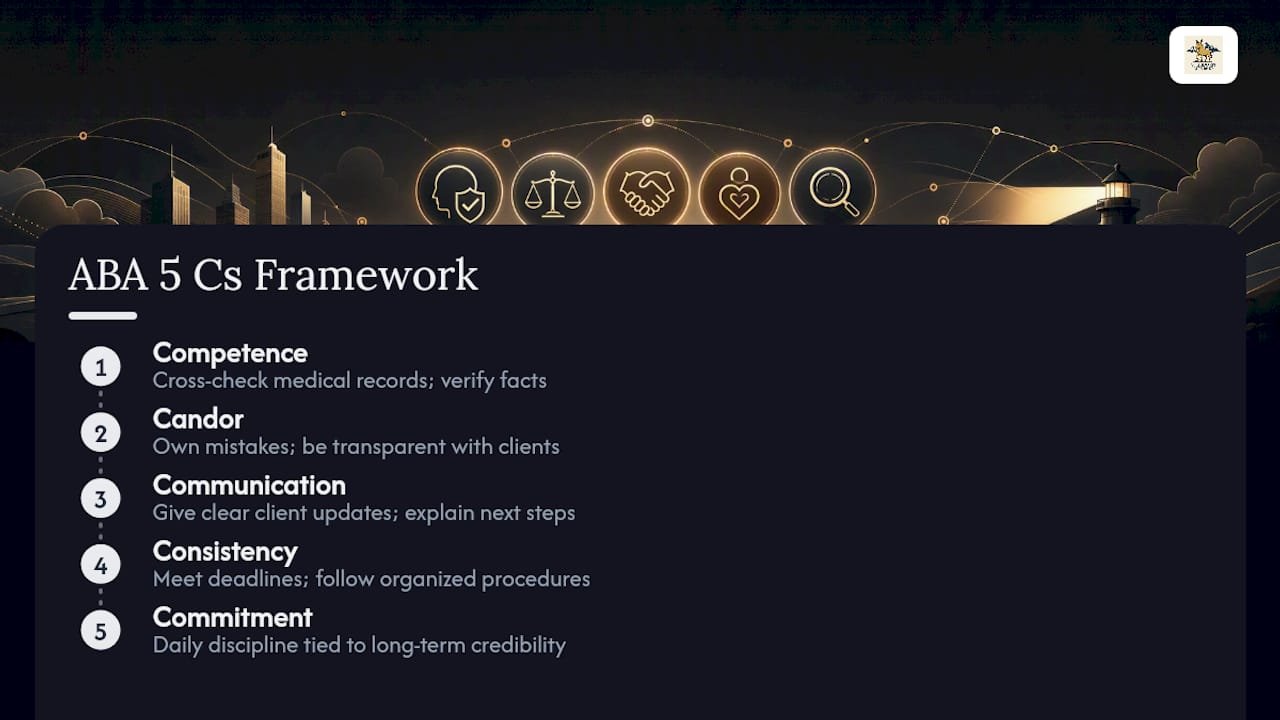
Credibility gets built in the unglamorous work: tracking deadlines, cross-checking medical records, catching a discrepancy in a police report. The ABA’s 5 Cs framework ties this daily discipline directly to long-term credibility, not just isolated wins.
Transparent fees and billing clarity
Get the fee structure in writing before you sign anything, whether it’s hourly, flat fee, or contingency. This isn’t just good practice, it’s an ethical baseline the profession expects.
Reputation: bar membership and disciplinary record
Every attorney should have a clean, verifiable standing with their state bar. If they hesitate when you ask about their bar number or won’t tell you which state they’re licensed in, that hesitation tells you something.
Commitment to continuing legal education
Laws change. Insurance company tactics change. An attorney who hasn’t updated their approach in a decade is litigating yesterday’s rules against today’s adjusters.
The trust equation breaks down to four factors: credibility, reliability, intimacy, and low self-orientation. The lower an attorney’s self-orientation, meaning the less the conversation centers on their own ego or fees, the higher the trust score in practice.
How To Verify These Traits Before You Sign Anything
Trust but verify. Here’s the order to do it in:
- Call the office and time the response. A callback within one business day is reasonable; three or more days is a warning sign.
- Ask for a written fee agreement before your first paid meeting. Refusal or vagueness here is disqualifying.
- Check your state bar’s attorney lookup tool for licensing status and any disciplinary history.
- Ask for two or three references from past clients with similar cases, and actually call them.
- Request a sample retainer agreement and read the fine print on how expenses are handled.
- Cross-check peer-review listings like Best Lawyers alongside, never instead of, the state bar check.
Keep notes from every conversation: dates, what was promised, who you spoke with. If you’re comparing multiple firms, our guide on choosing legal representation that wins walks through how to weigh those notes against each other.
- Response time: 1-2 business days is standard.
- Fee agreement: should arrive in writing, not verbally described.
- References: recent (within the last two years) and case-relevant.
Red Flags That Undermine Trust
Some behaviors disqualify an attorney outright. Guaranteed outcomes (“I’ll get you $50,000, guaranteed”) are the biggest one, since no ethical attorney promises a number before reviewing evidence. Others include:
- Evasive answers when you ask how fees work.
- Pressure to sign a retainer during the first call, before you’ve reviewed anything.
- Credentials you can’t verify through the state bar.
- No written agreement, just a handshake and a promise.
- Refusing to let you keep a copy of what you sign.
Pro Tip: If you sense pressure, say you need 24 hours to review the agreement. A trustworthy attorney will agree without pushback. One who insists you sign now is telling you the offer, and maybe the case, won’t hold up to scrutiny.
Note the difference between a red flag and a personality mismatch. An attorney who’s blunt about your case’s weaknesses isn’t being aggressive, they’re being honest. Assertive advocacy in a negotiation is not the same as unethical pressure in a sales pitch.
A Practitioner Snapshot: How These Traits Play Out In A Real Case
A trustworthy attorney doesn’t form a confident opinion about your case in the first five minutes. Comprehensive document review, medical records, police reports, prior correspondence with insurers, comes before any definitive assessment. That discipline is where the real trust gets built or lost.
Ryan Malnar has spent over a decade practicing personal injury law in Colorado, and before that, worked as a federal claims adjudicator, which means he’s seen these cases evaluated from the insurance side of the table too. That dual perspective shapes how a case gets assessed: realistically, with the strengths and weaknesses both on the table before a strategy gets set.
A lawyer who forms a confident case assessment within minutes of hearing one side of the story is skipping the work. The comprehensive review comes first. The opinion comes second.
Three lessons any reader can apply when interviewing attorneys:
- Ask what documents they’d need before giving even a preliminary opinion.
- Notice whether they explain the “why” behind their strategy, not just the “what.”
- Expect an honest range, not a number pulled from thin air.
Emotional Intelligence And Interpersonal Skills
Legal knowledge gets a case started. Emotional intelligence is what keeps a client informed, calm, and cooperative through months of paperwork, medical appointments, and insurance back-and-forth. An attorney with strong interpersonal skills reads the room, knows when you need a plain answer versus a detailed explanation, and adjusts accordingly.
This shows up most clearly under pressure. When an insurance adjuster lowballs an offer or a deadline gets tight, an emotionally intelligent attorney stays composed instead of reacting. That composure isn’t about being soft, it’s self-control that keeps negotiations productive rather than personal. Indeed’s breakdown of core lawyer qualities lists composure alongside persuasiveness for exactly this reason: the two work together, not against each other.
Interpersonal skill also means knowing how to talk to opposing counsel, court staff, and expert witnesses without burning bridges you’ll need later. An attorney who’s respected by the people on the other side of the table often gets better outcomes than one who’s merely feared. That’s not a soft skill footnote, it’s a functional part of how cases actually resolve.
Trustworthiness Shown Through Past Client Outcomes
Settlement history and client testimonials matter, but only when you can verify them. Ask a firm directly about outcomes in cases similar to yours, not just headline numbers from their best year. A firm with hundreds of resolved injury cases and real settlement history has patterns you can ask about: typical timelines, common obstacles, how they’ve handled difficult insurers.

Testimonials carry more weight when they describe process, not just payout. A client saying “they explained every step and called me back the same day” tells you more about trustworthiness than a dollar figure alone. Look for reviews on independent platforms, Google, Avvo, your state bar’s referral service, rather than only testimonials curated on a firm’s own site.
Be skeptical of testimonials that read like ad copy. Genuine client feedback usually mentions specifics: a particular delay, a specific staff member, a moment where the attorney pushed back on a lowball offer. Vague five-star praise with no detail is worth less than three-star feedback that explains exactly what went right and wrong.
Honest Talk About Legal Risk And Case Strength
A trustworthy attorney tells you what could go wrong before they tell you what could go right. That means walking through the actual weaknesses in your case: a gap in medical documentation, a comparative fault issue, a statute of limitations that’s closer than you think. Skipping this conversation to keep you optimistic isn’t kindness, it’s a setup for disappointment later.
Case strength assessments should come with reasoning, not just a verdict. Instead of “your case is strong,” expect something closer to “your case is strong on liability because the police report cites the other driver, but weaker on damages until we get your full medical records.” That specificity is the difference between a real assessment and a sales pitch.
Ask directly: what’s the biggest risk in my case? An attorney who answers immediately and specifically has already done the analysis. One who deflects or repeats generic reassurance hasn’t, or is choosing not to tell you.
How To Recognize A Good Lawyer In Practice
Recognizing a good lawyer comes down to matching what they say against what they do. Someone can talk convincingly about experience and dedication, but the pattern shows up in small, checkable actions: did they call back when they said they would, did the written fee agreement match what they described verbally, did they answer your hardest question directly instead of pivoting.
Watch how they handle a question they can’t answer immediately. A good lawyer says “let me check on that and get back to you by Thursday,” then actually does it. That follow-through, more than any single credential, predicts how the rest of your case will go.
Compare intake conversations across two or three firms if you have the time. The differences become obvious fast: one firm asks detailed questions about your accident and medical treatment, another rushes to talk about fees. Our guide on qualities to seek in a Colorado personal injury lawyer breaks down region-specific signals worth checking if you’re comparing local firms.
Why We Built Our Practice Around These Traits
I’ve watched enough insurance claims from both sides, first as a federal claims adjudicator, now as an attorney, to know that the traits on this list aren’t abstract virtues. They’re the difference between a client who feels informed through a difficult year and one who feels managed. Malnar Injury Law, now operating as Stubbornattorney, has resolved hundreds of injury cases and recovered millions in settlements by treating transparent fees and honest case assessments as non-negotiable, not optional extras.
When you sit down for an initial consultation with us, expect a written fee structure, a direct answer about your case’s real strengths and weaknesses, and verification of everything we tell you. That’s what choosing Stubbornattorney for your injury case actually means in practice.
Where To Verify Attorney Credentials Yourself
Don’t take any firm’s word for it, including ours. Check these sources directly:
- Your state bar’s attorney lookup confirms licensing status and any disciplinary history.
- The ABA’s 5 Cs framework explains the professional standards attorneys are held to.
- Best Lawyers offers peer-reviewed recognition, useful alongside, not instead of, bar verification.
- Practitioner guides like Attorney at Work explain how advocacy style separates effective lawyers from merely aggressive ones.
Get A Straight Answer About Your Case
Most firms make you guess whether your case is worth pursuing before you’ve even had a real conversation. Stubbornattorney runs on contingency, so there’s no fee unless we recover compensation for you, and that structure means our incentive lines up with yours from day one: get you the strongest result, honestly assessed, not the fastest signature. Ryan Malnar’s decade of experience, paired with years spent evaluating claims from the federal government’s side, means you get a case assessment grounded in how insurers actually think, not just how a firm hopes your case will look.
If you’ve been in a car, truck, motorcycle, or pedestrian accident anywhere in Colorado, start with a free case evaluation and ask us the same verification questions this article just walked you through. If you’re in the Pueblo area specifically, our Pueblo personal injury page has direct contact details for a free consultation. Bring your questions. A trustworthy attorney should welcome them.
This article is general information, not a substitute for advice from a qualified lawyer. Consult a qualified legal professional about your own circumstances before acting on anything here.
Sources
- How to Hire a Good Lawyer: 10 Potential Qualities to Look For – Best Lawyers
- Back to Basics: the 5 Cs – American Bar Association
- Five traits of great lawyers – Attorney at Work
- Lawyer qualities: top traits for an excellent legal professional – Indeed
FAQ
What personality traits make for a good lawyer?
The traits clients consistently value most are strong communication, honesty about outcomes, empathy, organization, and composure under pressure, alongside the technical competence to handle your specific type of case.
What is the 80/20 rule for lawyers?
Definitions of this rule vary across firms and practice areas, so there’s no single agreed-upon meaning worth stating as fact here. If you’ve heard this term from a specific attorney, ask them directly what they mean by it.
How do you recognize a good lawyer?
Look for consistency between what they promise and what they deliver: timely callbacks, a written fee agreement that matches what was discussed, and a case assessment that includes both strengths and weaknesses.
How do you know you can trust a lawyer?
Trust builds through verification, not instinct: confirm their state bar standing, request a written fee agreement, ask for references from similar cases, and notice whether they explain risk honestly rather than promising a specific outcome.
Should I choose the most aggressive-sounding attorney?
Not necessarily. Assertive, respectful advocacy tends to produce better results with judges and opposing counsel than attorneys who rely on visible aggression, which can undermine credibility rather than build it.