

Truck Accident Attorney in Colorado Springs: What to Know
A truck accident attorney in Colorado Springs is a personal injury lawyer who specializes in commercial vehicle collisions, federal trucking regulations, and the complex evidence requirements that separate these cases from standard car accidents. The formal industry term is “commercial vehicle personal injury attorney,” though most clients and courts use the two terms interchangeably. What sets this practice apart is not just legal skill. It is a working knowledge of Federal Motor Carrier Safety Administration rules, post-accident testing deadlines, and records that trucking companies are required by law to keep. Without that knowledge, critical evidence disappears before a claim is ever filed.
Truck accident cases in Colorado Springs involve multiple layers of liability. The driver, the motor carrier, the cargo loader, and even the vehicle manufacturer can each share fault. Ryan Malnar at Stubbornattorney, recognized for Top-Rated Legal Excellence in Colorado Springs and featured by KRDO and KKTV 11, has spent over a decade building cases that hold every responsible party accountable. The difference between a fair settlement and a denied claim often comes down to what your attorney does in the first 48 hours.
What critical federal regulations affect truck accident cases in Colorado Springs?
Federal trucking law governs every commercial vehicle on I-25 and Highway 24 in Colorado Springs. Two regulations in particular shape how attorneys build personal injury cases after a crash.

The 6-month records retention rule under 49 CFR 395.8
Motor carriers must retain Records of Duty Status and all supporting documents for at least 6 months after a crash. Supporting documents include toll receipts, fuel purchase records, dispatch logs, and electronic logging device data. This means a window exists to demand those records before the retention period expires and routine destruction begins. An attorney who knows this rule sends a preservation letter immediately, before the trucking company’s normal document cycle eliminates the evidence you need.
Hours of Service logs are particularly valuable. They show whether the driver was fatigued, whether the carrier pressured drivers to exceed legal driving limits, and whether the vehicle was on an authorized route. Courts treat these records as primary evidence of negligence when they reveal violations.
Post-accident drug and alcohol testing under 49 CFR 382.303
FMCSA post-accident testing must be completed within strict timelines: alcohol testing within 8 hours of the crash, drug testing within 32 hours. If either deadline passes without a completed test, the carrier must stop all testing attempts and document why the deadline was missed. Missing these windows is itself a regulatory violation, and that violation becomes evidence of non-compliance in your personal injury claim.
Practitioners confirm that missing the 8-hour alcohol testing window can harm a claim irreparably. If the carrier failed to test the driver on time, your attorney can argue that the company either did not follow federal law or deliberately avoided producing a positive result. Either argument strengthens your case significantly.
- Records of Duty Status (RODS): Must be retained for 6 months; show driving hours, rest periods, and route compliance
- Electronic Logging Device (ELD) data: Automatically records driving time and cannot be manually altered
- Post-accident alcohol test: Must occur within 8 hours or the attempt must stop with written documentation
- Post-accident drug test: Must occur within 32 hours under the same stop-and-document rule
- Supporting documents: Toll receipts, fuel logs, and dispatch records corroborate or contradict the official RODS
Pro Tip: Ask your attorney whether they have already sent a preservation letter to the trucking company. If they have not done this within the first few days of your case, the carrier’s routine document destruction schedule may already be running.
How do you preserve crucial evidence after a truck accident in Colorado Springs?
Evidence in a truck accident case is perishable in a way that evidence in a car accident is not. Trucking companies operate under federal retention schedules, and once those schedules expire, records are gone. Early evidence preservation is the first substantive legal step a truck accident lawyer takes, sometimes before a formal representation agreement is even signed.
Here is the sequence a qualified attorney follows immediately after a Colorado Springs truck crash:
- Send a spoliation letter to the motor carrier. This formal legal notice demands that the company preserve all records related to the crash, including ELD data, maintenance logs, driver qualification files, and dispatch communications. It creates legal liability if the company destroys records after receiving the letter.
- Request the official accident report from Colorado Springs Police or the El Paso County Sheriff. This report identifies the responding officers, witnesses, road conditions, and any citations issued at the scene.
- Obtain driver logs and Hours of Service records. These show whether the driver was within legal driving limits at the time of the crash. A driver who had been on the road for 14 consecutive hours before impact is a driver whose carrier may share direct liability.
- Collect toll records, fuel receipts, and GPS data. These corroborate or contradict the official route and timing recorded in the RODS. Discrepancies between GPS data and driver logs are among the most powerful forms of negligence evidence.
- Secure post-accident drug and alcohol testing documentation. If testing was completed, obtain the results. If it was not completed on time, obtain the documentation explaining why. Both outcomes are useful.
- Photograph and preserve physical evidence. Skid marks, vehicle damage, road conditions, and cargo placement all deteriorate or disappear quickly. A truck accident attorney coordinates with accident reconstructionists to document the scene before it changes.
“Client testimonials often mention the importance of attorneys who quickly secure all trucking company records before they disappear.” — Malnar Injury Law
The most common mistake victims make is waiting. They assume the police report is enough. It is not. The police report does not capture ELD data, driver qualification files, or the carrier’s internal safety audit history. Those records exist only within the trucking company’s systems, and they are only preserved if your attorney demands them fast.
Pro Tip: If you were in a crash involving a commercial truck, photograph the truck’s DOT number on the door before the vehicle is moved. That number identifies the carrier and allows your attorney to pull the company’s federal safety record within hours.
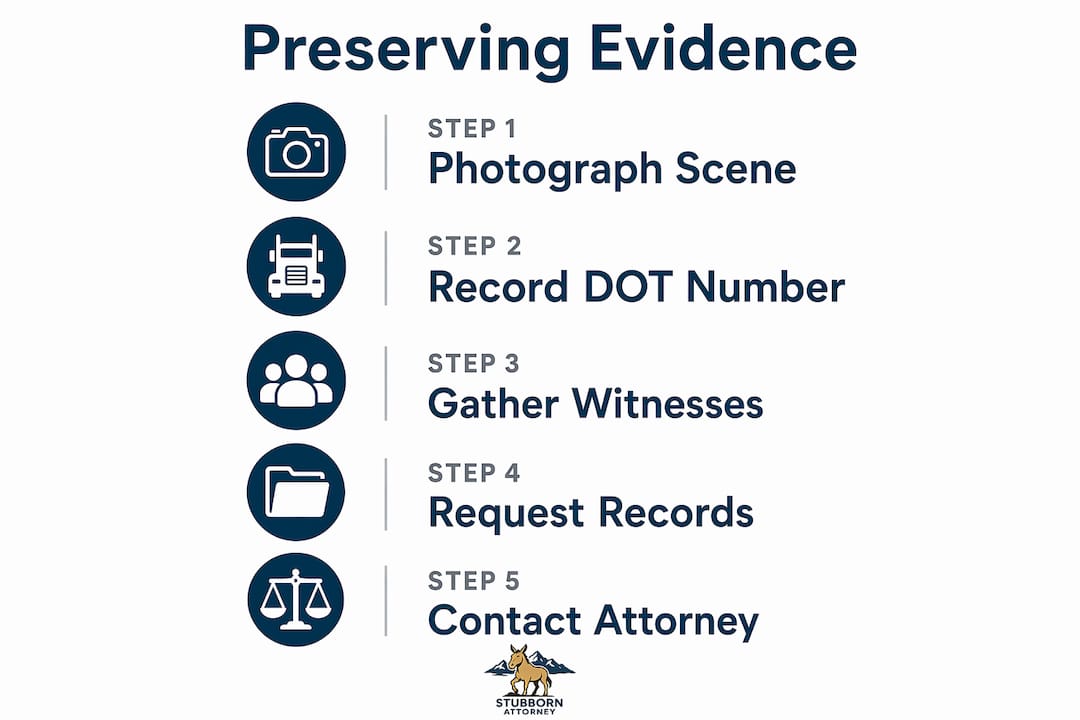
For a detailed breakdown of what evidence matters most after a Colorado Springs collision, the evidence you need guide at Stubbornattorney covers the full checklist.
What qualifications should you look for in a Colorado Springs truck accident attorney?
Not every personal injury attorney is equipped to handle commercial vehicle cases. The complexity of federal trucking regulations requires attorneys to engage accident reconstructionists, toxicology experts, and regulatory compliance specialists. A general practice attorney who handles the occasional fender-bender does not have those relationships or that knowledge base.
When evaluating a truck injury lawyer in Colorado Springs, look for these specific qualifications:
- Working knowledge of FMCSA regulations, including Hours of Service rules under 49 CFR 395.8 and post-accident testing requirements under 49 CFR 382.303
- Experience coordinating expert witnesses, including accident reconstructionists, trucking industry safety experts, and medical specialists who can quantify long-term injury costs
- A track record of settlements and verdicts in commercial vehicle cases, not just general personal injury outcomes
- Familiarity with Colorado’s comparative fault rules, which allow you to recover damages even if you were partially at fault, as long as your fault does not exceed 50%
- Willingness to go to trial, because insurance carriers for large trucking companies settle faster when they know your attorney will not back down
The table below compares what to expect from a general personal injury attorney versus a specialized commercial vehicle attorney in Colorado Springs:
| Qualification | General personal injury attorney | Commercial vehicle specialist |
|---|---|---|
| FMCSA regulation knowledge | Limited | Deep, case-specific |
| Evidence preservation letters | Rarely sent immediately | Sent within 24 to 48 hours |
| Expert witness network | General medical experts | Reconstructionists, toxicologists, trucking compliance specialists |
| Insurance negotiation leverage | Standard demand letters | Regulatory violation documentation |
| Trial readiness | Variable | Demonstrated in trucking cases |
Hiring a specialist truck accident lawyer increases your chances of a fair settlement because the attorney understands exactly which evidence the carrier’s insurer fears most. That knowledge shapes every demand letter and every deposition.
What compensation can a truck accident attorney help you obtain in Colorado Springs?
Average truck accident settlements range significantly, often between $100,000 and $500,000, depending on the severity of injuries and the strength of liability evidence. Cases involving catastrophic injuries, wrongful death, or clear federal regulation violations can exceed those figures substantially. The settlement range reflects how much more severe commercial vehicle crashes are compared to standard car accidents, given the weight and speed of fully loaded semi-trucks.
| Damage category | What it covers | How an attorney maximizes it |
|---|---|---|
| Medical expenses | Emergency care, surgery, rehabilitation, future treatment | Expert medical testimony on long-term costs |
| Lost wages | Income lost during recovery | Vocational experts who document earning capacity loss |
| Pain and suffering | Physical pain, emotional distress, reduced quality of life | Detailed documentation and consistent medical records |
| Property damage | Vehicle replacement or repair costs | Independent appraisals separate from insurer estimates |
| Punitive damages | Awarded when carrier conduct was reckless or willful | FMCSA violation records and internal safety audit failures |
An experienced attorney maximizes claim value through meticulous case building and negotiation. The specific factors that affect your final settlement include the clarity of liability, the documentation of your injuries, and whether the carrier committed regulatory violations. Understanding the factors affecting settlement amounts before you negotiate is the difference between accepting the first offer and securing what you actually deserve.
The key steps your attorney takes to build maximum claim value include:
- Documenting every medical appointment, prescription, and treatment cost from day one
- Retaining a vocational expert if your injuries affect your ability to work in your current occupation
- Identifying all liable parties, including the driver, the carrier, the cargo loader, and any third-party maintenance contractors
- Using FMCSA violation records to argue for punitive damages when the carrier’s conduct was reckless
- Rejecting early lowball settlement offers from the carrier’s insurer, which are designed to close the claim before the full extent of your injuries is known
What I’ve learned from a decade of Colorado Springs truck accident cases
After more than ten years handling personal injury cases in Colorado Springs, and before that as a claims adjudicator for the federal government, I can tell you one thing with certainty: the cases we win are almost always decided in the first week. Not in the courtroom. In the evidence.
The trucking industry is not passive after a crash. Carriers have legal teams and insurance adjusters working the moment an accident is reported. They know exactly which records are most damaging, and they know when those records can be legally destroyed. When I take a truck accident case, the first call I make is not to the insurance company. It is to the carrier’s records department, in the form of a formal preservation demand.
What I have also learned is that clients who act quickly give us the most to work with. The accident report alone tells maybe 20 percent of the story. The ELD data, the driver’s qualification file, the carrier’s internal safety audit history, and the post-accident testing results tell the rest. Every day that passes without a preservation letter is a day that evidence may be lost permanently.
I also want to be direct about something most attorneys will not say: not every truck accident case is worth the same amount, and not every case should go to trial. My job is to tell you the truth about what your case is worth, build the strongest possible record, and then fight like a mule to get it. The mule is not just a symbol at Stubbornattorney. It is a standard. Once we commit to your case, we do not let go.
If you are searching for the best legal options in Colorado after a truck crash, start with an attorney who can tell you exactly what evidence they plan to preserve and how fast they plan to move.
— Ryan
How Stubbornattorney fights for Colorado Springs truck accident victims
Stubbornattorney, the brand home of Malnar Injury Law, represents only injured victims. Ryan Malnar and his team have settled hundreds of injury cases and recovered millions of dollars for people across Colorado Springs. As a former federal claims adjudicator, Ryan knows exactly how large insurance carriers evaluate truck accident claims and where they look for weaknesses. The firm moves fast on evidence preservation, coordinates expert witnesses, and does not back down from carriers with deep-pocketed legal teams. If you were injured in a commercial vehicle crash, start with a free personal injury case review and find out what your claim is actually worth.
FAQ
What does a truck accident attorney in Colorado Springs do?
A truck accident attorney handles personal injury claims involving commercial vehicles by gathering FMCSA-regulated evidence, sending preservation letters to motor carriers, and negotiating with trucking company insurers. Their specialized knowledge of federal trucking law is what separates these cases from standard car accident claims.
How soon should I contact a truck accident lawyer after a crash?
Contact an attorney within 24 to 48 hours of the crash. Post-accident drug testing deadlines under 49 CFR 382.303 expire within 8 and 32 hours, and records retention schedules begin running immediately, so every hour of delay risks permanent evidence loss.
What is the average settlement for a truck accident in Colorado Springs?
Truck accident settlements typically range between $100,000 and $500,000 depending on injury severity and liability evidence, with cases involving regulatory violations or catastrophic injuries often exceeding that range. An attorney who documents FMCSA violations and long-term medical costs consistently secures higher outcomes than one who does not.
Can I still recover compensation if I was partially at fault?
Yes. Colorado follows a modified comparative fault rule, which allows you to recover damages as long as your share of fault does not exceed 50 percent. Your total compensation is reduced by your percentage of fault, which makes accurate liability documentation by your attorney especially important.
What records does a truck accident attorney request from the trucking company?
An attorney requests Records of Duty Status, ELD data, driver qualification files, maintenance logs, dispatch records, toll and fuel receipts, and post-accident drug and alcohol testing results. These records, governed by FMCSA regulations, form the evidentiary foundation of a strong commercial vehicle personal injury claim.
Recommended
- How Can a Colorado Springs Accident Attorney Help You? – Malnar Injury Law
- Can a Colorado Springs motorcycle accident lawyer help you? – Malnar Injury Law
- Car accident attorney Colorado Springs: What evidence do I need? – Malnar Injury Law
- #1 Colorado Springs Semi-truck Accidents Lawyer | Free Case Review