

Step-by-Step Accident Report Guide for California 2026
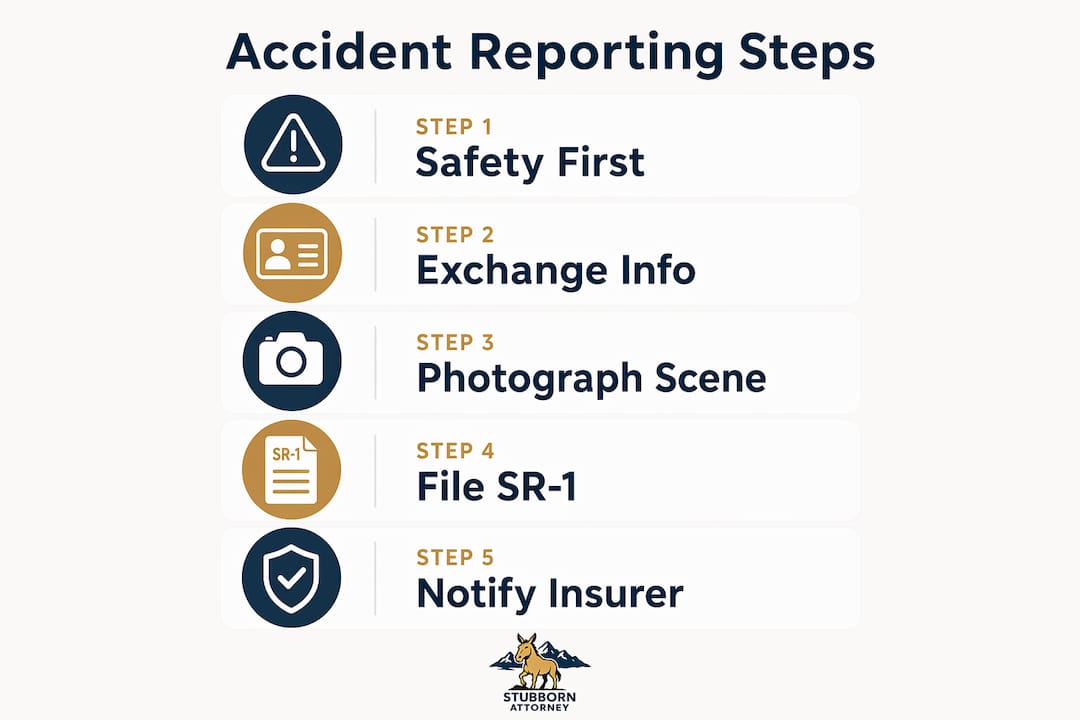
California law requires you to file a Report of Traffic Accident (SR-1 form) with the DMV within the legally required time period of any crash involving injury, death, or property damage over the legal threshold, regardless of fault. Miss that deadline and you risk license suspension. Here is what the full process looks like, from the moment of impact to the moment you have an official report in hand:
- Secure the scene: Move vehicles if safe, turn on hazard lights, check for injuries, and call 911 when needed.
- Exchange information: Names, addresses, driver’s license numbers, license plate numbers, and insurance policy details from every driver involved.
- Call police: Request the officer’s name and badge number for follow-up.
- Document everything: Photographs, witness contacts, road and weather conditions.
- Notify your insurer: Separately and promptly, regardless of who was at fault.
- Complete the SR-1 form: Obtain it from the California DMV website or a local DMV office.
- Submit within the legally required time period: Online, by mail, or in person.
- Obtain the official report: Request it from the responding agency or CHP once filed.
Each of these steps carries real legal and financial weight. The sections below walk through each one in detail.
What to do immediately after the accident
Your first obligation is safety, not paperwork. Get your vehicle off the road if you can do so without making injuries worse, turn on your hazard lights, and check yourself and your passengers before stepping out. If anyone is hurt or vehicles are blocking traffic, call 911 right away.
Once the scene is stable, the information exchange begins. California law requires drivers to stop, exchange names, addresses, driver’s license numbers, license plate numbers, and insurance policy details with every other driver involved. Do not rely on memory. Write it down or photograph each person’s license and insurance card on the spot.
When police respond, ask the officer for their name and badge number before they leave. That information is how you track down the official report later. If injuries are serious or a fatality occurs, stay at the scene, cooperate fully with law enforcement, and do not move any vehicle until officers instruct you to.
Hit-and-run situations require a different response. If the other driver flees, note as much as you can: color, make, model, partial plate, direction of travel. Call 911 immediately and file a report with police. You will still need to submit the SR-1 form to the DMV on your own timeline, and your own uninsured motorist coverage may be your primary financial protection.
Pro Tip: Write down the facts at the scene or record a voice memo on your phone within minutes of the crash. Memories shift faster than most people expect, and a detail you feel certain about today can blur within 48 hours.
Photographing the scene effectively
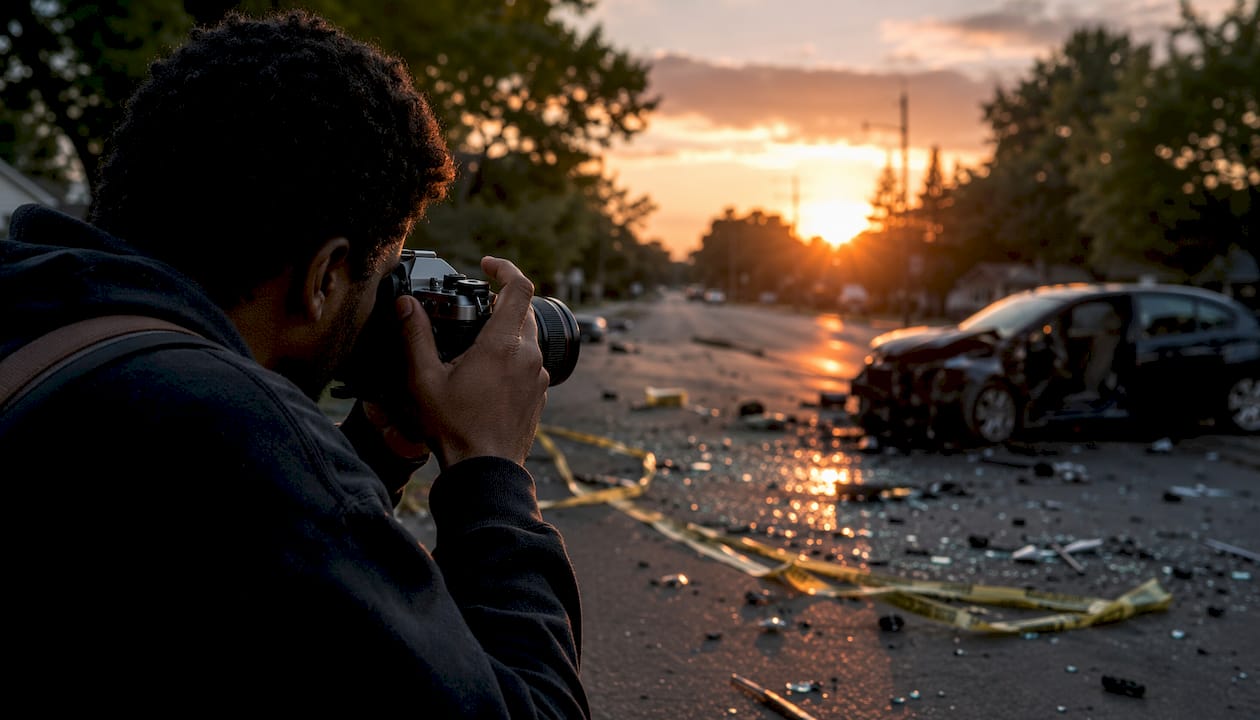
Wide-angle shots showing vehicle positions, traffic controls, skid marks, and road conditions give insurance adjusters the context they need to reconstruct what happened. Close-ups of damage matter, but they tell only part of the story. Photograph license plates, street signs, any debris on the road, and anything that shows weather or lighting conditions. These images support your written narrative and can resolve disputes that words alone cannot.
How to fill out and submit the California SR-1 form
The SR-1 is the official driver’s self-report form required by the California DMV. You need it any time a crash results in injury, death, or significant property damage, and the filing deadline starts on the date of the accident, not the date you learn about the damage estimate.
Where to get the form
Download the SR-1 directly from the California DMV website or pick up a physical copy at any DMV office. The form is free. Do not fill it out from memory. Sit down with your collected notes, photographs, and the other driver’s information in front of you before you write a single word.
What the form asks for
The SR-1 has four main sections:
| Section | What to include |
|---|---|
| Driver information | Your full legal name, address, license number, and date of birth exactly as they appear on your license |
| Vehicle information | Year, make, model, and VIN from your registration, not from memory |
| Accident narrative | A factual, chronological account of what happened, including speed, direction, road conditions, and point of impact |
| Scene diagram | A simple sketch showing vehicle positions, directions of travel, traffic controls, and street names |
Accuracy on every field matters. A transposed digit in a license number or a misspelled name can create verification problems that delay your claim. Use the other driver’s actual license, not what they tell you verbally. For the diagram, you do not need artistic skill. Draw the roadways, label them, number each vehicle, and use arrows to show direction of travel. Include traffic signals and lane markings if they are relevant.
Submission options and consequences
You can submit the SR-1 online through the California DMV portal, by mail, or in person at a DMV office. Whichever method you use, keep proof of submission. A confirmation email, a certified mail receipt, or a stamped copy from the clerk’s window all work.
Failure to file can lead to license suspension under California DMV regulations. That consequence applies even if the accident was not your fault. Filing late does not erase the obligation; it just adds a compliance problem on top of whatever claim you are already managing.
Pro Tip: Make at least two copies of the completed SR-1 before you submit it, one digital and one physical. Insurance claims can drag on for months, and you may need to reference the exact language you used long after the details have faded.
How to obtain and use the official accident report
The official accident report and your SR-1 are two different documents. The SR-1 is your self-report to the DMV. The official report is the one law enforcement files after responding to the scene. You need both for insurance claims and any potential legal action.
Requesting the report
If California Highway Patrol (CHP) responded, request the report through the CHP’s online portal or by mail to the local CHP area office. If a local police department responded, contact that department’s records division directly. Most agencies charge a small fee for copies. You can get a police report fast by having the report number ready, which the responding officer can provide at the scene.
- Online: CHP offers online report requests through its website.
- By mail: Send a written request with the report number, date, and location of the crash to the relevant agency.
- In person: Visit the records division of the responding agency with a valid ID.
What the report contains and why it matters
The official report documents the officer’s observations, statements from drivers and witnesses, a diagram of the scene, and any citations issued. Insurance adjusters treat it as a primary reference when evaluating fault and damages. If the report contains an error, such as a wrong license plate or an incorrect street name, contact the reporting officer promptly. Most agencies will not rewrite the original document, but they will attach a supplemental narrative that corrects the record. Act within a couple of weeks while evidence is still available.
When police did not respond
Not every crash draws a police response. For minor fender-benders, officers may decline to come to the scene. California drivers are still responsible for filing the SR-1 with the DMV within the 10-day window even when no officer files a report. Waiting for police who never arrive is one of the most common reasons drivers miss the legal deadline.
Submitting the SR-1 to the DMV does not replace your obligation to notify your insurer. Contact your insurance company separately and promptly. Delays in notifying your carrier can lead to coverage problems or outright claim denial, regardless of what you filed with the DMV.
How to write your own detailed accident report
Beyond the SR-1, writing a personal accident report gives you a clear, organized record that supports your insurance claim and protects you if the situation escalates legally. Think of it as your version of events, written before memory fades.
Structure it chronologically
An effective accident report uses a neutral, chronological narrative with precise details: time, date, location, environmental conditions, and a factual sequence of events. Start with where you were coming from and what you were doing before the crash. Move through the moment of impact with specifics about speed, direction, and what you observed. Then describe the aftermath: where vehicles came to rest, who was injured, what was said, and when emergency services arrived.
What to include
- Identifying information: Your full name, address, phone number, and role in the accident.
- Environmental conditions: Weather, lighting, road surface, visibility, and any relevant traffic controls.
- Vehicle details: Make, model, color, year, and license plate for every vehicle involved.
- Witness contacts: Names and phone numbers for anyone who saw the crash.
- Injuries and damage: A factual description of what you observed, not a diagnosis.
- Police report number: Reference it in your statement so the adjuster can pull the official file.
What to avoid
Statements to other drivers should focus solely on exchanging information, not admitting fault. The same discipline applies to your written report. “The other vehicle entered the intersection” is a fact you observed. “The other driver ran the red light” is a conclusion. Write the first; let the evidence support the second. Avoid emotional language, speculation about the other driver’s intentions, and any admission of responsibility. Adjusters and attorneys read these documents carefully, and a single careless sentence can shift liability in ways you did not intend.
Pro Tip: Draft your personal report within 24 hours of the crash. The specific details, exact distances, the color of the traffic light, the sound of brakes, are sharpest in that window. A report written a week later reads like a reconstruction, not a record.
Why accurate accident reporting matters more than most people realize
Most drivers treat the accident report as a formality. That is a mistake that costs people real money.
The report is the foundation of your insurance claim. Adjusters build their liability determination from it. If your account is vague, contradictory, or missing key details like road conditions or the exact point of impact, the adjuster fills in those blanks without your input. That rarely works in your favor. A well-documented report, one with photographs, a clear narrative, and witness contacts, gives the adjuster a complete picture that is harder to dispute.
The legal stakes are just as real. Reporting an accident promptly with clear, objective facts limits your liability exposure in any subsequent proceedings. Incomplete or late filings, on the other hand, create gaps that opposing counsel can exploit. The 10-day SR-1 deadline is not a suggestion; missing it can trigger license suspension and signal to insurers that something is off.
The mistake I see most often is not dishonesty. It is people writing their reports in a way that sounds defensive rather than factual. They want to explain themselves, to justify their actions, and in doing so they introduce speculation and emotional language that undermines their credibility. A calm, factual account of what you observed, written in the same tone you would use to describe a traffic pattern, is far more persuasive than a narrative that reads like an argument. The accident injury reporting process rewards precision, not persuasion.
If your accident involved injuries and you are uncertain whether your documentation is complete, talking to a personal injury attorney before you finalize anything is worth the time. Legal representation in car accident claims can make a measurable difference in how insurers evaluate your case, particularly when liability is disputed.
FAQ
What are the steps of accident reporting in California?
Move to safety, call 911 if there are injuries, exchange driver and insurance information, document the scene with photos, notify your insurer promptly, and submit the SR-1 form to the California DMV within the legally required time period of any crash involving injury, death, or property damage over the legal threshold.
How long do you have to report a car accident in California?
California requires drivers to file the SR-1 form with the DMV within the legally required time period of an accident that involves injury, death, or property damage exceeding $1,000. Failure to file on time can result in license suspension.
How do you write a simple accident report?
Write a short, factual, first-person account in chronological order: where you were before the crash, what happened at the moment of impact, and what occurred immediately after. Include the date, time, location, weather conditions, vehicle details, and witness contacts. Stick to what you personally observed and avoid any language that assigns blame.
What should you include in an accident report?
A complete accident report includes driver and vehicle information for all parties, the exact date, time, and location, environmental conditions, a chronological narrative of events, photographs of the scene and damage, witness names and contact information, and the police report number if law enforcement responded.
What happens if police did not respond to your accident?
You are still legally required to file the SR-1 self-report with the California DMV within the legally required time period if the crash meets the reporting threshold. Waiting for officers who never arrive is one of the most common reasons drivers miss the deadline and face license suspension.