
Car Accident Liability Factors: Your 2026 Guide
Car accident liability factors are the specific legal elements that determine who is responsible for a collision and who must pay for the resulting damages. Understanding these factors is the difference between a denied claim and fair compensation. Negligence law forms the backbone of most car accident claims, requiring proof of duty of care, breach, causation, and actual harm. State fault rules, evidence quality, and the number of parties involved all shape the final outcome. This guide breaks down each factor so you know exactly what influences your case.
1. What are the key car accident liability factors in negligence law?
Negligence-based liability requires proving four elements: duty of care, breach of duty, causation, and actual harm. Failure to prove any element may result in claim denial. That means even a clear-cut crash can fall apart legally if one piece of the puzzle is missing.
Here is what each element means in practice:
- Duty of care: Every licensed driver owes a legal obligation to operate their vehicle safely and avoid harming others on the road.
- Breach of duty: The defendant violated that obligation through actions like speeding, running a red light, texting while driving, or driving under the influence.
- Causation: The breach must directly cause the collision. If the speeding driver would have hit you regardless of speed, causation becomes contested.
- Actual damages: You must have suffered real, measurable harm. This includes medical bills, lost wages, property damage, and pain and suffering.
All four elements must be present. A driver who ran a red light but caused no collision has breached a duty without causing harm. That means no valid liability claim exists.
Pro Tip: Document your damages from day one. Medical records, pay stubs showing missed work, and repair estimates are the concrete proof that satisfies the “actual damages” element.

2. How comparative negligence and fault-sharing rules affect your claim
Fault in a car accident is rarely 100% one person’s problem. Comparative negligence rules allocate payouts proportionally to each party’s fault percentage. A driver found 60% at fault typically pays 60% of the total damages. The other driver covers the remaining 40%.
Three main fault systems operate across the United States:
- Pure comparative negligence: You can recover damages even if you are 99% at fault, though your payout is reduced by your fault percentage. California and New York follow this system.
- Modified comparative negligence (50% rule): You can recover only if your fault is below 50%. Colorado follows this standard, meaning you lose all recovery once you hit the 50% threshold.
- Modified comparative negligence (51% rule): Similar to the 50% rule but bars recovery at 51% fault. Many Midwestern states use this version.
- Pure contributory negligence: Five jurisdictions apply this harsh rule, which bars any recovery if you are even 1% at fault. Virginia, Maryland, Alabama, North Carolina, and Washington D.C. use this system.
Insurance adjusters are trained to push your fault percentage as high as possible. Every percentage point they add to your share of fault reduces what they owe you. A driver initially assigned 20% fault who gets bumped to 40% can lose thousands of dollars in compensation. Challenging that assignment with evidence is not optional. It is necessary.
Understanding which system your state uses is the first step in knowing what you can realistically recover. For multi-vehicle crashes, fault percentages get even more complex. Stubbornattorney handles multi-car fault disputes where these calculations directly affect your payout.
3. What kinds of evidence influence liability determination?
Evidence is the foundation of every liability claim. Without it, fault becomes a matter of competing stories. The right evidence, gathered quickly, can shift a disputed case decisively in your favor.
Key evidence types and their roles:
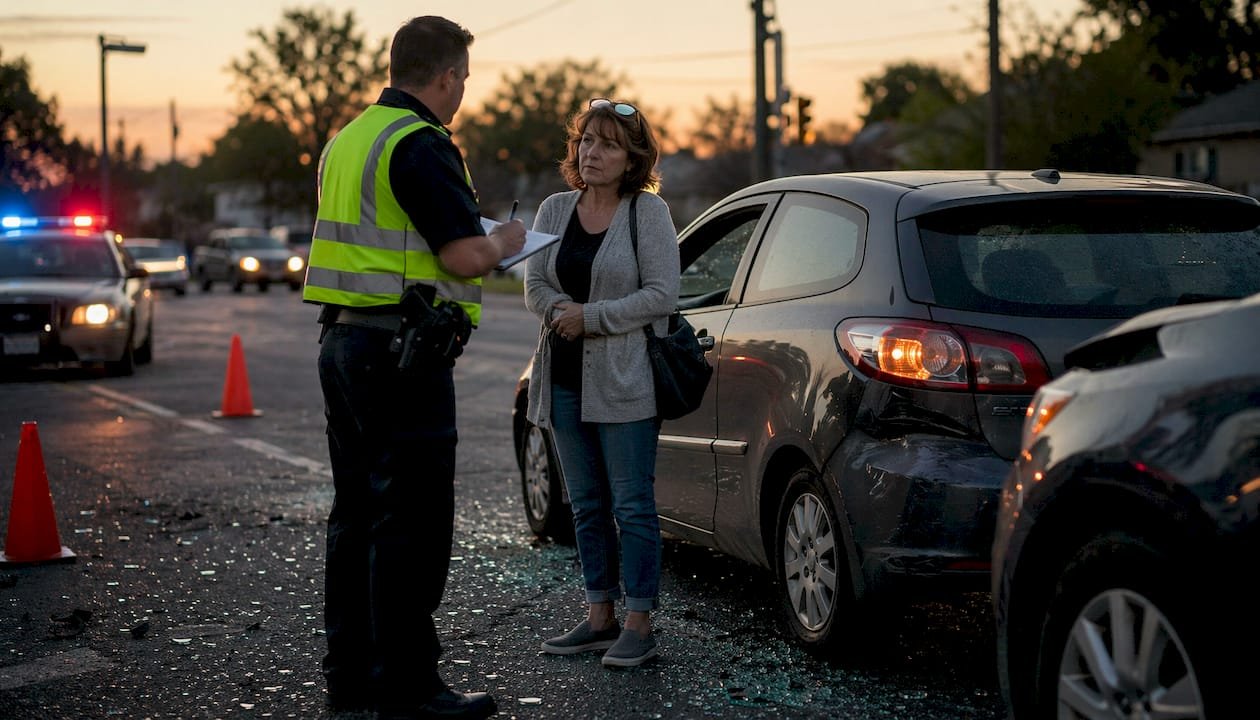
- Police reports: Officers document the scene, note traffic violations, and sometimes assign preliminary fault. Police reports can be inadmissible in court but carry significant weight with insurance adjusters during the claims process.
- Photographs and physical evidence: Skid marks show braking distance and speed. Vehicle damage patterns reveal the angle and force of impact. Photos of road conditions, traffic signals, and weather add critical context.
- Electronic event data recorders (EDRs): Modern vehicles record speed, braking force, steering input, and seatbelt status in the seconds before a crash. EDRs provide objective data that neither driver can dispute after the fact.
- Dashcam footage: Video evidence is the most persuasive form of documentation available. It removes ambiguity about what happened and in what sequence.
- Independent witness statements: Bystanders with no stake in the outcome carry more credibility than either driver. Their accounts often break ties in disputed cases.
- Accident reconstruction experts: These specialists analyze physical evidence and vehicle data to determine impact speeds and collision causes. Such analyses are costly but critical in serious injury crashes where fault is genuinely contested.
Pro Tip: Request the EDR data from both vehicles as soon as possible after a crash. This data can be overwritten or lost if the vehicle is repaired or totaled before anyone preserves it.
Evidence degrades fast. Skid marks fade, witnesses forget details, and surveillance footage gets deleted. The window to preserve critical evidence is often days, not weeks.
4. Who else can be liable besides the drivers involved?
The driver who hit you is not always the only party with legal responsibility. Identifying every liable party matters because it expands the pool of available compensation, especially when a single driver’s insurance limits are not enough to cover your losses.
- Vehicle owners: Owners can be held liable under the doctrine of negligent entrustment if they knowingly allowed an unfit driver to use their vehicle. Lending a car to someone with a suspended license or a known history of DUI creates direct owner liability.
- Employers: Employers face vicarious liability when a driver causes a crash while acting within the scope of their employment. Delivery drivers, sales representatives, and rideshare drivers on active trips all fall under this rule. Employer liability is valuable because businesses typically carry much higher insurance limits than individuals.
- Vehicle manufacturers: A defective brake system, faulty tire, or flawed steering component can cause a crash even when the driver does nothing wrong. Product liability claims against manufacturers operate under different legal standards than negligence claims.
- Government entities: Poorly maintained roads, missing signage, broken traffic signals, and dangerous intersection designs can all contribute to crashes. Government liability for road conditions exists but requires navigating specific notice requirements and shorter filing deadlines than standard injury claims.
- Bars and restaurants: Dram shop laws in many states allow injured parties to sue establishments that overserved an impaired driver. This extends liability beyond the driver to the business that contributed to their impairment.
Pursuing extended liability requires identifying these parties early. Evidence linking them to the crash, such as employment records, vehicle maintenance logs, or road inspection reports, must be preserved before it disappears.
5. How do state fault rules and insurance systems shape your claim?
The state where your crash occurs determines the entire framework for your claim. Two fundamentally different insurance systems govern how claims are filed and what you can recover.
| Feature | At-Fault (Tort) States | No-Fault States |
|---|---|---|
| Who you file with | The at-fault driver’s insurer | Your own insurer (PIP) |
| Lawsuit access | Available for most injuries | Restricted to serious injuries |
| Pain and suffering | Recoverable in most cases | Limited by injury thresholds |
| Examples | Colorado, Texas, California | Colorado Springs , Michigan, New York |
Twelve U.S. states operate no-fault insurance systems, requiring drivers to file personal injury protection (PIP) claims with their own insurer regardless of who caused the crash. This speeds up medical bill payment but limits your right to sue for non-economic damages like pain and suffering.
In no-fault states, PIP covers medical bills up to policy limits regardless of fault, but lawsuits for pain and suffering require meeting a serious injury threshold. Colorado Springs , for example, sets a $10,000 medical bill threshold before a lawsuit for additional damages becomes available.
At-fault states like Colorado follow tort liability rules. The at-fault driver’s insurer pays your damages. Your ability to recover depends directly on proving the other driver’s fault and navigating comparative negligence rules. Uninsured and underinsured motorist coverage becomes critical when the at-fault driver carries insufficient insurance to cover your losses.
Knowing your state’s system before you file determines which insurer you contact, what documentation you need, and whether a lawsuit is even an option.
What I’ve learned about liability disputes after a decade of injury cases
The biggest mistake I see injured people make is accepting the insurance adjuster’s initial fault determination as final. Insurance adjusters aim to minimize payouts and can inflate your share of fault. That first number is a starting position, not a verdict.
I’ve worked cases where a rear-end collision looked open-and-shut until evidence showed the lead driver had brake-checked the other vehicle. Obvious fault cases get complicated fast when you actually dig into the evidence. That’s why I tell every client the same thing: gather everything you can, as fast as you can, and do not give a recorded statement to the other driver’s insurer without legal counsel present.
The other thing people underestimate is extended liability. Most injured drivers focus entirely on the person who hit them. But in cases involving commercial vehicles, rideshare drivers, or crashes on poorly maintained roads, the real money often comes from a second or third liable party. Trusting adjusters’ fault decisions without independent legal review can cost you compensation you never knew was available.
My honest advice: treat the first 72 hours after a crash as your most critical window. Preserve evidence, get medical attention, and consult an attorney before you sign anything. The legal system rewards preparation. It does not reward patience with insurers.
— Ryan
Stubbornattorney fights for fair liability outcomes in Colorado
Proving fault after a car accident requires more than a police report. It requires a thorough liability assessment, knowledge of Colorado’s comparative negligence rules, and the ability to identify every responsible party. Stubbornattorney brings over a decade of personal injury experience and a former insurance adjuster’s inside knowledge to every case. Ryan Malnar knows exactly how insurers evaluate claims because he spent years on that side of the table. Review common personal injury case examples to see how liability factors play out in real cases, or request a free case review through Stubbornattorney’s Colorado personal injury services. There is no cost to find out where you stand.
FAQ
What are the main car accident liability factors?
The main factors are duty of care, breach of duty, causation, and actual damages. All four must be proven to establish negligence and hold another driver legally responsible for your losses.
Who is liable in car accidents involving multiple parties?
Liability can extend beyond the at-fault driver to vehicle owners, employers, manufacturers, and government entities. Comparative negligence rules then assign fault percentages to each party, reducing payouts proportionally.
How does comparative negligence affect my compensation?
Your compensation is reduced by your percentage of fault. In Colorado, you cannot recover anything if you are 50% or more at fault. A driver found 30% at fault receives 70% of the total damages awarded.
Does a police report determine fault in a car accident?
Police reports influence insurance evaluations but are often inadmissible in court because they contain officer opinions and hearsay. Independent evidence like EDR data, photos, and witness statements carries more legal weight.
How do no-fault states change the claims process?
In the 12 no-fault states, you file medical claims with your own insurer through PIP coverage regardless of who caused the crash. Lawsuits for pain and suffering require meeting a serious injury threshold set by state law.