


Why Legal Representation Matters in Car Accident Claims
Legal representation is the single most reliable factor that improves your chances of a favorable outcome in a car accident claim. Represented parties achieve favorable outcomes at a rate of approximately 74%, compared to only 38% for those who go it alone. That gap is not a coincidence. It reflects the difference between someone who knows the system and someone learning it under pressure. Why legal representation matters comes down to three things: procedural mastery, negotiation power, and the ability to protect your rights when an insurance company is working against you. Understanding these advantages is the first step toward making a decision that could define the outcome of your claim.
Why legal representation matters in car accident claims
Legal advocacy, the formal term for an attorney acting on your behalf in legal proceedings, is far more than courtroom performance. The most critical value of lawyers lies in strategic planning, risk mitigation, and navigating procedural complexities. That is where most car accident claims are won or lost, long before any judge sees the case.

Procedural accuracy protects your claim from the start
Car accident claims operate under strict civil procedure rules and evidentiary standards. Miss a filing deadline, submit the wrong form, or fail to properly authenticate a piece of evidence, and your claim can be dismissed regardless of its merit. Procedural non-compliance is one of the leading reasons unrepresented claimants lose cases that should have succeeded. An attorney tracks every deadline, files every document correctly, and knows which procedural rules apply to your specific situation in Colorado.
Evidence preservation requires immediate action
Evidence degrades fast after a car accident. Surveillance footage gets overwritten. Witnesses forget details. Vehicle damage gets repaired before it is properly documented. An attorney steps in immediately to send spoliation letters, preserve physical evidence, and coordinate with accident reconstruction experts when needed. Early legal engagement facilitates evidence preservation and communication strategies that non-lawyers rarely achieve independently. That early work often determines whether your claim has the foundation to succeed.
Negotiation leverage with insurance companies
Insurance adjusters are trained negotiators with one goal: minimize what the company pays. You are not their priority. An attorney changes that dynamic entirely. Lawyers understand how insurers calculate claim value, what arguments move the needle, and when a lowball offer is worth rejecting. Attorneys act as buffers preventing self-incriminating statements that hurt claims during insurer communications. That protection alone can be worth thousands of dollars in your final settlement.
Key ways legal expertise directly improves your claim:
- Attorneys identify all liable parties, including third parties you may not have considered
- Lawyers calculate the full value of your claim, covering future medical costs, lost earning capacity, and pain and suffering
- Counsel manages all written and verbal communications with the insurance company on your behalf
- Attorneys know when to push for litigation versus when a settlement serves your best interest
- Legal teams access professional networks including medical experts, economists, and accident reconstructionists
Pro Tip: Never give a recorded statement to an insurance adjuster without your attorney present. Adjusters are trained to ask questions that minimize your claim, and anything you say can be used to reduce your settlement.
What are the measurable benefits of having legal representation?
The data on legal representation benefits is clear and consistent. Represented claimants do better across every measurable outcome: settlement amounts, case success rates, and speed of resolution.
“Access to dedicated legal counsel increased the likelihood of clients being granted relief by 366 percent and boosted the probability of release on bond by 46 percent. That scale of advantage does not happen by accident. It reflects the structural power that legal expertise brings to any high-stakes proceeding.”
Vera Institute of Justice
That 366% figure comes from a study of high-stakes legal proceedings, but the principle applies directly to personal injury claims. When you have someone who understands the system fighting for you, the system responds differently.
The financial case for hiring a lawyer
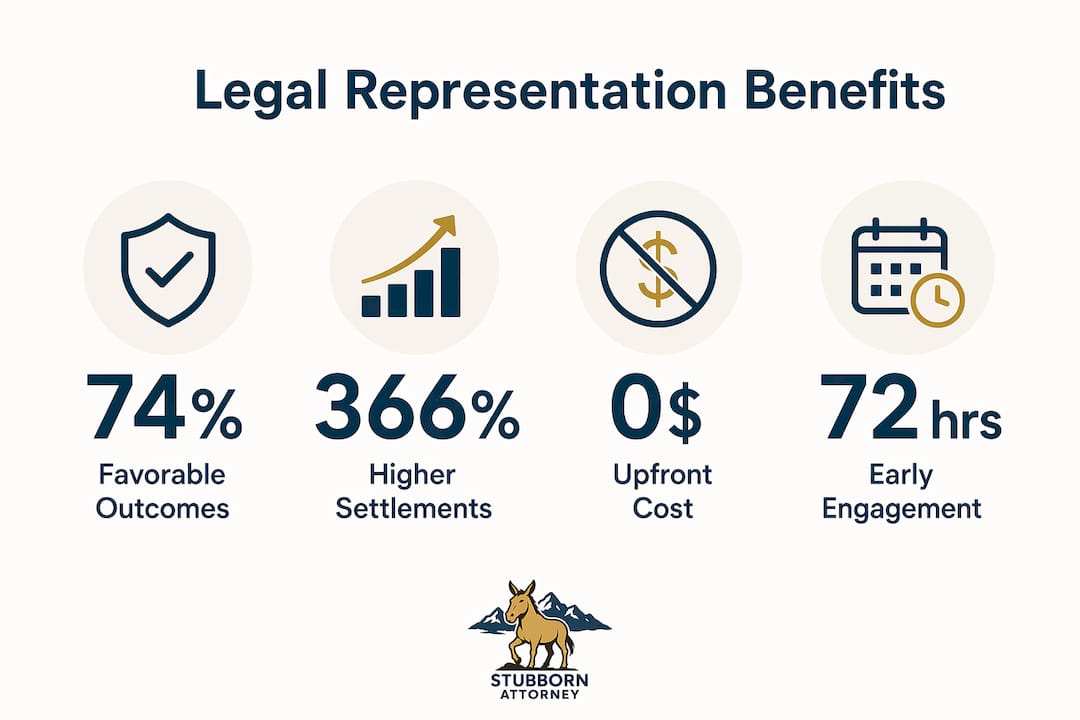
Most personal injury attorneys work on a contingency fee basis. You pay nothing unless you win. That structure removes the financial barrier and aligns your attorney’s incentives with yours. The attorney earns more when you earn more, which means they have every reason to fight for the highest possible settlement.
| Outcome Category | With Legal Representation | Without Legal Representation |
|---|---|---|
| Favorable outcome rate | ~74% | ~38% |
| Risk of procedural dismissal | Significantly reduced | High |
| Access to expert witnesses | Yes | Rarely |
| Insurance negotiation buffer | Yes | No |
| Full damages calculation | Yes | Often incomplete |
The financial advantages extend beyond the settlement check. Attorneys catch damages that claimants routinely miss, including future medical expenses, diminished earning capacity, and non-economic damages like emotional distress. A claimant handling their own case often accepts a settlement that covers only current medical bills, leaving years of future costs uncompensated.
Psychological and strategic advantages
Legal representation offers psychological advantages by grounding decisions in facts rather than emotion. After a car accident, you are dealing with pain, stress, and financial pressure. Those conditions make people vulnerable to accepting the first offer an insurer puts on the table. An attorney removes that emotional pressure from the equation. They evaluate offers objectively, advise you on realistic outcomes, and prevent panic-driven decisions that cost you money.
Common pitfalls of self-representation in car accident claims
Self-representation, sometimes called “pro se” litigation, is legal. It is also consistently associated with worse outcomes. The pitfalls are not random. They follow predictable patterns that attorneys see repeatedly.
-
Missing critical deadlines. Colorado’s statute of limitations for personal injury claims is generally three years from the date of the accident. Miss it, and your claim is gone. But deadlines exist throughout the process, not just at filing. Discovery deadlines, response windows, and hearing dates all require precise tracking. Missed deadlines and procedural errors can cause case dismissal or reduced compensation regardless of how strong the underlying claim is.
-
Accepting a lowball settlement. Insurance companies make early offers that sound reasonable to someone in financial distress. Those offers almost never reflect the full value of the claim. Without an attorney to calculate long-term damages and push back, many claimants accept settlements they will regret for years.
-
Making damaging statements. A casual phone call with an adjuster can sink your claim. Saying “I’m feeling better” or “the accident wasn’t that bad” gives the insurer ammunition to minimize your injuries. Insurance adjusters’ tactics require expert navigation, and claimants without counsel regularly make statements that reduce their settlement value without realizing it.
-
Failing to document injuries properly. Medical documentation is the backbone of a personal injury claim. Gaps in treatment, inconsistent records, or failure to connect injuries to the accident give insurers grounds to dispute your claim. Proper medical documentation and strict procedural compliance are often overlooked by claimants but are pivotal for full compensation.
-
Lacking access to expert witnesses. Serious injury claims often require testimony from medical experts, accident reconstructionists, or economists. Self-represented claimants rarely have access to these professionals. Without expert support, complex claims become difficult to prove, even when the facts favor the claimant.
Pro Tip: If you are unsure whether your claim is strong enough to warrant an attorney, schedule a free consultation before deciding. Most personal injury attorneys offer free case evaluations, and that conversation will give you a clear picture of what your claim is actually worth.
How and when to engage legal representation for maximum benefit
Timing matters as much as the decision itself. The earlier you bring an attorney into your claim, the more they can do for you.
Engage counsel immediately after the accident
The first 72 hours after a car accident are the most critical for evidence preservation. An attorney contacted within that window can send preservation letters to relevant parties, advise you on what to document, and prevent you from making statements that damage your claim. Treating legal counsel as a proactive asset rather than a last resort consistently produces better outcomes. Waiting until the insurance company makes an offer puts you in a reactive position from the start.
What an attorney handles from day one:
- Sends spoliation letters to preserve surveillance footage, vehicle data, and physical evidence
- Advises you on what to say and what not to say to insurers and other parties
- Coordinates your medical treatment documentation to build a consistent injury record
- Evaluates all potentially liable parties beyond the at-fault driver
- Manages all insurer communications to prevent damaging admissions
Understanding your representation options
Not every car accident claim requires full litigation. Attorneys offer a range of involvement levels depending on your situation. Limited-scope representation, where an attorney handles specific tasks like reviewing a settlement offer or drafting a demand letter, is an option for straightforward claims. Full representation covers everything from initial investigation through trial if necessary.
The right level of involvement depends on the severity of your injuries, the complexity of liability, and the insurer’s behavior. A local Colorado attorney brings additional value because they know the local courts, the judges, and the insurers operating in your area. That local knowledge translates directly into better strategic decisions.
Factors to consider when choosing an attorney
Choosing the right attorney is as important as choosing to hire one. Look for a personal injury attorney with specific experience in car accident claims, a track record of settlements and verdicts in your state, and a clear contingency fee structure. Ask about their caseload. An attorney carrying too many cases at once may not give yours the attention it deserves. Stubbornattorney’s approach, built on the principle of persistent, client-focused representation, reflects what the best personal injury attorneys actually deliver: undivided attention and a refusal to settle for less than you deserve.
What I’ve learned after a decade of fighting for accident victims
After more than ten years representing injured clients in Colorado, I have seen one pattern repeat itself more than any other. The clients who wait too long to call an attorney almost always leave money on the table. Not because their claims were weak. Because the window to build a strong case had already started closing.
The misconception I hear most often is that hiring an attorney is expensive. People assume the legal fees will eat up their settlement. The reality is the opposite. Attorneys working on contingency have a direct financial incentive to maximize your recovery. My fee comes from the settlement I win for you. If I do not win, I do not get paid. That structure means we are on the same side from the first conversation.
I also see clients who handled early communications with the insurer themselves before calling me. Sometimes those conversations are recoverable. Sometimes they are not. A single recorded statement made without counsel can define the ceiling on what a claim is worth. That is not a scare tactic. It is what I watch happen in real cases.
The other thing I want you to understand is that attorneys fight insurance companies not because it is dramatic, but because it is necessary. Insurers have teams of adjusters and lawyers whose job is to reduce what they pay. You deserve someone equally committed on your side. The mule is our symbol at Stubbornattorney for a reason. Once we take your case, we do not let go.
— Ryan
How Stubbornattorney approaches your personal injury claim
Stubbornattorney, the brand home of Malnar Injury Law, represents only injured victims. Ryan Malnar spent years as a federal claims adjudicator before becoming a personal injury attorney, which means he knows exactly how insurers evaluate claims and where they look for weaknesses. That background is a direct advantage for every client he represents. If you were injured in a car accident in Colorado, you can review common personal injury case examples to understand how similar claims have been handled. For a direct evaluation of your situation, Stubbornattorney offers a free personal injury case review with no obligation. The consultation costs you nothing. The information you get from it could change everything about how your claim proceeds.
FAQ
What is legal representation in a car accident claim?
Legal representation in a car accident claim means an attorney acts on your behalf to investigate the accident, document your injuries, negotiate with insurers, and pursue full compensation. The attorney manages all legal and procedural requirements so you can focus on recovery.
Why do represented claimants get better outcomes?
Represented parties achieve favorable outcomes at roughly 74% compared to 38% for unrepresented claimants. Attorneys bring procedural expertise, negotiation skill, and access to expert witnesses that self-represented claimants cannot replicate.
When should I hire a lawyer after a car accident?
Hire an attorney as soon as possible after the accident, ideally within the first 72 hours. Early legal involvement preserves critical evidence, prevents damaging statements to insurers, and gives your attorney the maximum time to build a strong case.
Does hiring a lawyer cost money upfront?
Most personal injury attorneys work on a contingency fee basis, meaning you pay nothing unless they win your case. The fee is a percentage of the settlement or verdict, so there is no financial risk to consulting or hiring an attorney after an accident.
What happens if I talk to the insurance company without a lawyer?
Insurance adjusters are trained to ask questions that minimize claim value. Statements made without legal counsel, even casual ones, can be used to dispute the severity of your injuries or reduce your settlement. An attorney manages all insurer communications to protect your claim from the start.