

3 Rulings (2024–2026) That Change Colorado Liability Waivers
Colorado courts often enforce liability waivers for ordinary negligence, but three recent rulings show real limits. In Miller v. Crested Butte, LLC, the state’s highest court said a waiver cannot erase duties created by statute. In Shive v. 24 Hour Fitness, vague wording sank a gym’s defense. Timing matters too, since a signed DR 2100 release serves a narrow, different purpose than a recreational waiver. The case summaries below explain why.
Table of Contents
- What Colorado Waivers Typically Cover and Where They Stop
- Miller, Shive, and Litterer: What Each Case Actually Decided
- The Jones Factors and a Drafting Checklist That Holds Up
- Pre-Injury Waivers, Post-Injury Releases, and the DR 2100 Form
- Mistakes People Make and What to Do Right After an Injury
- What Judges Actually Look for When a Waiver Is Challenged
- How Malnar Injury Law Helps When a Waiver Is in Play
- Sources
- FAQ
What Colorado Waivers Typically Cover and Where They Stop
A well-written waiver in Colorado will usually protect a business from claims of ordinary negligence, the kind of carelessness that happens even when everyone follows the rules. Ski resorts, gyms, climbing walls, and adventure tour operators rely on these agreements every day, and courts generally uphold them when the language is specific and the signer had a real chance to read it.
That protection has edges. A waiver cannot excuse gross negligence or intentional misconduct, and it cannot override a duty that a statute or regulation specifically assigns to the business. Courts also refuse to enforce a waiver when its wording is too broad or vague to tell the signer what risks they were actually giving up.
The pattern shows up across activity types:
- A ski pass waiver can bar some claims related to skiing risks but not those tied to chairlift malfunctions covered by state safety law.
- A gym membership waiver can cover an injury from using a treadmill improperly, but may not cover a slip on an icy sidewalk outside the building.
- An outdoor tour waiver can cover the inherent risks of rafting or zip-lining, but not an operator’s failure to maintain required safety equipment.
Miller, Shive, and Litterer: What Each Case Actually Decided
Three rulings from 2024 through 2026 reshaped how Colorado courts read these agreements, and each one turns on a different piece of the puzzle: statutory duty, clarity, and timing.
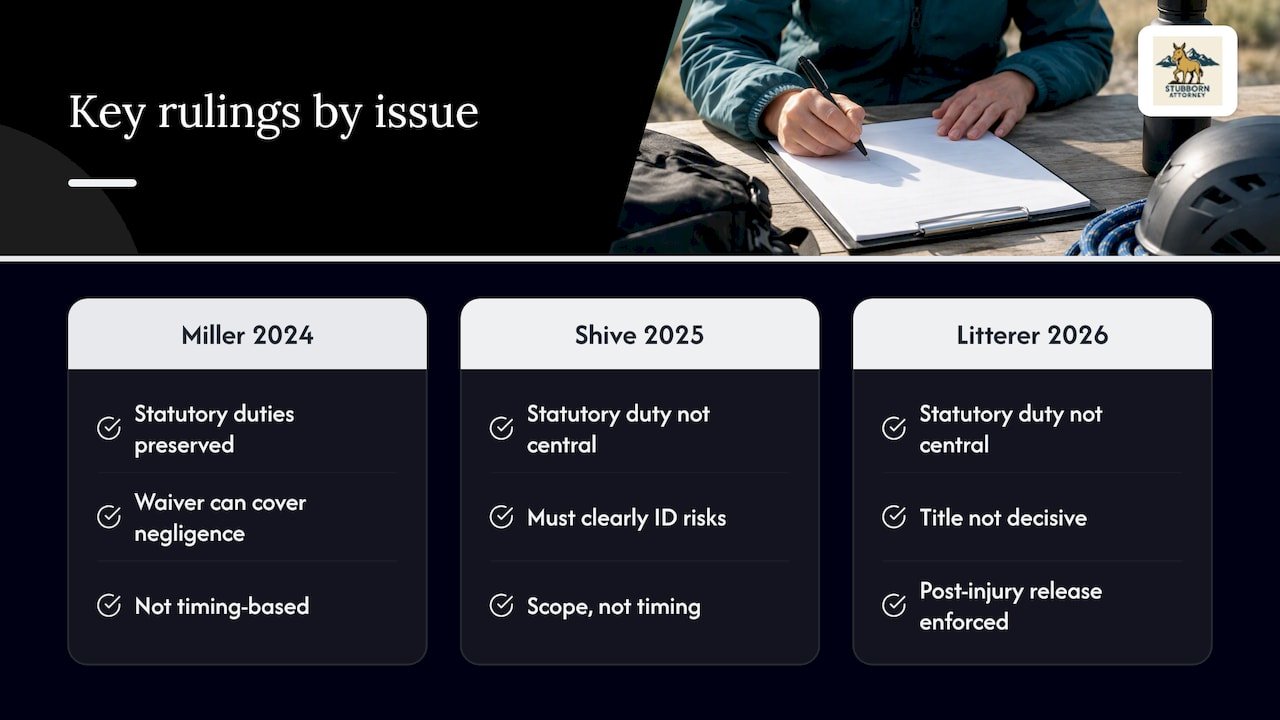
Miller v. Crested Butte (2024). The Colorado Supreme Court held that a ski-area waiver could not eliminate liability tied to duties created by the Ski Safety Act and the Passenger Tramway Safety Act. The court distinguished ordinary negligence, which a waiver can cover, from claims rooted in a regulatory duty the legislature intended operators to carry. A related Colorado Bar Association analysis of Miller notes that courts ask whether lawmakers meant to preserve that protection regardless of what a contract says. Practically, this means chairlift-related injury claims often survive a waiver defense even when the release language looks airtight.
Shive v. 24 Hour Fitness (2025). The Colorado Court of Appeals reversed summary judgment for a gym after finding its waiver, which referenced the company’s “facilities,” did not clearly cover an icy sidewalk injury outside the building. The ruling turned on the fourth Jones v. Dressel factor: whether the waiver’s language clearly and unambiguously identified the risk being released, according to the Shive opinion. Vague, catch-all phrasing does not automatically extend to every injury connected to a visit.
Litterer (2026). The Colorado Supreme Court addressed a waiver signed online after a collision had already occurred, and treated it as a release rather than a standard pre-injury exculpatory agreement. The court found that timing and the document’s actual function, not just its title, determine how it gets treated, and the release barred certain pleaded claims including requests for exemplary damages, per the Litterer opinion.
The Jones Factors and a Drafting Checklist That Holds Up
Every Colorado waiver gets measured against the four-factor test from Jones v. Dressel, discussed in Redden v. Clear Creek Skiing Corporation. Courts ask whether the business owes a duty to the public, whether the service is essential or specialized, whether the agreement was entered into fairly, and whether the waiver’s intent is stated clearly. A gym or tour operator selling a recreational, non-essential service tends to clear the first two factors easily. The third and fourth factors, fairness of entry and clarity of language, are where most disputes actually get decided.
For anyone drafting or reviewing a waiver, a few steps make the difference between one that holds up and one that gets thrown out:
- Name the specific activity and list its most foreseeable risks instead of relying on general terms like “facilities” or “premises.”
- Put the release language in a readable font, under a clear heading that signals legal consequences, not buried in fine print.
- Require a separate signature or initial specifically for the waiver section, not just a general signup form.
- Limit the waived risks to what a participant could reasonably expect from the activity itself.
- Include specific parental-consent language and a separate signature line when minors are involved.
Pro Tip: Read the waiver as if you’re the injured party’s lawyer looking for a gap. If a phrase could plausibly not cover the injury that happened, a judge may agree with you.
Avoid the traps that sink otherwise solid waivers: omnibus language that tries to cover every possible harm without naming any of them, hidden click-through boxes with no real chance to read the terms, and treating a post-injury release the same way you’d treat a pre-injury waiver.
Pre-Injury Waivers, Post-Injury Releases, and the DR 2100 Form
Timing changes everything. A pre-injury waiver, the kind at issue in Miller, is signed before any harm occurs and gets tested against the Jones factors and any statutory duties in play. A post-injury release, the kind in Litterer, is signed after an incident and functions more like a settlement document, one that can bar claims outright if its language covers them.
Colorado also has a narrow, purpose-built form worth knowing: DMV form DR 2100, a statutory “Release From Liability” tied to the Financial Responsibility Act. It exists for motor-vehicle crash situations, not recreational activities, and requires specific crash details, a named released party, and signatures that may need notarization.
A few points worth remembering:
- Never sign a post-injury release or settlement document on the spot without legal review.
- A DR 2100 form does not substitute for, or resemble, a general activity waiver.
- Online “click to continue” releases signed after an incident can carry real legal weight, as Litterer shows.
Mistakes People Make and What to Do Right After an Injury
Most waiver disputes trace back to a handful of avoidable mistakes: signing without reading, assuming an online click-through is harmless, agreeing to a release immediately after an injury under pressure, or failing to preserve evidence before it disappears.
If you’re injured at a gym, resort, or event in Colorado, a short list of actions protects your options later:
- Photograph the scene, your injury, and any equipment or hazard involved.
- Keep a copy of whatever waiver or release you signed, including the date and format.
- Get names and contact information for any witnesses on the scene.
- Seek medical care promptly and keep timestamped notes about what happened.
- Preserve the clothing, gear, or equipment involved rather than discarding it.
Pro Tip: Ask for a copy of the waiver before you leave the property. Businesses aren’t always quick to provide one later, and the exact wording often decides the case.
Call a lawyer when you’re unsure whether a waiver actually covers your injury, when the injury is serious or long-term, when a statutory duty like the Passenger Tramway Safety Act might apply, or when someone pressures you to sign a release before you’ve had time to think it through.
What Judges Actually Look for When a Waiver Is Challenged
Judges rarely decide these cases on the big picture. They focus on specific words, the layout of the document, and whether the legislature meant to protect a particular duty regardless of what a contract says. A single vague phrase, like “facilities” in Shive, can undo months of otherwise careful drafting.
My advice to anyone signing or relying on a waiver in Colorado: have it reviewed before you rely on it, treat online assent with the same caution as a paper signature, and never sign a release after an injury without a lawyer looking at it first. Small wording decides these cases more often than people expect.
— Ryan
How Malnar Injury Law Helps When a Waiver Is in Play
A waiver you signed doesn’t automatically end your claim, and figuring out whether it applies takes someone who reads these documents for a living. At Stubbornattorney, we represent injured Coloradans on a contingency basis, meaning you owe nothing unless we recover compensation, and we offer a free case evaluation to review your waiver, photos, and timeline. Whether your case involves a slip and fall, a ski accident, or an injury a release might not actually cover, bring what you have and we’ll tell you honestly where you stand. Reach out through our pricing and services page to get started.
This article is general information, not a substitute for advice from a qualified lawyer. Consult a qualified legal professional about your own circumstances before acting on anything here.
Sources
- Shive v. 24 Hour Fitness (No. 24CA2075) — Colorado Court of Appeals (2025)
- Miller v. Crested Butte, LLC — Colorado Supreme Court (2024)
- Colorado DMV form DR 2100 (Release From Liability) (11/08/24)
FAQ
What are the common mistakes on liability waivers?
The most frequent errors are vague language that doesn’t name the specific activity or risk, burying release terms in fine print, and treating an online click-through the same as a properly signed document. Courts, as seen in Shive, will not stretch broad terms like “facilities” to cover injuries outside the activity’s core scope.
How enforceable are liability waivers?
Colorado courts often enforce waivers for ordinary negligence when the language is clear and the four Jones v. Dressel factors are satisfied. They typically fail when a statutory duty is involved, as in Miller v. Crested Butte, or when the wording is too ambiguous to give real notice of the risk.
Can you make your own liability waiver?
You can draft one, but a homemade waiver risks the same ambiguity problems that sank the gym’s defense in Shive. Because enforceability depends on specific wording, placement, and how courts read legislative intent behind related statutes, a waiver meant for real legal protection benefits from professional drafting rather than a generic template.
Do liability waivers hold up in court?
They frequently do for ordinary negligence claims tied to recreational activities, but recent rulings show clear limits. Statutory duties, unclear language, and the timing of when a release was signed can all determine whether a Colorado court upholds it or lets a claim proceed.