

5 Steps to Maximize Your Colorado Total Loss Claim Payout
If your insurer has declared your car a total loss in Colorado, you will likely get a cash offer based on actual cash value, with the option to accept it, keep the vehicle for a reduced payout, or push back if the number looks low. Colorado law requires certain fees to be covered as part of that payout. Your first moves: get the valuation in writing, photograph the vehicle and gather maintenance records, and confirm your lender’s payoff amount before you sign anything.
Table of Contents
- What counts as a total loss in Colorado
- How insurers calculate your payout and what they owe you
- What happens to the vehicle: titles and DMV steps
- Your immediate checklist after a total loss determination
- How to dispute a valuation you believe is too low
- When a Colorado attorney can help with your total loss claim
- What I see most often go wrong in these claims
- Get a free case review for your total loss dispute
- FAQ
- Sources
What counts as a total loss in Colorado
Colorado defines a salvage vehicle under C.R.S. § 42-6-102 as one where repair costs exceed the vehicle’s retail fair market value immediately before the damage occurred. Notably, hail damage is excluded from that particular salvage test, so a hail-damaged car can rack up a large repair bill without automatically becoming a salvage title.
Colorado does not set a fixed percentage threshold for insurers to follow. Instead, the law leaves that calculation to each carrier, as long as the valuation rests on credible, documented sources. Insurers typically pull from a mix of:
- National pricing guides like those used in the auto industry
- Local dealer quotes for comparable vehicles
- Computerized valuation services that pull regional sales data
- Independent appraisals when the vehicle has unusual features or condition
Because the threshold is not standardized, two insurers can reach different conclusions about the same car. That is one reason it pays to ask exactly which sources your adjuster used.
How insurers calculate your payout and what they owe you
Insurers pay actual cash value (ACV) for a total loss, not the cost to replace the car new. ACV accounts for depreciation, mileage, prior damage, and the vehicle’s condition before the loss, so two identical model years can settle for different amounts depending on wear and history.
Beyond the base valuation, Colorado law adds specific obligations. Under C.R.S. § 10-4-639, insurers must also pay applicable title fees, sales tax, and other transfer or registration fees tied to the total loss, and they must disclose towing and storage benefit details. The Colorado Division of Insurance has reinforced this in a bulletin on registration fee payments, clarifying that registration fees for passenger vehicles generally must be covered, with only narrow exceptions.
These statutory add-ons often go unmentioned on a first settlement offer, according to the Colorado Division of Insurance, which is why claimants should ask for an itemized breakdown before accepting.
If you still owe money on the car, your lender gets paid first. Before you cash any check, confirm:
- The exact lien payoff amount your lender has on file
- Whether the settlement check is issued jointly to you and the lender
- That you receive a lien release once the loan is satisfied
What happens to the vehicle: titles and DMV steps
Once a vehicle is declared a total loss, it typically gets a salvage title, a designation that restricts how it can be driven or sold until it goes through a rebuild process. Some vehicles are instead labeled nonrepairable, meaning they can only be used for parts or scrap and can never return to the road.
If you want to keep and repair a salvage vehicle, Colorado’s DMV salvage title guidance lays out the steps:
- Obtain the salvage certificate from your insurer or the prior title holder.
- Complete repairs and keep receipts for all parts and labor.
- Pass a POST-certified VIN inspection using form DR2704.
- File the Salvage Title Statement (DR2424) with your county motor vehicle office.
- Submit the rebuilt-from-salvage checklist, form DR2415, along with your repair receipts and inspection results.
In some cases, a surety bond is required before the state will issue a rebuilt title, particularly when paperwork from the original salvage sale is incomplete or when liens were not properly released.
Your immediate checklist after a total loss determination
The decisions you make in the first days after a total loss notice shape how much you ultimately recover. Work through these steps in order:
- Photograph the vehicle from every angle, including the interior, odometer, and any pre-existing wear, before it leaves your possession.
- Gather maintenance records, repair receipts, and recent upgrade invoices (new tires, a recent battery, aftermarket parts).
- Request the insurer’s full valuation report in writing, including the specific vendor names and comparable vehicles used.
- Call your lender to confirm the exact payoff figure and ask how the lien release will be documented.
- Decide whether to accept the offer, retain the vehicle for a reduced payment, or dispute the valuation, since each path requires different paperwork going forward.
Pro Tip: Ask your adjuster for the valuation report’s comparable vehicle listings by name and mileage, not just the final number. A generic “market analysis” summary is much harder to challenge than a list of specific comps you can independently check.
For a broader walkthrough of claim timelines and documentation, our step-by-step guide to Colorado car accident claims covers the process from the first report through settlement.
How to dispute a valuation you believe is too low
Most Colorado auto policies include an appraisal clause you can invoke when you disagree with the insurer’s number. The standard process involves each side hiring its own appraiser; if those two appraisers disagree, they select a neutral umpire whose decision typically becomes binding.
The Colorado Division of Insurance sets specific standards for this process:
- Appraisers and umpires must be fair, competent, and impartial, under Bulletin B-5.26.
- Both sides are expected to disclose potential conflicts of interest before the appraisal begins.
- Claims files should document the specific valuation methodology and vendor names used, not just a final dollar figure.
If an insurer refuses to invoke appraisal, delays unreasonably, or will not explain its methodology, you can file a complaint with the Colorado Division of Insurance. Persistent stonewalling or unexplained lowball offers can also point toward insurer bad faith, which is a separate legal claim worth discussing with an attorney. Our guide to Colorado insurance bad faith claims walks through what that evidence looks like.
When a Colorado attorney can help with your total loss claim
Legal help tends to make the most sense when the gap between your insurer’s offer and your vehicle’s real value is significant, when a lien dispute is holding up your payout, or when the insurer is dragging out the process without explanation, so consulting with Nevada & California Personal Injury Lawyers can provide valuable support.
An attorney experienced in Colorado total-loss disputes can typically:
- Commission an independent appraisal to challenge the insurer’s number
- Negotiate directly with the adjuster or their supervisor
- Resolve lienholder disputes that are blocking your settlement check
- File a Division of Insurance complaint or pursue litigation when an insurer acts in bad faith
If liability for the underlying accident is also contested, our guide to fault in Colorado car accidents explains how fault determinations can affect your total-loss settlement too.
What I see most often go wrong in these claims
The biggest mistake I see is accepting the first number an adjuster offers without asking for the valuation report behind it. Insurers are required to document their methodology, and a vague “market analysis” without named comparables is a red flag worth pushing back on.
Other warning signs: missing lien payoff details, deductions you were never told about, or an adjuster who won’t explain how they reached a figure. Keep every document, and if liability or value is contested, get a lawyer involved early rather than after you’ve already signed a release.
— Ryan
Get a free case review for your total loss dispute
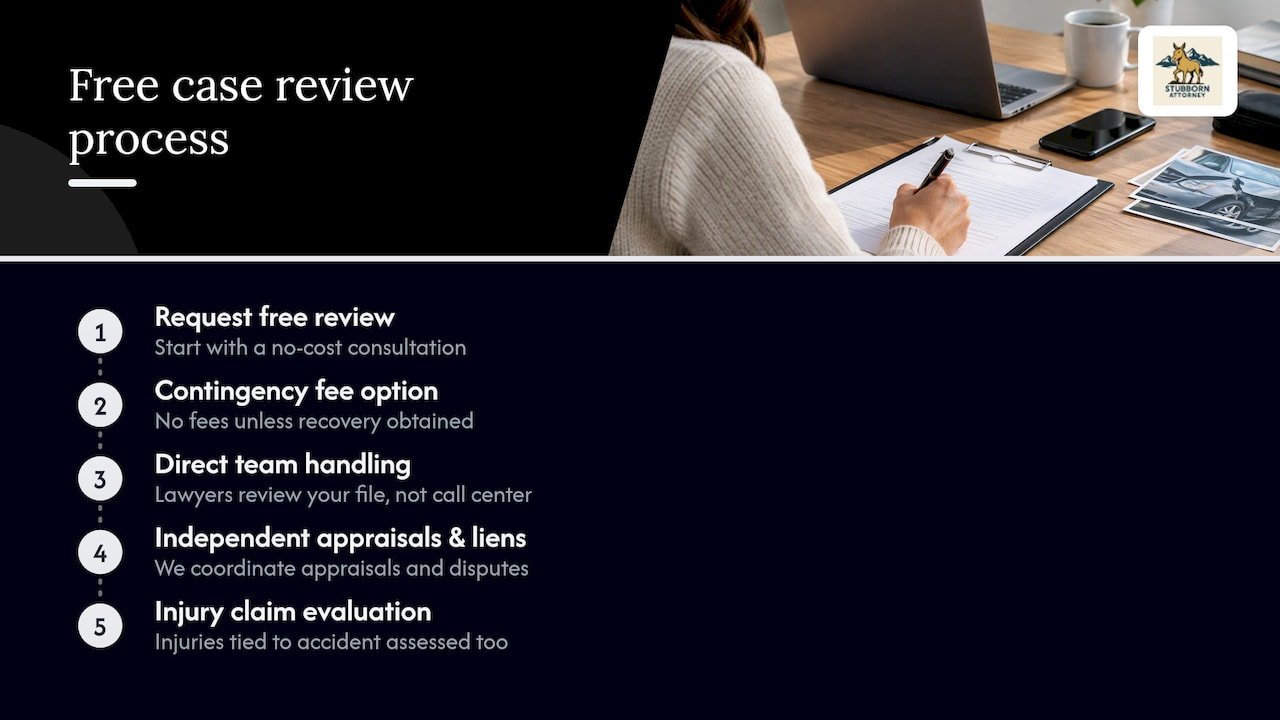
If your total-loss settlement feels low, or your insurer won’t explain how it reached its number, we handle exactly these disputes for Colorado drivers. We offer contingency fee arrangements so that clients may not have to pay unless a recovery is obtained, and consultations are available to discuss your claim status at no initial cost.
Our team reviews personal injury and insurance dispute cases directly, without handing your file off to a call center, and we coordinate independent appraisals and lien disputes as part of fighting for a fairer payout. If your total loss came out of a car accident where someone else was at fault, we can also evaluate the injury side of your claim at the same time. Start with a free case review through our services page to see what your options look like.
This article is general information, not a substitute for advice from a qualified lawyer. Consult a qualified legal professional about your own circumstances before acting on anything here.
FAQ
What happens if a vehicle is totaled in Colorado?
Your insurer will issue an actual cash value offer and, in most cases, the vehicle receives a salvage title that restricts its use until it’s properly repaired and inspected. Colorado law also requires the insurer to cover title fees, sales tax, and applicable registration fees as part of the settlement.
What is the phone number for Geico auto claims?
We don’t have Geico’s claims phone number listed as part of our research. Check the contact information on your Geico insurance card or policy documents, or look up the number directly through Geico’s own customer service channels.
What is the $3,000 rule for car repairs?
Colorado doesn’t use a fixed dollar threshold for total-loss decisions. Instead, state law bases the salvage determination on whether repair costs exceed the vehicle’s retail fair market value before the damage occurred, with hail damage specifically excluded from that test.
What should I avoid telling my insurance company?
Avoid guessing at speeds, damage costs, or fault before you’ve reviewed the facts, and avoid agreeing to a recorded statement without understanding what it covers. Stick to factual, verifiable details and ask for everything in writing, especially valuation methodology and fee breakdowns.
Sources
For the official statute language, forms, and regulator bulletins referenced above, go directly to the Colorado Division of Insurance and the Colorado DMV. These pages stay current as rules and forms change, which makes them the most reliable reference point when you need the exact text or a specific PDF form.
- C.R.S. Section 10-4-639 — Claims practices for property damage
- Concerning Insurer’s Payment of Registration Fees for Total Loss Vehicles (DOI bulletin)
- Vehicle Title – General Information | Department of Revenue – Motor Vehicle