

New $1.5M Cap vs $36,314 Average: Colorado Car Accident Settlements
Most Colorado car accident settlements land somewhere between a few thousand dollars for minor soft-tissue injuries and well over $300,000 for serious or permanent harm, with the average paid bodily injury claim in the state running $36,314. Where your case falls depends mostly on three things: how severe your injuries are, what percentage of fault gets assigned to you, and how much insurance coverage is actually available. The next section breaks those ranges down by injury type.
Table of Contents
- Colorado settlement ranges by injury severity
- How Colorado law changes settlement value: comparative fault, deadlines, and damage caps
- What damages are included and how insurers calculate settlement offers
- Typical settlement timeline and the steps from crash to payout
- Common insurer tactics, negotiation pitfalls, and what to avoid
- When hiring a Colorado personal injury attorney makes a measurable difference
- Author perspective: Ryan Malnar’s practical view on settlement value and insurer behavior
- How we think about settlements: a client-centered approach
- StubbornAttorney: free case review and contingency-fee representation for Colorado crash victims
- Sources
- FAQ
Colorado settlement ranges by injury severity
The $36,314 average for a paid bodily injury liability claim in Colorado, based on 2022 claim-year data with a 2020 to 2022 average of $33,900, represents what insurers pay across every type of claim combined, from minor whiplash to catastrophic injury. It is a useful anchor, but it hides enormous variation. A broken wrist and a spinal fusion both get folded into that same average, which is why knowing your injury category matters more than knowing the overall number.
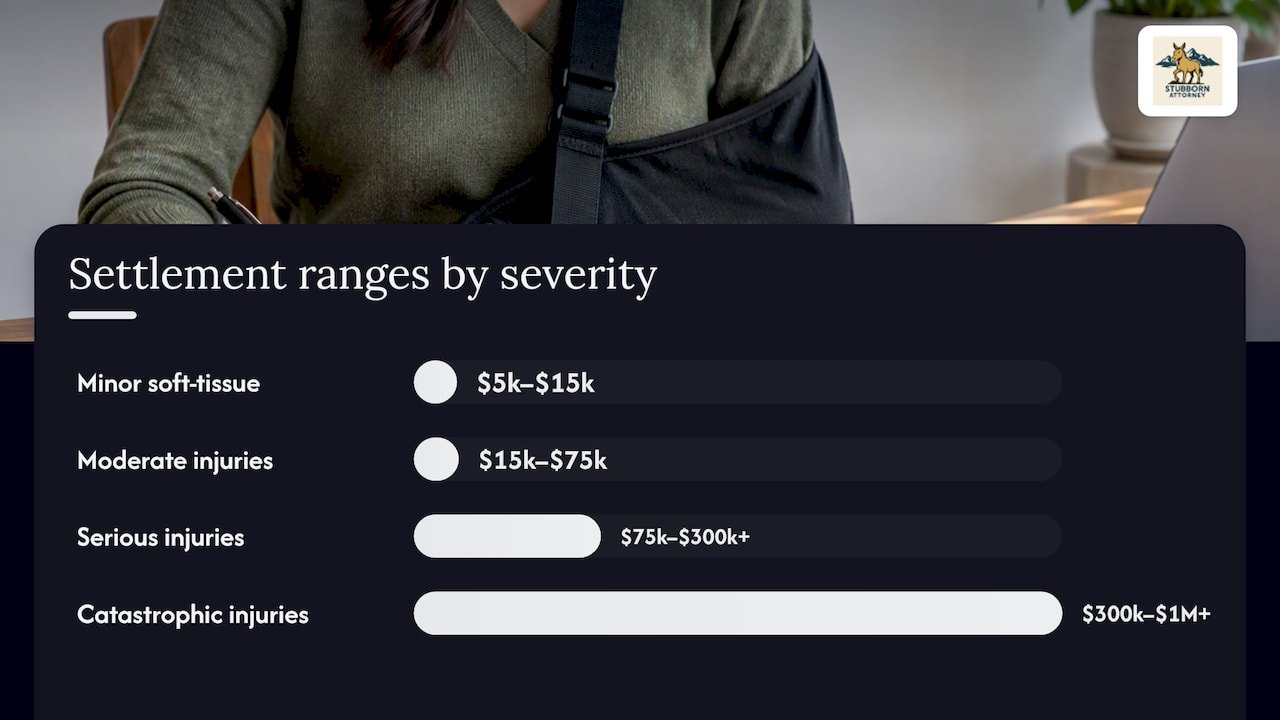
Settlements tend to cluster into five broad bands. Each one reflects a different mix of medical treatment, lost income, and how clear liability is.
- Minor soft-tissue injuries ($5,000 to $15,000): whiplash, bruising, or strains treated with a handful of physical therapy visits and no lasting impairment.
- Moderate injuries ($15,000 to $75,000): fractures, torn ligaments, or injuries requiring a few months of treatment, some missed work, and possibly minor procedures.
- Serious injuries ($75,000 to $300,000 or more): surgical repairs, herniated discs, or injuries that produce measurable permanent impairment and ongoing care needs.
- Catastrophic injuries ($300,000 to $1 million or more): traumatic brain injury, spinal cord damage, amputation, or anything that changes a person’s ability to work or live independently.
- Wrongful death: valued differently than injury claims, shaped heavily by the damage caps discussed in the next section and by the deceased’s earning capacity and family circumstances.
Within each band, the same variables keep showing up. Medical costs are the biggest driver: a case with $8,000 in bills settles very differently than one with $80,000 in bills, even if the injury sounds similar on paper. Lost earnings matter just as much for working adults, particularly when an injury forces a job change or reduces future earning capacity. And liability clarity can swing a case up or down regardless of injury severity. A rear-end collision with a police report naming one driver at fault moves faster and settles higher, proportionally, than a intersection crash where both drivers dispute what happened.
Soft-tissue cases often settle within weeks of finishing treatment because the story is simple: an accident happened, treatment followed, and the bills are documented. Catastrophic cases move slower and settle higher because they require expert testimony on future medical needs, vocational impact, and sometimes life-care planning. A wrongful-death case sits in its own category because Colorado law treats those damages differently from a personal injury claim, which is where the next section becomes important.
One pattern worth flagging: insurance-industry averages like the $36,314 figure tend to understate what serious injury victims actually recover. Averages get pulled down by the high volume of minor claims. A case involving surgery, permanent impairment, or future care needs routinely settles well above the statewide average once it is properly documented and packaged, particularly if it goes into negotiation or litigation rather than getting resolved with a quick first offer.
How Colorado law changes settlement value: comparative fault, deadlines, and damage caps
Three legal rules shape almost every Colorado settlement negotiation, and understanding them changes how you read an insurance adjuster’s first offer.
The first is comparative negligence. Colorado follows a modified comparative negligence system with a 50% bar: your recovery is reduced by your percentage of fault, and you are barred from recovering anything if you are found 50% or more at fault. For example, if your damages total $100,000 but you are assigned 20% fault, your recovery would be reduced accordingly; if fault reaches 50%, you recover nothing. This single rule is why insurers fight so hard over fault percentages early in a claim, sometimes before you have even finished treatment. Our breakdown of how fault gets assigned walks through how adjusters build these arguments, and our detailed look at the 50% rule covers how special verdicts work when a case goes to trial.
The second is timing. Colorado motor-vehicle tort claims carry a three-year statute of limitations under Colo. Rev. Stat. § 13-80-101(1)(n). Miss that window and you generally lose the right to sue, regardless of how strong your case is. Claims against a government entity carry much shorter notice deadlines, often measured in months rather than years, and uninsured or underinsured motorist claims can carry their own contractual timing rules that run separately from the statute of limitations. Anyone dealing with a government vehicle or a hit-and-run situation should treat the clock as running faster than three years until an attorney confirms otherwise.
The third, and newest, is the change to non-economic damage caps.
HB24-1472 raised Colorado’s cap on non-economic damages to $1.5 million for many actions filed on or after January 1, 2025, with staged increases and inflation adjustments continuing through 2029. This matters because non-economic damages, pain and suffering, loss of enjoyment of life, are often the largest component of a serious injury or wrongful-death settlement, and the prior cap sometimes forced negotiators to settle for less than the harm actually justified.
In practice, this legal change does not mean every serious case now settles near $1.5 million. Two things still act as practical ceilings regardless of the statutory cap:
- Available insurance coverage, since an insurer generally will not pay more than the at-fault driver’s policy limit without a bad-faith or excess-judgment scenario.
- How clearly liability is established, since disputed fault cases settle for less than cases with a clean, well-documented liability picture, no matter what the caps allow.
For most moderate and serious injury claims, the caps rarely come into play at all. They matter most in catastrophic injury and wrongful-death cases where pain and suffering damages could otherwise exceed the statutory limit, and insurers who once negotiated against a lower ceiling now have less room to argue a case is “capped out” early in negotiations.
What damages are included and how insurers calculate settlement offers
A Colorado settlement is built from two categories of damages, and understanding both helps you evaluate whether an offer is fair or lowball.
Economic damages are the costs you can document with a receipt, bill, or pay stub. These include past medical bills, estimated future medical treatment, lost wages from time missed at work, reduced future earning capacity if the injury affects your job performance long-term, and property damage to your vehicle. Adjusters generally accept these numbers once you provide records, though they will scrutinize future-care estimates and argue over whether treatment was reasonable and necessary.
Non-economic damages cover pain and suffering, emotional distress, and loss of enjoyment of life, and they are inherently harder to price because there is no invoice for physical pain. Insurers commonly estimate this category using a medical-bill multiplier, taking your total medical expenses and multiplying by a factor that reflects injury severity, sometimes applying a per-diem approach instead, assigning a daily dollar value for pain and suffering across your recovery period. Neither method is a fixed formula, and adjusters adjust the multiplier based on how sympathetic, well-documented, and severe the case appears.
Policy limits sit underneath all of this as a practical ceiling. If the at-fault driver carries Colorado’s minimum required coverage, that caps what their insurer will pay regardless of how strong your case is.
Pro Tip: Ask your own insurer about your uninsured/underinsured motorist (UM/UIM) coverage early, since it can fill the gap when the at-fault driver’s policy limit is lower than your actual damages.
When the at-fault driver’s coverage falls short of your damages, your own UM/UIM coverage becomes the next source of recovery, and the timing rules for making that claim differ from the standard three-year statute of limitations, which is worth confirming with your own policy or an attorney rather than assuming the same deadline applies. Our page on how compensation gets calculated after a crash walks through worked examples of how these categories combine into a total demand figure.
Typical settlement timeline and the steps from crash to payout
The clock on your settlement starts the moment the crash happens, and what you do in the first days shapes what you can recover months later.
- Get medical care immediately and follow through on recommended treatment, since gaps in care are one of the easiest excuses an insurer uses to reduce an offer.
- Document the scene with photos, witness contact information, and a police report, then notify your own insurer of the crash even if you were not at fault.
- Continue treatment until you reach maximum medical improvement, the point where your doctor confirms your condition has stabilized, which typically takes anywhere from a few weeks for minor injuries to a year or more for serious ones.
- Send a demand package once treatment concludes, including medical records, bills, lost-wage documentation, and a demand letter outlining what you are owed.
- Negotiate with the insurer, a back-and-forth that can resolve in a few weeks for straightforward soft-tissue cases or stretch several months for disputed or serious injury claims.
- Accept a settlement or file suit if negotiations stall, which restarts the clock under formal litigation deadlines and often triggers mediation before trial.
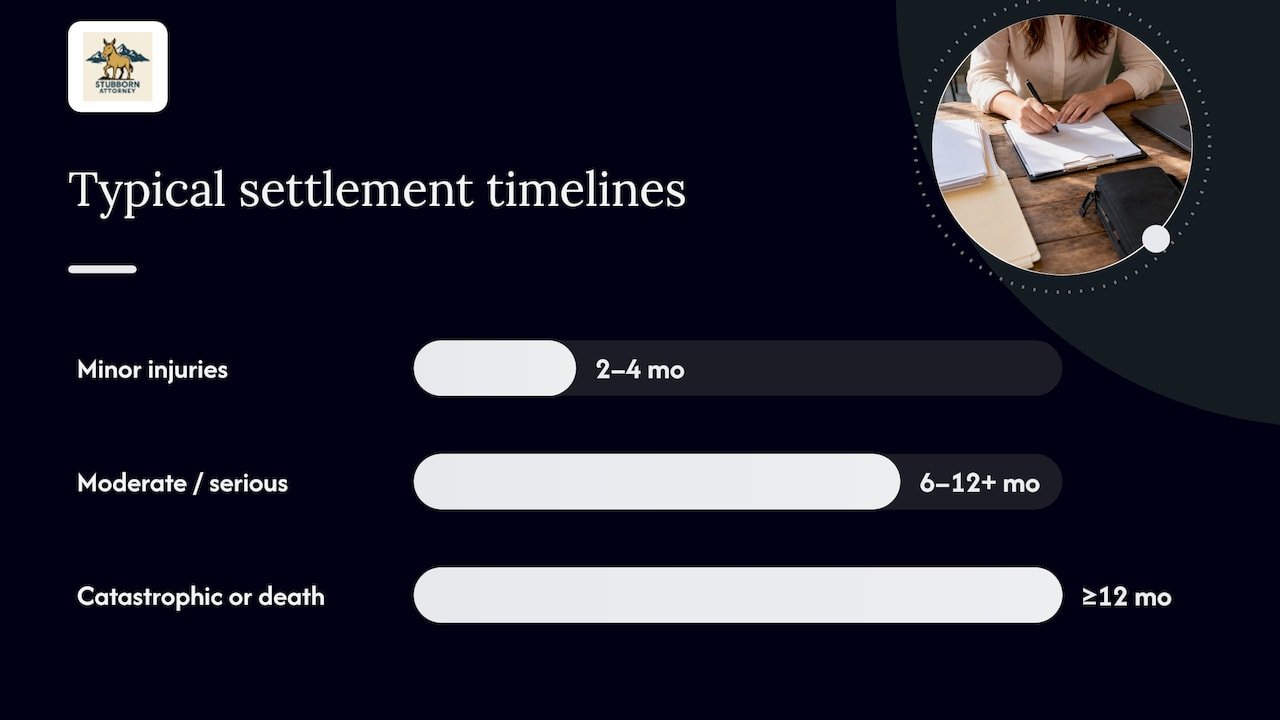
Minor cases can resolve in two to four months from the date of the crash. Moderate and serious injury cases more commonly take six months to over a year, largely because treatment itself takes longer and the demand package requires more medical documentation to support. Catastrophic cases and wrongful-death claims frequently take a year or more, particularly when they proceed into litigation, since they often require expert testimony on future care costs or lost earning capacity.
Filing a lawsuit does not mean your case is headed for trial. Most filed cases still settle before a courtroom date, often after mediation, a structured negotiation session with a neutral third party, or arbitration, a more formal process where a neutral decision-maker resolves the dispute. Filing suit tends to signal to the insurer that you are prepared to litigate, which sometimes moves a stalled negotiation forward. Our step-by-step guide to strengthening a claim covers the documentation habits that make each of these stages move faster.
Common insurer tactics, negotiation pitfalls, and what to avoid
Insurance adjusters are trained negotiators working for a company whose interest is paying as little as possible. Recognizing their tactics protects the value of your claim.
The first tactic is the low first offer paired with pressure to settle quickly. An early offer that arrives before you have finished treatment is almost never your case’s real value, and accepting it means signing a release that closes the door on any future claim, even if your injury turns out to be worse than initially understood.
- Recorded statements are often requested early, and anything you say can be used to argue your injuries are less severe or that you share more fault than you actually do.
- Broad medical authorizations let an insurer dig through your entire medical history, not just records related to the crash, looking for pre-existing conditions to blame for your current pain.
- Gaps in treatment get flagged as evidence that your injury was not serious or that something else caused your ongoing pain, even when the gap was due to scheduling, cost, or simply feeling better temporarily.
Pro Tip: Decline a recorded statement to the at-fault driver’s insurer until you have spoken with an attorney, and limit any medical authorization to records specifically related to the crash.
Pre-existing conditions deserve particular attention here. Colorado law allows you to recover for the aggravation of a pre-existing condition, meaning if a crash worsened an old back injury, you can still recover for that worsening, but insurers routinely use medical history as leverage to argue the current pain predates the crash entirely. Thorough documentation from before and after the accident, along with a treating physician willing to explain the distinction, is often what separates a denied claim from a paid one.
When hiring a Colorado personal injury attorney makes a measurable difference
Not every fender bender needs a lawyer. A minor claim with clear liability, modest medical bills, and a cooperative insurer can sometimes be handled directly. Certain situations change that calculation.
- Surgery or permanent impairment raises the value and complexity of a claim enough that an insurer will fight harder, which means you need someone fighting back.
- Disputed liability, where the insurer argues you share fault, turns into a negotiation over comparative fault percentages that directly affects your final recovery.
- Policy-limit issues, where damages exceed the at-fault driver’s coverage, require navigating UM/UIM claims or identifying other liable parties.
- Wrongful-death claims involve their own damage categories, statutory beneficiaries, and now the updated caps under HB24-1472, all of which benefit from experienced handling.
An attorney’s value shows up less in courtroom drama and more in the groundwork: building a complete demand package with medical records and expert input, understanding what an insurer’s internal valuation software is likely to spit out, and demonstrating actual trial readiness so the insurer knows a lowball offer will not simply be accepted. Our guide on when to hire an accident attorney covers this decision in more depth.
In a free consultation, ask direct questions: How many cases like mine have you handled? What is your fee structure? Who will actually handle my file? Most personal injury attorneys, including firms across Colorado, work on contingency, meaning you pay nothing unless they recover money for you, with the fee taken as a percentage of the settlement or verdict.
Author perspective: Ryan Malnar’s practical view on settlement value and insurer behavior
Before practicing personal injury law, Ryan Malnar worked as a claims adjudicator and adjuster for the federal government, which means he has sat on the other side of the table, evaluating claims the way insurers evaluate them now. That background shapes how Malnar Injury Law approaches negotiation: knowing what an adjuster is trained to look for, and where their internal valuation tends to undervalue real harm.
Two patterns show up again and again. First, clients who stop treatment too early, often because they feel better or cannot afford another copay, routinely see their claims undervalued, because an insurer reads a treatment gap as proof the injury was not serious. Second, clients who accept a first offer without a demand package built around complete medical documentation almost always leave money on the table, since that first number is calculated to close the file cheaply, not to reflect the case’s actual worth.
The firm has settled hundreds of injury cases and recovered millions of dollars in settlements for Colorado clients, and the throughline across those cases is consistent: the claims that resolve for the most money are the ones supported by complete records, clear liability documentation, and a demand package built to withstand scrutiny, not the ones rushed to a quick close.
If there is one habit worth adopting immediately, it is this: treat every doctor’s appointment and every piece of paperwork as part of building your case, because insurers are building their counter-argument from the moment they open a file.
— Ryan
How we think about settlements: a client-centered approach
Our approach to every settlement starts with the same priority: protect what the client is owed while making sure they can actually get the medical care they need during the process, not just at the end of it. That means immediate access to treatment regardless of a client’s financial situation, clear communication about where a case stands, and honest expectations about timeline rather than inflated promises.
A common misunderstanding is that a settlement is a single negotiation that wraps up quickly. In reality, most cases move through stages, treatment, documentation, demand, negotiation, and sometimes litigation, and rushing any one of those stages tends to cost the client money later. We would rather tell a client the honest timeline up front than create false urgency toward a quick, undervalued check.
StubbornAttorney: free case review and contingency-fee representation for Colorado crash victims
If you are navigating a Colorado car accident claim and unsure whether an offer reflects what your case is actually worth, a free case evaluation with Malnar Injury Law costs nothing upfront. We work on contingency, so you pay nothing unless we recover money for you, and every case is handled directly by attorneys rather than passed off to a high-volume case processing team.
A free consultation covers your accident details, a review of your medical treatment so far, and an honest read on where your claim likely stands given Colorado’s fault rules and damage caps.
- Bring your police report, medical records and bills to date, insurance correspondence, and any photos from the scene.
- Ask how the firm handles cases like yours and what the likely timeline looks like.
- Start with a free evaluation before accepting any offer from an insurance adjuster.
Explore our full range of services, review pricing plan details, or reach out directly through our Colorado Springs personal injury page to get started.
Sources
- Colorado Car Accident Calculator | Settlement Insight
- AN ACT (HB24-1472) — Colorado Session Laws
- 1994 session law amending statute of limitations (Colorado)
This article is general information, not a substitute for advice from a qualified lawyer. Consult a qualified legal professional about your own circumstances before acting on anything here.
FAQ
What is the average settlement for a car accident in Colorado?
The average paid bodily injury liability claim in Colorado was $36,314 for claim year 2022, with a 2020 to 2022 average of $33,900. Individual settlements vary widely based on injury severity, fault percentage, and available insurance coverage, so this figure works better as a benchmark than a prediction for any single case.
Do injections increase your settlement?
Additional medical treatment, including injections for pain management, typically increases the documented medical costs used to calculate both economic damages and any multiplier-based estimate of pain and suffering. Whether it meaningfully increases your final settlement depends on whether the treatment was reasonable, necessary, and clearly tied to the crash rather than a pre-existing condition.
Can I sue for emotional distress in Colorado?
Emotional distress falls under non-economic damages in a Colorado personal injury claim, and it is compensable alongside pain and suffering and loss of enjoyment of life. Since January 1, 2025, these damages are subject to the updated caps under HB24-1472, which raised the limit for many actions to $1.5 million.
How much are most car accident settlements?
Most Colorado car accident settlements fall between a few thousand dollars for minor soft-tissue injuries and roughly $75,000 for moderate injuries requiring more extensive treatment, with serious and catastrophic injuries settling well above that range. The statewide average paid bodily injury claim was $36,314 for claim year 2022, though this figure blends minor and serious claims together.