

Prove Hours of Service Violations From ELD Files in Truck Crash Claims
An hours-of-service violation happens when a commercial driver exceeds the driving or on-duty limits set in 49 CFR Part 386, as recorded by the vehicle’s electronic logging device. The immediate fallout typically includes an out-of-service order, a roadside citation, a mark on the carrier’s CSA record, and far steeper penalties if the driver falsified the log.
Table of Contents
- Federal hours-of-service rules that most often get broken
- Common HOS violations inspectors cite on the road
- Penalties, out-of-service orders, and license consequences
- ELDs, falsified logs, and why tampering draws the hardest penalties
- How HOS violations matter in a crash claim
- Contesting or appealing an HOS citation
- What repeated or severe violations cost beyond the fine
- Where HOS rules have changed and what it means now
- What carriers and drivers owe each other on compliance
- Preventing violations before they happen
- Our perspective on building HOS evidence into a crash claim
- If an HOS violation contributed to your crash, here’s what to do next
- FAQ
- Sources
Federal hours-of-service rules that most often get broken
The core rule is simple: after 10 consecutive hours off duty, a property-carrying driver gets 11 hours of driving time inside a 14-hour on-duty window, under 49 CFR §395.3. Once that 14-hour clock starts, it keeps running whether the driver is driving, loading, or stuck at a dock.
Weekly limits cap drivers at 60 hours on duty in 7 days or 70 hours in 8 days, depending on the carrier’s schedule. A 34-hour break resets that clock. Drivers also need a 30-minute break after 8 cumulative hours of driving, satisfied by any non-driving period, under FMCSA’s guidance.
Sleeper-berth drivers can split their required off-duty time into two periods (7/3 or 8/2), with the longer period counting toward the 10-hour reset. Short-haul operations and adverse driving conditions carry their own exceptions, both clarified in FMCSA’s 2020 rule revisions. Knowing which exception applied, or didn’t, is often the first question in disputing a citation.
Common HOS violations inspectors cite on the road
A single roadside stop rarely produces just one citation. Inspectors pull up to eight days of ELD data and compare it against what they observe, and overlapping violations show up often because one broken habit, like ignoring the 14-hour window, tends to cascade into others.
- 11-hour violation: driving past the daily driving cap recorded on the ELD.
- 14-hour window violation: driving after the on-duty window has closed, even with driving hours left.
- Missed 30-minute break: driving past 8 cumulative hours without a qualifying break.
- 60/70-hour violation: exceeding the weekly on-duty limit without a valid 34-hour restart.
- No record of duty status: missing or unavailable logs, often tied to ELD malfunction without paper backup.
Roadside fines vary by state and violation severity, but they sit well below the federal civil-penalty maximums: up to $4,812 per violation for a driver and up to $19,246 per violation for a carrier, with egregious violations exceeding limits by more than three hours drawing the maximum penalty.
Penalties, out-of-service orders, and license consequences
Civil penalties scale with severity. Federal maximums top out at $4,812 per violation for drivers and $19,246 per violation for carriers, with the harshest violations, those exceeding a limit by more than three hours, drawing penalties at the legal ceiling.
An out-of-service order under 49 CFR 395.13 stops a driver from operating until the violation clears, commonly a 10-hour rest period for 11-hour, 14-hour, or missed-break violations, according to enforcement guidance. Serious or repeated violations can also trigger CDL disqualification, and falsification cases carry the steepest exposure of all.
Every citation feeds the carrier’s HOS BASIC percentile under the Compliance, Safety, Accountability program, and lands on the driver’s Pre-Employment Screening Program record, where it stays visible to future employers for three years.
ELDs, falsified logs, and why tampering draws the hardest penalties
ELDs automatically record driving time, engine status, and location, but they don’t capture everything an inspector needs. That’s where supporting documents, fuel receipts, toll records, dispatch logs, come in: they corroborate or contradict what the device shows, and FMCSA guidance treats them as central to verification.
Falsification takes several recognizable forms:
- Shifting logged days to hide excess driving time.
- Running a second driver account to mask true hours.
- Misusing the personal-conveyance category to disguise on-duty driving.
Inspectors flag these patterns by cross-referencing receipts against the ELD’s own timeline, and CVSA bulletins instruct officers to cite 395.8(e)(1) or (e)(2) and place the driver out of service when records can’t be reconciled. Falsification cases routinely draw the highest penalties available under federal civil-penalty rules, and egregious cases can escalate into carrier-level investigations or criminal referrals.
How HOS violations matter in a crash claim
When a crash involves a commercial truck, the ELD file and the roadside inspection report become two of the most important documents in the case. Together with supporting documents, they establish whether the driver was legally allowed to be on the road at the moment of the crash, which speaks directly to negligence.
After a wreck, preserve:
- The ELD output file and any malfunction logs.
- The inspection report, if one was issued.
- Dispatch records and load/delivery paperwork.
- Fuel and toll receipts covering the days around the crash.
- Photos of the scene and the vehicles.
- Names and contact information for witnesses.
A carrier that pressured a driver to run over hours, or simply looked away while it happened, faces broader liability than the driver alone, which changes how a truck accident lawyer approaches settlement talks. Establishing fault often draws on the same evidentiary chain used in any car accident liability case, just applied to a heavier vehicle and a more regulated driver.
Drivers who believe a citation was wrongly issued can file a DataQs challenge, which routes the dispute to the issuing agency for review and correction.
Contesting or appealing an HOS citation
A citation isn’t the final word. The DataQs system lets a driver or carrier formally challenge a roadside violation they believe was recorded incorrectly, whether that’s a wrong CFR section, a misread ELD screen, or a violation that falls outside the eight-day inspection window CVSA instructs officers to review under Operational Policy 14.
The process starts with submitting a request through the DataQs portal, where the challenge routes to the agency that issued the citation, either a state inspection authority or FMCSA directly. That agency reviews the supporting evidence the filer submits: ELD exports, paper logs, fuel receipts, or dispatch records that contradict the cited violation.
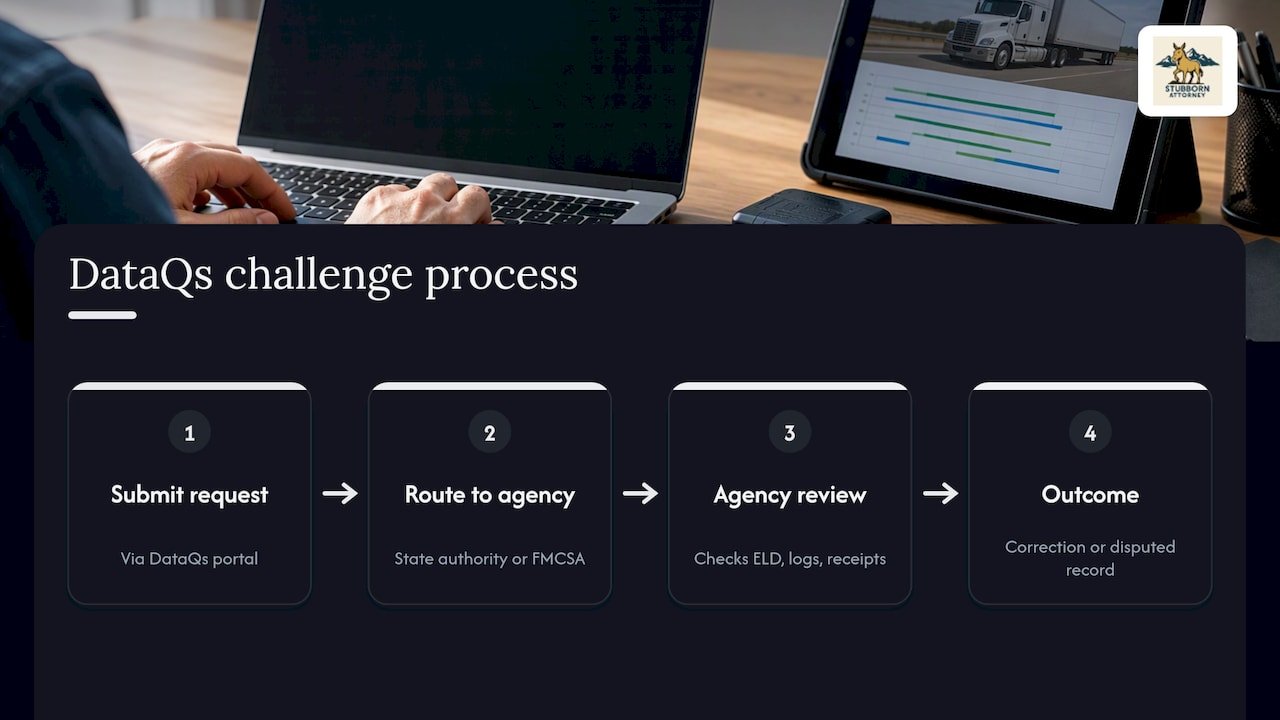
Strong challenges rely on documentation, not argument. A driver disputing a false RODS citation needs the actual ELD data file showing the discrepancy, not just a claim that the inspector misread the screen. A carrier disputing a citation tied to an ELD malfunction needs the paper logs the driver reconstructed under 49 CFR Part 395.8, since those logs are the legally required substitute when the device fails.
Timing matters. Filing promptly, while records and the inspector’s notes are still fresh, improves the odds of a correction. A successful DataQs challenge can remove the violation from the carrier’s CSA record and the driver’s PSP file, which matters for insurance rates and hiring decisions well beyond the citation itself. An unsuccessful one still creates a documented record that the violation was disputed, which can matter later if the same incident becomes part of a crash claim.
What repeated or severe violations cost beyond the fine
A single violation is a fine and a mark on a record. A pattern of violations changes the picture entirely. Repeated HOS violations push a carrier’s HOS BASIC percentile higher, which triggers more frequent roadside inspections and can draw a full compliance review from FMCSA.
For drivers, repeated or severe violations, especially falsification, can lead to CDL disqualification. A disqualified driver can’t legally operate a commercial vehicle for the disqualification period, which ends employment with most carriers immediately. Severe cases involving tampering or reengineered logs can also open the door to criminal exposure, particularly when the falsification concealed a condition that contributed to a crash.
Carriers face their own escalation path. A pattern of violations, especially where dispatch records suggest the carrier knew drivers were running over hours, can prompt FMCSA to downgrade the carrier’s safety rating. A conditional or unsatisfactory rating affects insurance costs, shipper contracts, and in serious cases, the carrier’s authority to operate at all.
None of this resets quickly. PSP records carry violations for three years, and a poor CSA history takes sustained clean inspections to improve. For a driver or carrier already facing one violation, the real cost is usually the next twelve months of heightened scrutiny, not the citation itself.
Where HOS rules have changed and what it means now
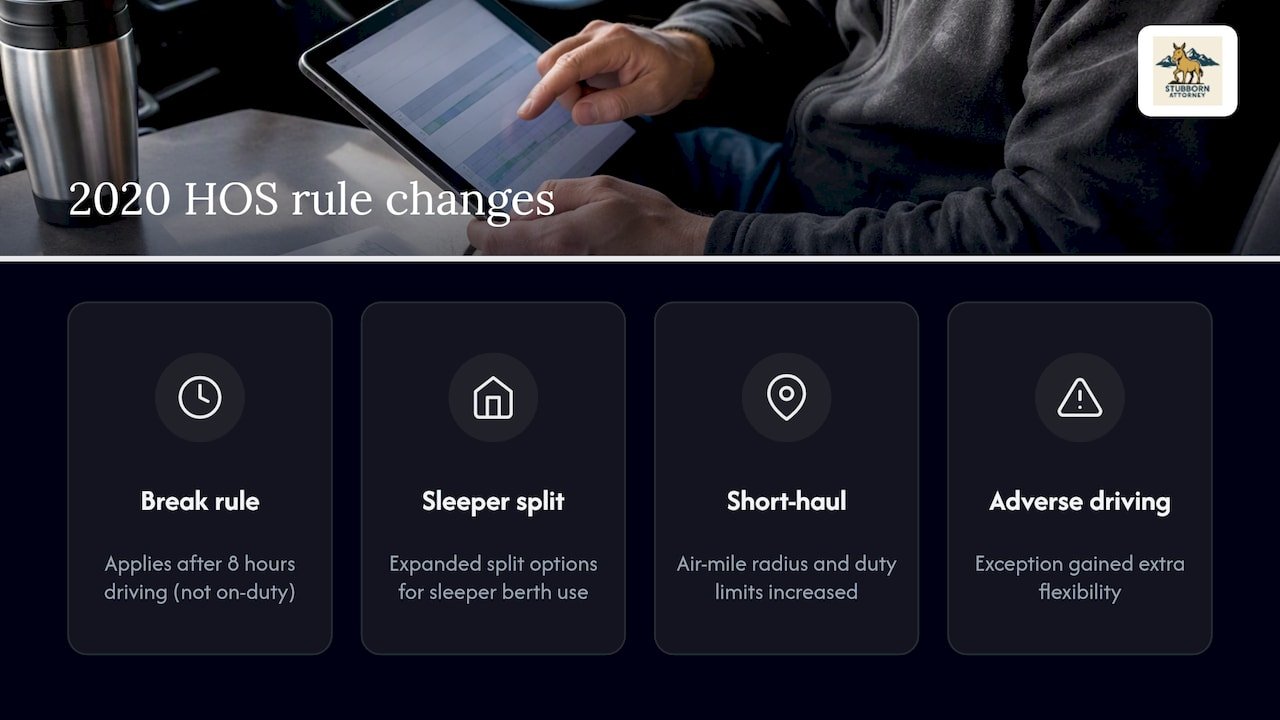
The HOS framework most carriers operate under today traces back to FMCSA’s 2020 rule revisions, which took effect September 29, 2020. Four changes reshaped how violations get assessed: the 30-minute break requirement shifted to apply only after 8 hours of driving time rather than on-duty time, sleeper-berth split options expanded, the short-haul exception’s air-mile radius and duty-period limits grew, and the adverse driving conditions exception gained extra flexibility.
Those changes matter for anyone reviewing older citations or comparing enforcement patterns, since a break violation cited under the pre-2020 standard wouldn’t necessarily be a violation under the current one. The Federal Register’s final rule lays out the specific provision language FMCSA adopted, which is the document attorneys and compliance officers reference when a citation’s legal basis is in dispute.
Since that rule took hold, enforcement attention has shifted toward ELD data integrity rather than the underlying driving limits themselves. CVSA’s inspection bulletins on false records and ELD tampering reflect that shift: the hard limits haven’t moved much in recent years, but how aggressively inspectors verify compliance through supporting documents has intensified. For drivers and carriers, that means the paperwork habits around ELD use now carry as much practical weight as the hour limits themselves.
What carriers and drivers owe each other on compliance
Preventing violations isn’t solely a driver’s job, and it isn’t solely a carrier’s either. Each side has a distinct set of obligations, and when either one skips theirs, violations follow.
Drivers are responsible for logging accurately in real time, taking required breaks even when a load is behind schedule, and reporting ELD malfunctions immediately so they can reconstruct records on paper as required. A driver who falsifies a log to hit a delivery window carries personal liability for that decision, regardless of pressure from dispatch.
Carriers are responsible for scheduling loads that can be completed within legal hours, maintaining ELDs in working order, and training dispatchers not to pressure drivers into running over. FMCSA’s coercion rule specifically prohibits carriers from threatening a driver’s job or pay to force an HOS violation, and a documented pattern of unrealistic scheduling can establish carrier-level fault separate from the driver’s own citation.
Where the two sides share responsibility is in supporting documentation. Drivers need to keep fuel and toll receipts; carriers need to retain dispatch and load records. Both documents protect the driver during an inspection and the carrier during a safety audit, and both become central evidence if a crash ever turns the violation into a lawsuit.
Preventing violations before they happen
Most HOS violations trace back to a handful of avoidable habits rather than deliberate rule-breaking. Building a few checks into the daily routine closes most of the gap.
- Check remaining drive time and on-duty window before accepting the next load, not after.
- Take the 30-minute break as soon as it’s due rather than pushing it to “catch up” later.
- Log personal conveyance only for genuine off-duty movement, never to extend a workday.
- Save fuel and toll receipts for every stop; they’re the first thing an inspector checks against the ELD.
- Report ELD malfunctions immediately and switch to paper logs that meet 49 CFR Part 395.8.
Pro Tip: Keep a week’s worth of receipts in the cab, not just the current day’s. An inspector reviewing an eight-day window will ask for backup you may not remember to print later.
At a roadside stop, hand over the ELD display calmly and answer only what’s asked. Volunteering explanations for gaps in the record often creates more confusion than it resolves.
Our perspective on building HOS evidence into a crash claim
Ryan Malnar spent years as a federal claims adjudicator before practicing personal injury law, which shapes how we read an HOS violation inside a crash file: not as a citation to mention, but as a piece of a liability chain that has to connect cleanly to the moment of impact. We pull the ELD export, the inspection report, and the dispatch records together early, because a violation that looks damning on its own can fall apart without the supporting documents tying it to the crash itself.
— Ryan
If an HOS violation contributed to your crash, here’s what to do next
We represent injured drivers and families in semi-truck accident cases on contingency, meaning you owe us nothing unless we recover compensation for you. When a commercial driver’s hours violation plays a role in a crash, that evidence needs to be preserved and secured before it disappears.
- Get medical care first, even if injuries seem minor at the scene.
- Preserve or request the ELD data, inspection report, and dispatch records as early as possible.
- Call for a free case review before speaking with the carrier’s insurer.
Our full range of services covers truck, car, and other commercial-vehicle crashes across Colorado, and a free consultation costs you nothing to start.
This article is general information, not a substitute for advice from a qualified lawyer. Consult a qualified legal professional about your own circumstances before acting on anything here.
FAQ
What happens if you violate hours of service?
A violation typically triggers a roadside citation, and depending on severity, an out-of-service order that keeps the driver off the road until the required rest period passes. It also adds a mark to the carrier’s CSA record and the driver’s PSP file, affecting future inspections and hiring.
What are the main rules under hours-of-service regulations?
The core limits are an 11-hour driving cap inside a 14-hour on-duty window, a 30-minute break after 8 hours of driving, and weekly caps of 60 or 70 hours depending on the carrier’s schedule, reset by a 34-hour break. Sleeper-berth drivers can split required off-duty time between two qualifying periods.
What are the two most common hours of service violations?
The 11-hour driving violation and the 14-hour on-duty window violation show up most often on inspection reports, frequently together since exceeding one tends to involve exceeding the other. Missing the 30-minute break is a close third, especially on tight delivery schedules.
What is the 14-hour rule in hours of service?
The 14-hour rule limits a driver to 14 consecutive hours on duty after coming off a qualifying 10-hour break, during which they can use up to 11 hours for driving. Once the 14-hour window closes, the driver must stop driving even if driving hours remain, under 49 CFR §395.3.