

Fault in Colorado car accidents: know your rights
TL;DR:
- Fault in Colorado car accidents is based on legal responsibility and can be shared, meaning liability can be distributed among parties.
- Understanding evidence like police reports, witness statements, and vehicle data is essential to accurately determine fault and protect your financial interests.
Most people assume fault in a car accident is simple. One driver ran a red light, so they’re 100% responsible. Done. But Colorado’s legal system is a lot more nuanced than that, and misunderstanding how fault actually works can cost you thousands of dollars or, worse, eliminate your right to any compensation at all. Whether you were rear-ended on I-25 or clipped on a mountain highway, knowing how fault is determined, disputed, and applied to your claim is one of the most important things you can do to protect your financial future and your legal rights.
Table of Contents
- How fault works in Colorado car accidents
- Key factors that influence fault after a crash
- Common accident scenarios and how fault is assigned
- How fault impacts your insurance claim and compensation
- What to do if you disagree with a fault determination
- Our perspective: why Colorado’s fault system isn’t as clear-cut as it seems
- Get help with fault disputes and maximize your Colorado claim
- Frequently asked questions
Key Takeaways
| Point | Details |
|---|---|
| Fault is critical in Colorado | Who is at fault determines who pays and whether you can recover damages after an accident. |
| Evidence makes or breaks cases | Police reports, witness statements, and expert technical analysis carry the most weight in fault disputes. |
| Partial fault reduces recovery | If you’re partly to blame, your compensation is reduced proportionally but not blocked unless you are 50% or more at fault. |
| Disputing fault is possible | You can challenge insurance decisions through reviews, expert input, and legal action if needed. |
| Legal guidance maximizes outcomes | Qualified injury attorneys and technical experts help protect your rights if fault is wrongly assigned. |
How fault works in Colorado car accidents
Fault in a Colorado auto accident refers to legal responsibility for causing the crash. It determines who pays for damages, medical bills, lost wages, and other losses. Colorado operates as an at-fault state, meaning the driver responsible for the accident bears financial liability through their insurance policy. This is different from so-called “no-fault” states, where each driver’s own insurance pays regardless of who caused the crash.
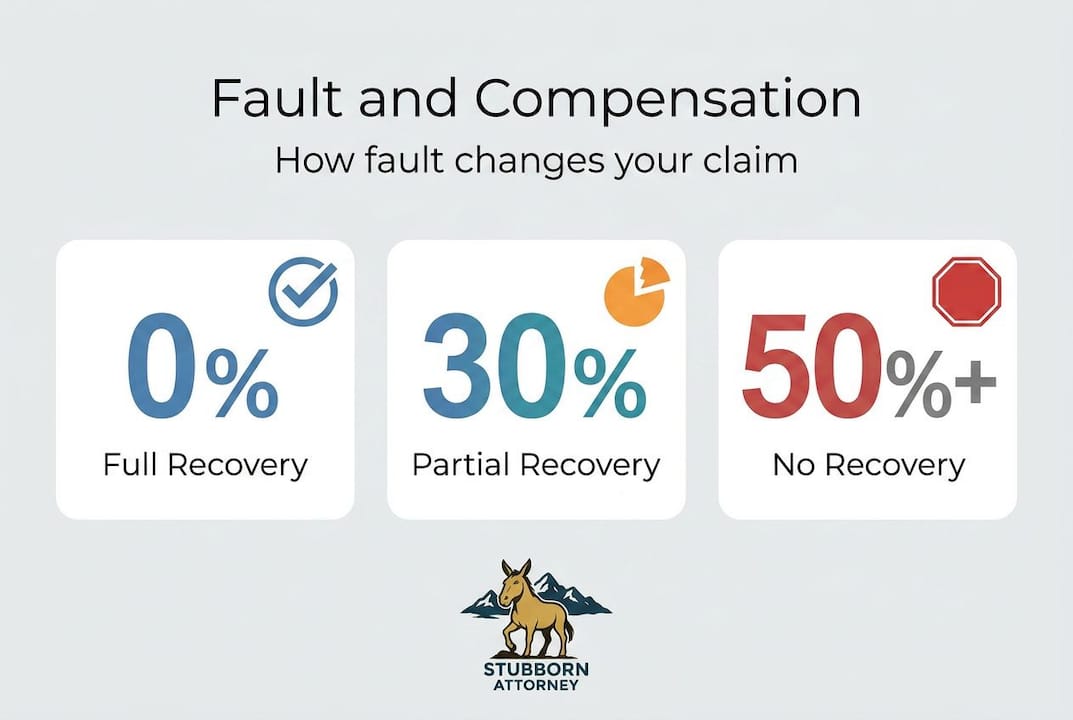
The legal framework Colorado uses is called modified comparative negligence. Under this rule, each party involved in an accident can be assigned a percentage of fault. Your ability to recover damages depends on that percentage. If you are found to be 50% or more at fault, you cannot recover anything. If you are 49% or less at fault, you can still recover, but your total compensation is reduced by your percentage of fault. For example, if your damages total $100,000 and you are 30% at fault, you can only recover $70,000.
This matters enormously, because insurance companies know exactly how this math works. They are motivated to assign you as much fault as possible to reduce what they owe you. Understanding this dynamic before you file a claim or speak with an adjuster is critical. Reviewing a car accident legal checklist after a crash can help you avoid early mistakes that make fault worse to dispute later.
What evidence is used to determine fault
Fault is rarely decided on someone’s word alone. Investigators, insurers, and courts rely on a range of evidence sources:
- Police reports: Officers at the scene document their observations and may include citations or opinions about who caused the crash.
- Witness statements: Bystanders or passengers can provide independent accounts that support or contradict a driver’s version of events.
- Physical evidence: Skid marks, debris patterns, vehicle damage locations, and road conditions all tell a story about how a crash unfolded.
- Surveillance and dashcam footage: Video evidence is increasingly common and often decisive in disputed claims.
- Crash data recorders: Many modern vehicles record speed, braking, and steering inputs in the seconds before impact.
- Accident reconstruction experts: These specialists apply physics-based analysis and objective data to help establish fault and causation in complex or disputed crashes.
“Fault decisions should never rest on one adjuster’s opinion. Physical evidence and technical analysis can completely change the outcome of a claim.”
One common misconception is that a citation automatically settles fault. A traffic ticket means a driver violated a law, but it does not legally bind the civil claim. Courts and insurers weigh the full picture. Another myth is that the driver who rear-ends another is always 100% at fault. That can be true, but if the front driver cut off traffic or brake-checked suddenly, fault may shift. Colorado law is built around shared responsibility, which means your rights after injury depend on the complete evidentiary record, not just who got a ticket.
| Fault percentage assigned to you | Recovery allowed? | Compensation amount |
|---|---|---|
| 0% | Yes | 100% of damages |
| 25% | Yes | 75% of damages |
| 49% | Yes | 51% of damages |
| 50% or higher | No | $0 |
Key factors that influence fault after a crash
Understanding the general principles is one thing. Next, let’s see what actually determines fault in real Colorado crash investigations.
Insurance adjusters, attorneys, and law enforcement each have their own method for evaluating a crash, but they all pay attention to a similar set of factors. Knowing what those factors are helps you understand why certain evidence matters so much in the days and weeks after your accident.
Traffic law violations are one of the first things investigators look at. Speeding, running a red light, failing to yield, and improper lane changes are all strong indicators of fault. If a citation was issued, it becomes part of the record, but as mentioned earlier, it is not automatically conclusive in a civil claim.
Physical and technical evidence often carries more weight than any statement. The location of vehicle damage, the direction of impact, and the distance vehicles traveled after the crash can be measured and analyzed objectively. Accident reconstruction specialists can use physics-based analysis to reverse-engineer the sequence of events, establishing speed, braking force, and collision angles with scientific precision.
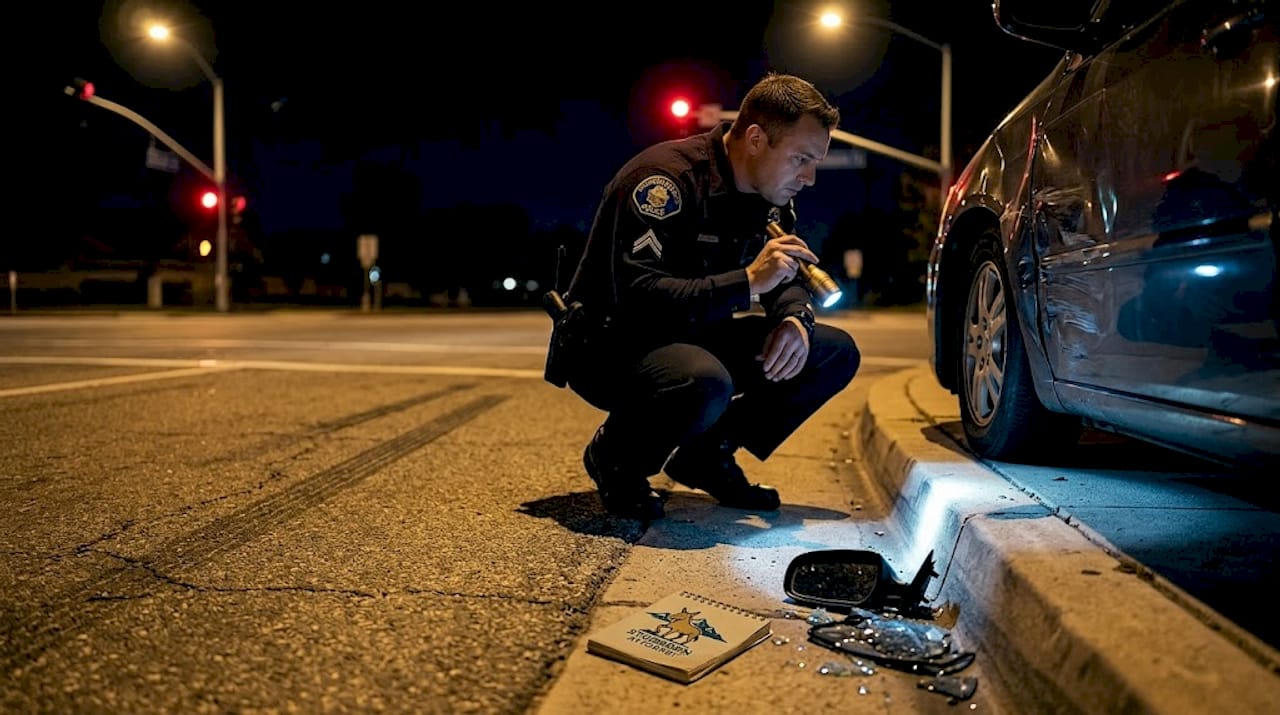
Statements from involved parties are double-edged. What you say immediately after the crash, especially to police or insurance adjusters, can be used to assign you a higher percentage of fault. Admitting you “didn’t see them coming” or apologizing at the scene can be interpreted as admissions. Be factual, be calm, and avoid speculating about causes until you have spoken with an attorney.
Insurance company investigations operate on a profit motive. Their adjusters are trained to gather information that minimizes payouts. An independent review of the car accident claim types applicable to your situation can help you understand what your insurer is actually obligated to cover versus what they would prefer not to pay.
Pro Tip: Never give a recorded statement to the other driver’s insurance company without consulting an attorney first. That recording will be scrutinized for anything that can be used to increase your assigned fault percentage.
Here is how different sources of fault evidence compare in terms of typical weight and reliability:
| Evidence type | Strength in claim disputes | Can be challenged? |
|---|---|---|
| Police report | Moderate to high | Yes, by technical experts |
| Witness statements | Moderate | Yes, through cross-examination |
| Crash data recorder | Very high | Rarely, requires technical analysis |
| Accident reconstruction | Very high | Yes, with competing expert |
| Party statements | Low to moderate | Yes, frequently disputed |
| Surveillance video | Very high | Rarely |
- Request the police report as soon as it is available, usually within days of the crash.
- Photograph all vehicle damage, road markings, signage, and debris before the scene is cleared.
- Identify any witnesses and collect their contact information on the spot.
- Do not post anything about the accident on social media, as this can be discovered and used against you.
- Preserve all vehicle data if your car has a black box or event data recorder.
Common accident scenarios and how fault is assigned
Now that we know the factors, let’s see how these rules play out in the accidents Coloradans actually experience.
Fault assignment is not abstract. It happens in recognizable, everyday crash scenarios. Understanding who typically bears fault in common situations helps you anticipate how your case might be evaluated.
-
Rear-end collisions: The driver who strikes from behind is almost always found primarily at fault. Colorado law requires drivers to maintain a safe following distance. However, if the front driver suddenly reversed, cut into a lane, or had non-functioning brake lights, partial fault can shift. A $80,000 damages case where the front driver is found 20% at fault still pays that driver $64,000.
-
Left-turn accidents: When a vehicle turning left is struck by oncoming traffic, the turning driver is typically at fault for failing to yield. Exceptions exist when the oncoming driver was speeding significantly above the limit or ran a red light. Accident reconstruction specialists using objective data have overturned initial fault assignments in these cases by proving the oncoming vehicle’s speed made a safe turn legally reasonable.
-
Multi-car pileups: These are among the most complex scenarios. Colorado’s I-70 mountain corridor sees its share of chain-reaction crashes, especially in winter. Fault is often distributed across several drivers, and reconstruction experts become essential. If you are assigned 15% fault in a five-car pileup, your recovery is reduced only by 15%.
-
Sideswipe accidents: When two vehicles traveling in the same direction make contact, fault usually falls on the driver who drifted or made an unsafe lane change. But road conditions, distracted driving by either party, and sudden obstacles complicate these cases significantly.
-
Intersection T-bone crashes: These often involve disputes about which driver had the right of way, signal timing, and vehicle speed. Skid marks and intersection camera footage are critical here.
Pro Tip: Even if you feel partially responsible, do not assume the case is lost. Under Colorado’s modified comparative negligence rule, being 49% at fault still allows you to recover more than half your damages. The exact percentage assigned can make a massive financial difference.
Understanding how partial fault works in practice is essential for financial compensation after a crash. Many Colorado accident victims abandon valid claims because they assume any share of fault disqualifies them entirely. That is simply not true, and there are strong reasons to pursue an injury case even when fault is shared. Depending on your injuries, you may be entitled to economic damages like medical bills and lost income, and non-economic damages like pain and suffering. Reviewing Colorado personal injury compensation types gives you a clearer picture of what a successful claim can actually recover.
How fault impacts your insurance claim and compensation
So, how does fault actually change the outcome of your insurance claim or possible lawsuit in Colorado?
The short answer: fault percentage is the single most powerful number in your claim. Insurance companies build their settlement offers around it. They assign fault percentages internally during their investigation and then use those numbers to calculate the maximum they believe they owe you. The problem is that their internal fault determination is not neutral. It favors their bottom line.
Here is how fault percentage directly affects your claim:
- If you are found 0% at fault, the other driver’s liability insurance should cover all your documented damages, subject to policy limits.
- If you are found 20% at fault, you receive 80% of your total calculated damages. On a $150,000 claim, that difference is $30,000.
- If you are found 49% at fault, you can still recover 51% of your damages, but every percentage point matters enormously.
- If the insurer assigns you 50% or more, they may deny the claim outright under Colorado law.
Disputing the insurer’s fault assignment is one of the most valuable things an experienced attorney can do. Insurers make initial determinations quickly, often before a thorough investigation is complete. They may rely on a one-sided police report or a recorded statement they obtained without giving you time to consult counsel. Following the injury compensation workflow used by experienced personal injury attorneys helps ensure no critical step gets skipped in building your claim.
Practical tips for negotiating with insurers:
- Never accept the first settlement offer. Initial offers almost always undervalue your claim.
- Request the insurer’s written explanation of how they assigned fault percentages.
- Get an independent medical evaluation if the insurer disputes injury severity.
- Document every interaction with the insurer in writing, including phone call summaries.
- Obtain independent technical review of the crash if fault is disputed. As physics-based crash analysis demonstrates, objective data can override an adjuster’s opinion.
When fault is genuinely disputed or when injuries are serious, having an attorney is not just helpful. It is often the difference between a fair settlement and walking away with nothing. Attorneys know how insurance companies think because experienced Colorado injury lawyers have worked inside that system and understand exactly how claims are evaluated and undervalued.
What to do if you disagree with a fault determination
But what if the fault decision doesn’t match the facts, and you need to challenge or appeal it?
Disagreeing with an insurance company’s fault determination is more common than most people realize. Insurers work fast, and fast often means incomplete. If you believe you were wrongly assigned fault or that your share was inflated, you have real options.
-
Request a written review: Ask the insurer to provide a formal written explanation of how fault was determined. This creates a record and may reveal weaknesses in their analysis.
-
Compile your own evidence: Gather everything you preserved from the scene, photos, dashcam footage, witness contact information, medical records, and any surveillance footage from nearby businesses.
-
Hire an accident reconstruction expert: Physics-based analysis conducted by a qualified specialist can produce an independent technical report that directly contradicts the insurer’s version of events. This kind of evidence is extremely difficult to dismiss.
-
Consult a personal injury attorney: An attorney experienced with Colorado fault disputes knows how to apply pressure effectively. They understand what evidence will move an insurer to reconsider and when escalation is warranted. Look for the top qualities of an injury lawyer when choosing who represents you.
-
File a formal complaint: Colorado’s Division of Insurance handles complaints about insurer conduct. If an insurer is acting in bad faith by distorting fault findings, this regulatory option puts real pressure on them.
-
Pursue civil litigation: When settlement negotiations fail, filing a lawsuit is often the most effective path. A jury, not an insurance adjuster, becomes the fact-finder. Juries in Colorado have awarded significantly more than insurance companies initially offered in disputed fault cases.
“Insurance adjusters are not neutral arbiters. They are employees of a company with a financial interest in minimizing payouts. Independent legal and technical review is your most powerful counterweight.”
For personal injury dispute guidance, consulting resources beyond your insurer is essential. The earlier you involve experienced counsel, the stronger your position in any challenge.
Our perspective: why Colorado’s fault system isn’t as clear-cut as it seems
After over a decade of representing injured Coloradans and working as a former federal claims adjudicator, I can tell you something that rarely appears in legal guides: the initial fault determination is not the final word. Not even close.
Insurance companies move fast because speed benefits them. A quick determination, made before you’ve had time to gather evidence or consult an attorney, sets the baseline. Once that number is in their system, shifting it takes effort, evidence, and someone who knows where to push. Most injured people don’t know they can push at all.
The cases I see go wrong are almost never the dramatic ones. They are the ordinary ones where someone accepted a fault percentage they didn’t deserve because they didn’t know they had grounds to contest it. A 20% fault assignment sounds reasonable until you realize it just cost you $30,000 on a significant injury claim. Small numbers have large consequences.
Another pattern I see regularly is underutilization of technical evidence. Drivers don’t think to mention dashcam footage. They don’t know their car’s data recorder captured braking data. They assume the police report is the whole story. It almost never is. Reviewing a Colorado accident checklist immediately after a crash helps preserve exactly the evidence that later makes a fault dispute winnable.
The most costly error? Talking too much, too soon. Adjusters are trained to ask open-ended questions that invite you to speculate. “What do you think caused the accident?” is not a casual question. Your answer can be used to assign you a higher fault percentage. Say what you know. Say nothing you don’t. And consult an attorney before you give any formal statement.
Colorado’s fault system rewards preparation. It rewards people who gather evidence, document injuries consistently, and understand the rules of the game. It often punishes those who assume the system will figure things out on their own. We are stubborn in our pursuit of the right outcome for every client because we know how easily a legitimate claim can be undervalued when nobody is fighting for it.
Get help with fault disputes and maximize your Colorado claim
If you’re facing a fault dispute or want to protect your legal rights after a Colorado auto accident, here’s how professional help can make a difference.
At Malnar Injury Law, now known as StubbornAttorney.com, we represent only injured victims because that is where our commitment lies. We have settled hundreds of injury cases and recovered millions of dollars for people across Colorado, including many whose fault percentages were initially inflated by insurers. Understanding your rights after injury is the foundation of every strong claim. Start with a thorough injury case evaluation to understand what your specific situation is worth and what fault issues need to be addressed. You don’t need to figure this out alone, and you shouldn’t have to.
Frequently asked questions
Is Colorado a no-fault state for car accidents?
No, Colorado is an at-fault state, meaning the driver determined to be responsible for the crash must cover the resulting damages through their liability insurance.
Can you recover damages if you are partially at fault?
Yes. Under Colorado’s modified comparative negligence rule, you can recover damages as long as your fault percentage is below 50%, though your compensation is reduced by your share of the blame.
What evidence is most important for proving fault in a Colorado crash?
Police reports, witness statements, vehicle data, and physics-based accident reconstruction are the most powerful tools for establishing or challenging fault in Colorado crashes.
How does fault affect your Colorado insurance claim?
Your assigned fault percentage directly reduces the compensation you can recover. A 30% fault assignment on a $100,000 claim means you receive a maximum of $70,000, making every percentage point financially significant.
What should you do if you disagree with the insurance company’s fault decision?
Request a written explanation of their determination, gather independent evidence, consult a qualified accident reconstruction specialist, and speak with a personal injury attorney who can challenge the finding through negotiation or litigation if necessary.