

Lowball Insurance Settlement in Colorado: What to Do Next
A lowball insurance settlement is an offer far below what your claim is worth, and the first offer after a crash very often is. Do not sign anything yet. You can reject it, counter it, and ask the insurer to explain in writing how it got its number. Signing a release usually ends your right to more money for that crash, so the order matters: finish treatment, add up every loss, then respond.
This guide shows how to tell a fair offer from a lowball, why insurers make low offers, what to do in the first week, and which Colorado rules help you. It also covers when a lawyer changes the math. We are a Colorado personal injury firm, so we see these offers every week.
Table of Contents
- What counts as a lowball offer
- Why insurers make low offers
- What to do in the first week after a low offer
- Can you decline an insurance settlement offer?
- Colorado rules that work in your favor
- Lowball offers on the car itself
- How much of a settlement do you actually keep?
- When to bring in a lawyer
- Our perspective
- Talk to us before you sign
- FAQ
- Sources
What counts as a lowball offer
A lowball offer is not just “less than I hoped.” It is an offer that leaves out or undervalues parts of your loss. Nolo explains that an offer may be too low if it ignores medical bills, lost income, vehicle damage, other economic losses, pain and suffering, or the insurance coverage actually available. The same source says an insurer’s first offer is almost always low compared with what the claim is really worth, and that it often arrives before you understand your full losses.
That last point is the heart of it. Offers tend to come early, while you are still in treatment and still unsure whether you will miss more work. A number that looks like relief in week three can look very different in month six.
Signs an offer is too low
No single sign proves it, but these patterns show up again and again:
- It arrives fast. An offer before you have finished treatment, or before you have all your bills, is a guess made on partial information.
- It is vague. The letter gives a total but does not break it into medical bills, wage loss, property damage and pain and suffering.
- It matches only the bills you have sent. If it equals your medical bills to date and nothing more, it pays nothing for pain, disruption or future care.
- It treats future care as zero. If your doctor expects physical therapy, injections or surgery, the offer should account for that.
- It blames you without explanation. Insurers sometimes assign you a share of fault to shrink the payment. Ask what facts support that.
- It comes with pressure. A short deadline, a request for a recorded statement, or a release in the first envelope are all red flags.
A simple way to check the number
Add up what you can document:
- Medical bills to date, and your doctor’s estimate of future treatment.
- Lost wages, plus any reduced earning ability.
- Vehicle repair or replacement, and out-of-pocket costs such as rental, towing and prescriptions.
- Pain, inconvenience and loss of enjoyment, which have no receipt but are real damages.
If the offer is not clearly larger than lines 1 to 3 combined, it is paying little or nothing for line 4. That is the most common shape of a lowball.
Why insurers make low offers
It is not personal, and it is not always a scheme, but the incentives are plain. AutoInsurance.com notes that insurers may lowball to save money and to settle claims cheaply before the full extent of your injuries and long-term costs is known. It adds that an insurer has a reason to pay the lowest amount you will accept, and many hope you will not push back on a first offer.
The pressure is sharper when you are not the insurer’s customer. Clark.com points out that companies are often tempted to lowball third-party victims because they have no direct customer relationship with them. If the other driver caused your crash and you are dealing with that driver’s insurer, that insurer owes you nothing in loyalty. Its adjuster works for the company’s bottom line.
Attorney Richard P. Console Jr. goes further and calls such offers predatory, because they tend to land when a claimant is still in treatment and uncertain about their financial future. You do not have to share that view to take the practical lesson: the timing of an offer tells you something.
There is also software and process. The Consumer Federation of America’s claims guide advises claimants to ask whether the insurer uses third-party evaluators or injury-evaluation software, and to supply their own medical bills and records rather than wait for the insurer to collect them. A number produced by software from a thin file is going to be low.

What to do in the first week after a low offer
Stay calm and slow the process down. Nothing in the first week requires you to accept.
1. Do not sign, and do not give a recorded statement yet
A release gives up your right to further legal action over the crash. If a payment arrives with a release attached, hold both. Cashing a check marked as full and final settlement can create problems, so read what it says first.
2. Ask for the offer in writing, itemized
The Colorado Division of Insurance advises consumers to request an itemized, written explanation of the settlement offer and to ask the adjuster to cite specific policy language if a claim is denied or disputed. That advice came in a storm-damage context, but the principle holds for any claim: make the insurer show its work. The NAIC says the same in its auto claims guidance, noting that when you disagree with a settlement the insurer should explain its decisions in writing.
A useful email is short:
Please send an itemized breakdown of your settlement offer, including how you valued medical expenses, lost income, property damage and non-economic damages, and identify any policy provisions or fault findings you relied on.
3. Keep treating, and follow your doctor
Nolo advises waiting until treatment has ended or you have reached maximum medical improvement, so the full damages are known. Gaps in treatment give the insurer an argument that you were not really hurt. If cost is the barrier to seeing a doctor, tell us early, because that is a problem we can often solve. We help clients get medical care regardless of their financial situation.
4. Build your documentation
AutoInsurance.com’s guidance suggests gathering repair estimates, medical bills, extra photographs, vehicle-value evidence, medical records and the police report, then asking for a written explanation and making a documented counteroffer when the amount leaves out or undervalues your losses. Add a simple journal of symptoms, missed events and sleep or work problems. Details written down at the time carry more weight than memory a year later.
Our page on what evidence you need after a Colorado Springs car accident lists what we ask clients to collect.
5. Counter in writing
A counteroffer should name a figure, list your documented losses and attach proof. Keep it factual. Do not threaten, and do not say what you would “take.” Leave room to move.
Can you decline an insurance settlement offer?
Yes. Nolo says you can reject or counter the first offer, and that rejection almost never causes the insurer to withdraw it. More often it starts real negotiation. The risk is not in saying no. The risk is in saying yes too early, because a signed release is hard to undo.
What can happen if you reject:
- The insurer raises its number, often modestly at first.
- It holds firm and waits to see if you will accept or let time pass.
- It disputes a specific item, such as a treatment it calls unnecessary.
- If talks stall, the next step is a lawsuit, where a judge or jury, not an adjuster, decides the value.
That last point matters because of the clock. Under C.R.S. § 13-80-101, injury and property claims from motor vehicle crashes generally must be filed within three years after the claim accrues. Negotiating does not stop that clock. Some claims have shorter deadlines, such as notice rules when a government vehicle is involved, so confirm your deadline with a lawyer early instead of assuming you have three years.
Colorado rules that work in your favor
The state’s noneconomic damages cap is much higher now
Insurers value pain and suffering with the state’s cap in mind. For civil actions filed on or after January 1, 2025, Colorado raised the cap on noneconomic damages from $250,000 to $1.5 million, with inflation adjustments scheduled to begin in 2028. If an adjuster’s thinking still seems anchored to the old ceiling, that is worth challenging. Our guide to Colorado car accident settlements under the new cap walks through how this affects real claims.
You can complain to the Division of Insurance
If you believe an insurer is acting unfairly or not honoring its contract, the NAIC says you may file a complaint with your state’s department of insurance. In Colorado that is the Division of Insurance. A complaint will not raise a bodily injury offer by itself, and it is better suited to disputes over how your own insurer handled your policy, but it puts the file in front of a regulator. In its FY 2024-25 complaint report, the division described pressing an insurer to reimburse $500 in tear-down and administrative fees for a consumer, which shows that these complaints can produce concrete corrections.
Appraisal clauses
Many policies include an appraisal clause for disputes over the amount of a loss, most often vehicle value. The NAIC notes that consumers can use the policy’s appraisal clause where it exists. Check your policy for it before you accept a total-loss number you doubt.
If your own insurer is the one lowballing you
The rules change when the insurer is yours and you are claiming benefits under your policy, such as collision, uninsured motorist or med-pay coverage. Colorado law lets a first-party claimant whose benefits were unreasonably delayed or denied sue for attorney fees, court costs and two times the covered benefit. This does not apply to a claim against the other driver’s insurer, and a low offer is not automatically unreasonable. But a pattern of stalling, unexplained denials or ignoring your documents can cross the line. Read more in our overview of insurance bad faith and our evidence plan for Colorado bad faith claims.
Lowball offers on the car itself
Property damage is where many people first meet a lowball. A total-loss offer that is too low usually means the insurer picked comparison vehicles that are not truly comparable.
The NAIC’s model claims regulation describes a defensible valuation as the actual cost of a comparable vehicle, including applicable taxes, license and transfer fees, less your deductible, with itemized, measurable deductions and a full explanation of the basis. The same model says that if you report within 35 days of receiving the claim draft that the settlement cannot buy a comparable car, the insurer should reopen the file. Treat this as a model standard, not a guarantee: it is not automatically binding law in every state, so use it as a benchmark when you ask for an explanation, and not as a deadline you can cite as Colorado law.
Two practical Colorado notes from the state’s regulator:
- If a repair estimate falls below your deductible, the insurer will not issue a payment, the Division of Insurance reminds consumers. A low number is not always a lowball; sometimes it is simply under the deductible.
- If the payout does not cover your loan balance, gap protection, if you bought it, may cover the difference. Check your loan paperwork before you assume you owe the lender the shortfall.
For step-by-step help, see our guide to maximizing a Colorado total loss claim. If your car was repaired but lost resale value, ask about diminished value in Colorado.
One more note on scope. If you were hurt while working, for example driving for your employer when another car hit you, workers’ compensation runs on a separate benefit system with its own formulas. A Colorado workers’ comp settlement chart and calculator can help you see how those benefits are estimated, and a third-party injury claim against the at-fault driver may still exist alongside it.
How much of a settlement do you actually keep?
The headline number is not what lands in your account. When you weigh an offer, subtract what comes out of it:
- Attorney fees, if you hire a firm. On a contingency fee arrangement you pay no fee unless there is a recovery, and the fee comes out of that recovery.
- Case costs, such as records, expert opinions and filing fees.
- Medical liens and reimbursement claims, from health insurers, medical providers or government programs that paid your bills.
- Unpaid balances, such as a car loan shortfall.
Here is a worked example, using round numbers for illustration only and not a prediction. Suppose a $25,000 offer arrives, and you have $9,000 in medical bills, of which a health insurer is owed $5,000 back. The remaining $20,000 is before fees and costs. If you accepted alone, you would keep about $20,000. But if the $25,000 was a lowball and a documented claim could reasonably be worth much more, then the $5,000 you saved on fees does not make up for the gap. The right comparison is not offer versus fee. It is offer versus what the claim would likely resolve for after a lawyer’s work, net of that fee.
We cannot tell you that comparison without your records. We can say that liens are often negotiable, and that reducing them is part of getting more money to you.
For typical ranges and the factors that move them, see our pages on financial compensation after a Colorado crash and Colorado whiplash settlements.
When to bring in a lawyer
You can handle a small, clear claim yourself: minor property damage, no injury, a fair explanation. Bring in a lawyer when any of these is true:
- You have ongoing treatment, injections, surgery or a doctor discussing permanent limits.
- You missed significant work or cannot do your old job.
- The insurer disputes fault or says your injuries came from something else.
- The offer arrived with a release before you finished treatment.
- The at-fault driver may be underinsured, or several parties and policies are involved.
- The insurer has gone quiet, delayed without reason, or refuses to explain its number.
The Colorado Division of Insurance notes that consumers are not required to hire a public adjuster, and if you do, the adjuster should be licensed in Colorado and the contract read carefully. A public adjuster generally helps with property claims, not injury claims. Bodily injury negotiation and litigation is a lawyer’s job.
For more on timing, read when to hire an automobile accident attorney and why legal representation matters in car accident claims. Our piece on why attorneys fight insurance companies in Colorado explains what changes once an insurer knows you have counsel.
Our perspective
We have settled hundreds of injury cases and recovered millions of dollars for clients, and almost every one began with a number we thought was too low. What stays with us is how reasonable those first offers sound. The adjuster is polite, the letter is official, and the amount feels like help when your bills are stacking up.
Before this work, Ryan was a claims adjudicator and adjuster for the federal government. He knows how large insurers and government agencies evaluate claims from the inside: what goes in the file, what moves a reserve, and which documents change a valuation. The most reliable thing we have learned is that a number rises when the file is complete and the person on the other side believes you will not walk away. That is what our name means. A mule does not bolt and does not stop on the trail because the climb is steep.
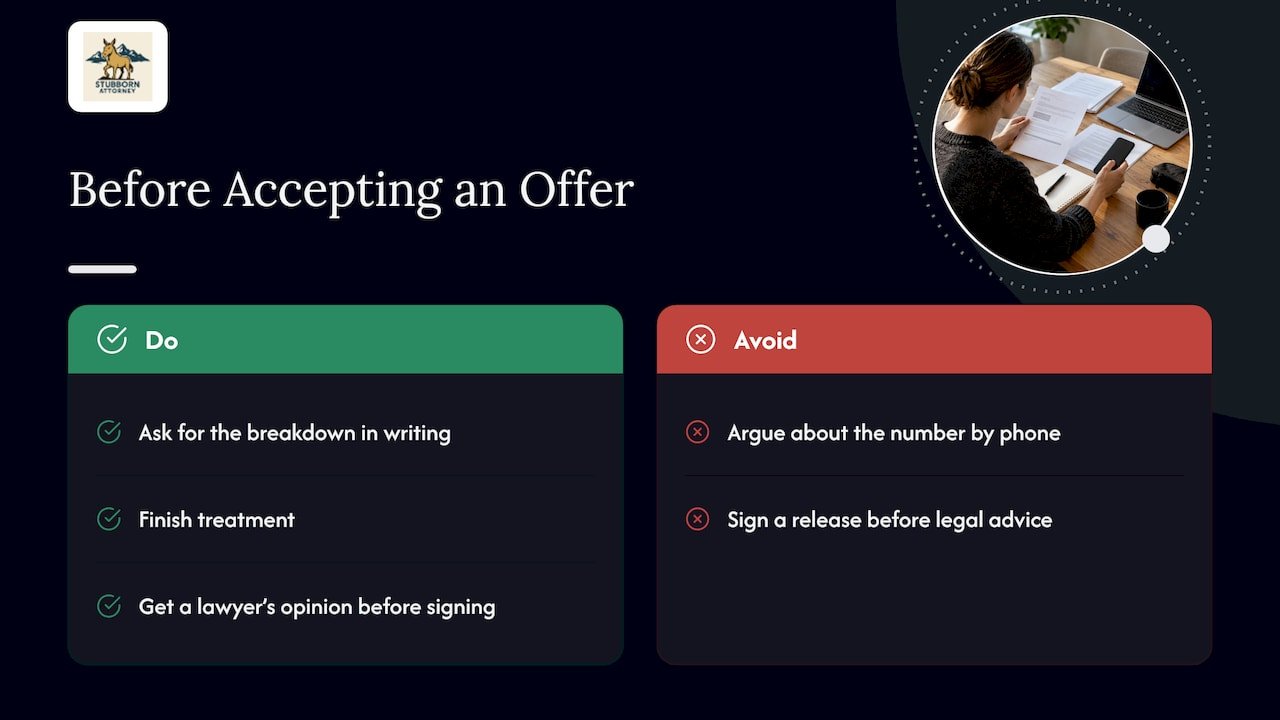
Our firm represents only injured people. Your case is handled directly by attorneys, not passed along like a case mill file. Our advice for anyone holding a low offer is the same advice we would give family: do not argue about the number on the phone, ask for the breakdown in writing, finish treatment, and get a lawyer’s opinion before you sign a release. Most people do not realize how much room exists until someone documents it.
— Ryan
Talk to us before you sign
If you are holding a low offer after a crash in Colorado Springs or elsewhere in the state, we will review it with you. We work on a contingency fee basis, which means you pay nothing unless we recover money in your case. Start with our Colorado Springs car accident lawyers page for a free case review, or see everything we handle, from motorcycle and semi-truck crashes to wrongful death.
FAQ
What should I do if an insurance company lowballs me?
Do not sign a release or accept the check as final. Ask the insurer for an itemized written explanation of its number, gather your bills, records, photos and wage proof, and send a documented counteroffer. If the offer arrived early or you are still in treatment, speak to a lawyer before responding further.
Why is my settlement offer so low?
Common reasons are that treatment is not finished, so future costs are not counted, the insurer is using software or a thin file, or it is assigning you part of the fault. Sometimes it also leaves out pain and suffering. A written breakdown usually shows which of these applies.
How much of a $25,000 settlement will I get?
It depends on fees, case costs, medical liens and any unpaid balances. With a contingency fee, the lawyer’s percentage and costs come out of the recovery, and liens are often repaid from it too. Ask any lawyer for a written estimate of your net amount before you agree.
Can you decline an insurance settlement?
Yes. You can reject or counter any offer. Rejection rarely causes the insurer to withdraw it and usually leads to negotiation. Just keep in mind Colorado’s general three-year deadline for motor vehicle injury lawsuits, and confirm the exact deadline for your situation.
Sources
- Nolo: car insurance settlement offer options
- AutoInsurance.com: what to do if your auto insurance payout is too low
- Clark.com: lowball insurance estimates
- National Law Review: beware of lowball offers from auto insurance companies
- Consumer Federation of America: navigating auto claims
- NAIC: what you should know about filing an auto claim
- NAIC: consumer auto insurance guide
- NAIC: unfair property/casualty claims settlement practices model regulation
- Colorado Division of Insurance: consumer advisory
- Colorado Division of Insurance: 2025 annual complaint and recoveries report
- Colorado Division of Insurance: insurance FAQs on gap protection
- Colorado legislature memo on statutes of limitations
- Colorado HB24-1472: raise damage limit in tort actions
- C.R.S. 10-3-1116: remedies for unreasonable delay or denial of benefits