

Household Services Damages in a Colorado Car Accident Claim
If a crash left you unable to cook, clean, drive the kids, mow the lawn or care for a parent, Colorado law treats that as a real, dollar-valued loss. It is called loss of household services. It is an economic damage, so it is recoverable on top of medical bills and lost wages, and it is not subject to the cap on pain and suffering. It is also one of the most commonly skipped items in a claim, because insurers rarely volunteer it and many injured people never think to ask. At Malnar Injury Law, now StubbornAttorney.com, we represent injured Colorado drivers and families on a contingency basis: you pay nothing unless there is a monetary recovery in your case. This guide explains what household services damages are, how they are valued, and how to build the proof.
Table of Contents
- What household services damages are
- Which tasks and losses can qualify
- Why household services are not capped like pain and suffering
- How household services are valued
- Building the proof
- How this fits with medical bills and lost wages
- Where claims go wrong
- Perspective: why this category gets overlooked
- Getting help with your claim
- FAQ
- Sources
What household services damages are
Colorado juries are guided by pattern jury instructions written by a Supreme Court committee. Instruction 6:6 describes the damages for loss of household services the injured spouse would have performed, along with any resulting expenses the plaintiff has had or will have in the future. In plain terms, it covers the work that keeps a home running and that you can no longer do, or can do only with pain or help, because of the collision.
That work is real even when no paycheck comes with it. If you used to handle the laundry, yard, meals, repairs and school runs, and now you can’t, someone has to do it. The law treats the cost of that gap as part of your loss.
Two features make this category worth understanding early:
- It is economic. Under Instruction 6:1, juries must consider economic losses you have had or will probably have, including lost earnings, reduced earning ability, and reasonable and necessary medical and other expenses. Household services sit in that same family of losses.
- It looks forward. The instruction covers losses you have already had and those you will probably have in the future. A back injury that will limit lifting for years produces years of lost household help, not just the first few months.
Which tasks and losses can qualify
Think of the full list of unpaid work in your home. Typical examples in a car accident case include:
- Cooking, grocery shopping and meal planning
- Cleaning, laundry and general housekeeping
- Yard work, snow shoveling and routine home maintenance
- Child care, school transportation and help with homework
- Caring for an aging parent or a disabled family member
- Managing the household’s errands, appointments and paperwork
The test is not whether you hired a housekeeper before the crash. The instruction speaks of services the injured person would have performed and the resulting expenses, so the lost work itself is the loss. If you already pay for help, those bills are evidence. If you never did, the cost of replacing your labor is how the loss is measured.
Spouses, children and the household
The rules reach beyond the injured adult. When a child is hurt, Instruction 6:3 allows parents to recover past and future loss of household and similar services the child would have provided until age 18 or emancipation. Our guide to Colorado child injury claims covers what parents need to know when a minor is the injured person.
When one spouse is injured, the other often absorbs the extra work. The jury instructions’ Notes on Use for 6:6 say that when the uninjured spouse’s replacement-services expenses could also fit the injured spouse’s damages under 6:1, a cautionary instruction should be given to prevent double recovery. The same replacement cost cannot be paid twice. That is a reason to present the claim as one coordinated picture of the household rather than as separate pieces.
Why household services are not capped like pain and suffering
Colorado limits noneconomic damages, the category that includes pain and suffering and emotional distress. Under HB 24-1472, which took effect January 1, 2025, the limit for most injury claims that accrue on or after that date is $1.5 million. Medical malpractice and wrongful death are governed separately, and wrongful death noneconomic damages are capped at $2.125 million, with no cap for felonious killings. The $1.5 million figure is scheduled for an inflation adjustment starting January 1, 2028, and every two years after that, using the Denver-Aurora-Lakewood consumer price index.
For claims filed before January 1, 2025, the older limit was $250,000, which a court could raise to as much as $500,000 on clear and convincing justification. Which version applies to you can turn on when your claim accrued, which is why we wrote about the accrual date trap and the $1.5 million cap.
Household services are an economic loss, so the noneconomic cap does not apply to them. They are proven with evidence and numbers, not with a jury’s judgment about suffering. For most families, the economic side is where a claim is won or underpaid, and it is where careful documentation pays off. Our overview of types of personal injury compensation in Colorado shows how the categories fit together.

How household services are valued
Because no one hands you an invoice for work you used to do yourself, valuation takes some method. Forensic economists, the experts who put dollar figures on future losses, mainly use a replacement cost approach. A peer-reviewed article in the IARP’s Rehabilitation Professional describes it as the present value of the stream of household services lost to the injury, using time-use survey hours and commercial wage rates for similar labor. The same article notes that the Dollar Value of a Day series from Expectancy Data is the most widely quoted source for these figures.
In practice that means three inputs:
- Hours. How many hours per week of each task you performed before the crash, and how many you can still perform.
- Rate. What it costs in your area to hire someone for each task: a cleaner, a landscaper, a child care provider, a handyman.
- Duration. How long the limitation will last, based on your treating providers’ opinions about your recovery and any permanent restrictions.
The article also describes an alternative called opportunity cost. It values the income you could have earned with the hours you now spend on household work, and it runs from the moment of injury. Replacement cost instead measures what it would cost to buy the services commercially and lines up with life care planning going forward. Which method fits depends on your facts, and the choice can change the number.
A worked example
Suppose you used to spend 10 hours a week on housework, yard care and meals, and a spinal injury now limits you to 3 hours. That leaves 7 hours a week of lost labor. If comparable paid help costs $25 an hour, the weekly loss is $175, or $9,100 over a year. Over a recovery of 18 months, the past-loss figure would be about $13,650, before any future loss if restrictions are permanent. These numbers are illustrations only. Your own hours, local rates and medical restrictions decide the real figure.
Future losses are reduced to present value, which means the total is adjusted to reflect what a lump sum is worth today. When the future component is large, claims often involve an economist or accountant to build the calculation. CPA expert witness support is one example of the kind of calculation work that backs up a reasonably anticipated future loss.
Building the proof
A household services claim fails more often from thin documentation than from weak law. You carry the burden of proving your damages by a preponderance of the evidence, meaning more likely than not, as Instruction 6:1 states. Start collecting these while the changes in your life are fresh.
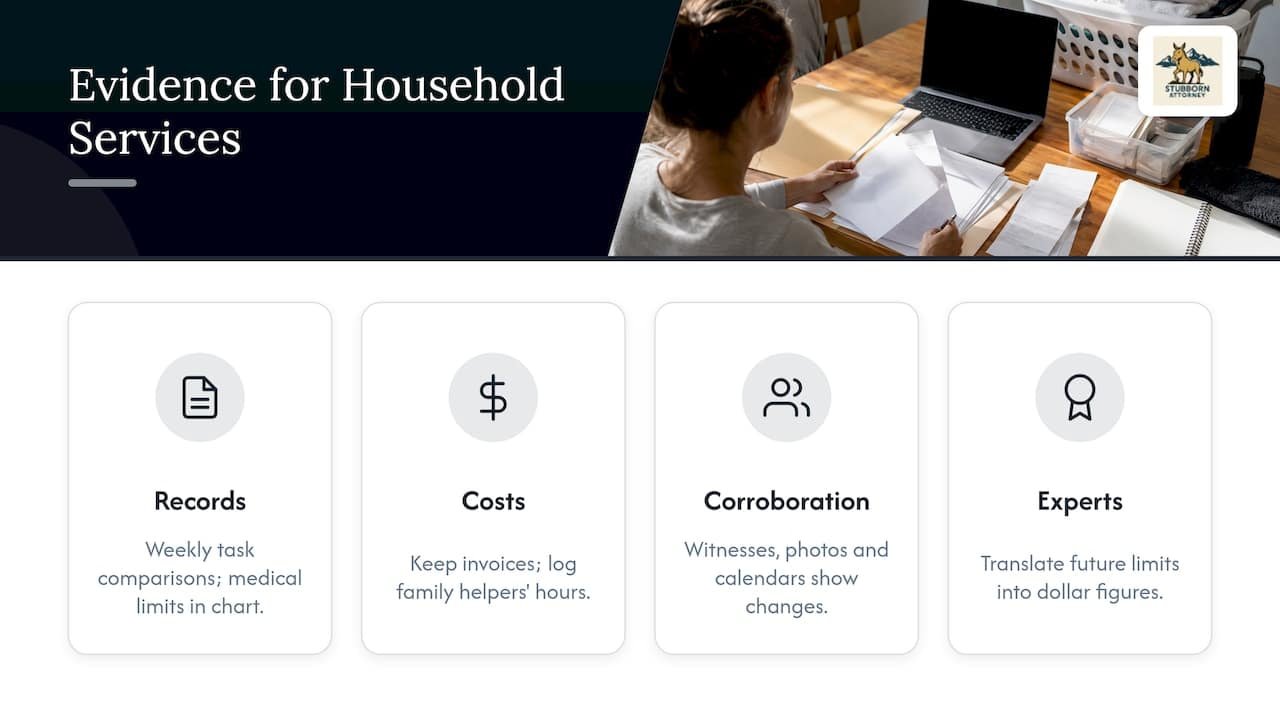
Before and after picture. Write down who did which tasks before the crash and how that changed. A simple weekly table of tasks, hours before, and hours now is a strong base. Be specific: “I shoveled the driveway and walks after every storm” is better than “I did yard work.”
Medical restrictions. Ask your providers to put lifting, bending, standing and driving limits in your chart. A record that says no lifting over ten pounds for twelve weeks explains why you can’t do the laundry or carry groceries, and it ties the loss to the injury.
Replacement costs actually incurred. Keep receipts and invoices for cleaners, lawn crews, meal delivery, child care, and any added help. If family members stepped in, note who, what they did and for how many hours.
Witnesses. Spouses, relatives, neighbors and friends who saw the change can describe it. Their accounts matter most for tasks that never produced a receipt.
Photos and calendars. Pictures of an uncut lawn or an unshoveled driveway, and calendar entries for missed school pickups or appointments, show the loss over time.
Expert support. For long-term or permanent limitations, a life care planner, vocational expert or economist can translate restrictions and hours into a future dollar figure.
Our article on content you need for your injury claim goes deeper on what to gather, and the 10 steps to strengthen an injury claim after a car accident lays out the order to do it.
How this fits with medical bills and lost wages
Household services are one piece of the economic picture, not a replacement for the others. Medical bills cover treatment. Lost wages cover income you missed. Household services cover unpaid labor that has a replacement value. Keeping them distinct matters because insurers sometimes reduce one category by pointing at another.
Self-employed people face a common overlap. If your business income fell and you also stopped doing work at home, those are two separate losses, and we explain the income side in lost wages as a self-employed person and in our Colorado lost wages claim guide. To see how the pieces add up to a number, read how to value your Colorado injury case step by step.
Physical impairment and disfigurement are treated separately again. Section 13-21-102.5(5) states that the noneconomic limits do not restrict recovery of compensatory damages for physical impairment or disfigurement. A well-built claim keeps each category clean so none gets folded into another.
Where claims go wrong
- Never mentioning it. Insurance adjusters ask about medical bills and missed work. They rarely ask who now does your housework. If the claim never lists it, it is rarely paid.
- Waiting to document. Memory fades and receipts get lost. A log kept from week one is far more persuasive than a reconstruction a year later.
- Treating family help as free. A spouse or adult child doing your chores is still a loss to the household. Record the hours.
- Underestimating the future. If your doctor expects lasting limits, the claim should reflect years of reduced capacity, not only the months until your last appointment.
- Double counting. Because courts guard against double recovery, a spouse’s replacement costs and your own claim should be presented consistently.
- Settling before the picture is clear. Once you sign a release, the claim is closed. Settling before your restrictions are known can leave future household losses uncompensated.
Perspective: why this category gets overlooked
Before I practiced as an injury lawyer, I worked as a claims adjudicator for the federal government. I know how large insurers and agencies evaluate a claim, and I know what a file looks like when the household side was never built.
Medical bills arrive on paper and wage loss shows up on a pay stub. Household services never arrive on their own. Someone has to sit down with the client and ask who mowed the lawn, who got the kids to school, and who is doing it now. That is not a spreadsheet task, it is a conversation, and it takes an attorney who is paying attention to the person and not only the file.
At our firm, cases are handled directly by attorneys, not run through a case mill. That is how a detail like a Saturday spent on yard work or caring for a parent ends up in the demand instead of being left out. We represent only injured victims, we have settled hundreds of injury cases, and we do not let go of a claim because one category is harder to prove than another. That is what the mule means to us.
Ryan
Ryan
Getting help with your claim
If you were hurt in a crash in Colorado Springs, Denver or anywhere else in the state, we can review how household services, medical expenses, lost income and noneconomic damages should be presented. We take injury cases on a contingency fee, so you owe no fee unless there is a monetary recovery. You can see the accident types we handle, read about when to hire an automobile accident attorney, or start at StubbornAttorney.com to ask for a case review.
FAQ
Can I claim household services if I never paid anyone to do them?
Yes. Colorado’s jury instruction describes loss of household services the injured person would have performed, so the lost work is the loss. Evidence of the hours you performed and the going local rate for similar help is how that loss is measured.
Is there a cap on household services damages in Colorado?
The noneconomic cap, $1.5 million for most claims accruing on or after January 1, 2025, applies to categories like pain and suffering. Household services are an economic loss, so that cap does not govern them. Your claim still has to be proven with evidence.
Can parents recover for household services a hurt child would have provided?
Yes, in the right circumstances. Instruction 6:3 allows parents of an injured minor to recover past and future loss of the household and similar services the child would have provided until age 18 or emancipation. The facts of the child’s chores and injury matter.
Does my spouse’s extra work count too?
It can, but the same replacement expense cannot be recovered twice. Colorado’s instruction notes call for a cautionary instruction against double recovery. Presenting the household’s losses together, with consistent records, keeps the claim clean.
Sources
- Colorado Judicial Branch, Pattern Civil Jury Instructions Chapter 6 (2025 edition)
- Colorado Judicial Branch, Pattern Civil Jury Instructions Chapter 6 (2026 edition)
- Colorado General Assembly, HB 24-1472 session law
- Colorado General Assembly, HB 24-1472 signed text
- C.R.S. 13-21-102.5 (2025)
- IARP Rehabilitation Professional, Evaluation of Household Services by Forensic Economists
- CPA expert witness and litigation support services