

Gap in Treatment After a Colorado Car Accident: Your Claim
A gap in treatment does not end a Colorado car accident claim, but it gives the insurance company its best argument for paying you less. A gap is a stretch of time when you were hurt and were not seeing a doctor, therapist or other provider. The gap itself is not the problem. An unexplained gap is. If you can show why the break happened and that your symptoms never went away, most gaps can be handled. If you are in that spot now, the fastest fix is to get back to care and put the reason for the break in writing. A Colorado car accident lawyer can then build the record around it, and our team at Malnar Injury Law does this for injured people across Colorado Springs and the state.
This guide is for people who were hurt in a crash in Colorado, did not follow up on care the way they planned, and now worry the claim is damaged. It explains what an insurer looks for, what Colorado law says about timing, how to explain a break and what to do this week.
Table of Contents
- What counts as a gap in treatment
- How insurers use a gap against you
- Does a gap end your Colorado car accident claim?
- The Colorado deadline keeps running during a gap
- Why people have gaps, and how each one is explained
- The evidence that bridges a gap
- What to do if you have a gap right now
- Mistakes that make a gap worse
- Our perspective
- How we can help with a gap in your claim
- FAQ
- Sources
What counts as a gap in treatment
A gap in treatment is any meaningful period without medical care while you are still claiming symptoms from the crash. It shows up in two common forms:
- A delay at the start. You were hurt on the day of the crash but did not see anyone for days or weeks.
- A break in the middle. You saw a provider, then stopped going, then came back later or never came back.
There is no fixed number of days that makes a gap official. You will see articles that say four weeks, six weeks or thirty days, but those are rules of thumb that lawyers and adjusters use, not a Colorado statute. What matters is whether the pause looks long enough, compared with your injury, for an insurer to say you had recovered or that something else caused what you feel now.
That is why the same two weeks can mean very different things. Two weeks without care after a sprained wrist that was already improving is easy to explain. Two weeks without care after a doctor told you to return in three days for severe neck pain is harder.
A few things are not gaps in the way insurers use the word:
- Time between appointments that your doctor scheduled. If your orthopedist said to come back in six weeks, six weeks is the plan, not a gap.
- Time when you were following a home program a provider prescribed, such as stretching, rest or a home exercise routine.
- Time when your provider discharged you because you reached maximum improvement, as long as your later symptoms are tied to a new appointment and a medical explanation.
If you wonder how a delay at the start connects to injuries that show up late, our page on delayed injury symptoms after a Colorado crash covers why pain from whiplash and concussions can take a day or more to appear.
How insurers use a gap against you
An adjuster reads your medical records looking for places where the story has holes. A gap gives them three arguments, and each one is aimed at paying you less.
“You got better”
If you stopped treatment, the insurer says you stopped because you no longer hurt. Every week without a record becomes a week they can call healed. This argument cuts off the end of your damages: they accept the early bills and refuse the later ones.
“Something else caused it”
If symptoms are first recorded after a long pause, the insurer says a fall, a workout, a job task or an old condition is the real cause. The longer the pause, the more room they have to point at something that happened in between.
“It must not be that serious”
People with severe pain usually seek care. The insurer uses that common-sense idea to suggest your injury was minor. This is the argument that most affects the settlement number, because it recasts the whole claim as smaller than you describe.
We know these arguments well. Ryan Malnar is a lawyer of more than a decade and a former claims adjudicator and adjuster for the federal government, so he has seen from the inside how large insurers and government agencies evaluate a claim. A gap rarely decides a case alone. It becomes a problem when nothing in the file answers it.
Does a gap end your Colorado car accident claim?
No. A gap weakens the evidence, but it does not erase the claim. Your claim rests on three questions: who was at fault, what injuries the crash caused, and what those injuries cost you. A gap touches only the second and third. The insurer still has to deal with the crash itself, the police report, the photos and your first medical visit.
What a gap does is shift the work. Without a gap, the records tell the story on their own. With one, you or your lawyer must supply the missing explanation and connect your ongoing symptoms back to the crash. The rest of this guide is about doing that well.
The weakest position is not a gap. It is a gap that nobody explained until the insurer raised it. Explaining early, in your own records and in your lawyer’s demand letter, takes the argument away before it is made.
The Colorado deadline keeps running during a gap
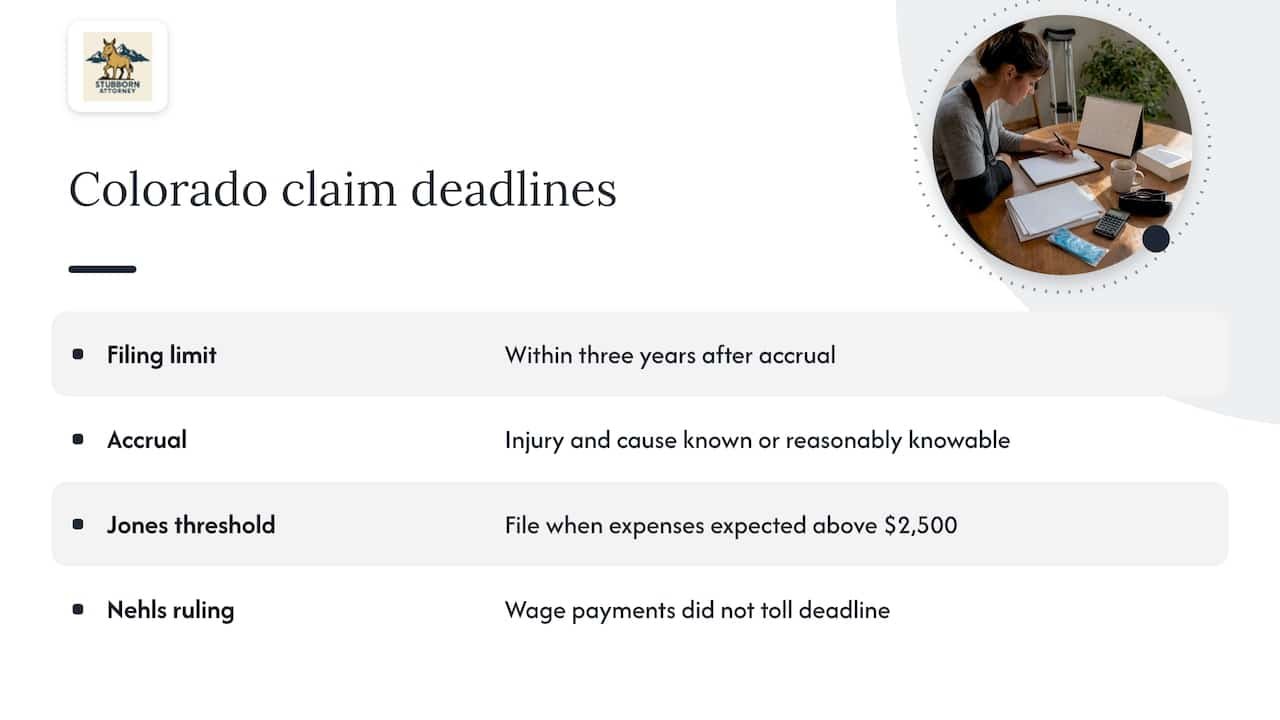
While you sort out the medical side, the legal clock does not pause. Under C.R.S. § 13-80-101(1)(n), added by a 1994 session law, tort actions for bodily injury arising from the use or operation of a motor vehicle must be started within three years after the cause of action accrues. The same act provides in C.R.S. § 13-80-108(12) that a claim accrues when both the injury and its cause are known, or should have been known with reasonable diligence.
In plain terms, “accrues” means the clock starts. For most people it starts on the day of the crash or when they learned they were hurt by it. Waiting on treatment does not move that date.
The Colorado Supreme Court dealt with this timing in Jones v. Cox (1992). It held that the three-year period under the Colorado Auto Accident Reparations Act begins when the physical injury and its cause were known or should have been known with reasonable diligence, and that a claim may be filed once medical expenses are reasonably expected to pass the $2,500 threshold in that statute.
Courts also enforce the limit strictly. In Nehls v. Farmer Alliance Mutual Insurance Co. (10th Cir. 2007), the claimant received wage-loss payments through October 1998 but did not file until October 2005, and the court refused to toll the deadline. Payments from an insurer did not stop the clock.
The practical lesson for a treatment gap: a long break is bad for your evidence, and a long break plus a missed filing deadline can end the claim for good. If your crash was more than a year or two ago, do not wait to find out where you stand. Our guides on the statute of limitations for car accidents and key deadlines for Colorado injury claims explain the dates in more detail. Other claim types, such as wrongful death and medical malpractice, have their own rules, so check the date for your specific claim.
Why people have gaps, and how each one is explained
Most gaps have ordinary reasons. Insurers know this, which is why a documented reason carries weight and a vague one does not. The table below pairs the common reasons with the kind of proof that supports them.
| Reason for the break | What helps support it |
|---|---|
| No health insurance or cost worries | Billing statements, a note of when coverage ended or was denied, records of when you sought low-cost care |
| Work schedule or a job that could not be missed | Employer letter or schedule showing hours, texts or emails about missed time |
| Childcare or caring for a family member | Short written statement with dates, supporting messages if you have them |
| Transportation problems after the crash | Records of the vehicle being totaled or repaired, rental dates, rideshare or bus receipts |
| Provider could not see you | Appointment requests, call logs, a referral that was delayed, or a wait list confirmation |
| Insurance denied a referral or treatment | Denial letters, claim numbers, the date of any appeal |
| You felt better, then symptoms returned | Journal entries, a provider note describing the flare-up and the date it began |
| Illness, surgery or another life event | Records of that event, so the dates are clear and the timeline is honest |
What the table has in common is dates. A reason is only convincing when it lines up with the specific weeks of the gap.
Cost is the reason we hear the most often, and it is the one with a practical answer. If you are worried about paying for care, read our page on what to do with no health insurance after a Colorado car accident. Our firm’s approach is that your financial situation should not decide whether you get medical care after a crash, and we help clients get access to care regardless of their finances.
The evidence that bridges a gap
The goal is to connect three points: the crash, your symptoms during the gap and your symptoms when you returned to care. Here is what builds that bridge.
Your first medical record
The first visit sets the baseline. Whatever you told the provider about pain, where it was and how the crash happened, that note will be read for years. If you left something out at that visit, tell the next provider fully and without exaggeration.
A symptom journal
Write a few lines on days when you hurt: what hurts, how bad it is on a scale of 1 to 10, what you could not do. Dates matter more than polish. A journal kept during the gap shows that the problem continued even when no doctor was in the room.
Statements from people who saw you
Family members, coworkers and friends can describe what they saw: you wincing when you lifted a box, sleeping in a chair, skipping a family event. A short signed note with dates is better than a vague memory later.
Work and activity records
Missed shifts, reduced duties, a doctor’s work restriction or a request for accommodations all show the injury affected daily life during the break.
Photos and messages
Bruising photos, a brace, a heating pad on the nightstand, and texts to a friend saying your back is still killing you all carry a date and a record that is hard to dispute.
A provider’s opinion on why the symptoms are connected
This is the strongest piece. When you return to care, ask the provider to document in their notes whether your current symptoms are consistent with the crash and whether the break in care changes that view. A medical opinion in the chart outweighs a lawyer’s argument alone. Be straightforward with the provider about the reason you did not come sooner; a clear, honest note is worth more than a polished one.
What to do if you have a gap right now
- Go back to care. Call the provider you were seeing, or see a new one. Do not wait until the claim is ready to settle. Every additional week without care adds to the problem.
- Tell the truth about the break. Explain it plainly at the appointment. Do not say you were in pain every day if you were not. Overstating symptoms hurts more than the gap does.
- Collect the proof of why. Pull the denial letters, work schedules, receipts and messages from the table above while they are still easy to find.
- Start the journal today. It will not cover the past weeks, but write what you remember now with your best estimate of the dates and label it as written today.
- Follow the treatment plan from here forward. Go to every appointment, finish physical therapy and fill the prescriptions your doctor orders. Consistency now helps account for the earlier pause.
- Be careful what you tell the insurance company. Adjusters may ask in a recorded call why you stopped treatment. Your answer becomes part of the file. Speak with a lawyer before giving a recorded statement.
- Check your deadline. Confirm how much time is left to file, using the three-year rule above as your starting point and a lawyer’s review for your specific facts.
- Talk to a lawyer. A lawyer can send the explanation to the insurer in a form it has to answer, with the medical support attached.
For a broader checklist of the first days after a crash, see what to do immediately after a car accident in Colorado.
Mistakes that make a gap worse
A gap on its own is manageable. These habits make it harder:
- Giving a casual answer. Saying “I’m fine” or “it’s not that bad” to an adjuster, a provider or on social media becomes evidence that you recovered.
- Posting activity online. A photo of a hike, a gym session or a trip during the gap is easy for an insurer to use, whatever the real context was.
- Guessing about dates. Stating that you stopped care in March when records say April invites doubt about everything else you say.
- Skipping a referral. If a doctor sends you to a specialist and you never go, the insurer will say you did not follow medical advice.
- Leaving out old injuries. If you hurt the same body part before, say so. A prior injury that you disclose can be handled. One that the insurer finds on its own damages your credibility.
There is a wider list in this overview of common personal injury case mistakes to avoid, and our own page on the biggest mistakes after car accidents applies it to Colorado crashes.
Our perspective
We read treatment gaps the way an insurance company reads them, because that is where Ryan spent part of his career. He worked as a claims adjudicator and adjuster for the federal government, and he knows how a file gets reviewed: the adjuster scans the dates first and the story second.
What that taught us is that a gap is mostly a documentation problem. People stop treatment for reasons that make complete sense. They cannot afford the copay, they cannot leave work, or they think the pain will fade. The injury is real, but the file does not say why the care stopped. Our job is to make the file say it.
That is also why we handle cases directly as attorneys and do not run them like a case mill. A gap has to be explained with the specifics of one person’s life, and that takes someone who has read your records and talked to you, not a form letter. We organize the timeline, collect the proof behind each break, and present your injury so the insurer has to answer the facts.
We also believe nobody should skip care because of money. We help clients get access to medical care regardless of their financial situation, and because we work on contingency, you pay us nothing unless we recover money in your case. We are stubborn about this on purpose. When we take your case, we do not let go.
Ryan
How we can help with a gap in your claim
Malnar Injury Law, now at StubbornAttorney.com, represents injured people in Colorado and Colorado Springs after car, motorcycle, semi-truck, bicycle and pedestrian crashes, as well as slip and fall and other injury cases. We work on a contingency fee basis: no payment from you unless there is a monetary recovery in your case. If you have a gap and are not sure how badly it affects your claim, you can start with a free case review on our Colorado Springs personal injury page, or see everything we handle on our services page.
If you want to understand how a claim moves from first call to settlement, our overview of personal injury claims in Colorado walks through it.
FAQ
How long is a gap in treatment for a car accident claim?
Colorado law does not set a number of days that makes a gap official. Insurers tend to take notice when a pause runs for weeks, particularly when no doctor ordered it. What matters is whether the pause fits your injury and whether you can explain it with records.
Can I still get compensation if I waited to see a doctor?
Yes, in many cases. A late first visit gives the insurer an argument that the crash did not cause your injury, but you can answer it with a symptom journal, witness statements and a provider’s note linking your condition to the crash. The sooner you are seen, the stronger that link becomes.
Should I tell the insurance adjuster why I stopped treatment?
Be careful. A recorded statement can lock in an answer before you have gathered your records, and the adjuster’s questions are designed to support the insurer’s position. Speak with a lawyer first so the explanation is accurate, complete and backed by documents.
Does the three-year deadline stop while I am recovering?
Not automatically. Colorado’s three-year period for motor vehicle injury claims starts when you knew or should have known about the injury and its cause, and courts have enforced it strictly, including where an insurer paid benefits for years. Confirm your own date with a lawyer as early as you can.
What if I could not afford to keep going to appointments?
Cost is one of the most common reasons for a gap, and it is a documentable one. Keep your bills, denial letters and any records of when coverage ended, and return to care as soon as you can. We help clients find access to care regardless of their finances.
Sources
- Colorado 1994 Session Law 348 (C.R.S. 13-80-101 and 13-80-108)
- Jones v. Cox, 828 P.2d 218 (Colo. 1992)
- Nehls v. Farmer Alliance Mutual Insurance Co. (10th Cir. 2007)