

Colorado Minor Settlement Approval: How the Court Process Works
If your child was hurt in a Colorado car accident, an insurance company’s offer is not the end of the process. A child under 18 cannot sign a binding contract, so the settlement of a minor’s injury claim is typically made binding through a court petition. In Colorado that petition is governed by Colorado Rule of Probate Procedure 62, and a judge decides whether the deal is reasonable for your child before anyone is paid. The process has real paperwork, a hearing and strict rules about where the money goes. An injury lawyer who handles this work every day can carry most of that weight for you. At Malnar Injury Law, now StubbornAttorney.com, we represent only injured people, and we work on contingency: you pay no attorney fee unless there is a monetary recovery.
This guide walks through what the court looks at, what you file, what happens at the hearing and how the money is protected.
Table of Contents
- Why a Colorado court reviews a child’s settlement
- When approval is needed after a car accident
- Step 1: Build the claim before you file
- Step 2: Gather the exhibits the court expects
- Step 3: File in the right court and give proper notice
- Step 4: The hearing
- How the judge decides whether the deal is fair
- Attorney fees are reviewed too
- Where the money goes after approval
- What if the court will not approve the settlement as written?
- Perspective: why this is not a form to fill out alone
- Getting help in Colorado and Colorado Springs
- FAQ
- Sources
Why a Colorado court reviews a child’s settlement
The starting point is simple contract law. Because persons under 18 cannot enter legally binding contracts, a petition may be made to the appropriate probate court to approve a minor’s settlement and bind the minor, using the procedure in C.R.P.P. 62, according to a Colorado compendium of insurance law.
That matters to both sides. For you, the judge’s review is a second set of eyes on whether the number, the attorney fees and the handling of the money serve your child. For the insurance company paying the claim, an approval order is what gives them a final, binding release. Insurers know this, which is why a carrier will often insist on court approval before it pays on a child’s claim of any real size.
The rule itself sets procedures for court approval of proposed settlements of claims on behalf of a minor, or an adult in need of protection, under C.R.S. § 15-14-401 and following, as stated in the current text of Rule 62 posted by the Colorado Judicial Department.
A few plain-language definitions help here:
- Petition: the written request you file asking the court to approve the settlement.
- Respondent: in this setting, the child whose claim is being settled.
- Fiduciary: the person who will legally receive and manage the money for the child, such as a parent or a conservator (a court-appointed money manager).
- Subrogation: the right of a health insurer or other payer that covered your child’s medical bills to be repaid out of the settlement.
When approval is needed after a car accident
The practical trigger is any settlement that would resolve your child’s own injury claim. A car crash is the most common example: a child riding in a family vehicle, a teen driver, a child on a bicycle or a pedestrian struck near a school. If the insurer wants a full release of the child’s claims, the release needs to bind the child, and that is what the court order does.
Two points often confuse parents:
- Your own claims are separate. Parents may have their own claims, such as medical bills they paid. The child’s claim is the one the court reviews.
- A signature from a parent alone is not the safe route. Because a minor cannot be bound by contract, a release signed only by a parent leaves the insurer exposed, and it can leave the family without the finality it expected. That is why carriers ask for the court’s order.
For how injuries to children are valued and the deadlines that can apply, our guide on Colorado child injury claims covers what parents need to know.
Step 1: Build the claim before you file
A court will not approve a settlement it cannot understand. The petition has to tell the whole story of the claim, so the work starts with the claim itself.
Under Rule 62(d), the petition must cover several categories, as set out in the rule:
- Facts: the child’s name and date of birth, legal guardians and a description of the event.
- Claims and liabilities: the parties involved, the insurance companies and the policy limits.
- Damages: injuries, lost income, property damage, medical expenses and who paid them.
- Medical status: the child’s current condition and prognosis.
- Status of claims: subrogation liens and the efforts made to negotiate them.
- Proposed settlement and disposition: any restricted account, structured settlement details and the legal fees requested.
Where it goes wrong: parents settle too early. Children heal, grow and sometimes show symptoms months later. A prognosis written before treatment is finished is a weak foundation for a release that cannot be reopened. The court is told about the child’s condition, and so is the insurer, so the record needs to be complete.
This is also where our background matters. Ryan Malnar spent time as a claims adjudicator and adjuster for the federal government and has been a lawyer for over a decade, so he knows how large insurers and government agencies evaluate a claim. We use that to put together the damages picture that the petition has to describe. If an offer already looks low, see our page on what to do about a lowball insurance settlement in Colorado.
Step 2: Gather the exhibits the court expects
The petition is filed with attachments. Per the 2024 rule and the court’s JDF 872 form, you should expect to supply:
- A written statement from a physician or other health-care provider about the child’s injuries and condition. The 2024 rule refers to C.R.P.P. 27.1, while the JDF 872 form and the 2018 Colorado Bar Association rules refer to Rule 60, per the 2018 Colorado Bar Association compilation of the probate rules.
- Legal fee agreements and billing records.
- The proposed settlement agreement and release.
- Conservatorship forms where a conservator is proposed.
The Judicial Department’s JDF 872 petition form lays the money out line by line: the gross settlement, fees, costs, medical and subrogation payments and the net proceeds. It is a useful picture of what a judge wants to see: how much is coming in, who takes what and what is left for the child.
If exhibits are missing, the court may continue the matter, vacate the hearing or condition approval, according to the rules compilation. In plain terms, a missing document costs you weeks. A medical statement that does not match the bills, or a fee agreement that was never signed, are the usual causes of delay.
Handling liens before the hearing
Liens are claims against the settlement money by those who paid for your child’s care. Health insurers, government programs and employer plans may all assert them. The petition has to report them, and the court adjudicates liens and attorney fees against the funds. Employer health plans governed by federal law can be especially stubborn about repayment, and our guide to an ERISA lien settlement in Colorado explains how injury victims approach them.
The point is that the child’s net recovery is what the judge cares about. A strong gross number can shrink fast if liens are ignored. Working through them with the payers before the petition is filed gives the court a clean net figure to approve.
Step 3: File in the right court and give proper notice
An interested person files the petition under Rule 62, in the venue provided by C.R.S. § 15-14-108(3). Notice follows C.R.S. § 15-14-404(1) and (2) and C.R.P.P. 8, per Rule 62.
Notice is where families and unrepresented filers most often stumble, and the statute is unforgiving. Under C.R.S. § 15-14-404(1), as reproduced in a statute compilation, the petition and hearing notice must be personally served on a respondent who has reached 12 years of age, with a statement that the respondent must be physically present unless excused. The same source says that failing to serve substantially compliant notice is jurisdictional, meaning the court cannot grant the petition.
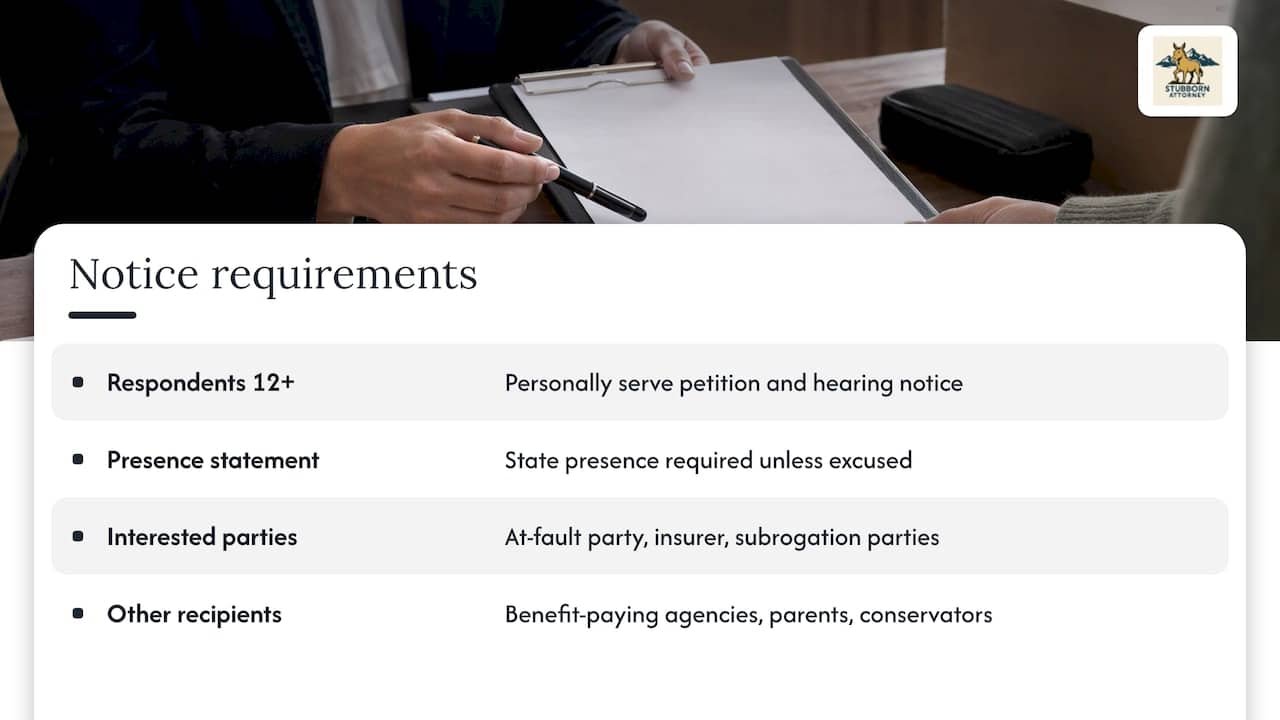
That last point deserves emphasis. A defect in notice is not a paperwork quibble. It can stop the court from approving anything, and then the insurer has no binding release. Notice must also reach the other interested people: the at-fault party, the insurer, subrogation parties, benefit-paying agencies, parents and conservators.
Our team handles this sequence as part of representing an injured child’s family, so you are not trying to decode service requirements while also caring for a hurt child.
Step 4: The hearing
Rule 62 requires an appearance hearing. The petitioner, the respondent and the proposed fiduciary attend unless excused for good cause, per the rule.
For a family, this tends to be shorter and less intimidating than people expect, especially when the petition is complete. The judge wants to hear that the parents understand the settlement, understand that it is final and see why it is reasonable. Children old enough to be in the room are often asked only simple questions, or none.
Before the hearing, parents should be ready to say in their own words:
- What happened and how the child was hurt.
- How the child is doing now, and what doctors expect going forward.
- That they understand the release ends the claim for good.
- Where the money will be held.
If your child’s injury is a serious one, such as a head injury, the question of future care weighs heavily. Our overview of what drives value in a Colorado brain injury settlement shows why a prognosis matters so much.
How the judge decides whether the deal is fair
The court does not simply rubber-stamp the paperwork. Under Rule 62, the judge considers the reasonableness of the settlement, whether the parties understand its finality, the liens and attorney fees, and protective arrangements in the child’s best interests. The nature and scope of the settlement, any disability and future medical-care costs are also taken into account, along with other relevant factors, according to Rule 62.
In practice, that gives you a checklist for what a good petition answers before the judge asks:
| Question the court weighs | What a strong petition shows |
|---|---|
| Is the amount reasonable? | Injuries, bills, lost income, policy limits and prognosis laid out clearly |
| Does everyone understand finality? | Parents who can explain the release in plain terms |
| Are fees and costs fair? | Fee agreement and billing records attached |
| Are liens handled? | Subrogation claims identified and negotiated, with the net figure stated |
| Is the money protected? | A restricted account, structured settlement or conservatorship proposed |
| Will future care be covered? | A provider statement addressing ongoing treatment |
The policy limit is a major piece of this. If the at-fault driver carried modest coverage, the court sees that the offer may be most of what is available. A lawyer who has looked at other sources of recovery can show the judge that the number was not left on the table. For a sense of how settlement ranges are framed in the state, see our article on Colorado car accident settlements.
Attorney fees are reviewed too
Parents often worry that the court process adds a second layer of lawyer cost. The better way to see it is that the judge reviews the fee. Rule 62 has the court adjudicate attorney fees against the funds, and the petition must state the legal fees requested, per the rule.
Our firm works on a contingency basis. You pay nothing unless there is a monetary recovery in the injury case, and the fee we request is disclosed to the court with the fee agreement and billing records attached. That transparency is built into the process rather than something you have to chase.
Where the money goes after approval
Approval is not the last step. The settlement has to be paid and protected.
The court’s JDF 873SC order provides that the net settlement may be deposited into a restricted account, with no withdrawals without prior court approval, within the number of days the court sets. The petitioner must then file a JDF 867SC acknowledgment of deposit, and attorney fees are not paid until the court acknowledges the deposit, per the JDF 873 order form.
Three things follow for a family:
- The funds are not a household account. Money in a restricted account is the child’s. Withdrawals, for example for a medical need or education, need the court’s prior approval.
- There is a deadline to deposit. Missing it creates problems, so get the account set up before the order is signed.
- Fees come last. Because attorney fees wait for the court’s acknowledgment of the deposit, the structure puts the child’s protection first.
Other arrangements the petition may propose include structured settlements, which pay out over time, and a conservatorship. Where a settlement is large or a child has long-term needs, the court may weigh whether a guardian ad litem (a lawyer appointed to speak for the child’s interests) or a conservator would benefit the child. Careful communication matters through all of this, and a guide to litigation communications offers a perspective on handling messaging while a dispute is pending.
What if the court will not approve the settlement as written?
A judge who has questions can continue the hearing, ask for more documents or condition approval on changes, as the rules allow when exhibits are missing or the arrangements are not adequate. Common fixes include a stronger medical statement, a better plan for the funds or a clearer accounting of liens and fees.
There is a larger risk in the other direction: skipping the process. Without an approval order, the insurer lacks the final, binding release it wants, and your family lacks the court’s confirmation that the deal was in the child’s interests. We would not recommend settling a child’s claim informally and hoping it holds. If an insurer offers to pay quickly on a child’s claim, talk to a Colorado injury attorney first.
Perspective: why this is not a form to fill out alone
Parents come to us after the worst week of their year. A child has been hurt, the bills are arriving and an adjuster is calling with an offer that sounds fast and fair. The court process that follows can feel like one more burden.
Here is how we see it. Court approval protects your child, and it protects the settlement. But a petition is only as good as the claim behind it. Before I started representing injured people, I worked as a claims adjudicator and adjuster for the federal government. I know how insurers and agencies evaluate a claim, what they discount and what they hope you will not ask about. That is what we bring to a child’s case: we have settled hundreds of injury cases and recovered millions of dollars for people just like you.
We represent only injured victims, and attorneys handle your case directly. We are not a case mill. A mule does not quit halfway up the trail, and neither do we. The name on the door changed, but the team and the commitment did not.
Ryan
Getting help in Colorado and Colorado Springs
If your child was injured in a crash anywhere in Colorado, including Colorado Springs, we can review the claim, deal with the insurer, work through liens and prepare the court petition and exhibits. Because we work on contingency, there is no attorney fee unless we recover money for your family. See our personal injury services or start from StubbornAttorney.com to reach us.
If the crash also involved a serious medical error, our page on Colorado medical malpractice deadlines covers the time limits that can apply.
FAQ
Does every child’s injury settlement in Colorado need a judge’s approval?
Because a minor cannot enter a binding contract, a petition to the probate court under C.R.P.P. 62 is how a settlement is made to bind the child. Insurers commonly require it before paying. A Colorado injury attorney can tell you whether your child’s claim calls for it.
What forms does Colorado use for a minor settlement?
The court’s JDF 872 form is the petition for approval of settlement of claims and is based on Rule 62. The JDF 873SC order covers deposit into a restricted account, and the JDF 867SC is the acknowledgment of deposit. Your attorney will confirm the current versions.
Can I spend my child’s settlement money as I need to?
Not if it is in a restricted account. The court’s order provides that no withdrawals are allowed without prior court approval. This keeps the money available for your child rather than for general family expenses.
Does my child have to come to the hearing?
Often yes. Rule 62 expects the petitioner, the respondent and the proposed fiduciary to attend unless excused for good cause. For a child 12 or older, the notice must say that the child must be present unless excused.
How much does it cost to hire us for a child’s injury claim?
We work on contingency, so you pay no attorney fee unless there is a monetary recovery. The fee we request is disclosed to the court when it reviews the settlement.
Sources
- Colorado insurance law compendium
- C.R.P.P. Rule 62, Colorado Judicial Department (2024)
- JDF 872 Petition for Approval of Settlement of Claims
- JDF 873 order form
- C.R.S. 15-14-401 to 15-14-434 compilation
- Colorado Rules of Probate Procedure compilation (2018)
- Litigation communications guide