

Wrongful Death vs. Survival Action in Colorado
After a fatal crash in Colorado, two different claims can come out of the same death. A wrongful death claim compensates the surviving family for what they lost. A survival action belongs to the person who died and is brought by their personal representative to recover what that person lost before death, with any recovery going to the estate. Colorado law treats them as distinct causes of action with distinct remedies, and a family that files only one can leave money and rights unclaimed. Our attorneys at Malnar Injury Law handle wrongful death cases for Colorado families through our Colorado Springs wrongful death practice.
This guide is written for families in Colorado and Colorado Springs who are trying to understand what happens legally after a car, truck, motorcycle or pedestrian crash kills someone they love. It explains the law in plain terms. It is general information, not advice on your specific case, and the right filing strategy depends on facts only an attorney can review.
Table of Contents
- The short version: who each claim is for
- What a wrongful death claim covers
- What a survival action covers
- Can a family bring both claims?
- Who can file in Colorado
- Deadlines: the part families miss
- A worked example
- What affects how much a family recovers
- Why the filing strategy matters
- Perspective
- Talking to a Colorado wrongful death attorney
- FAQ
- Sources
The short version: who each claim is for
The cleanest way to separate the two claims is to ask whose loss is being paid for.
| Wrongful death claim | Survival action | |
|---|---|---|
| Whose loss | The surviving family’s | The person who died |
| Who brings it | Eligible family members, in an order set by statute | The personal representative of the estate |
| What it recovers | Family losses such as grief, loss of companionship and emotional stress | Losses the person suffered before death, such as earnings lost and expenses incurred |
| Who receives the money | The eligible family members | The estate |
| Main deadline | Generally two years from accrual | Depends on the underlying injury claim |
Both start from the same event: someone’s negligence caused a fatal injury. Without the death, the injured person would have had their own injury claim. The survival statute exists so that claim does not vanish when they die. The wrongful death statute exists because the family has its own separate harm.
What a wrongful death claim covers
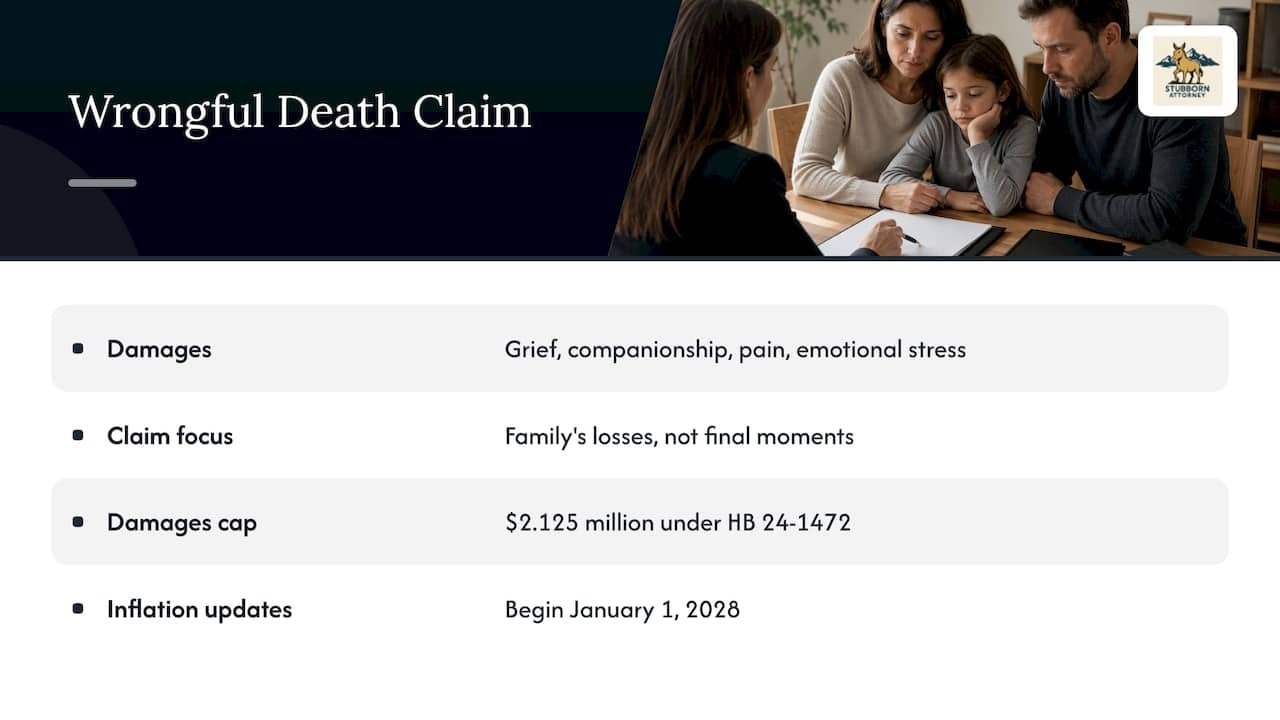
A wrongful death claim is the family’s lawsuit. Under Colorado law, damages for the surviving parties entitled to sue may include grief, loss of companionship, pain and suffering and emotional stress. In a fatal car crash, that typically means a spouse who has lost a partner, children who have lost a parent, or parents who have lost a child.
Two features matter most to families.
The claim is about the family’s loss, not the decedent’s final moments. The law lets eligible relatives seek compensation for what the death took from them: the relationship, the household, the support and the future.
A damages cap applies. Colorado’s wrongful death damages cap is $2.125 million under HB 24-1472, which took effect on January 1, 2025. The same law provides for inflation adjustments beginning January 1, 2028, and every two years after. The amount that applies to a given case depends on the filing date and the facts, so confirm it with an attorney before you rely on any figure. For a deeper look at how Colorado limits pain and suffering damages, see our guide on the accrual date and Colorado’s pain and suffering cap.
What a survival action covers
Colorado’s survival statute, C.R.S. § 13-20-101, says that causes of action generally survive a party’s death, with exceptions such as slander and libel. The personal representative, the person who manages the estate, may bring or continue the claim, and any recovery belongs to the estate.
The important limit for crash cases: for a personal injury tort, Colorado’s statute restricts a survival action to earnings lost and expenses incurred before death. It excludes pain, suffering and disfigurement, and it excludes earnings the person would have made after death.
That is a real difference from some other states, where survival actions can recover the decedent’s own pain and suffering. Families who read national articles about survival claims may expect that. In Colorado, the survival action is narrower, so the main value of the case often sits in the wrongful death claim.
In practical terms, a survival action in a crash case commonly includes:
- Medical bills from the ambulance, emergency room, surgery or intensive care between the crash and the death
- Wages the person lost between the crash and the death
- Other expenses incurred because of the injury before death
If the person died at the scene, there may be little to recover under the survival action. If they survived for days or weeks in the hospital, the medical expenses can be significant. For more on how these categories work in a living-victim case, our guide to types of personal injury compensation and our explanation of a Colorado lost wages claim show how each item is documented.
Can a family bring both claims?
Yes. Colorado’s survival statute expressly states that a survival action does not preclude a wrongful death action arising from the same event. They are two claims against the same at-fault party, usually the same driver and sometimes an employer, vehicle owner or trucking company.
The damages are kept apart. Family losses go to the wrongful death claim. The decedent’s pre-death losses go to the estate. This matters for two reasons:
- Different recipients. Wrongful death money goes to the eligible family members. Survival money goes to the estate, to be handled by the personal representative.
- Different proof. Wrongful death requires evidence of the family’s relationship and loss. Survival requires bills, pay records and the medical timeline between injury and death.
Both claims usually rest on the same liability facts: who was at fault, whether the other driver was speeding, impaired or distracted, and what the insurance coverage is. Building that proof once and using it for both claims is the efficient approach.
Who can file in Colorado
The wrongful death claim
Colorado sets an order of who may sue. Under the statute as amended by HB 24-1472, which took effect on January 1, 2025, a surviving spouse has priority in the first year after the death. During that year, the spouse can make a written election allowing the heirs to bring or join the claim.
If there is no surviving spouse, the deceased person’s children, and in some circumstances an eligible designated beneficiary, may bring the claim. HB 24-1472 also added siblings as claimants in certain circumstances. Whether a particular relative qualifies depends on the family situation, so a parent, sibling or partner should have an attorney confirm their standing before assuming they can or cannot file.
This ordering has consequences. If a spouse and adult children disagree about whether to sue, the first-year rule gives the spouse control, and the written election is how the children get a seat at the table.
The survival action
Only the personal representative may bring or continue it. That is the person named in the will, or appointed by a court if there is no will. If no one has been appointed yet, the family usually needs to open an estate, which may involve probate court. An attorney can coordinate the estate steps and the lawsuit so neither delays the other.
Deadlines: the part families miss
Colorado’s general limitation period for wrongful death is two years after the claim accrues under C.R.S. § 13-80-102(1)(d). In most fatal crash cases, that means two years from the date of death.
There is one longer period. Under § 13-80-102(2), a four-year period applies when the defendant committed vehicular homicide and, in the same criminal episode, left the scene of the fatal accident. Hit-and-run deaths are the situation this addresses, but whether your case fits depends on the facts and the criminal charges.
Two more points on timing:
- Government defendants have a much shorter notice window. If a public entity may share fault, for example a road defect or a government vehicle, the claim can need written notice long before the lawsuit deadline. The Colorado Office of Risk Management states that a claim against the State must be submitted in writing within 182 days under § 24-10-109. Notice rules for cities and counties are separate and need to be checked case by case.
- Evidence disappears faster than deadlines. Vehicle data, surveillance video and witness memory can be gone within weeks. Our page on Colorado wrongful death car crash claims explains why early action matters.
The filing deadline for a survival action depends on the underlying claim, so do not assume it matches the wrongful death date. Have an attorney calendar both from the first meeting.
A worked example
Here is an illustration, not a real case or a prediction of any result.
A 45-year-old married father of two is hit by a distracted driver on a Colorado Springs road. He spends nine days in the hospital before he dies.
- Survival action (the estate): His personal representative, perhaps his wife, claims the hospital and ambulance bills and the wages he lost during those nine days. These are the losses he incurred before death. Any recovery goes into his estate.
- Wrongful death claim (the family): His wife, and with her written election in the first year his children, claim damages for grief, loss of companionship and emotional stress. Any recovery goes to the eligible family members.
If the family files only the wrongful death claim, the medical bills and lost wages that belong to the estate can go unclaimed. If they file only the survival action, the much larger family losses never reach a jury or an insurer. That is why the two claims are normally evaluated together.
What affects how much a family recovers
Families often search for an average wrongful death payout. No reliable single number exists, because every case turns on its own facts. The factors that shape the outcome include:
- The statutory cap. Colorado’s wrongful death cap is a ceiling on the damages the law allows, as described above.
- Insurance coverage. The at-fault driver’s policy limits, any underinsured motorist coverage on the family’s own policy, and any commercial coverage if a truck or employer was involved.
- Fault. Colorado reduces recovery in proportion to a victim’s share of fault, so disputes over what the person who died did or did not do matter.
- Who survives. The number and relationship of eligible claimants, and the evidence of what the relationship meant to them.
- Documented economic loss. Medical bills, funeral costs and the decedent’s income history.
If you are comparing numbers you found online, treat them with care. A headline settlement from another state, or from a case with a different defendant, tells you little about a Colorado case with different insurance and different claimants. How the money is divided and paid out is a separate question we cover in getting compensated after a wrongful death claim.
On the tax question many families ask, speak with a tax professional about your own situation before you assume anything about how a settlement is treated.
Why the filing strategy matters
Most of the confusion families run into comes from the gap between the two claims. They have different plaintiffs, different damages, different recipients and potentially different deadlines. A mistake in one, such as the wrong person filing, a missed election by the spouse, or an estate that was never opened, can cost the family a claim that cannot be revived later.
The liability work, meanwhile, is shared. A strong case starts with the crash itself: who was at fault, what the insurance covers and what evidence needs preserving now. Our pages on fault in multi-car accidents and car accident liability factors explain how fault is established, and our overview of Colorado wrongful death claims, rights and damages goes further into the family’s side of the case.
Perspective
Families usually come to us in the worst week of their lives, and the first thing they ask is whether the law will let them do anything at all. It will. The harder part is that Colorado’s two claims are easy to confuse, and the deadlines do not wait for grief.
I spent years as a claims adjudicator for the federal government before I practiced law for over a decade, so I know how large insurance companies and government agencies evaluate a claim. That matters in a death case, because the other side starts building its position immediately. Our firm represents only injured victims and their families, and the cases are handled directly by attorneys, not passed through a case mill.
Our approach is simple. We look at both claims from day one, we work out who has standing and who controls the estate, and we keep the family informed about what each claim can and cannot recover. We work on a contingency fee, so no client pays unless there is a monetary recovery in their case. When we take a case, we do not let go.
Ryan
Talking to a Colorado wrongful death attorney
If someone you love died in a crash in Colorado Springs or elsewhere in Colorado, the next step is a conversation about which claims exist, who should bring them and which deadlines are running. Our team represents families in fatal car, truck, motorcycle, bicycle and pedestrian cases, and you can read about what we handle on our services page or contact us through our wrongful death page for a case review.
Bring what you have: the police report number, the names of insurers, hospital records, and any information about the estate or a will. You do not need to have everything organized. Sorting that out is part of the work.
FAQ
Is a survival action the same as a wrongful death claim?
No. A wrongful death claim compensates eligible family members for their own losses, and the money goes to them. A survival action is the decedent’s own claim, brought by the personal representative, and any recovery goes to the estate. Colorado treats them as separate causes of action with their own remedies.
Can the decedent’s pain and suffering be recovered in Colorado?
Not through a survival action for a personal injury tort. Colorado’s statute limits that claim to earnings lost and expenses incurred before death and excludes pain, suffering and disfigurement. Family members may seek damages for their own grief, loss of companionship and emotional stress through the wrongful death claim.
How long do I have to file?
Colorado’s general wrongful death deadline is two years after the claim accrues, with a four-year period in certain hit-and-run vehicular homicide situations. Claims involving a government entity can require written notice much sooner. Speak with an attorney quickly so every deadline is identified.
Who gets the money from each claim?
Wrongful death recovery goes to the eligible family members who bring or join the claim. Survival action recovery belongs to the estate and is handled by the personal representative. How the proceeds are divided depends on the claimants and the facts of the family.
Do siblings have a right to file in Colorado?
Since January 1, 2025, siblings may bring a wrongful death claim in certain circumstances under HB 24-1472. Whether a particular sibling qualifies depends on who else survives the person who died, so an attorney should review the family situation.
Sources
- Colorado Revised Statutes § 13-20-101
- Colorado Revised Statutes § 13-80-102
- Colorado HB 24-1472, enrolled text
- Colorado HB 24-1472, bill page
- Colorado Office of Risk Management, submit a claim