

Lost Wages as a Self-Employed Person After a Colorado Car Accident
Yes, you can claim lost income after a car accident when you work for yourself. The hard part is proof, because you have no employer pay stub to hand an insurance adjuster. The claim is built from your tax returns, invoices, bank deposits and the real cost of the work you could not do. If you were hurt in a crash in Colorado or Colorado Springs, our team at Stubbornattorney (the new name of Malnar Injury Law) handles these claims on a contingency fee, so you pay nothing unless there is a monetary recovery in your case.
This guide covers what counts as self-employed lost income, how Colorado courts have treated it, which records carry the most weight, and how to handle the numbers when your earnings go up and down.
Table of Contents
- Why self-employed claims are harder than a paycheck claim
- What counts as lost income when you work for yourself
- How Colorado courts have treated self-employed income
- Lost earnings versus lost earning capacity
- The records that prove self-employed income
- Calculating income that is not steady
- What to do in the first weeks after a crash
- Why a lawyer changes the outcome of a self-employed claim
- Our perspective
- Talk to us about your claim
- FAQ
- Sources
Why self-employed claims are harder than a paycheck claim
An employee can show a pay rate, hours and a letter from human resources. An insurer reads that in minutes. A freelancer, contractor, gig driver or small business owner offers something messier: income that arrives unevenly, expenses that cut into profit, and work that might have been booked but never made it to a calendar.
Adjusters know this and use it. They tend to look for the gaps: a slow quarter, a year with a loss on paper, cash payments with no record, or a business that kept running while you were hurt. Each gap becomes a reason to offer less.
Our lead attorney, Ryan Malnar, is a former claims adjudicator for the federal government and has practiced law for over a decade. He knows how large insurers and agencies evaluate a claim, and that is the lens we use when we assemble yours before anyone on the other side sees it.
What counts as lost income when you work for yourself
Lost income is not only the paycheck you did not receive. For a self-employed person, it can include several things:
- Profit from your own personal effort. Money you would have earned by doing the work yourself: client sessions, jobs, deliveries, shifts, projects.
- The cost of a substitute. If you paid someone to do your work while you recovered, that cost can be part of the loss.
- Gig and contract income. Rideshare, delivery, freelance and 1099 earnings are income, even without a W-2.
- Future earning capacity. If your injuries limit what you can earn after the case settles, that is a separate and often larger question, covered below.
The line between profit from your effort and profit from your investment matters. A national model law on motor vehicle accident compensation, discussed by the Colorado Court of Appeals in Grahn v. Truck Insurance Exchange, defines work loss to include profit attributable to personal effort in self-employment, as opposed to profit attributable to investment, as well as the cost of hiring a substitute. If your business earns money mainly because other employees or equipment produce it, expect an insurer to argue that only your own labor counts.
How Colorado courts have treated self-employed income
Two Colorado decisions show how the courts think about this. Neither is a substitute for advice on your own case, but they explain why documentation matters so much.
Grahn (1992). A self-employed farm helper was hurt and paid a replacement worker. The Colorado Court of Appeals held in Grahn v. Truck Insurance Exchange that her canceled checks to that worker could be reasonable proof of her lost gross income, and it reversed a ruling that had thrown out her wage-loss claim. The case was decided under Colorado’s earlier No Fault Act. The lesson that carries over is practical: a self-employed person who was working at the time of the crash can show loss through the extra cost or reduced profit that the injury caused, and ordinary business records can do the proving.
Hodge (2022). In Hodge v. Matrix Group, Inc., the Colorado Court of Appeals held that the profits of a plaintiff’s solely owned S corporation were admissible as evidence of his lost earning capacity when those profits came from his personal services, rather than from capital and the labor of others. The court also held that a corporation’s loss of business profits is not a separate item of personal injury damages. If you operate through an LLC or S corporation, how your income is structured and which part comes from your own work can shape how the claim is presented.
Lost earnings versus lost earning capacity
These two terms sound alike, but they answer different questions.
- Lost earnings are the income you missed during recovery: the weeks or months you could not work or worked at reduced capacity.
- Lost earning capacity is the reduction in your ability to earn in the future because of lasting injuries.
Colorado has long treated the measure of recovery as earning capacity rather than only past earnings. A 1963 Colorado Law Review article on personal injury damages explains that for a self-employed person, evidence of past business earnings is an aid in valuing the person’s time. It also describes the reasoning: if the test were strictly actual lost earnings, people such as students or those temporarily out of work would receive nothing, so capacity cannot be limited to past wages alone.
For a freelancer with a shoulder injury or a contractor with a back injury, this second category can matter more than the weeks of missed work. If you want to see how attorneys approach it, our page on how attorneys calculate loss of earning capacity and what experts do goes deeper. Our general guide to types of personal injury compensation in Colorado shows where lost income sits next to medical bills and other damages.
The records that prove self-employed income
Insurers believe documents. The goal is to show what you earned before the crash, what you earned after it, and why the difference comes from your injuries. These are the records that usually carry the most weight.
Tax returns
If you are a sole proprietor, your net profit or loss is figured on Schedule C, filed with Form 1040. IRS Publication 334 explains that a separate Schedule C is used for each sole-proprietorship business, and that you must file a return when net self-employment earnings reach $400 or more. Several years of returns show a baseline, which is much harder to dispute than a single number you state after the fact.
Colorado filers also have a state return. The Colorado Department of Revenue publishes the Colorado individual income tax filing guide with the DR 0104 return, which can be pulled alongside your federal filings.
Business and bank records
The IRS lists the kinds of paperwork that support self-employment income in Publication 583: sales slips, invoices, receipts, bank deposit slips, canceled checks, and Forms 1099-MISC and 1099-NEC. The same publication notes that insurance companies or creditors may require records to be kept longer than the IRS does, which is a good reason to keep everything until your claim is fully resolved.
For most claims, we would want to gather:
- Tax returns with all schedules for the last two to three years
- Year-to-date profit and loss statements for the current year
- Invoices and contracts from before and after the crash
- Bank statements showing deposits
- Forms 1099 from clients or platforms
- Calendars, booking records or messages showing work you turned down or lost
- Receipts for any replacement worker you paid
If your books are disorganized, cleaning them up early helps. This overview of organizing your self-employed finances is useful when you are pulling together the paperwork behind your income.
Proof tied to the injury
Numbers alone do not finish the job. You also need to connect the missed work to the crash. That means medical records and a doctor’s work restrictions: what you could not do, for how long, and whether you tried to work anyway. Our guide on the content you need for your injury claim in Colorado lists the documents that support the whole claim, not just income.
Calculating income that is not steady
Most self-employed people do not earn the same amount every month. That is normal, and it can be handled, but the method needs to be chosen on purpose.
Start with a baseline period. A common approach is to average your net income over a stretch before the crash, such as the prior two or three years, so one unusually slow or strong month does not distort the figure. If your income was trending up, a recent period may represent you better than an older one.
Use net, not gross, where it applies. Business expenses you would have paid anyway reduce profit. Expenses you saved because you could not work may count differently from fixed costs that continued, such as rent, insurance or loan payments. Sorting these out is where a claim can be won or lost.
Account for seasonality. A landscaper hurt in April has lost more than a landscaper hurt in January. Showing the pattern of past seasons keeps the insurer from averaging your peak into a flat figure.
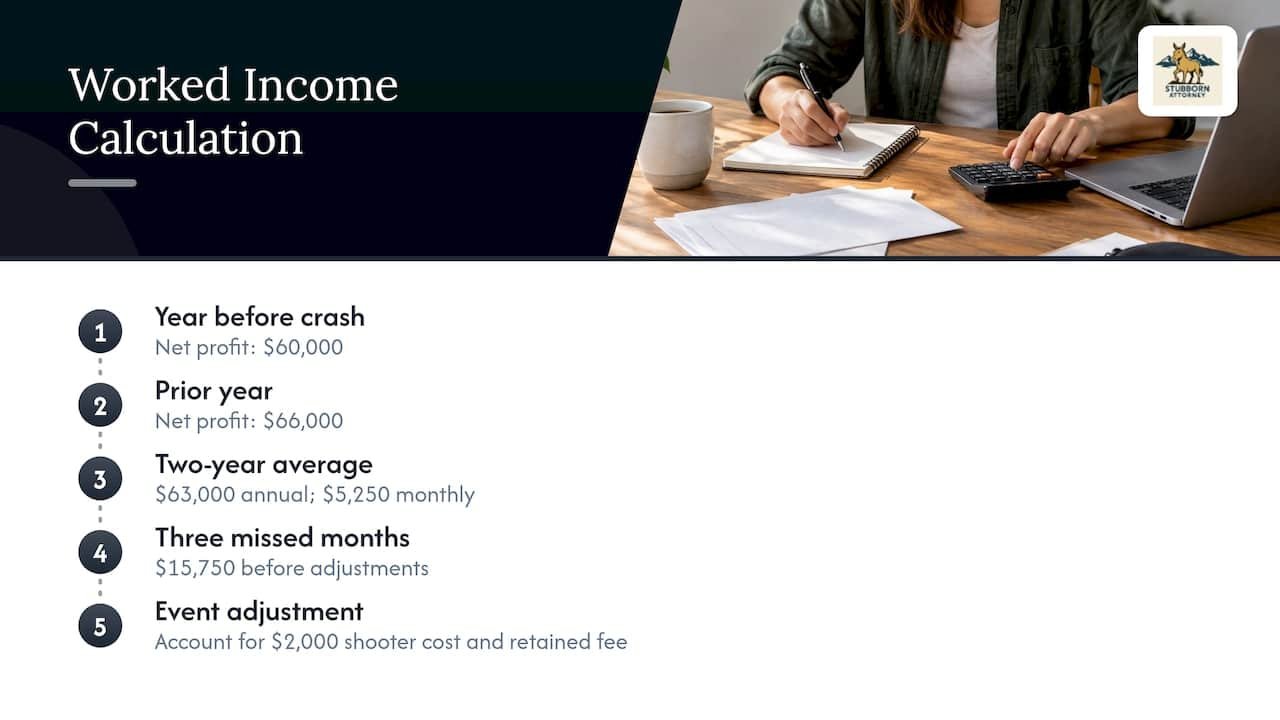
A worked example. Suppose a freelance photographer’s tax returns show net profit of $60,000 in the year before the crash and $66,000 the year before that. The crash leaves her unable to shoot for three months, and her calendar shows booked events she had to hand off or cancel. A baseline built from the two returns averages $63,000 a year, or $5,250 a month. Three months at that rate is $15,750. If she paid a second shooter $2,000 to cover one booked event and kept part of the fee, the net cost of that substitute is added after we account for what she still earned. The figures here are made up to show the arithmetic, not to predict any outcome.
For lasting injuries, projecting future losses takes more than a monthly average. The CPA Journal’s overview of estimating economic loss in personal injury cases describes how a forensic expert builds a profile from earnings history and impairments, then projects the loss using work-life expectancy, inflation and discount rates. The same article warns that such projections carry pitfalls like aging data, so an expert must show the data fit the plaintiff and are current. A well-prepared claim has that reasoning laid out and defensible.
What to do in the first weeks after a crash
If you are self-employed and hurt, these steps protect the income claim:
- Get medical care and follow it. Gaps in treatment give insurers an argument that you could have worked.
- Ask your doctor for written work restrictions. A note saying what you cannot do and for how long ties your missed work to the injury.
- Keep a work log. Record each day you could not work, each job you turned down and any reduced hours.
- Save every record. Do not delete invoices, messages or booking calendars, and keep paying a replacement worker by check or transfer, not cash.
- Be careful what you say to the other driver’s insurer. A casual statement about “getting back to work” can be quoted against you. Our guide to the biggest mistakes after car accidents covers the common ones.
- Know your coverage. Colorado’s Division of Insurance says that medical payments coverage of $5,000 is included in an auto policy unless you reject it. That coverage is about medical costs, but it is worth knowing what your own policy holds when the bills begin.
Deadlines for filing a lawsuit are strict in Colorado, and they differ by the type of claim. Speak with an attorney early so that no deadline passes while you are focused on recovering.
Why a lawyer changes the outcome of a self-employed claim
A self-employed claim is a documentation project with a legal argument on top. The insurer’s goal is to read your records in the way that produces the lowest number. Someone has to decide which years form the baseline, which expenses are deducted, whether an expert is worth the cost, and how to present a future loss. Each of those choices moves the final figure.
We are an injury-only firm: Malnar Injury Law represents only injured victims. Our attorneys handle cases directly rather than passing them through a case mill, and we have settled hundreds of injury cases and recovered millions of dollars for clients. Because we work on contingency, you do not pay us unless we recover money in your case, so a gap in your income while you heal does not also have to become a gap in your ability to hire a lawyer.
For how we approach the claim itself, see our page on Colorado lost wages claims after a car accident and our step-by-step guide to estimating damages after a car accident.
Our perspective
When someone who runs their own business calls us, they are usually worried about two things at once: their health and their customers. Every day they cannot work is a day the business may lose ground, and an insurer’s first offer rarely reflects that.
Before I started representing injured people, I worked as a claims adjudicator for the federal government. I know how a claim is evaluated from the inside: what an adjuster looks for, which documents they trust, and where they hunt for a reason to say the number is smaller. That is why we build a self-employed claim around the evidence before the negotiation starts, not after.
The mule is our symbol for a reason. A mule is steady, does not quit on a hard trail, and does not get rattled. A self-employed lost-income claim is a hard trail: years of returns, a business that does not fit neatly into a form, and an insurer that is in no hurry. We stay with the case until it is resolved.
The name changed. The team, and the commitment, did not.
Ryan
Talk to us about your claim
If you were hurt in a crash in Colorado Springs or elsewhere in Colorado and your income depends on your own work, we can review how your lost earnings and future earning capacity should be presented. Our Colorado Springs personal injury page explains how to request a free case review, and you can see the other accident types we handle on our services page. You can also start from our home page.
FAQ
Can I claim lost wages if I am self-employed in Colorado?
Yes. Self-employed people can seek compensation for income lost because of an injury, and Colorado courts have accepted business records such as canceled checks to a replacement worker as proof of loss. The strength of the claim depends on how well your tax returns, invoices and bank records show what you earned before and after the crash.
What if my income varies from month to month?
Variable income is common and can still be claimed. Attorneys usually use an average over a baseline period, adjust for seasonal swings, and compare it with what you earned after the crash. Several years of tax returns make that baseline much harder for an insurer to dispute.
Do I need tax returns to prove my lost income?
Tax returns are the strongest single record, but they are not the only one. Invoices, 1099 forms, bank deposits, contracts and booking calendars can all support a claim, especially when some of your income was not fully reported or the business is new. Send us whatever you have and we will help work out what is missing.
What is the difference between lost wages and loss of earning capacity?
Lost wages are the income you missed while you recovered. Loss of earning capacity is the reduction in what you can earn in the future because of lasting injuries. Colorado has long focused on earning capacity as the measure of recovery, and for self-employed people past business earnings help value that capacity.
Will it cost me anything to hire a lawyer for this?
We work on a contingency fee, which means you pay nothing unless there is a monetary recovery in your injury case. You can request a free case review to talk through your situation first.
Sources
- Grahn v. Truck Insurance Exchange, Colorado Court of Appeals (1992)
- Hodge v. Matrix Group, Inc., 2022 COA 4
- Personal Injury Damages in Colorado, Colorado Law Review (1963)
- IRS Publication 334, Tax Guide for Small Business
- IRS Publication 583, Starting a Business and Keeping Records
- Colorado Department of Revenue, Book 104 Individual Income Tax Filing Guide
- Estimating Economic Loss in Personal Injury Cases, CPA Journal (2004)
- Colorado Division of Insurance, Auto Insurance
- Self-employed finances overview