

How to value your Colorado injury case step by step
TL;DR:
- Most injury claim values in Colorado are limited by insurance policy caps, regardless of documented damages. Proper documentation, understanding damages categories, and legal guidance are essential to accurately estimate and maximize case worth. Insurance limits, evidence strength, and local court tendencies make injury case valuation more art than science.
Most Coloradans who’ve been hurt in an accident have no idea what their case is actually worth. That’s completely normal. Injury law is not intuitive, and the gap between what you think your damages are and what you can actually recover often comes as a shock. Two claimants with similar injuries can end up with very different outcomes because claim value is shaped by insurance policy limits, available evidence, and dozens of other practical factors. This guide walks you through each step so you can build a realistic picture of your case value before you ever sit across from an insurance adjuster.
Table of Contents
- Essential factors influencing injury case value
- Step-by-step process to estimate your injury case worth
- Common mistakes and practical limitations in valuing your case
- Verifying and maximizing your case value with legal help
- Why valuing an injury case is more art than science in Colorado
- Ready to maximize your Colorado injury case value?
- Frequently asked questions
Key Takeaways
| Point | Details |
|---|---|
| Insurance limits matter | Even strong cases are capped at the defendant’s insurance coverage. |
| Evidence is crucial | Solid documentation directly increases your case’s value. |
| Professional review helps | Legal expertise ensures you consider all types of compensation and avoid mistakes. |
| Real-world results vary | Two similar injuries can have different payouts due to practical factors. |
Essential factors influencing injury case value
Understanding what drives your case value is the starting point for everything else. Before you can estimate a number, you need to know what goes into that number. Colorado personal injury law recognizes three broad categories of compensation, and each one works differently.
Economic damages are the straightforward, dollar-for-dollar losses you can document. These include medical bills, future medical costs, lost wages, reduced earning capacity, and out-of-pocket expenses like prescription costs or transportation to medical appointments. If you have a receipt or a bill, it almost certainly counts.
Non-economic damages are harder to pin down because they don’t come with a price tag. Pain and suffering, emotional distress, loss of enjoyment of life, and the impact of permanent disability or disfigurement all fall into this category. Colorado does not cap non-economic damages in most personal injury cases, though medical malpractice cases have their own separate limits. You can learn more about how the different compensation types work under Colorado law to understand exactly which category your losses fall into.
Punitive damages are rare. They are awarded only when the defendant’s conduct was particularly reckless or malicious. Courts in Colorado use these to punish bad behavior, not simply to compensate you. Most standard injury cases, like car accidents or slip-and-falls, do not involve punitive damages unless egregious conduct is proven.
Then there is the practical ceiling that catches many people off guard: insurance policy limits. No matter how large your documented losses are, your actual recovery is almost always constrained by how much insurance coverage exists. Policy limits cap recovery even when a jury might award far more. This is one of the most important facts to understand early, and it’s a key part of case evaluation basics that every injured person should review before making decisions.
Here’s a comparison of the three damage types to keep them straight:
| Damage type | Examples | How it’s calculated | Colorado cap? |
|---|---|---|---|
| Economic | Medical bills, lost wages, future care costs | Receipts, records, expert estimates | No |
| Non-economic | Pain, suffering, emotional distress | Multiplier method or per diem | No (most cases) |
| Punitive | Reckless conduct punishment | Court discretion | Yes (capped at economic damages amount) |
Beyond the damage categories, attorneys and insurance adjusters look at a specific set of factors when they size up a claim. Knowing these ahead of time puts you in a much stronger position.
- Severity and permanence of your injuries
- Length and cost of medical treatment
- Whether you followed your doctor’s treatment plan consistently
- Your age and occupation (affects lost earnings calculations)
- How clearly liability can be established
- The credibility and consistency of your account
- Whether you share any fault under Colorado’s comparative negligence rules
- The available insurance coverage (defendant’s policy limits, your own underinsured motorist coverage)
- Quality and volume of your documentation
Looking at case outcomes examples from real Colorado cases can give you a sense of how these factors play out in practice, since similar-sounding injuries can produce very different numbers depending on the combination of factors above.
Pro Tip: Start a dedicated folder on day one. Keep every medical bill, every explanation of benefits from your insurer, every receipt related to your injury, and a running journal of how your pain affects your daily life. This habit costs you nothing and can be worth thousands of dollars when it’s time to negotiate.
Step-by-step process to estimate your injury case worth
Once you understand what drives value, you can start putting actual numbers together. This is not a substitute for legal advice, but it gives you a working estimate and helps you have a much more informed conversation with an attorney.
Step 1: Gather all your documentation.
You need two types of records. Medical records include emergency room reports, imaging results, surgical notes, physical therapy logs, prescription history, and any future care plans your doctor has outlined. Financial records include pay stubs covering the period you missed work, tax returns if you’re self-employed, receipts for every out-of-pocket expense, and repair estimates if property was damaged.

Step 2: Calculate your economic damages.
Add up every medical bill you have received so far. Then get a written estimate from your treating physician about anticipated future care costs. Include any specialists, ongoing physical therapy, medical equipment like braces or assistive devices, and potential surgery. Add the wages you lost, including any paid time off you were forced to use. If your injury affects your long-term earning capacity, work with an economist or your attorney to project that loss.
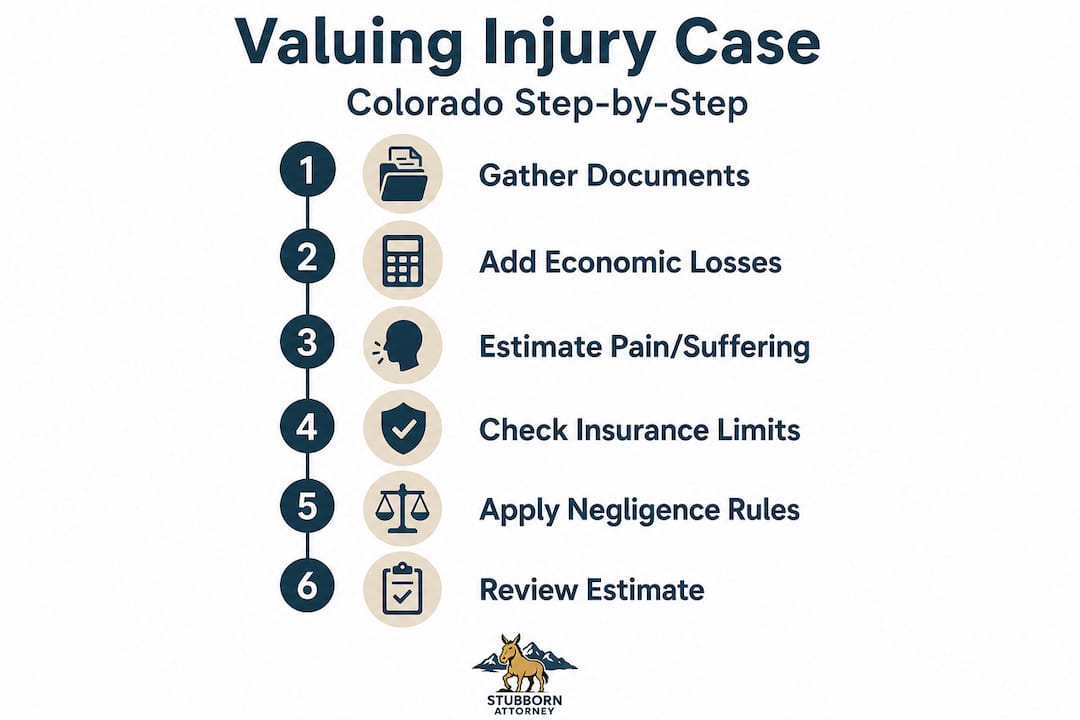
Step 3: Estimate non-economic damages.
Insurance adjusters and plaintiff attorneys both use calculation methods to arrive at a number for pain and suffering. The most common approach is the multiplier method, where you multiply your total economic damages by a number between 1.5 and 5. The multiplier depends on severity. A clean broken bone that heals well might use a 1.5 to 2 multiplier. A traumatic brain injury or permanent disability might justify a 4 or 5 multiplier. The per diem method assigns a daily dollar value to your pain and multiplies it by the number of days you suffered. Both methods are starting points, not guarantees.
Step 4: Check the insurance coverage available.
Find out the at-fault party’s policy limits. In Colorado, drivers are required to carry minimum liability limits, but those minimums may not cover your actual losses. Also check your own underinsured motorist (UIM) coverage, which can fill the gap when the other driver’s policy is inadequate.
Step 5: Apply Colorado’s comparative negligence rules.
Colorado follows a modified comparative negligence standard. If you are found to be 50% or more at fault, you cannot recover at all. If you’re less than 50% at fault, your recovery is reduced by your percentage of fault. For example, if your total damages are $100,000 and you’re found 20% at fault, you recover $80,000. Be honest with yourself about your share of responsibility before you walk into a negotiation.
Step 6: Review your compiled estimate.
Use a tracking table like the one below to organize everything before you meet with an attorney or begin any settlement discussions.
| Damage category | Your amount | Notes |
|---|---|---|
| Past medical bills | $ | Include all providers |
| Future medical costs | $ | Get written doctor estimate |
| Lost wages to date | $ | Use pay stubs or tax records |
| Future lost earning capacity | $ | May need expert |
| Non-economic damages (pain and suffering) | $ | Use multiplier or per diem |
| Out-of-pocket expenses | $ | Receipts required |
| Total estimate | $ | Before fault reduction |
Review the full list of compensation types to make sure you aren’t leaving a category off your list. And look at injury case evaluation steps to see how attorneys organize the same information professionally.
“In practice, claim value is also constrained by insurance policy limits and other practical ceilings, so two claimants with similar injuries can end up with different outcomes.”
This is why your estimate needs to include a realistic look at what’s actually collectible, not just what you deserve on paper. Real case outcomes overview data shows this gap can be significant.
Common mistakes and practical limitations in valuing your case
Most people make at least one significant error when they try to value their own case. Some of these mistakes shrink a legitimate claim by thousands of dollars. Others derail a case entirely.
The most common errors include:
- Overestimating pain and suffering without medical backing. Claiming $500,000 in pain and suffering for a soft tissue injury that resolved in six weeks will destroy your credibility. Every non-economic claim should be supported by consistent medical records, a treatment timeline, and documented functional limitations.
- Under-documenting losses. If you can’t prove it, it generally doesn’t count. Many people fail to track days of work missed, stop saving receipts after a few weeks, or never write down how their injury affects their sleep, relationships, or ability to do daily tasks.
- Ignoring comparative negligence. If you were texting when you got hit, or you were walking against the light, that affects your recovery. Failing to account for your own potential fault leads to unrealistic expectations.
- Accepting a quick settlement too soon. Insurance companies know that injured people face financial pressure. An early offer often comes before the full scope of your injuries is known. Once you settle, you can’t go back for more.
- Forgetting future costs. People often calculate only the bills they’ve received so far. If your injury requires ongoing care, that future cost is real and compensable. Overlooking it means leaving money on the table.
- Not understanding the insurance cap problem. This deserves its own emphasis.
“Claim value is constrained by insurance policy limits and other practical ceilings, so two claimants with similar injuries can end up with different outcomes.”
This is not a legal technicality. It is one of the most practical limitations in personal injury law. The other driver may have minimum liability coverage of $25,000. If your medical bills alone total $80,000, you have a $55,000 problem that documentation and a great attorney cannot fully solve without accessing your own underinsured motorist policy or other sources.
Understanding how fighting insurance companies actually works in practice helps you see why having the right strategy matters before you make any move. And reviewing a compensation workflow guidance resource can help you see the full picture of how a claim moves from injury to settlement.
One more common mistake deserves a blunt mention: going it alone without understanding what you don’t know. Insurance adjusters are professionals. Their job is to evaluate claims every single day. They know the leverage points, the weak documentation, and the moments when injured people are most likely to accept less than they deserve.
Pro Tip: Consult a Colorado personal injury attorney before you speak to any insurance adjuster, including your own. A single phone call with an adjuster, before you understand your rights, can create statements that haunt your case later. Most attorneys offer free consultations, and the qualities to look for in a lawyer matter a great deal when choosing who to trust.
Verifying and maximizing your case value with legal help
Calculating a rough estimate is useful. But getting actual maximum value from your Colorado injury case is a different skill set entirely, and it’s where legal help earns its cost many times over.
Here’s how an experienced personal injury attorney adds measurable value at each stage:
-
Reviewing all damages categories systematically. Attorneys are trained to find losses that non-lawyers miss. Future care costs, loss of household services, loss of consortium for spouses, and reductions in earning capacity all require specific documentation and framing that an attorney knows how to build.
-
Gathering and preserving evidence early. Witnesses forget. Surveillance footage gets deleted. Accident scenes change. An attorney can act quickly to preserve the evidence that makes or breaks a claim, including sending legal preservation notices to businesses and requesting black box data from vehicles.
-
Identifying all available insurance coverage. Many injured people don’t know they have underinsured motorist coverage or don’t realize a commercial vehicle policy may apply. Attorneys know where to look and how to stack coverage when multiple policies are available.
-
Countering low-ball offers with documented responses. When an insurance company offers far less than your documented losses, an attorney knows exactly how to respond with a formal demand package that builds a compelling case for higher value.
-
Negotiating from a position of strength. Insurers know which attorneys take cases to trial when needed. That credibility alone changes what they offer during settlement negotiations.
-
Protecting you from the comparative negligence trap. Defense attorneys and adjusters will look for any way to shift fault onto you. An experienced attorney anticipates these tactics and builds a case structure that protects your percentage of fault.
When you’re looking for the right attorney in Colorado, focus on someone who has actually handled similar cases, can explain their track record honestly, and communicates clearly about what’s realistic. Experience with the insurance claims process on both sides is especially valuable because it means your attorney already knows the playbook.
The goal of maximizing your case isn’t just about getting a bigger number. It’s about making sure every legitimate loss you suffered is seen, documented, and fought for. Understanding your rights after an injury is the foundation everything else builds on.
Pro Tip: Most personal injury attorneys in Colorado work on contingency, meaning they collect no fee unless you win. Taking advantage of a free case evaluation costs you nothing and gives you a professional second opinion on the estimate you built using this guide. Treat that consultation like a job interview: bring your documentation, ask specific questions, and evaluate whether that attorney’s experience matches your needs.
Policy limits shape outcomes in ways that even strong documentation cannot always overcome, but a skilled attorney will exhaust every avenue before accepting that ceiling as the final answer.
Why valuing an injury case is more art than science in Colorado
After more than a decade of working injury cases in Colorado, including years as a federal claims adjudicator before becoming a plaintiff’s attorney, I can tell you something that most legal guides don’t say out loud: there is no formula that reliably predicts what a case is worth.
That’s not a failure of the system. It’s just the truth.
Two people can suffer nearly identical fractures in almost identical car accidents and receive settlements that differ by $40,000 or more. One had a treating physician who documented functional limitations in precise clinical language. The other had a physician who noted the injury and discharged the patient with minimal follow-up documentation. Same injury. Completely different paper trail. Completely different outcomes.
The legal standard doesn’t change between those two cases. But juries respond to stories. Adjusters respond to documentation strength. Opposing counsel responds to the credibility of your legal team. None of that shows up in a damages calculator.
Colorado also has its own jurisdictional quirks. Juries in different counties respond differently to injury claims. What plays well in Denver may land differently in a more rural county. Experienced local attorneys know these differences because they’ve seen them in real cases, not just read about them in law school. Reviewing actual case examples from Colorado helps illustrate how the same legal principles produce different dollar outcomes depending on the full context of a case.
The most important mindset shift I encourage every client to make is this: stop trying to arrive at a number and start trying to build the strongest possible factual record. The number flows from the record. If your documentation is thorough, your treatment was consistent, your losses are well-supported, and you have an attorney who refuses to accept the first low offer, your case will find its value. Negotiation is where preparation meets persistence.
And remember: practical ceilings like insurance limits are real constraints, but they aren’t always the final word. Umbrella policies, multiple liable parties, and your own coverage can all affect what’s ultimately available. The art is knowing where to look and when to push.
Ready to maximize your Colorado injury case value?
You’ve now seen exactly how case value is built, what limits it, and where most people make costly mistakes. The next step is getting a professional review of your specific situation. At Malnar Injury Law, operating as StubbornAttorney.com, we’ve settled hundreds of injury cases across Colorado and recovered millions for people who were told their cases weren’t worth pursuing. Start by reviewing your rights after an injury in Colorado so you walk into any conversation fully informed. Then get your claim evaluated by our team at no cost. We built our reputation on being stubborn for our clients, and we don’t let go once we take your case.
Frequently asked questions
What are the most important factors in valuing a Colorado injury case?
Medical bills, lost income, pain and suffering, and insurance policy limits are the most important factors. As claim value research confirms, even strong damages can be constrained by practical ceilings like the at-fault party’s coverage limits.
How do insurance limits affect my injury settlement?
Your compensation generally cannot exceed the at-fault party’s insurance coverage, even if your documented damages are far larger. Insurance coverage limits create a practical cap on what’s actually recoverable, which is why identifying all available policies, including your own underinsured motorist coverage, matters so much.
Can I value my case without a lawyer?
You can estimate your economic losses on your own using the steps outlined in this guide, but a lawyer helps you avoid costly mistakes, find overlooked coverage, and negotiate effectively against experienced insurance professionals who handle claims every day.
What should I bring to my injury case consultation?
Bring medical records, wage statements or tax returns, all receipts related to your injury, any accident reports or photos, and insurance information for all parties involved. The more organized your documentation, the more accurate and useful your evaluation will be.