

Colorado Nursing Home Neglect: Your Rights and Next Steps
If you think a loved one in a Colorado nursing home is being neglected, you have three jobs: get them safe, put the problem on record with the right agency, and talk to a personal injury attorney before the facility’s insurer shapes the story. Colorado law defines neglect, requires facilities to report it, and gives families several places to complain. A lawyer who represents only injured people, as Malnar Injury Law does, can then pursue compensation for the harm. Our attorneys work on a contingency fee, so you pay nothing unless there is a monetary recovery in the case.
This guide explains what the law calls neglect, what the warning signs look like, where to report, what facilities must do when something happens, and how a legal claim fits in.
Table of Contents
- What counts as nursing home neglect in Colorado
- The rights your loved one already has
- Warning signs families should take seriously
- What to do first: a practical sequence
- Where to report suspected neglect in Colorado
- What the facility itself must do
- How state inspections work, and what they can tell you
- Who can be held responsible
- What compensation can look like, and what limits apply
- Deadlines you should not guess at
- How Malnar Injury Law helps families
- Frequently asked questions
- Sources
What counts as nursing home neglect in Colorado
Neglect is not only a bad day or a slow call light. Colorado’s adult protection statute, C.R.S. §26-3.1-101, defines caretaker neglect as a caretaker failing to timely secure or provide what an at-risk adult needs: food, clothing, shelter, psychological or physical care, medical care, supervision or other treatment. The standard is the care a reasonable person in the same situation would exercise.
The same law also covers a second kind of neglect that surprises families: knowingly using harassment, undue influence or intimidation to create a hostile or fearful environment for an at-risk adult. A resident who is afraid of a particular aide can be a neglect case even if no bruise ever appears.
Under the statute, “mistreatment” is the broader umbrella. It includes abuse, caretaker neglect, exploitation and harmful acts. Self-neglect is defined separately and does not cover lifestyle choices alone or certain valid refusals of treatment, so a resident who declines a treatment is not automatically a neglected resident.
In practice, neglect in a facility often looks like:
- Missed repositioning, which leads to pressure sores
- Poor hydration or nutrition, with weight loss no one explains
- Unanswered calls for help, including calls to use the toilet
- Unsupervised residents who wander or fall
- Medication errors or delayed medical attention
- Unsanitary rooms, bedding or hygiene
Our page on the forms of abuse commonly encountered in nursing homes walks through how these overlap with physical, emotional and financial abuse.
The rights your loved one already has
Residents do not need to earn good treatment. Colorado’s official long-term care ombudsman program, Colorado LTC Ombudsman, explains that nursing home residents hold federal rights under 42 C.F.R. §483.10. These include freedom from abuse, neglect and exploitation, dignity, a voice in care planning, privacy, visitors, and the freedom to complain without retaliation.
That last right matters to families who hesitate. The ombudsman states that a facility may not retaliate against a resident for contacting the ombudsman or filing a complaint or grievance. Federal guidance in Your Resident Rights and Protections says the same: residents may report suspected abuse or neglect and complain without fear of punishment.
A right is only as useful as the record behind it. When care falls short, the goal is to document the failure so those rights can be enforced.
Warning signs families should take seriously
No single sign proves neglect, and some have innocent explanations. A pattern, or a change with no clear explanation, is what deserves action. The Colorado Attorney General’s Medicaid Fraud, Abuse and Neglect Unit lists these possible physical indicators:
- Unexplained bruises, welts, lacerations, broken bones or burns
- Injuries that do not match the explanation you were given
- Sudden fearfulness, mistrust, withdrawal or agitation
The same office lists warning signs of financial exploitation inside a facility:
- Missing resident-fund ledgers
- A ledger that does not match the bank balance
- Large withdrawals the resident did not know about
- Spending on items that do not benefit the resident
To those, families commonly add what they see on visits: a resident left in soiled clothing, a call button out of reach, a room that is always understaffed at mealtimes, or a loved one who suddenly stops wanting to be left alone with a particular person. Trust the pattern you see.
What to do first: a practical sequence
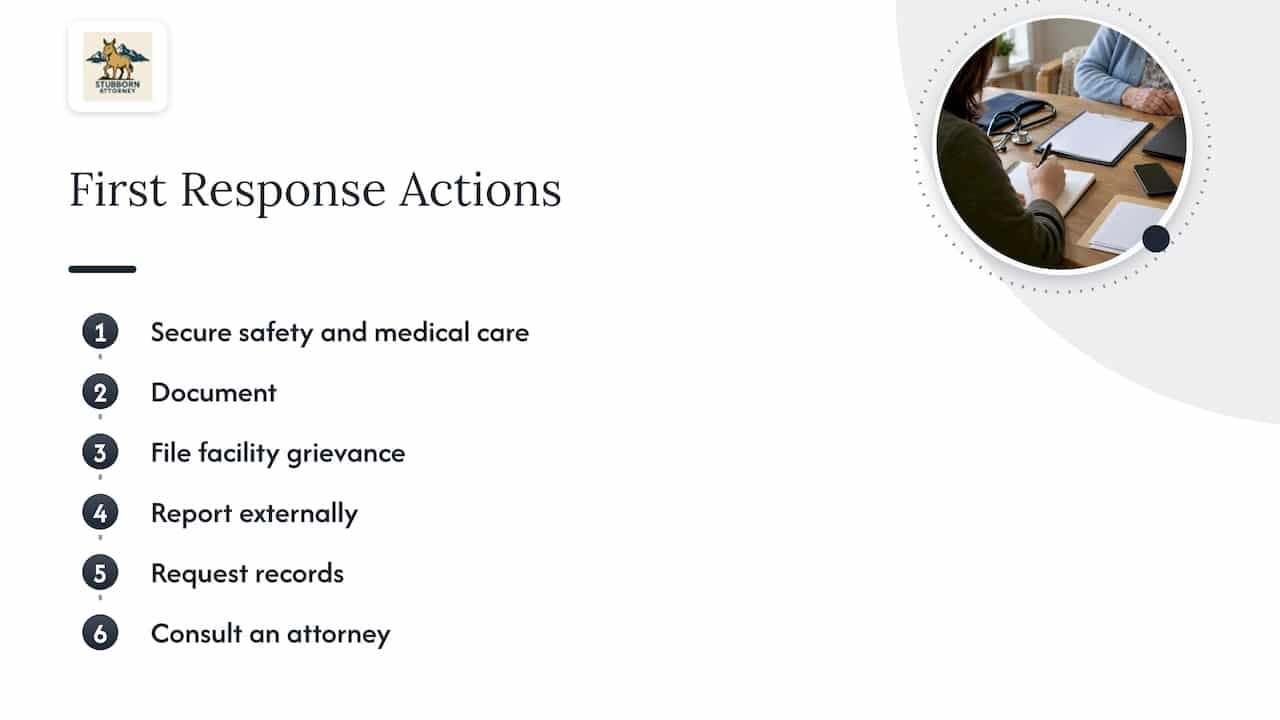
1. Make sure your loved one is safe and medically checked
If there is an injury, a fall, a serious sore or a sudden decline, get medical attention first. A treating physician’s records are among the strongest evidence of what happened and when. If you believe someone is in immediate danger, call 911.
2. Write things down the same day
Note dates, times, names of staff, what you saw and what you were told. Photograph injuries, the room, the bedding and anything unsafe. Keep a simple running log. Memory fades quickly, and facility charting may not reflect what you saw.
3. Raise it inside the facility, in writing
The ombudsman suggests residents or advocates consider talking to staff, filing a written grievance, or seeking help from the resident council. A written grievance creates a dated record that the facility knew about the problem. Keep a copy.
4. Report to the outside agencies
Internal complaints alone are rarely enough. The next section shows where outside reports go.
5. Ask for records, and do not sign anything you do not understand
Facilities may ask families to sign incident summaries, discharge papers or arbitration paperwork. Before you sign anything that follows an injury, talk with an attorney. Medical charts, care plans, incident reports and staffing records can all matter later.
6. Speak with a personal injury attorney early
Evidence such as video, staffing schedules and charting can be lost or changed over time, and legal deadlines run from the injury. Early contact lets an attorney identify what to preserve. Our team handles personal injury, wrongful death and medical malpractice matters across Colorado, and the first conversation is where you learn whether the facts support a claim.
Where to report suspected neglect in Colorado
Reports are not either-or. Several offices handle different parts of the problem, and using more than one is reasonable.
| Who | What it does | How to reach it |
|---|---|---|
| Colorado State Long-Term Care Ombudsman | Advocates for residents, takes complaints, keeps communications confidential subject to disclosure approval | 1-800-886-7689, or the online complaint form at coombudsman.org |
| Colorado Department of Public Health and Environment (CDPHE) | State survey agency that investigates complaints about care, resident rights, abuse, dietary issues, staffing and environment | See CDPHE’s survey page |
| Colorado Attorney General, Medicaid Fraud, Abuse and Neglect Unit | Can investigate physical assaults by providers or employees of Medicaid-funded facilities, even if the resident is not on Medicaid | Online, or (720) 508-6696, via the Attorney General’s page |
| Local law enforcement | Receives reports of suspected physical or sexual abuse, caretaker neglect or exploitation of at-risk elders | The agency covering where it happened |
One limit to know about: CDPHE says billing and insurance complaints are outside its investigative jurisdiction. A dispute about charges belongs elsewhere, while a care failure belongs with CDPHE.
A report to an agency is not a lawsuit, and an agency cannot get your family compensation for the harm. Its job is oversight and enforcement. A legal claim is the route to recovering costs and damages.
What the facility itself must do
Facilities carry legal duties once they learn of a problem, and knowing them helps you judge whether yours followed the rules.
Under current federal rule 42 C.F.R. §483.12, a facility must report allegations involving abuse or serious bodily injury immediately and no later than 2 hours. Allegations involving neither must be reported within 24 hours. Reports go to the administrator and other officials, including the State Survey Agency and adult protective services where state law gives them jurisdiction.
The same rule requires the facility to investigate, protect residents from further potential mistreatment while it does so, report the results within 5 working days, and take corrective action when a violation is verified.
Colorado adds its own layer. Under Chapter 5 of 6 CCR 1011-1, effective July 1, 2025:
- Facility personnel involved in the admission, care or treatment of at-risk elders must report suspected physical or sexual abuse, exploitation and caretaker neglect to law enforcement within 24 hours.
- Facilities must notify CDPHE within 24 hours of discovering specified events, including neglect causing physical harm or mental anguish, abuse, suspicious injuries of unknown source, and misappropriation of a resident’s property.
Colorado’s mandatory reporting guidance from the Department of Human Services also lists care-facility staff, health-care providers, case managers, guardians and other professionals among those who must report qualifying mistreatment to law enforcement within 24 hours of learning of it.
Why this matters to a family: when a serious injury happens and nobody called you, no report was made, or the explanation does not fit the timeline, that gap is itself information. Ask when the facility reported the event and to whom.
How state inspections work, and what they can tell you
CDPHE says Colorado nursing homes receive unannounced annual surveys every 9 to 15 months, averaging about every 12 months. Survey teams observe care, review records and interview residents, families and staff.
The state regulation also requires a facility to post its latest statement of deficiencies or tell the public where and when it can be reviewed. If you are worried about a facility, ask to see it. A history of repeated findings about staffing, falls, pressure sores or supervision is useful context, though it does not by itself decide a legal claim.
The regulation also says nursing homes must admit only residents whose needs they can meet within their accommodations and services, and it requires a master staffing plan. Those two rules shape many neglect cases. A facility that took in a resident needing more help than it could give, or that ran below its own staffing plan, may bear responsibility for what followed.
Who can be held responsible
Neglect rarely comes from one person. Depending on the facts, responsibility can reach:
- The facility operator, for understaffing, poor training, unsafe admissions or weak supervision
- Individual caregivers, for specific acts or omissions
- Medical providers who treat residents, if their care fell below accepted standards
- Management or corporate owners who set staffing levels and budgets
Sorting out which of these applies is the work of an investigation. It is also why preserving records early matters: staffing schedules, care plans, incident reports, grievance logs and the facility’s inspection history can all point to who made which decision.
When neglect leads to a resident’s death, a separate wrongful death claim may be available to certain family members. Our guide to Colorado wrongful death claims explains who can bring one and what damages are involved. When the failure was in medical care, our page on medical malpractice and injuries is the better starting point.
What compensation can look like, and what limits apply
Families often ask how much they can sue for. There is no single number, and anyone who quotes one before reviewing the records is guessing. Compensation in an injury case generally reflects the medical costs caused by the neglect, the resident’s pain and suffering, and the loss of quality of life. The seriousness and permanence of the harm, and how well the evidence ties the harm to the care failure, drive the range.
Colorado also limits damages in health-care liability cases. HB24-1472, effective January 1, 2025, set the limit on all damages for a course of care, across all defendants, at the greater of $1 million present value per patient or 125% of the specified noneconomic-damages limit in effect when the acts or omissions occurred, subject to statutory exceptions. The bill also sets different noneconomic-damage limits depending on case type and date, with distinctions for actions filed before 2025 and claims accruing on or after January 1, 2025.
Whether a particular nursing home claim is treated as a health-care claim, and which limit applies, depends on who was at fault and how the claim is framed. That is a question to put to an attorney with the records in hand, not to answer from a headline.
Deadlines you should not guess at
Colorado injury claims run on strict filing deadlines, and the clock can differ by type of claim. Health-care claims, wrongful death claims and claims against different kinds of defendants may not share the same deadline. Our guide to key deadlines for Colorado injury claims lays out the timelines, and our medical malpractice deadlines page covers the health-care side. Do not wait to see whether things improve. Waiting is the most common way a valid claim is lost.
How Malnar Injury Law helps families
We represent only injured people. Our firm works on a contingency fee, which means you pay no attorney fee unless there is a monetary recovery in your case. Cases are handled directly by our attorneys, and we have settled hundreds of injury cases and recovered millions of dollars for clients.
Ryan Malnar spent time as a claims adjudicator for the federal government before practicing law for over a decade, so he knows how large insurers and government agencies evaluate a claim. That matters when a facility’s insurer asks for a recorded statement or offers a quick settlement.
To see how we handle injury and malpractice matters, visit our services page, or start with our overview of your rights after an injury in Colorado. If you are ready to talk about your loved one’s situation, reach us through stubbornattorney.com.
What we see in neglect cases
Families usually come to us after weeks of feeling dismissed. They told the aide, then the nurse, then the director, and each time they heard that it was being handled. By the time they call a lawyer, they are exhausted and often feel guilty for having chosen the facility.
That guilt is misplaced. You chose a place that promised care, and the law says that promise has to be kept.
The way we practice comes from something we care about: the mule. A mule does not quit halfway up the trail and does not get pushed around. That is how we approach a case. We do not let go. Because I worked on the other side of the table as a federal claims adjudicator, I know how insurers and agencies weigh a claim, and I put that to work for the injured person and the family.
Our firm represents only injured victims, and our attorneys handle your case directly. We are not a case mill. When your loved one cannot speak up, we do it for them.
Ryan
Frequently asked questions
What qualifies as elder abuse or neglect in Colorado?
Colorado’s adult protection statute covers abuse, caretaker neglect, exploitation and harmful acts. Caretaker neglect means failing to provide necessary food, shelter, medical care, supervision or other care with reasonable care, or knowingly using intimidation to create a fearful environment for an at-risk adult. The statute is C.R.S. §26-3.1-101.
Who do I call first if I suspect neglect?
If someone is in danger, call 911. Otherwise, you can contact the Colorado State Long-Term Care Ombudsman at 1-800-886-7689, report to CDPHE, or contact the Attorney General’s Medicaid Fraud, Abuse and Neglect Unit at (720) 508-6696. Suspected abuse or neglect can also go to local law enforcement, and you may talk to an attorney at the same time.
Can the nursing home punish my relative for complaining?
No. The Colorado ombudsman states that a facility may not retaliate against a resident for contacting the ombudsman or filing a complaint or grievance. Federal resident rights say the same. If you see changes in treatment after a complaint, write them down and tell the ombudsman and your attorney.
How much can I sue for nursing home neglect?
The amount depends on the medical costs, the seriousness of the harm and the evidence connecting the harm to the care failure. Colorado also applies limits on damages in health-care liability cases under HB24-1472, so the right figure depends on the facts and how the claim is brought. An attorney can review the records and give you a realistic range.
Do I pay a lawyer up front?
At Malnar Injury Law, you pay nothing unless there is a monetary recovery in your injury case. That is how our contingency fee works. The first conversation is where we review what happened and explain how your family’s case would proceed.
Sources
- C.R.S. §26-3.1-101, Colorado adult protection definitions
- Senior Residents’ Rights in Colorado, Colorado LTC Ombudsman
- Your Resident Rights and Protections, CMS
- Medicaid Fraud, Abuse and Neglect, Colorado Attorney General
- How the State Surveys Nursing Homes, CDPHE
- Mandatory Reporting of Adult Mistreatment, Colorado Department of Human Services
- 42 CFR 483.12, eCFR
- 6 CCR 1011-1 Chapter 5, Colorado Code of Regulations
- HB24-1472, Colorado General Assembly