

Colorado Car Crash Burn Claims: Delay Can Put Your Case at Risk
If you were burned in a Colorado car crash, you can usually pursue a personal injury claim against the at-fault driver, and motor vehicle claims typically must be filed within the applicable statute of limitations period. Get medical care right away, preserve every piece of evidence you can, and contact an attorney promptly. Early action protects both your recovery and your right to pursue medical costs, future care, and compensation for scarring or disfigurement.
Table of Contents
- How Burn Injuries Are Classified and Why Severity Affects Legal Value
- How Burns Happen in Car Accidents
- Legal Claim Types Available After a Burn in a Colorado Car Crash
- Colorado Deadlines and Statutes of Limitation for Burn Injury Claims
- What Compensation Can Include for Burn Injuries
- How to Prove Causation and Build Evidence for a Burn Claim
- Insurance Adjuster Tactics and Negotiation Considerations
- When to Hire an Attorney and How Malnar Injury Law Helps Burn Victims
- Practical Next Steps Checklist After a Burn in a Car Accident
- Special Considerations for Pediatric and Elderly Burn Victims
- Steps to Preserve and Collect Evidence Specific to Burn Injuries
- Typical Timelines for Burn Injury Recovery Relevant to Legal Claims
- Colorado-Specific Burn Injury Legal Precedents or Case Examples
- Medical Treatment and Rehabilitation Options for Burn Victims
- Long-Term Physical and Psychological Impacts of Burn Injuries
- A Note on How We Approach Burn Cases
- How We Can Help You Move Forward
- FAQ
- Sources
How Burn Injuries Are Classified and Why Severity Affects Legal Value
Burns are grouped by degree, and that classification shapes both treatment and the value of a legal claim. The World Health Organization explains that burns are classified as first, second, or third degree, with deeper burns often requiring surgery such as skin grafts and extended rehabilitation.
- First-degree burns affect only the outer skin layer and usually heal with basic wound care.
- Second-degree burns damage deeper skin layers, often blister, and may need specialized dressing or outpatient treatment.
- Third-degree burns destroy skin layers entirely and commonly require hospitalization, grafting, and long-term scar management.
The deeper the burn, the more medical intervention it demands, and the more it tends to affect pain, scarring, and psychological well-being over time. A third-degree burn that requires multiple grafting surgeries carries a far different claim value than a first-degree burn treated with cream and bandages, because both economic costs and non-economic suffering scale with severity.
The World Health Organization notes that severe burns often require surgical treatment and extended rehabilitation, a key reason burn claims tend to involve higher medical costs than many other crash injuries.
Specialized centers like the UCHealth Burn Clinic at Anschutz provide the kind of focused care that can materially affect how fully a burn victim recovers, which in turn affects what a claim should account for.
How Burns Happen in Car Accidents
Car accident burns rarely come from a single cause. Understanding the mechanism behind your injury helps identify who may be liable and what evidence matters most.
- Fuel-fed fires: a ruptured gas tank or fuel line ignites after impact, often in high-speed or rear-end collisions.
- Flash fires: a sudden ignition of vapor or spilled fuel that burns quickly but intensely.
- Scalding: hot coolant, radiator fluid, or steam escaping a damaged engine compartment.
- Contact burns: skin touching a hot exhaust pipe, engine block, or deployed airbag component.
- Electrical and chemical burns: damaged battery packs in electric or hybrid vehicles, or leaking battery acid and other corrosive fluids.
A crash that ruptures a fuel tank on impact can trigger a fire within seconds, while a rear-end collision that crushes the engine compartment might instead cause scalding from ruptured coolant lines. A chemical spill from a damaged battery pack presents an entirely different injury pattern.
Scene evidence matters here. Photographs of vehicle damage, burn patterns on clothing or skin, and the location of fire damage on the vehicle can all help an attorney connect your specific burn to the mechanics of the crash, which becomes important when an insurer questions causation later.
Legal Claim Types Available After a Burn in a Colorado Car Crash
Not every burn claim follows the same legal path. The right claim type depends on who caused the crash, your relationship to the vehicle, and whether a death resulted.
- Personal injury claims against an at-fault driver are the most common route, and Colorado’s car accident claim guide breaks down how liability typically works in these cases.
- Product liability claims may apply when a defective fuel system, battery, or airbag component caused or worsened the burn, separate from driver negligence.
- Premises or third-party claims can arise when a negligently maintained vehicle, a repair shop’s error, or a hazardous roadway condition contributed to the fire.
- Wrongful death claims allow surviving family members to seek compensation when a burn injury proves fatal, and Colorado law sets specific rules about who may bring that claim and when.
- Workers’ compensation applies instead of, or alongside, a personal injury suit when the crash happened during work duties, such as a delivery driver or rideshare driver on the job.
A rear-end collision caused by a distracted driver that ruptures your fuel tank points toward a standard personal injury claim. A battery fire traced to a manufacturing defect might instead support a product liability claim against the vehicle manufacturer. A fatal fire following a crash shifts the claim toward wrongful death, with its own procedural rules. When a burn happens while driving for work, workers’ compensation may cover initial medical costs.
Because these claim types can overlap, especially when a defective part and a negligent driver both contributed to the fire, sorting out which legal theory applies often benefits from early legal guidance.
Colorado Deadlines and Statutes of Limitation for Burn Injury Claims
Missing a filing deadline can end a valid claim before it starts, so timing matters as much as the facts of your case.
- Three year deadline: most Colorado motor vehicle accident claims must be filed within three years of the crash date, under rules maintained through the Colorado Judicial Branch.
- Two year deadline for some claims: certain personal injury claims outside the motor vehicle context fall under a two-year statute, so the applicable period depends on how your specific claim is categorized.
- Tolling exceptions: deadlines can pause or extend in specific situations, such as when the injured person is a minor or when an injury was not immediately discoverable.
- Evidence preservation starts immediately: photographs, medical records, and witness statements degrade or disappear quickly, so documentation should begin the day of the crash, not when a deadline approaches.
- Early attorney contact: reaching out to a Colorado injury attorney soon after the crash gives your legal team time to investigate, gather records, and file within the applicable window.
The Colorado Judicial Branch website hosts the statutes and court rules that determine these deadlines, and because the specific limitation period depends on how your claim is classified, confirming which rule applies to your situation early on protects your options.
What Compensation Can Include for Burn Injuries
Burn injury claims often involve more categories of damages than other crash injuries, because severe burns frequently produce lasting physical and emotional effects.
- Economic damages cover past and future medical bills, lost wages during recovery, and reduced future earning capacity if the burn limits your ability to work.
- Non-economic damages address pain and suffering, emotional distress, and loss of consortium, a legal concept the Cornell Law School defines as the loss of companionship or support a spouse experiences due to an injury.
- Burn-specific damages often include disfigurement, scarring, prosthetics, reconstructive surgeries, and long-term physical or occupational therapy.
- Future care costs can span years when a burn requires ongoing skin treatments, revision surgeries, or psychological counseling.
The American Burn Association notes that burn-specific damages like reconstructive surgery and lifetime therapy commonly make up the largest share of value in severe burn cases, which is a key reason burn claims are often valued differently than claims for broken bones or soft tissue injuries.
Colorado applies statutory caps on certain damage categories, which can vary over time and by claim type, and these rules can shift over time. Our analysis of Colorado car accident settlements walks through how damage caps and recent statutory changes affect what a claim can recover, and the Colorado Judicial Branch maintains the current statutory language. Because caps and calculation methods can change, confirming the current rules for your claim type matters more than relying on older summaries.
Colorado also follows a comparative negligence rule, meaning your own percentage of fault, if any, can reduce what you recover. Our breakdown of the 50% rule and special verdicts explains how that works in practice.
How to Prove Causation and Build Evidence for a Burn Claim
Linking your burn directly to the crash, rather than to some unrelated cause, is often the central challenge in these claims.
- Get treated immediately. A documented ER or burn center visit within hours of the crash creates the baseline record insurers and courts rely on to connect the injury to the collision.
- Collect scene evidence. Photographs of vehicle damage, burn patterns, the police report, and contact information for witnesses all support your account of how the fire or heat source caused your injury.
- Preserve the vehicle when possible. A vehicle inspection report, and fire forensics analysis when available, can establish exactly how and where the burn source originated.
- Track every expense. Keep receipts for medical bills, prescriptions, travel to appointments, and lost work hours, along with a daily log of symptoms and pain levels.
- Understand liens on your recovery. Health insurers often claim subrogation rights to part of a settlement to recover what they paid for your treatment, and attorneys can frequently negotiate these liens down under ERISA and state rules to preserve more of your final recovery.
Pro Tip: Start a simple daily notebook or phone note the day of the crash, logging pain levels, limitations, and doctor visits. That contemporaneous record often carries more weight with insurers than memories reconstructed months later.
The CDC’s emergency department data underscores why prompt evaluation matters so much: delayed treatment complicates both your recovery and the documentation trail that links your injuries to the crash. Our guide on evidence you need for a Colorado injury claim covers this checklist in more depth.
Insurance Adjuster Tactics and Negotiation Considerations
Insurance adjusters handle burn claims differently than routine fender benders, and recognizing their tactics early helps protect your claim’s value.
- Early low offers arrive before the full scope of your medical needs is clear, often before scarring or long-term effects are known.
- Delay tactics stretch out the claims process, hoping financial pressure pushes you toward a smaller settlement.
- Causation attacks question whether your burn actually resulted from the crash rather than some other source.
- Pre-existing condition arguments attempt to shift responsibility for your symptoms onto unrelated health issues.
Document your care promptly and consistently, and avoid giving a recorded statement to an adjuster before an attorney reviews your case, since casual wording can later be used to minimize your claim. Keep all communication factual and brief. Settling before your medical picture is fully known, particularly with a severe burn that may need future surgeries, risks accepting far less than the injury is actually worth, which is often when litigation becomes the better path to protect long-term damages.
When to Hire an Attorney and How Malnar Injury Law Helps Burn Victims
Burn cases involve more moving parts than a typical fender bender claim, from medical liens to future care valuation, and that complexity is where experienced counsel earns its keep.
- Evidence preservation: an attorney moves quickly to secure police reports, scene photos, and vehicle inspection data before they disappear.
- Lien negotiation: reducing health insurer subrogation claims means more of your settlement stays with you.
- Future care valuation: projecting the cost of years of scar treatment, grafts, or therapy requires experience with burn-specific damages.
- Litigation readiness: when insurers refuse a fair offer, a firm prepared to file suit carries more negotiating weight.
We have experience in personal injury practice and understand how insurers and government agencies evaluate burn claims. Our guide to compensation after burn and explosion injuries covers how we approach these cases in more detail.
For a consultation, bring your medical records, photos of injuries and the scene, the police report, your insurance information, and recent pay stubs if you missed work.
Practical Next Steps Checklist After a Burn in a Car Accident
- Seek urgent medical care and keep copies of every treatment record, even for follow-up visits that seem minor.
- Photograph your injuries and the accident scene, and get the police report number along with witness contact information.
- Notify your insurer with factual, minimal details, and keep a daily log of symptoms, limitations, and related expenses.
- Avoid recorded statements to any insurance adjuster until an attorney has reviewed your case.
- Contact a Colorado burn injury attorney promptly for a free case review, since early legal guidance helps preserve both evidence and deadlines.
Our guide on what to do immediately after a car accident in Colorado walks through these first steps in more detail.
Special Considerations for Pediatric and Elderly Burn Victims
Children and older adults often face different medical and legal realities after a car accident burn, and these differences affect both treatment and claim strategy.
Pediatric burn injuries can affect growth plates and skin development, sometimes requiring revision surgeries as a child grows, which means future medical costs are harder to project at the time of settlement. Colorado law also tolls certain filing deadlines for minors, meaning the statute of limitations clock may not start running until the child reaches adulthood, though the specific rules depend on the claim type and should be confirmed against current Colorado statutes.
Elderly burn victims often face slower healing, a higher risk of infection, and complications from pre-existing conditions that can make recovery longer and more expensive. Insurers sometimes attempt to attribute an older adult’s slower healing or existing health issues to age rather than the crash itself, which makes thorough medical documentation especially important.
In both groups, the psychological impact of a burn, particularly visible scarring, can be more pronounced, affecting a child’s social development or an older adult’s independence and quality of life. These factors should factor into how non-economic damages are calculated, not just the physical treatment costs.
Steps to Preserve and Collect Evidence Specific to Burn Injuries
Burn injuries leave evidence that can fade or disappear faster than other crash injuries, so preservation needs to start immediately.
Photograph the burn itself at multiple stages of healing, since the appearance changes significantly over days and weeks, and each stage documents the severity insurers need to see. Keep burned clothing or materials when possible, since burn patterns on fabric can help establish how the injury occurred. Request the full police report, including any notes about fire or smoke at the scene, and get contact information for first responders if they treated you on-site.
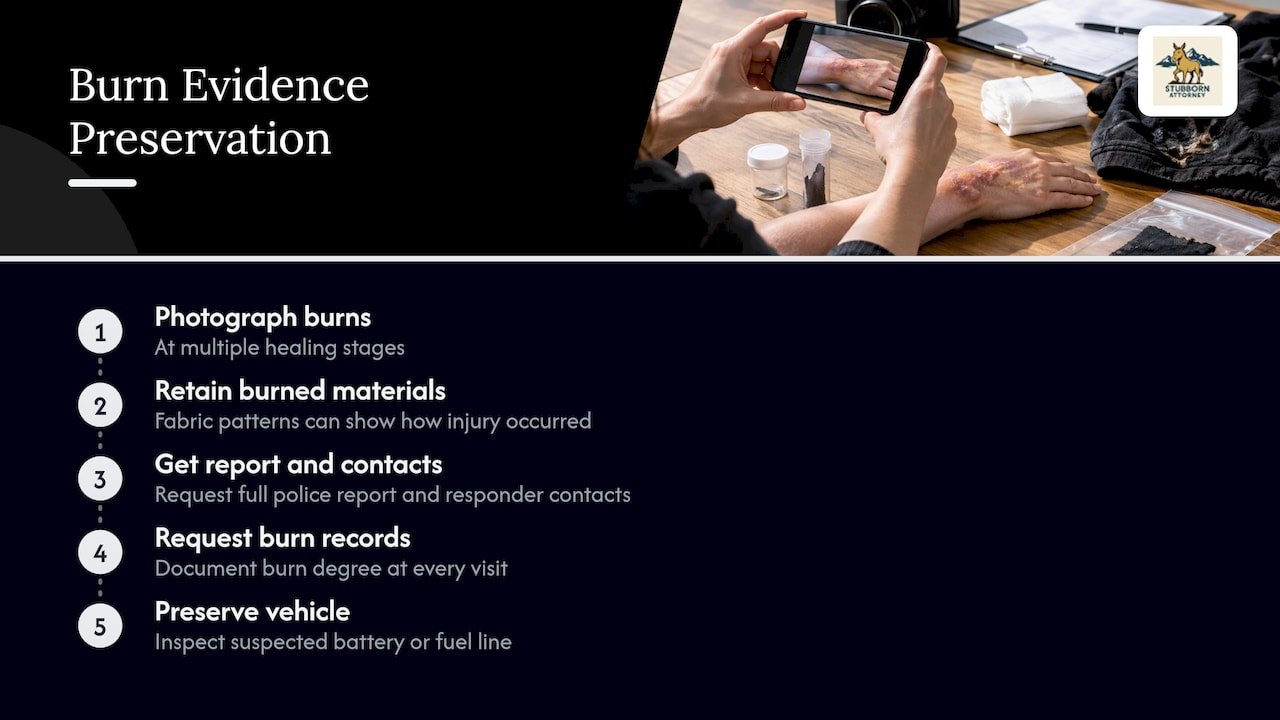
Ask your treating physician for detailed burn degree documentation at each visit, not just a general injury summary, since the medical record’s specificity directly affects how your claim is valued later. If a vehicle component, like a battery or fuel line, is suspected of causing the burn, request that the vehicle be preserved for inspection before it is repaired or scrapped. Our evidence checklist for Colorado Springs accident claims covers additional documentation steps that apply broadly to crash injury claims.
Typical Timelines for Burn Injury Recovery Relevant to Legal Claims
Burn recovery timelines vary widely by severity, and that variation directly affects when a claim should settle.
A first-degree burn may heal within days to a couple of weeks, with minimal lasting effect, which means a claim can often be resolved relatively soon after treatment concludes. A second-degree burn typically takes several weeks to a few months to heal, and scarring may continue to change in appearance for up to a year or more afterward.
Third-degree burns often require ongoing treatment over an extended period, including surgeries, therapy, and scar management as scar tissue matures. Settling a severe burn claim too early, before the full scope of scarring and future care needs is clear, risks accepting compensation that falls short of actual long-term costs.
This is why attorneys often advise waiting until you reach maximum medical improvement, the point where your doctors expect no further significant change, before finalizing a settlement. For a severe burn, that point may be a year or more after the crash, which is also why the three year filing deadline matters: it gives your case time to mature without forcing a premature settlement.
Colorado-Specific Burn Injury Legal Precedents or Case Examples
Colorado courts handle burn injury claims within the state’s broader personal injury framework, applying the same comparative negligence and damages rules that govern other car accident cases, with burn-specific damages layered on top.
Because Colorado follows a modified comparative negligence rule, a burn victim found partially at fault for a crash, for instance, for following too closely before a rear-end collision ignited a fuel leak, can still recover damages as long as their share of fault does not exceed the threshold set by Colorado law, though their total recovery is reduced proportionally. Our breakdown of Colorado’s comparative negligence rules explains how that reduction is calculated.
Colorado’s statutory damage caps and recent legislative changes also apply specifically to how non-economic and, in some cases, punitive damages are calculated in severe injury cases, including burns. The Colorado Judicial Branch maintains the current statutory text governing these caps, and because the rules can be updated, confirming the applicable version for your filing date matters more than relying on a general summary. Our guide to five common personal injury case examples illustrates how these rules play out across different injury types, including severe injuries like burns.
Medical Treatment and Rehabilitation Options for Burn Victims
Treatment for a car accident burn typically starts in the emergency room, but the path afterward depends heavily on burn depth and location.
Minor burns often resolve with wound cleaning, topical treatment, and follow-up visits to monitor healing. More severe burns usually require transfer to a specialized facility such as the UCHealth Burn Clinic at Anschutz, where treatment can include skin grafting, debridement, and coordinated wound care designed specifically for burn injuries.
Rehabilitation after a significant burn often extends well beyond the initial healing period. Physical therapy helps restore range of motion in joints affected by scar tissue, while occupational therapy addresses daily living skills when burns affect the hands or face. Scar management, including pressure garments and sometimes laser treatment, can continue for a year or more after the initial injury.
The Mayo Clinic outlines when burn symptoms warrant emergency care and what recovery generally involves, which can help set realistic expectations for how long treatment may take and what it may ultimately cost, both factors a legal claim needs to account for.
Long-Term Physical and Psychological Impacts of Burn Injuries
A burn injury’s effects often extend well past the point where the skin has healed, and both the physical and emotional dimensions deserve attention in a legal claim.
Physically, scar tissue can restrict movement, particularly over joints, and may require ongoing stretching, therapy, or revision surgery for years after the crash. Nerve damage in the burned area can cause chronic pain or altered sensation that persists long after visible healing. Temperature regulation in burned skin can also be permanently affected, making a person more sensitive to heat or cold in that area.
Psychologically, visible scarring, especially on the face or hands, can lead to lasting emotional distress, anxiety, or depression tied to changes in appearance and self-image. Some burn survivors experience symptoms consistent with post-traumatic stress related to the crash itself, which can affect their ability to drive or even ride in a vehicle again.
These long-term effects are exactly why non-economic damages matter so much in burn claims. A settlement that only covers medical bills and lost wages, without accounting for years of therapy, scar treatment, or emotional recovery, often falls short of what the injury actually costs a person over a lifetime.
A Note on How We Approach Burn Cases
Burn cases take time to value correctly, and that is where persistence matters most. We do not rush a severe burn claim toward a quick settlement before the full scope of scarring, future surgeries, or lasting pain is clear. Our approach favors steady, thorough preparation over speed, because a burn survivor’s long-term needs deserve that same patience. A free case review costs nothing and gives you a clear picture of what your claim may involve.
— Ryan
How We Can Help You Move Forward
Burn injuries from a car accident often involve more documentation, more medical complexity, and more long-term cost than a typical crash claim, and that is exactly the kind of case our firm handles directly, attorney to client, without passing your file between case managers. We work on a contingency fee basis, meaning you owe nothing unless we recover compensation for you.
Our services page outlines the types of injury cases we take on, including car accidents, product liability, and wrongful death claims that can stem from a severe burn. If you want to understand our fee structure in detail, our pricing plan page explains how our contingency arrangement works.
Call our office or fill out our online form for a free case review. We will walk through your medical records, the circumstances of the crash, and what your claim may be worth before you decide anything.
This article is general information, not a substitute for advice from a qualified lawyer. Consult a qualified legal professional about your own circumstances before acting on anything here.
FAQ
How much compensation do you get for a burn injury?
Compensation depends on burn severity, required medical treatment, and long-term effects like scarring or lost earning capacity, so there is no fixed amount that applies to every case. Claims factor in past and future medical costs, lost wages, and non-economic damages like pain and suffering, with severe burns generally commanding higher values due to extensive treatment and lasting impact, as the American Burn Association notes regarding burn-specific treatment costs.
What is the average settlement for a car accident in Colorado?
Settlement amounts in Colorado car accident cases vary widely based on injury severity, fault percentage, and insurance coverage limits, so no single figure represents a typical outcome. Our analysis of Colorado car accident settlements breaks down how damage caps and case specifics affect the range of outcomes in these claims.
Do burn victims ever fully recover?
Recovery outcomes depend heavily on burn depth and location, with first-degree burns typically healing completely within weeks. Deeper second and third-degree burns often leave lasting scarring, altered sensation, or restricted movement even after extensive treatment, according to the Mayo Clinic’s overview of burn symptoms and recovery.
What counts as being a burn victim?
Anyone who sustains thermal, chemical, or electrical skin injury, whether from fire, scalding liquid, hot surfaces, or corrosive substances, qualifies as a burn victim under both medical and legal definitions. In a car accident context, this includes injuries from fuel fires, hot engine components, airbag deployment burns, and chemical exposure from damaged vehicle systems, as described by the World Health Organization’s classification of burn causes.
Sources
- WHO — Burns fact sheet
- American Burn Association — Burn incidence fact sheet
- Mayo Clinic — Burns: symptoms and causes
- Colorado Judicial Branch