
Colorado Springs Bicycle Laws: 3 Feet, Electric Bike Rules, Claims
The essential legal rules that govern bicycling in Colorado Springs are the Colorado Safety Stop, the Three-Foot Law, and City Chapter 10 vehicle code covering sidewalks, bike lanes, and e-bikes. Follow those three frameworks, check posted trail signage before you ride, run working lights after dark, and document any unsafe pass or crash right away.
Table of Contents
- State law essentials: Safety Stop, Three-Foot Law, and bicyclist rights
- Colorado Springs city code: sidewalks, bike lanes, equipment, and impoundment
- E-bikes and power-assisted devices: where each class can go
- A pre-ride and on-road checklist for staying legal
- Enforcement and penalties for bicycle rule violations
- How compliance affects your bicycle crash claim
- What actually matters most for Colorado Springs cyclists
- If you’re hurt in a Colorado Springs bicycle crash, we can help
- FAQ
- Sources
State law essentials: Safety Stop, Three-Foot Law, and bicyclist rights
Colorado’s Safety Stop law lets riders age 15 and older treat a stop sign as a yield and a red light as a stop sign when conditions are safe, while younger riders may only do so with an adult present, according to CDOT’s bicyclist guidance. At a stop sign, that means slowing and stopping if safety requires it, or slowing to 10 mph or less when a full stop isn’t necessary. At a red light, riders must stop first, yield to cross traffic and pedestrians, and only then proceed cautiously or turn right once the intersection is clear.
The Three-Foot Law requires drivers and motorcyclists to leave at least three feet of space when passing a bicyclist, and to slow down and wait behind the rider if that space isn’t available, per the same CDOT guidance. The rule is reinforced on the ground by the Bicycle Passing Clearance sign, known as R4-19, which CDOT added to the Manual on Uniform Traffic Control Devices and now recommends for corridors based on crash history and traffic volume, detailed in the R4-19 sign guide.
Colorado Revised Statutes § 42-4-1412 ties it together: bicyclists get the same rights and the same duties as drivers of motor vehicles, with added rules specific to bikes, according to the Colorado bicycling manual. Key duties include:
- Riding as near the right side of the road as practical, except when passing, turning left, or avoiding hazards.
- Riding no more than two abreast, and only within a single lane.
- Signaling turns and stops, and yielding appropriately at crosswalks and intersections.
- Running a front white light and rear red reflector (or light) visible from a set distance when riding after dark.
One rule, two directions: the Safety Stop protects riders at intersections, and the Three-Foot Law protects riders being passed. Both assume the bicyclist is otherwise following the rules of the road.
Colorado Springs city code: sidewalks, bike lanes, equipment, and impoundment
State law sets the floor, but Colorado Springs adds its own layer through Chapter 10, Article 19 of the city code, which treats bicycles, e-bikes, and electric scooters as vehicles subject to local operating rules, according to the Code of the City of Colorado Springs. That local layer covers where you can ride and what your bike needs to be street legal within city limits.
Key provisions riders should know:
- Sidewalk riding is allowed in many areas but riders must yield to pedestrians and give an audible signal before passing.
- Parking a vehicle in a designated bike lane is prohibited, and certain protected lanes carry additional use restrictions.
- Bicycles must carry required lighting and reflective equipment to operate legally after dark, mirroring the state standard.
- Officers may impound a bicycle or e-bike found in an unsafe mechanical condition or missing required equipment, with a defined process for the owner to recover it once the device meets code.
The City of Colorado Springs Fire Department’s safety resources echo this framing: bicycles are vehicles first. Riders who treat intersections and lane position that way reduce their own risk—a point reinforced on the department’s bicycle safety page. Sidewalk riding in particular carries a tradeoff. It feels safer away from traffic, but motorists at driveways and cross streets don’t expect fast-moving sidewalk traffic. Therefore, the roadway or a marked bike lane is often the better call where one exists.
E-bikes and power-assisted devices: where each class can go
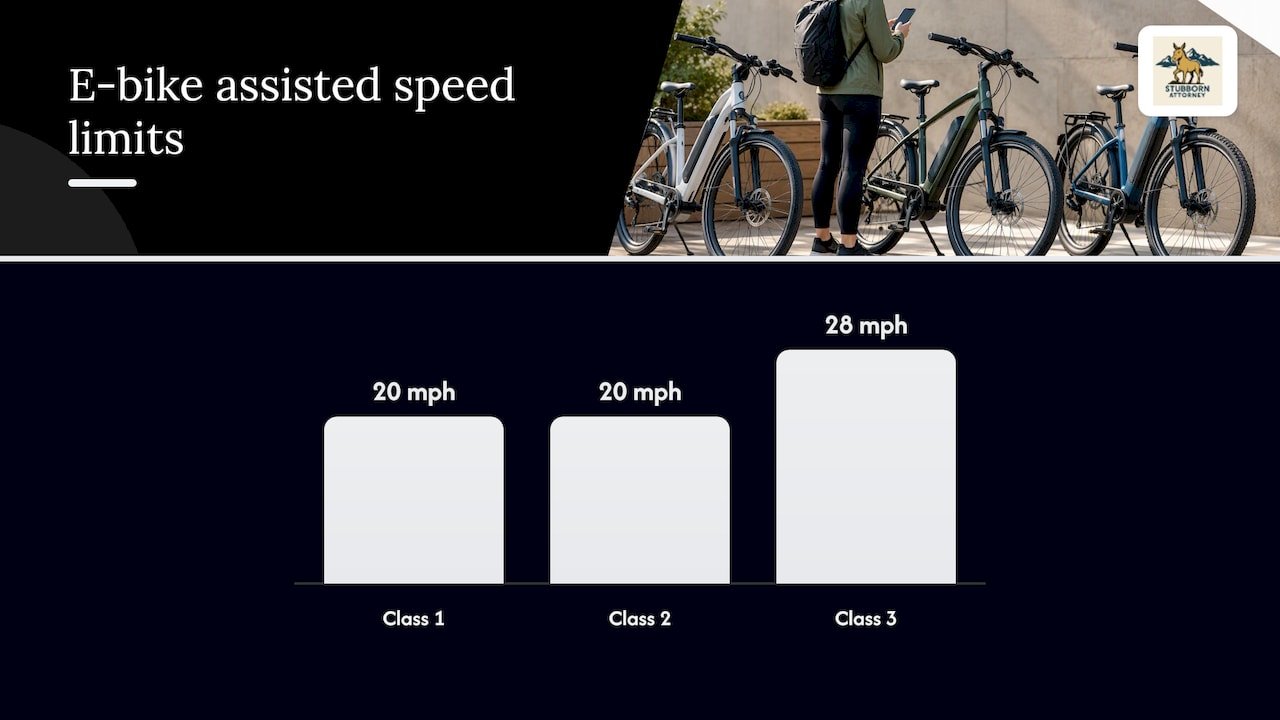
Colorado law splits electric bicycles into three classes, and Colorado Springs applies different trail access rules to each. A Class 1 e-bike provides pedal assistance only up to 20 mph with no throttle. Class 2 adds a throttle capped at the same 20 mph. Class 3 offers pedal assistance up to 28 mph and is typically restricted from multi-use trails.
The City of Colorado Springs is rolling out access in phases rather than all at once. As announced by the city, the phased rollout for Class 1 e-bikes opens select urban and regional trails to Class 1 devices, paired with new signage, rider education, and enforcement starting July 1, while Class 2 and Class 3 e-bikes remain restricted on many trails and open space properties.
Beyond e-bikes, other power-driven mobility devices fall under separate city guidance:
- OPDMDs (other power-driven mobility devices) face speed caps that range from walking speed in sensitive areas up to 20 mph on certain trails, along with size and weight limits, per city OPDMD guidance.
- The city retains authority to restrict any device seasonally or by location to protect natural areas or manage heavy trail use.
Pro Tip: Check the posted trailhead signage and the city’s current trail map before you ride an e-bike anywhere other than a paved urban trail. Rules vary by segment and by season.
A pre-ride and on-road checklist for staying legal
A short routine before and during every ride keeps you inside both state and city rules.
- Confirm trail or route permissions for your device class using the current city map, especially for Class 2 or 3 e-bikes.
- Test your front light and rear reflector or light even on daytime rides that might run late.
- Check brakes, tire pressure, and quick-release levers before heading out.
- Ride predictably: hold your lane position, signal turns and stops, and keep at least one hand on the handlebars at all times.
- Avoid the door zone next to parked cars, where a sudden door creates a collision with almost no reaction time.
- At stop signs, apply the Safety Stop correctly: slow and stop if needed, or roll through at 10 mph or less only when the intersection is clear.
- At red lights, stop fully, yield to cross traffic and pedestrians, then proceed only when it’s safe.
- After a close pass or a crash, capture the location, time, vehicle description or plate, photos of damage and road markings, and any witness contact information immediately.
Riders who treat intersections with the same caution the Safety Stop law intends tend to have cleaner, more defensible accounts of what happened if a dispute follows, under the bicyclist guidance CDOT publishes.
Enforcement and penalties for bicycle rule violations
Colorado Springs officers generally lean toward education for first-time or minor issues, reserving citations for repeated or clearly hazardous violations, consistent with the local code framework in Chapter 10, Article 19. Citations can carry fines, and the amount typically scales with the violation and whether it created a safety hazard.
- Riding without required lights or reflectors after dark is a common citation trigger, especially following a near-miss or complaint.
- A bicycle or e-bike in unsafe mechanical condition, or missing equipment required by code, can be impounded until it’s brought into compliance.
- Impoundment comes with a defined release process once the owner addresses the deficiency.
- A police report generated from any citation or crash becomes part of the record insurers and attorneys review later, which is why accuracy at the scene matters.
How compliance affects your bicycle crash claim
Whether a rider followed the Safety Stop, the Three-Foot Law, and local equipment rules often shapes how an insurance adjuster allocates fault after a crash. A cyclist riding with working lights, proper lane position, and a documented pattern of lawful conduct starts from a stronger position than one who can’t counter a driver’s version of events.
- Photograph the scene, your bike, and any vehicle involved before anything moves, including road markings and skid marks.
- Collect contact information from witnesses immediately, since memories fade within days.
- Request or obtain the police report, which becomes a key piece of evidence in any insurance claim.
- Early documentation tends to produce better claim outcomes than evidence gathered after the fact.
If a driver passed too closely, failed to yield, or a street defect caused your crash, a Colorado Springs bicycle accident attorney can review the facts with you at no cost and explain what a claim would involve, including how fault gets allocated under Colorado’s comparative negligence framework.
What actually matters most for Colorado Springs cyclists
Most riders who read about bicycle law focus on memorizing statute numbers, and that’s the wrong starting point. The Safety Stop and Three-Foot Law matter less as trivia and more as a shared expectation: drivers and cyclists each know what the other is supposed to do at an intersection or a pass, and that predictability is what actually prevents crashes.
The conventional advice, “know your rights,” undersells the local layer. Colorado Springs’ Chapter 19 and the phased e-bike rollout change by trail and by season, so a rider who learned state law years ago can still end up out of compliance on a specific city trail segment. Checking current signage isn’t a formality. It’s the difference between a smooth ride and an impounded bike.
If you ride regularly, prioritize two things over everything else: visible lighting after dark, since it’s the single easiest violation to avoid and the one most likely to affect a crash claim, and knowing your e-bike’s class before you pick a trail. Everything else in this digest supports those two habits.
— Ryan
If you’re hurt in a Colorado Springs bicycle crash, we can help
We represent injured cyclists on a contingency fee basis, so you owe us nothing unless we recover compensation for you. We handle insurance negotiations, help you access medical care, and preserve evidence like close-pass documentation and crash scene photos while your case is strongest. Visit our bicycle accident services page for a free case review.
This article is general information, not a substitute for advice from a qualified lawyer. Consult a qualified legal professional about your own circumstances before acting on anything here.
FAQ
What are the e-bike rules in Colorado?
Colorado law recognizes three e-bike classes: Class 1 and Class 2 are pedal-assist or throttle-assist up to 20 mph, and Class 3 reaches 28 mph with pedal assist. In Colorado Springs, access varies by class and by trail, with Class 1 e-bikes gaining phased access to select trails under the city’s rollout plan while Class 2 and 3 remain restricted on many open space trails.
What is the new rule for cyclists in Colorado?
Colorado’s Safety Stop law allows riders 15 and older to treat stop signs as yields and red lights as stop signs under safe conditions, as explained in CDOT’s bicyclist guidance. Riders under 15 can use the Safety Stop only when riding with an adult.
What is the Three-Foot Law and how is it enforced?
Colorado’s Three-Foot Law requires drivers to leave at least three feet of space when passing a bicyclist, or to slow and wait behind the rider if that space isn’t available, under state guidance. The R4-19 sign reinforces the rule along corridors with relevant crash history.
Can I ride my bicycle on the sidewalk in Colorado Springs?
Sidewalk riding is permitted in many parts of Colorado Springs under city code, but you must yield to pedestrians and give an audible signal before passing. The roadway or a marked bike lane is often safer at intersections, since drivers don’t expect fast sidewalk traffic there.
What should I do after a close pass or bicycle crash in Colorado Springs?
Document the location, time, and vehicle details, photograph the scene and any damage, and collect witness contact information as soon as possible. If you were hurt or a driver violated the Three-Foot Law, a personal injury claim review can clarify your options at no upfront cost.
Sources
- Information for bicyclists — Colorado Department of Transportation (CDOT)
- Code of the City of Colorado Springs — Article 19 (Operation of bicycles, electric scooters, and other human-powered vehicles)