

2026 Caps Reshape Colorado Pain and Suffering Claims. Protect Yours
Yes, pain and suffering is recoverable in Colorado as “noneconomic damages,” but statutory caps and rules shape how much you can collect. For most personal injury cases filed on or after January 1, 2025, HB24-1472 raised the cap on these damages to a specified statutory limit, with inflation adjustments starting in 2028. Comparative fault and mitigation rules can reduce that number further.
Table of Contents
- What pain and suffering covers under Colorado law
- Colorado’s statutory caps after HB24-1472
- How insurers and juries put a dollar figure on your pain
- Permanent impairment versus pain and suffering
- Comparative fault and the seat belt rule
- A practitioner’s take on protecting your claim
- How we help Colorado injury victims pursue fair compensation
- FAQ
- Sources
What pain and suffering covers under Colorado law
Colorado law groups pain and suffering under a broader category called noneconomic damages. Under § 13-21-102.5, “noneconomic loss or injury” includes physical and mental pain and suffering, inconvenience, emotional stress, and impairment of the quality of life. This is distinct from economic damages, which cover measurable financial losses like medical bills, lost wages, and future earning capacity.
When someone dies from their injuries, certain survivors can pursue derivative noneconomic damages through a wrongful death claim, covering their own grief and loss of companionship rather than the victim’s physical pain.
The statutory categories break down like this:
- Physical pain and suffering: discomfort, soreness, and ongoing physical distress from an injury.
- Mental and emotional suffering: anxiety, fear, sleep disruption, and psychological strain tied to the incident.
- Inconvenience: disruption to daily routines, hobbies, and responsibilities.
- Impairment of quality of life: the gap between how you lived before the injury and how you live now.
Colorado’s statutory caps after HB24-1472
Colorado’s legislature overhauled noneconomic damage limits with HB24-1472, and the change matters for anyone injured after the effective date. For most personal injury cases filed on or after January 1, 2025, the cap on noneconomic damages for direct or derivative loss, including pain and suffering, is set by statute to a specified limit. The legislature built in biennial inflation adjustments starting January 1, 2028, so the figure will climb over time rather than stay fixed.
The statutory cap applies to many non-medical personal injury claims filed on or after January 1, 2025, marking a substantial increase from prior limits (HB24-1472).
Wrongful death and medical malpractice claims follow a different schedule. The bill text phases in separate increases for wrongful-death noneconomic caps and for medical-malpractice noneconomic caps, each with its own timeline and indexing provisions. That means a car accident claim, a wrongful death claim, and a medical malpractice claim filed in the same year can face three different cap structures.
A few statutory exceptions matter too:
- Caps generally do not apply when the defendant caused the death through a felonious killing.
- Certain claims against public entities follow separate statutory limits under different sections of Colorado law.
- The cap that applies depends on when your claim accrued, not when you file paperwork or settle, which makes timing a legal question worth getting right early. Our accrual date guide walks through how filing dates interact with accrual rules.
Older online summaries sometimes cite lower historical cap figures from before this overhaul. Those numbers reflected the law before HB24-1472 and no longer apply to claims accruing after January 1, 2025.
How insurers and juries put a dollar figure on your pain
Nobody can measure suffering with a ruler, so attorneys, adjusters, and juries rely on a handful of practical methods to translate it into dollars.
- The multiplier method takes your economic damages (medical bills, lost wages) and multiplies them by a number reflecting injury severity, often somewhere between 1.5 and 5 for serious injuries. This works best for cases with clear economic damages as a baseline, though Colorado’s statutory caps limit how high the final noneconomic figure can land regardless of the multiplier used.
- The per diem method assigns a daily dollar value to your pain and multiplies it by the number of days you’re expected to suffer. This fits shorter recovery periods with a defined timeline better than it fits permanent or uncertain conditions.
- Jury discretion ultimately governs any case that goes to trial. Jurors weigh the intensity of pain, how long it lasted, whether it’s permanent, what doctors testified to, what family and coworkers observed, and how well-documented the daily impact was.
Pro Tip: Skip the online pain and suffering calculators. They can’t account for Colorado’s statutory caps, your comparative fault percentage, or how a specific jury pool tends to value cases, so the number they spit out is frequently misleading.
Our guide to valuing a Colorado injury case breaks down how to build the evidence file that supports whichever method fits your situation.
Permanent impairment versus pain and suffering
Colorado law treats permanent impairment and disfigurement as separate elements of damage, not as another way of describing pain and suffering. Colorado Judicial Branch jury instructions direct courts to present these as distinct categories so juries don’t double-count or under-compensate either one.
- Pain and suffering covers the subjective experience of discomfort and distress.
- Impairment and disfigurement cover the objective, lasting change to your body or function.
- An instruction on future or permanent impairment generally requires solid medical evidence establishing that the condition is lasting, not just painful in the moment.
Scarring, loss of mobility, or diminished physical capacity typically need specific medical documentation and, often, testimony addressing long-term prognosis to support a permanency finding.
Comparative fault and the seat belt rule
Colorado follows a modified comparative negligence system, and it can wipe out a pain and suffering claim entirely. If a jury finds you 50% or more at fault for the incident, you recover nothing, regardless of how severe your suffering was. Below that threshold, your award gets reduced by your percentage of fault.
- Colorado’s seat belt statute, C.R.S. § 42-4-237(7), allows evidence of seat belt nonuse to be introduced to show a failure to mitigate damages.
- Jury Instruction 5:3 guides how courts present this mitigation evidence, and case law including Anderson v. Watson supports the practice of letting juries reduce noneconomic awards on this basis.
- Juries can apportion a reduction specifically to the pain-and-suffering component of an award, separate from economic damages, when mitigation evidence applies.
A fault finding of 50% or greater bars recovery entirely under Colorado’s modified comparative negligence framework, so this threshold deserves serious attention in any contested liability case (Colorado Judicial Branch). Our breakdown of the 50% rule and special verdicts covers how insurers use comparative fault arguments to shrink payouts.
A practitioner’s take on protecting your claim
The biggest mistake we see is treating medical care and documentation as optional once the adjuster starts talking settlement. Getting consistent treatment, keeping a symptom journal, and collecting statements from people who’ve watched your daily life change all build the record that supports a real noneconomic number.
Having worked as a claims adjuster for the federal government before practicing law, I’ve seen how insurers price perceived litigation risk into their offers. They’re watching for gaps in treatment and thin documentation just as closely as they’re watching your injury severity. When caps, mitigation arguments, or serious injuries are in play, getting a lawyer involved early changes how the other side evaluates your case.
— Ryan
How we help Colorado injury victims pursue fair compensation
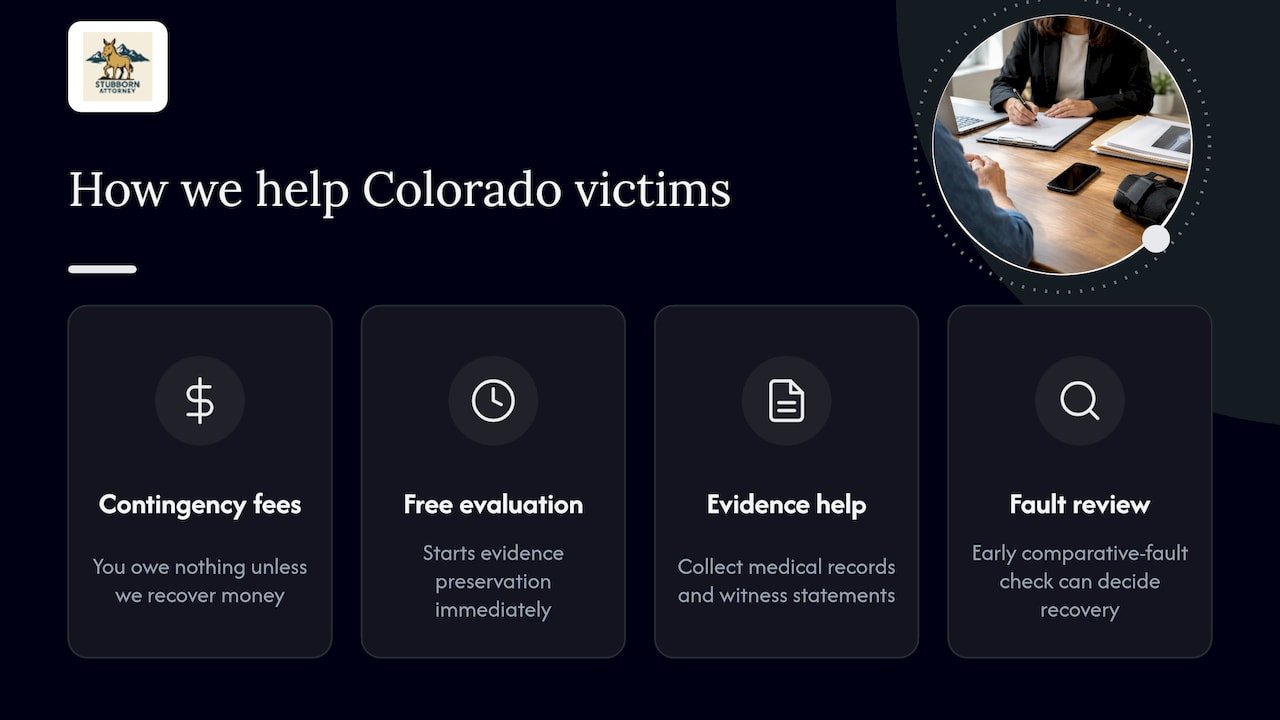
We represent injured people across Colorado in car accidents, motorcycle and semi-truck collisions, bicycle and pedestrian accidents, slip and falls, wrongful death claims, and medical malpractice cases, all on a contingency fee basis, so you owe us nothing unless we recover money for you.
A free case evaluation gives us the chance to start preserving evidence immediately: medical records, witness statements, and the documentation that supports a real pain-and-suffering valuation under current caps. We also look closely at comparative-fault exposure early, since that single finding can determine whether you recover anything at all. Our background on the insurance side means we know what adjusters look for and how to counter a lowball approach before it gets traction.
If you’re dealing with a significant injury or a complicated liability picture, reach out through our pricing and engagement options or start with a free case evaluation to find out where you stand.
This article is general information, not a substitute for advice from a qualified lawyer. Consult a qualified legal professional about your own circumstances before acting on anything here.
FAQ
Can you sue for pain and suffering in Colorado?
Yes, Colorado law recognizes pain and suffering as a recoverable form of noneconomic damages in personal injury claims. Recovery is subject to statutory caps under HB24-1472 and can be reduced or barred by comparative fault findings.
What is a reasonable settlement for pain and suffering?
There’s no fixed formula, since settlement value depends on injury severity, documentation quality, and the statutory cap that applies to your claim type. Attorneys often reference methods like the multiplier or per diem approach as starting points, but a fair figure comes from the specific facts and evidence in your case rather than a generic calculation.
What qualifies you for pain and suffering?
Under § 13-21-102.5, you can pursue pain and suffering damages when you’ve experienced physical or mental pain, emotional stress, inconvenience, or diminished quality of life due to someone else’s negligence. Strong medical records and documentation of how the injury changed your daily life support this type of claim.
What are the four proofs of negligence?
A negligence claim generally requires proving duty, breach, causation, and damages: that the other party owed you a duty of care, breached it, that the breach caused your injury, and that you suffered actual harm. Each element needs supporting evidence, and gaps in any one of them can weaken an otherwise strong pain-and-suffering claim.
Sources
- HB24-1472 Raise Damage Limit Tort Actions | Colorado General Assembly
- Colorado Judicial Branch — Chapter 5: General instructions relating to damages (2026)
- Colo. Rev. Stat. § 13-21-102.5 — Noneconomic loss or injury