

Colorado Construction Accident Claim: Who Pays and What to Do
If you were hurt in a construction accident in Colorado, your claim usually comes down to four things: who was responsible for the unsafe condition, whether you were a worker or a passing driver, pedestrian or cyclist, how much of the blame lands on you, and how fast you act. Deadlines can be as short as 182 days when a government agency is involved, and most negligence lawsuits must be filed within two years. Reporting the crash, getting medical care and documenting the scene in the first days will shape everything that follows.
This guide explains how a Colorado construction accident claim works, who can be held liable, what compensation can cover, and what to do next. It is written for injured people and families in Colorado Springs, Denver and across the state who want to understand their position before they talk to a lawyer.
Table of Contents
- Two very different kinds of construction accident claims
- Who can be responsible for a construction accident in Colorado
- Construction-zone crashes: what to do in the first days
- Hurt on the job: workers’ comp and third-party claims
- How fault is divided under Colorado law
- Claims involving a government agency: the 182-day rule
- Filing deadlines for the lawsuit itself
- What compensation can a construction accident claim include
- How long will a construction accident claim take
- What it costs to pursue a claim
- Our perspective: why these cases reward persistence
- Getting help with your claim
- Common mistakes that weaken a construction accident claim
- FAQ
- Sources
Two very different kinds of construction accident claims
People search for “construction accident claim” and mean one of two situations. The legal path is different for each, so start by deciding which one is yours.
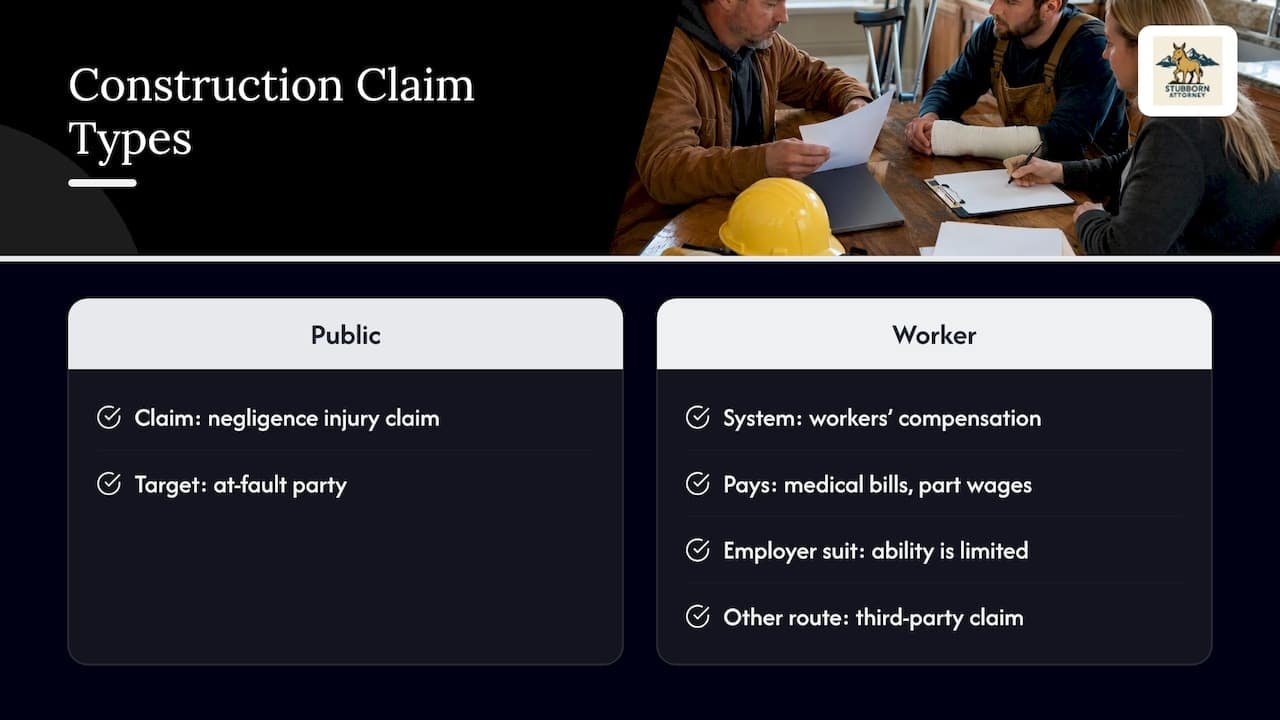
1. You were hurt as a member of the public. You were driving through a work zone, walking past a site, riding a bike along a detour, or you were a customer or visitor on a property under construction. You have no employment relationship with the companies involved, so you can generally bring an injury claim directly against whoever was at fault. This is a standard personal injury claim based on negligence.
2. You were hurt while working on the site. Employees hurt on the job are usually steered into the workers’ compensation system, which generally pays medical bills and part of lost wages regardless of fault, but in exchange limits your ability to sue your own employer. Even so, a different company on the site (a general contractor, another subcontractor, an equipment maker, a property owner) may have contributed to the injury. A claim against one of those outside parties is called a third-party claim, and it can reach damages that workers’ compensation does not.
Most of what follows applies to both groups, but the sections on work-zone crashes and government deadlines matter most to the first group, and the section on third-party claims matters most to the second.
Who can be responsible for a construction accident in Colorado
Construction sites involve many companies at once. That is why these claims often have more than one defendant. Liability depends on who controlled the hazard, who was supposed to make it safe, and who knew about it.
Contractors and subcontractors
A general contractor typically controls site safety and coordinates the trades. A subcontractor may be responsible for its own crew, equipment and the area where it works. Negligence can look like poor traffic control, unmarked trenches or drop-offs, unsecured materials, missing barriers, inadequate lighting, or unsafe equipment operation.
Responsibility can also continue after the work stops. In Collard v. Vista Paving Corp., a Colorado appeals court recognized that a road contractor that finishes work and leaves a dangerous condition behind has a duty, for a reasonable time, to eliminate the hazard or warn foreseeable users of it, unless it reasonably believes another authorized party will promptly do so (Collard v. Vista Paving Corp., 292 P.3d 1232 (Colo. App. 2012)). In practical terms, a loose gravel patch, an uneven pavement edge or an unmarked lane shift left behind at the end of a shift is not automatically someone else’s problem.
Property owners and developers
Owners of a site can be responsible for unsafe premises, especially when they knew about a hazard or hired a contractor they should have supervised. If you were hurt walking onto a property under renovation, the owner’s duties may matter as much as the contractor’s. Our guide to slip and fall injuries in Colorado explains how premises claims are built.
Equipment and product manufacturers
If a crane, scaffold, nail gun, harness, brake system or heavy vehicle failed because of a defect or a missing warning, the manufacturer or distributor may share responsibility. These are product liability claims, and they often depend on preserving the equipment itself, which is one reason to call a lawyer early.
Drivers
Sometimes the construction zone is the setting, not the cause. A distracted or speeding driver who rear-ends a stopped vehicle in a lane closure is responsible like any other at-fault driver. Our overview of fault in Colorado car accidents walks through how that works.
Government agencies
State and local agencies often design, inspect and manage road projects. If a poorly designed detour, missing signage or a known road hazard played a part, an agency may be a party. These claims carry special rules and a very short notice deadline, covered below.
Construction-zone crashes: what to do in the first days
Work-zone crashes are a common way ordinary drivers and cyclists end up with a construction accident claim. The steps below protect your health first and your claim second.
- Call 911 and get medical care. Adrenaline hides injuries. Whiplash, concussions and internal injuries can show up hours or days later, and a gap in treatment gives an insurer an argument that you were not really hurt.
- Make sure the crash is reported. Colorado law requires crashes to be reported immediately to the agency with jurisdiction, under C.R.S. 42-4-1601, according to the Colorado State Patrol. Our accident injury reporting guide covers what to expect.
- Photograph the work zone itself. Capture signs, cones, barriers, lane shifts, lighting, pavement edges, equipment and the company names on trucks or signs. Work zones change daily, and the evidence may be gone within a week.
- Write down names. Get contact details for witnesses, flaggers and workers, plus the project name or permit number if posted.
- Keep your vehicle and gear. Do not rush repairs or throw away a damaged helmet, bike or phone until your lawyer has seen them.
- Be careful with insurers. Give basic facts, but avoid recorded statements and early settlement offers before you know the full extent of your injuries.
- Talk to a lawyer early. Early involvement helps preserve video, inspection records and traffic-control plans that contractors and agencies may not keep forever. Our checklist of 10 steps to strengthen an injury claim after a car accident applies here too.
Hurt on the job: workers’ comp and third-party claims
If you were injured while working, report the injury to your employer promptly and see a medical provider. Workers’ compensation is generally the first path for medical care and wage replacement, and it does not require you to prove your employer was careless.
The question worth asking next is whether anyone other than your employer contributed. Construction sites are full of candidates:
- A general contractor that controlled site safety when you worked for a subcontractor.
- Another trade whose work created the hazard, such as a crew that left an opening uncovered.
- The maker of a defective tool, lift or fall-protection system.
- A property owner who ignored a known danger.
- A driver who struck you at a roadside work zone.
A third-party claim is a negligence claim, so it can include pain and suffering and other losses that workers’ compensation does not pay. The two systems can interact, because the workers’ compensation insurer may have a right to be repaid from a third-party recovery. A lawyer should explain how that works for your situation before you accept any settlement.
How fault is divided under Colorado law
Construction accidents often produce arguments about shared blame: the driver was “speeding through a posted work zone,” the worker “skipped a harness,” the pedestrian “ignored a barrier.” Colorado’s comparative negligence statute decides what those arguments are worth.
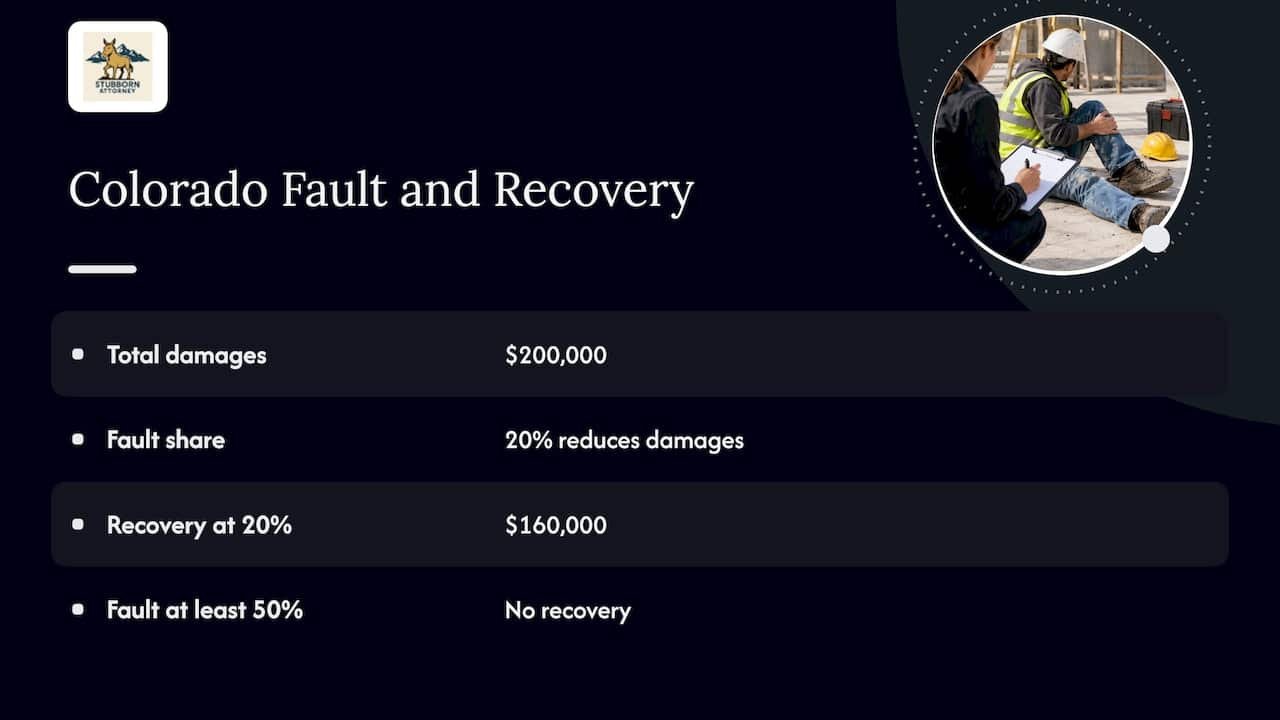
Under C.R.S. § 13-21-111, a plaintiff who is found 50% or more at fault is barred from recovering any damages (C.R.S. § 13-21-111 (2025)). When your share of fault is below 50%, your total damages are reduced by your percentage of fault under the same statute.
Here is a simple illustration. Suppose a jury finds your damages total $200,000 and decides you were 20% at fault for not slowing down in a signed work zone. Your recovery would be reduced by 20%, to $160,000. If the jury put your share at 50% or more, you would recover nothing.
Because one percentage point can change the result, insurers work hard to move blame onto the injured person. That is where evidence about signage, lane markings, lighting and traffic-control plans earns its keep. For the full picture, see our explanation of the 50% rule and special verdicts in Colorado comparative negligence.
Claims involving a government agency: the 182-day rule
The deadline most likely to catch people off guard applies when a state or local government entity may be responsible. That could include a highway department project, a city street crew or a public building under construction.
Colorado requires written notice of the claim within 182 days after you discover your injury, and filing that notice is a jurisdictional prerequisite to suing a public entity, under C.R.S. § 24-10-109 (C.R.S. § 24-10-109 (2025)). Jurisdictional means that missing it can end the claim before the court looks at the merits.
This is why the first question in a work-zone case should be: who actually owned, designed or managed this stretch of road? Sometimes the answer is a private contractor, sometimes a public agency, and sometimes both. If there is any chance a public body is involved, treat 182 days as your working deadline and do not wait for medical treatment to finish.
Our pages on the Colorado Governmental Immunity Act, filing within 182 days and road hazard claims go deeper on the notice process.
Filing deadlines for the lawsuit itself
Separate from the government notice, there is a statute of limitations on the lawsuit. According to Nolo’s summary of Colorado law, the general rule for negligence lawsuits is two years, and most motor vehicle accident lawsuits have a three-year limit (Nolo’s guide to Colorado personal injury statutes of limitations). The same source notes that the two-year period also applies to most wrongful death cases and to cases against government entities.
Which limit applies to you can turn on the type of claim: a driver hit in a work zone may fall under the motor vehicle rule, while a pedestrian hit by a falling object may not. Do not rely on the longer number without checking. Our 2026 guide to key deadlines for Colorado injury claims lays out the timelines side by side.
| Situation | Deadline to watch |
|---|---|
| Government entity may be at fault | Written notice within 182 days of discovering the injury |
| General negligence lawsuit | Two years |
| Most motor vehicle accident lawsuits | Three years |
| Wrongful death | Generally two years from the date of death |
These are general rules. Exceptions exist, and the clock can start at different points, so confirm your own dates with a lawyer promptly.
What compensation can a construction accident claim include
A claim is built from the losses the accident caused you. In most Colorado injury cases, those include:
- Medical expenses, past and future: emergency care, surgery, therapy, medication, equipment and ongoing treatment.
- Lost income and reduced earning capacity, which matters a great deal to tradespeople who cannot return to heavy physical work.
- Pain, suffering and loss of enjoyment of life.
- Property damage, such as a vehicle, motorcycle or bicycle.
- Wrongful death damages for surviving family members when a crash or site accident is fatal. See our guide to Colorado wrongful death claims and damages.
Catastrophic injuries such as spinal damage, traumatic brain injury and amputations call for careful planning, because the full cost may not be clear for months or years. Settling before you reach maximum medical improvement is one of the most common and costly mistakes.
How long will a construction accident claim take
There is no honest single number. A straightforward claim with clear fault and a full recovery can settle in a matter of months. Claims with serious injuries, several defendants, a government agency or disputed fault take longer, and a case that goes to trial takes longer still. The main drivers are how long your treatment lasts, how many parties are involved, whether the insurers accept liability, and the court’s calendar.
A fair settlement discussion usually waits until your doctors can describe your long-term outlook. A quick offer is often a lowball offer. A lawyer who is willing to file suit when talks stall tends to change how seriously an insurer treats your claim.
What it costs to pursue a claim
Most people worry about legal fees right after a crash, when income is uncertain. Personal injury firms commonly work on contingency, and ours does: you pay nothing unless there is a monetary recovery in your case. The fee is a portion of what is recovered, and you should read the engagement agreement carefully, including how case costs are handled, before you sign. Any lawyer you consider should be able to explain fees plainly and in writing.
We do not publish a fee for individual case types because every claim is different. You can start with a conversation about your situation and see whether we are a fit.
Our perspective: why these cases reward persistence
Construction accident claims are rarely simple, and we say that as lawyers who like hard cases. Several companies, an insurance carrier for each, a site that changes daily and sometimes a public agency with a 182-day clock: that is a lot of moving parts for someone trying to heal.
We approach these claims with a perspective shaped by Ryan’s years as a claims adjudicator for the federal government. He knows how large insurers and government agencies evaluate a claim, which means knowing what they look for, what they discount and where they hope the injured person will give up. We use that to prepare a case from the start as if it will be tried, which is how you get taken seriously.
Two things matter most to us. First, the case is handled directly by attorneys, not passed along like a file in a case mill. Second, persistence. Our brand reflects Ryan’s love of mules and Colorado’s mountain trails: when we take a case, we do not let go. Since the name changed from Malnar Injury Law, the team and the commitment are the same, and we have settled hundreds of injury cases and recovered millions of dollars for clients.
If you are hurt and unsure who to blame, do not carry that question alone. Part of our job is to find out who was responsible, and to do the chasing so you can focus on recovery.
— Ryan
Getting help with your claim
We represent injured people across Colorado, including Colorado Springs, on car, truck, motorcycle, bicycle, pedestrian and premises cases, as well as wrongful death and product liability. If a construction zone or job site is part of your story, we will look at who controlled the hazard and which deadlines apply to you. See our personal injury services or start with the Colorado Springs personal injury team for a free case review.
Common mistakes that weaken a construction accident claim
- Waiting to see if it gets better. Deadlines keep running while you wait, and the shortest one is 182 days.
- Skipping the doctor. A gap in treatment is an easy target for an insurer.
- Posting online. Photos of normal activity can be used against you, even when they are unrelated to your injury.
- Signing a release too early. Once you accept a settlement, it is generally final.
- Assuming one party is responsible. Pointing at only the driver, or only the employer, can leave other sources of recovery unexamined.
- Letting evidence disappear. Request that the contractor and agency preserve video, logs and plans as soon as a lawyer is involved.
FAQ
What is the statute of limitations for a construction accident lawsuit in Colorado?
The general rule for negligence claims is two years, and most motor vehicle accident lawsuits have a three-year limit, according to Nolo’s summary of Colorado law. If a government entity may be at fault, you must also give written notice within 182 days. A lawyer can confirm which deadlines apply to your facts.
Can I sue if I was partly at fault for the accident?
Often, yes. In Colorado, you can recover if your share of fault is below 50%, but your damages are reduced by your percentage of fault. At 50% or more, you are barred from recovering damages under C.R.S. § 13-21-111. Evidence about the site conditions can reduce the blame assigned to you.
Do I need a lawyer for a construction zone crash claim?
Not every claim requires one, but these cases often involve several companies, insurers and sometimes a government agency with its own notice rules. A lawyer can identify the responsible parties, preserve evidence and keep deadlines from passing. Our guide on when to hire an auto accident attorney can help you decide.
How much does it cost to hire a construction accident lawyer?
We work on a contingency basis, so you pay no attorney fee unless there is a monetary recovery in your case. Ask any firm to put its fee and cost terms in writing before you sign.
What if I was injured at work on a construction site?
Report the injury to your employer promptly and get medical treatment, since workers’ compensation is generally the first route for medical care and wage benefits. Then ask a lawyer whether a third party, such as another contractor or an equipment maker, may also be responsible, because that claim can recover damages workers’ compensation does not.
Sources
- Collard v. Vista Paving Corp., 292 P.3d 1232 (Colo. App. 2012)
- Crash Information, Colorado State Patrol
- C.R.S. § 13-21-111 (2025)
- C.R.S. § 24-10-109 (2025)
- Colorado Personal Injury Laws and Statutes of Limitations, Nolo