

Colorado Trampoline Park Injury: Your Rights and Next Steps
If you or your child was hurt at a trampoline park in Colorado, you may still have a claim, even if you signed a waiver. Three things decide whether it works: how the park’s conduct is judged under Colorado’s Premises Liability Act, what the waiver can and cannot cover, and whether you file within the deadline. The deadline is generally two years. Medical care comes first. Evidence and a prompt legal review come right after.
This guide explains how these injuries happen, what Colorado law says, and what to do in the first days. It is written for injured jumpers and for parents who are sorting through paperwork while a child is in a cast.
Table of Contents
- Why trampoline park injuries happen
- What to do in the first 72 hours
- Can you sue if you signed a waiver?
- How Colorado’s Premises Liability Act applies
- The deadline to file in Colorado
- What compensation can cover
- Safety tips if you still plan to visit
- Our perspective
- Work with a Colorado injury team
- FAQ
- Sources
Why trampoline park injuries happen
A commercial park is not a bigger backyard trampoline. The American Academy of Pediatrics (AAP) says the most frequent causes of trampoline injury are collisions with other jumpers, bad landings, falls off the jumping surface and the “double bounce”. A double bounce happens when one person’s landing launches another person into the air. All of these risks grow when many people share the same space.
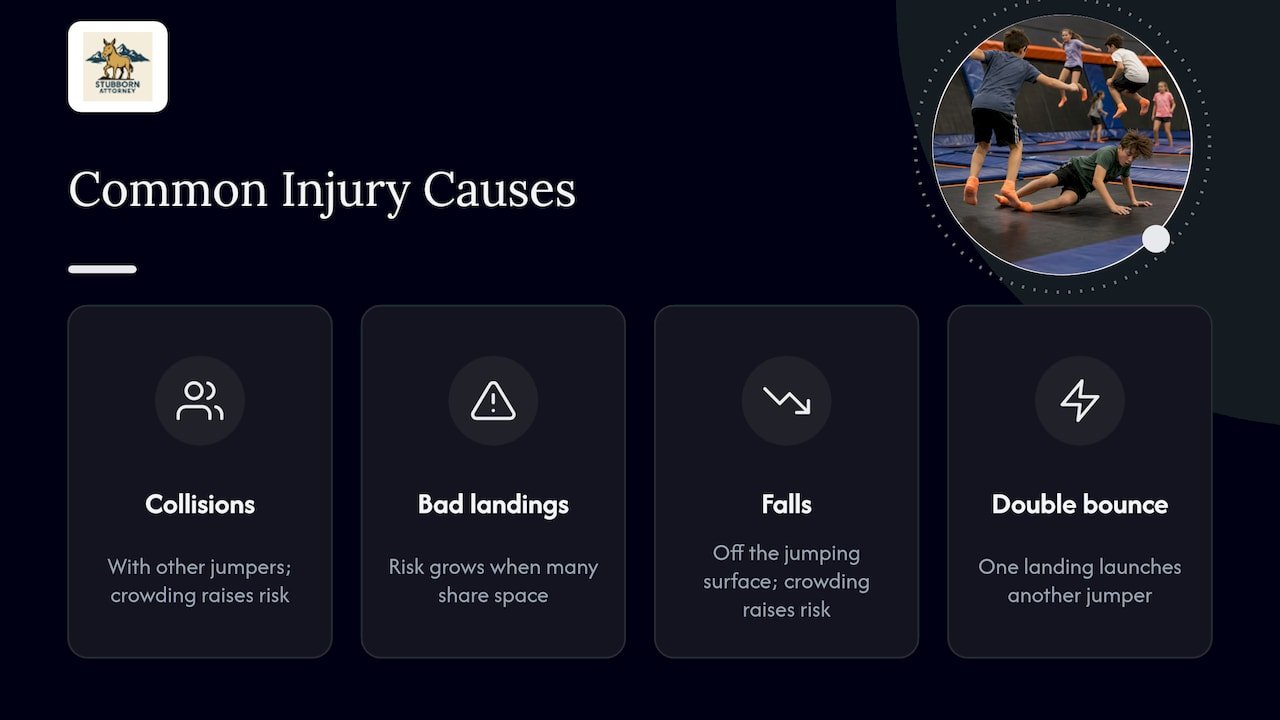
The same AAP guidance says parks can be more dangerous than home trampolines because the surfaces are often harder and bouncier and jumpers are packed close together. Parents often assume staff and safety nets make a park safer. The AAP page says severe injuries happen regardless of parental vigilance or safety equipment.
Research backs this up. A study of 2008 to 2017 federal injury surveillance data found that pediatric trampoline fractures were 32% more likely (odds ratio 1.32) to happen at a place of recreation or sport rather than at home. The AAP also reports that more than 800,000 children were hurt on trampolines between 2009 and 2018.
A prospective study of children with trampoline fractures found that severe injuries occurred even with safety equipment, supervision and parents who understood the dangers. That finding matters in a legal claim. A park cannot automatically blame a parent for an injury just because the parent allowed the child to jump.
Common injuries
The injuries we see described most often at parks include:
- Fractures of the arms, legs and ankles, including growth-plate injuries in children
- Sprains and torn ligaments, especially knees and ankles
- Head injuries and concussions
- Neck and back injuries, including spinal injuries from awkward landings or flips
- Injuries from collisions with another jumper, a wall, a pad edge or a foam pit
A broken bone is obvious. Concussions and neck strain are easier to miss at first. Symptoms can show up hours or days later, which is one reason to be checked by a doctor even when the person says they feel fine.
What to do in the first 72 hours
The steps below protect your health first and your claim second. They are the same steps we would give a friend.
- Get medical care. Go to urgent care or the emergency room, or call 911 for a suspected head, neck or spine injury. Do not move someone with a possible spinal injury. Tell the provider exactly where and how the injury happened so it is recorded in the chart.
- Report the incident to the park. Ask staff to complete an incident report and ask for a copy. Write down the name of the employee you spoke to, the time and the court or zone.
- Photograph everything. Take pictures of the area, the surface, torn netting, missing padding, signs, and the injury itself. Photograph the injury again over the following days as bruising and swelling develop.
- Collect names. Get contact details for witnesses, including other parents. Note whether staff were watching the court and how many people were jumping.
- Keep the clothing and grip socks your child wore, and keep every receipt, ticket and booking confirmation.
- Save the waiver. If you signed online, find the confirmation email. The exact wording matters.
- Be careful with the park’s insurer. Insurance adjusters may call quickly and ask for a recorded statement. You are not required to give one before you understand your rights.
- Write down what happened while it is fresh: the sequence, what staff said, and how the injury is affecting sleep, school, work and daily life.
Parks sometimes have security camera footage. Video can be overwritten on a routine schedule. Ask a lawyer to send a preservation request early, rather than assuming the footage will still exist in a few months.
Can you sue if you signed a waiver?
Usually, yes, in some situations. This is the most common misunderstanding we hear.
Colorado law does allow a parent to sign away a child’s claims in advance in some situations. The statute is C.R.S. § 13-22-107, and it covers waivers of prospective negligence claims. It does not protect a facility from claims involving willful, wanton, reckless or grossly negligent acts or omissions.
That difference shapes how a case is built. A waiver may cover a simple accident. It is a much weaker shield if the park:
- Ignored torn mats, broken springs or damaged netting that staff knew about
- Let far too many people onto a court at once
- Had no trained monitors watching the jumping area, or monitors who were on their phones
- Mixed small children and adults in the same zone despite its own rules
- Skipped inspections or maintenance it promised to do
- Ignored earlier injuries on the same attraction
A lawyer’s early job is to find out which category your case falls into. That means reviewing the waiver, the park’s rules, maintenance records, staffing levels, prior incident reports and the physical condition of the equipment. Not every injury is a legal case. A fall that happens despite a well-run park following its rules may not support a claim. We would rather say so honestly than take a case that does not fit.
How Colorado’s Premises Liability Act applies
Trampoline park claims in Colorado generally run through the state’s Premises Liability Act, C.R.S. § 13-21-115. Colorado’s judicial pattern jury instructions explain that the statute is the exclusive remedy for people injured on another’s property. The Colorado Supreme Court has also held that the statute is not limited solely to activities and circumstances directly or inherently related to the land. That matters for a park, where the harm may come from how an activity was run and not only from a defect in the floor.
Your status: invitee
The statute sorts injured people into trespassers, licensees and invitees. The court decides which one applies. Customers of a business, such as paying guests at a trampoline park, are generally invitees. That is the category with the strongest standing to recover. The invitee has to show the landowner failed to use reasonable care to protect against dangers it knew about or should have known about.
For a park, “should have known” is often where the case is won. A worn trampoline bed, a gap between pads or a crowded court is something a reasonable operator checks for.
Who is the “landowner”?
In the Act, “landowner” includes more than the person who holds title. It covers those legally responsible for the condition of the property or for activities conducted on it. The judicial guidance notes that plaintiffs sometimes lose cases by naming the wrong defendant or classifying the injured person incorrectly.
In practice, the building owner, the operating company, a franchisee and a franchisor may be different entities. An early investigation sorts out who ran the court and who controlled the equipment. Our overview of Colorado premises liability claims walks through the Act in more detail, and our guide to slip and fall injuries in Colorado covers the other common premises case.
Equipment makers
Sometimes the problem is the product, not the operation: a defective trampoline bed, a failed spring cover or a faulty safety net. In that situation a product liability claim against a manufacturer or distributor may sit alongside the claim against the park. We handle product liability injury claims as well.
The deadline to file in Colorado
General personal injury tort actions in Colorado, including negligence claims tied to premises liability, must be started within two years after the cause of action accrues. Under C.R.S. § 13-80-108, accrual is tied to when the injury and its cause are known, or should have been known.
Two years sounds long. It is not, once you count medical treatment, waiting for a child’s growth-plate recovery to be assessed, and the time needed to investigate a park and send preservation letters. Special rules can change the timing, for example when the injured person is a minor, or when a public entity runs the facility. Those exceptions are fact-specific, so do not rely on a guess. Our guide to key deadlines for Colorado injury claims is a good starting point, and a lawyer can confirm the date that applies to your situation.
What compensation can cover
A personal injury claim aims to compensate for the real losses the injury caused. In a trampoline park case, that can include:
| Type of loss | Examples |
|---|---|
| Medical expenses | Emergency care, imaging, surgery, casts, physical therapy, follow-up visits |
| Future medical care | Ongoing treatment, additional surgeries, rehabilitation for a growth-plate injury |
| Lost income | Missed work for an injured adult, or for a parent caring for a child |
| Pain and suffering | Physical pain, limits on activity, interrupted sports or school |
| Other losses | Out-of-pocket costs, travel to appointments, loss of enjoyment of life |
The amount in any case depends on the injury, the evidence, the insurance coverage and the legal rules. No honest lawyer can promise a number before reviewing the facts. Some limits on damages exist under Colorado law, so ask about them at your consultation.
Children’s claims need extra care
When a child is hurt, the real cost may not be clear for years. A fracture near a growth plate can affect how a bone grows. A concussion can affect school performance. Settling too early can leave a family paying for care later. If a settlement involves a minor, there are legal requirements that protect the child’s interest, so have a lawyer explain how that process works before anyone signs a release.
Safety tips if you still plan to visit
The AAP’s position is clear: it strongly recommends children avoid home trampolines, and says parks should only be considered for children 6 and older. Children under 6 face the highest risk of severe injury and should not jump.
If your family goes anyway, the AAP page suggests testing the jumping surface during quiet, non-peak hours to get a better sense of the risk. Beyond that, practical habits help:
- Choose a park that separates age groups and caps the number of jumpers per court
- Watch whether staff actually monitor the floor and enforce one-person-per-trampoline rules
- Look at the condition of the netting, padding and mats before you pay
- Skip flips and high-risk moves, especially in crowded areas
- Stop when your child is tired. Fatigue leads to bad landings
These steps lower risk. They do not remove it, and they do not decide who is legally responsible if the park fails in its own duties.
Our perspective
We have seen the same pattern in injury cases of all kinds: people assume the paperwork they signed ended their rights, so they never ask. The waiver gets treated as the end of the story, when it is really the first document we read.
Before starting this practice, I worked as a claims adjudicator for the federal government, and I have been a lawyer for over a decade. I know how large insurers and agencies weigh a claim, and the way they look for reasons to reduce it. With a trampoline park, the reasoning is predictable: the waiver was signed, the child chose to jump, accidents happen. Our job is to test each of those points against what the park actually did.

We represent only injured people. We handle cases directly with attorneys rather than passing them through a case mill, and we do not charge unless there is a monetary recovery in your case. We named our brand after the mule for a reason: when we take a case, we do not let go.
We also tell people honestly when a case is not there. Many injuries at parks are real, painful and still not legally actionable. Others, involving worn equipment, missing monitors or ignored rules, are cases that deserve a serious look.
— Ryan
Work with a Colorado injury team
If you or your child was hurt at a park in Colorado Springs or elsewhere in the state, Malnar Injury Law, now StubbornAttorney.com, can review what happened. We handle personal injury claims across a range of accident types, including premises cases, and you pay nothing unless there is a monetary recovery. Bring the waiver, the incident report if you have one, medical records and your photos. If you only have a few of those, bring what you have.
For background before you call, our guide to understanding personal injury claims in Colorado explains the process from first call to resolution.
FAQ
Can I sue a trampoline park in Colorado if I signed a waiver?
Possibly. Colorado allows parents to waive prospective negligence claims for a child under C.R.S. § 13-22-107, but the waiver does not protect against willful, wanton, reckless or grossly negligent conduct. A lawyer will look at the waiver’s wording and at what the park actually did, such as ignored repairs or missing monitors.
How long do I have to file a trampoline park injury claim in Colorado?
In general, personal injury tort claims must be filed within two years of when the injury and its cause were known or should have been known. Special circumstances, including a minor victim or a government-run facility, can change the timing. Speak with a lawyer early so evidence is preserved and the right date is confirmed.
What is the most common injury at a trampoline park?
Fractures are among the most studied. A federal-data analysis of pediatric trampoline fractures from 2008 to 2017 found that injuries at places of recreation or sport became more likely compared with home. Sprains, concussions and neck injuries are also common, and some symptoms appear days later.
Is a trampoline park liable if a child is hurt by another jumper?
It can be, depending on the facts. Colorado’s Premises Liability Act asks whether the operator used reasonable care against dangers it knew or should have known about. Overcrowded courts, poor supervision and ignored rules can all point toward liability. A collision alone does not prove a case, so the details matter.
How much does it cost to hire a lawyer for a trampoline park injury?
We work on a contingency fee basis, which means you pay no legal fee unless we recover money in your case. We do not publish a price for case representation. Ask about the terms at your free case review before you sign anything.
Sources
- Are Trampolines Safe for Kids? HealthyChildren.org (AAP)
- Trends in Trampoline Fractures: 2008 to 2017, Pediatrics
- Pediatric Fractures Secondary to Trampoline Injury: A Prospective Analysis
- C.R.S. § 13-22-107, waiver by parent of prospective negligence claims
- C.R.S. § 13-21-115, Premises Liability Act
- Colorado Civil Jury Instructions, Chapter 12: Premises Liability
- Colorado Supreme Court opinion, 12SA213
- C.R.S. § 13-80-102, two-year limitation
- C.R.S. § 13-80-108, when a cause of action accrues