

Grocery Store Slip and Fall in Colorado: What to Do and What You Can Claim
If you fell in a Colorado grocery store, your claim usually turns on one question: did the store know, or should it have known, about the hazard and fail to deal with it? Under Colorado’s Premises Liability Act, a customer can recover for harm caused by a landowner’s unreasonable failure to use reasonable care against dangers it actually knew about or should have known about. What you do in the first hours and days decides how much evidence exists to prove that.
This guide covers what to do right after a fall, how Colorado law treats grocery stores, what happens with icy entrances and parking lots, how fault is split, what compensation can include, and when to call a lawyer. It is general information, not advice on your specific case.
Table of Contents
- What to Do in the First 24 Hours After a Fall
- How Colorado Law Treats a Grocery Store Fall
- Ice, Snow and Black Ice Outside the Store
- How Fault Is Divided: The Comparative Negligence Rule
- What Compensation Can Include
- Deadlines You Cannot Miss
- Our Perspective: Why Grocery Store Cases Are Harder Than They Look
- Do You Need a Lawyer for a Grocery Store Fall?
- Talk to Us About Your Fall
- Frequently Asked Questions
- Sources
What to Do in the First 24 Hours After a Fall
Grocery stores are busy, well-lit and full of cameras. That cuts both ways: evidence exists, but it disappears quickly. Footage is often overwritten on a schedule, spills get mopped, and staff change shifts.
- Get medical care first. Fall injuries such as head trauma, torn ligaments, fractured wrists and hips and spinal injuries are not always obvious in the first hour. A prompt evaluation protects your health and creates a medical record dated to the fall.
- Report it to the manager and ask for an incident report. Give the facts: where, when, what you slipped on. Ask for a copy or at least the name of the person who wrote it. Do not guess about the cause and do not say you are “fine” if you are not sure.
- Photograph the spot. Capture the hazard (spill, produce on the floor, wet tile, a leaking cooler, a worn mat), the surrounding area, any wet floor signs or the lack of them, and your footwear.
- Get names. Witnesses, the employee who responded, and the manager on duty. Shoppers leave fast and are hard to find later.
- Keep your shoes and clothes as they were, unwashed.
- Ask that video be preserved. Say it plainly to the manager, and have a lawyer send a written preservation request as soon as possible.
- Be careful with insurers. A store’s insurance adjuster may call within days and ask for a recorded statement. You are not required to give one before you understand your injuries. Our page on recorded statements to insurance companies explains the risks.
- Write it down. Pain levels, missed work, sleep problems and activities you can no longer do. Details fade within weeks.
For the broader process, see our accident injury reporting guide.
How Colorado Law Treats a Grocery Store Fall
Colorado does not use the ordinary negligence framework for these cases. Premises liability is governed by a statute, and Nolo’s overview of Colorado slip and fall law notes that the state’s approach is unusual compared with states that rely on common law negligence alone.
Customers are “invitees”
A shopper is an invitee: someone on the property for the owner’s business purposes. Under the statute linked above, an invitee may recover for damages caused by the landowner’s unreasonable failure to exercise reasonable care to protect against dangers the landowner knew about or should have known about. The duty applies to owners, their authorized agents and people in possession of the property. In a grocery store, that can include the corporate operator, a landlord of the shopping center, or a contractor responsible for floors or parking lot maintenance, depending on who controlled the area.
What “knew or should have known” means in practice
This is where most grocery store cases are won or lost. You generally need to show one of the following:
- The store created the hazard. An employee stocking produce who leaves a grape cluster in an aisle, or a worker who mops without signage.
- The store knew and did nothing. A leaking freezer reported to staff the day before, or a repeated problem at the same spot.
- The hazard existed long enough that a reasonable inspection would have found it. This is the “should have known” route. Inspection logs, floor-walk schedules and staffing levels become important evidence.
Colorado courts have handled this kind of fact pattern for decades. In Lawson v. Safeway, Inc., a customer who was injured in a store won a judgment that the Colorado Court of Appeals affirmed. More recently, in Brown v. Dillon Companies, a 2025 Court of Appeals decision, King Soopers’ operator appealed a judgment for an injured plaintiff, arguing among other points that the trial court erred on a jury instruction. The details of each case differ from yours, but both show that these claims are litigated to verdict and that jury instructions and evidence of the store’s knowledge matter.
Common grocery store hazards
- Spilled liquids, broken jars and produce on the floor
- Leaking refrigeration or freezer cases, and condensation near the frozen section
- Wet entrances and vestibules where customers track in water
- Misting systems in the produce section
- Cluttered aisles, pallets and boxes left during restocking
- Worn, curled or poorly placed floor mats
- Uneven flooring, damaged tiles or poorly marked steps
- Icy sidewalks, curbs and parking lots in winter
Ice, Snow and Black Ice Outside the Store
Colorado winters create a second category of grocery store falls: the walk from the car to the door. Many readers searching for black ice claims are asking this exact question.
Colorado courts recognize that snow and ice are a natural part of winter, and a property owner is not automatically liable every time someone slips outdoors. The question is still the same as inside: what did the owner know, and what did it do about it? Reasonable care might mean salting and clearing entrances after a storm, treating areas where meltwater refreezes overnight, and addressing drainage that sends water across a walkway and freezes it.
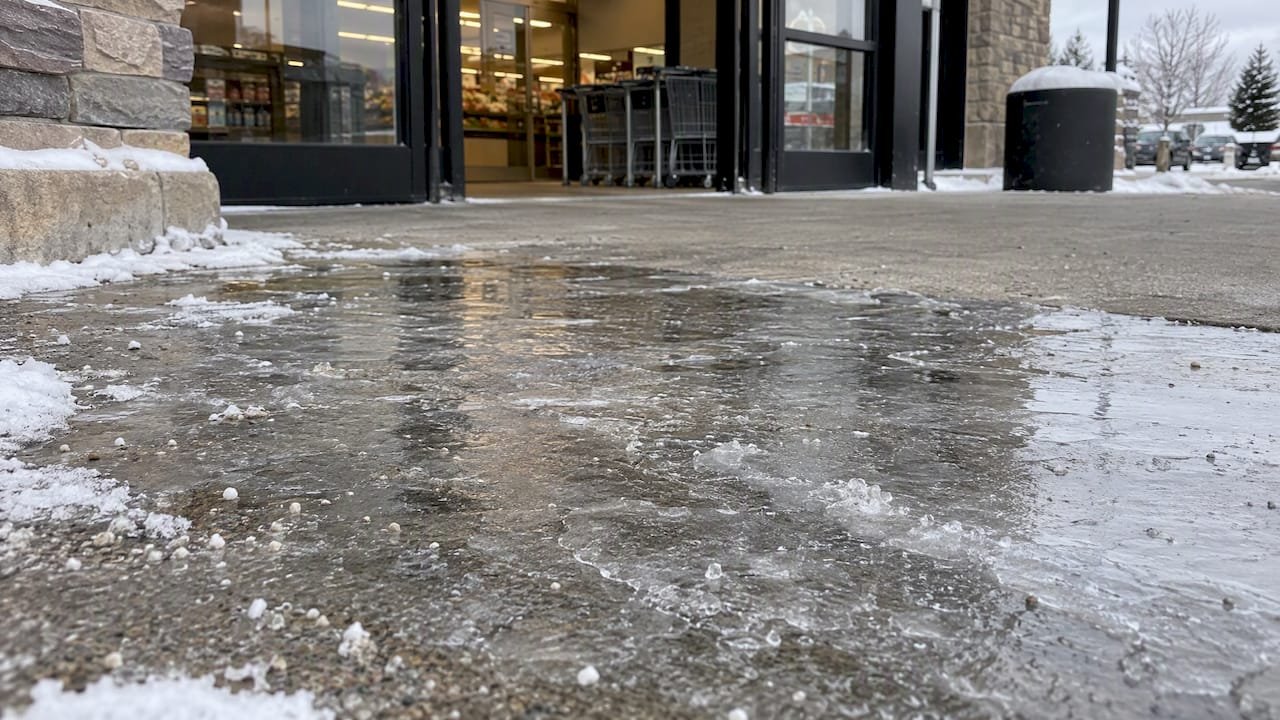
Ice cases have a long history in Colorado courts. In Jules v. Embassy Properties, Inc., the plaintiff alleged she slipped on ice-covered steps at an office building owned by the defendant. The case is not about a grocery store, but it shows that ice claims against property owners go through the same statutory analysis.
Facts that strengthen an ice claim:
- Photos of the ice showing thickness, color and whether any salt or sand was present
- Weather records for the previous 24 to 48 hours (a thaw followed by a freeze is a classic setup)
- Whether the store had a snow removal contractor, and when they last visited
- Whether other customers fell or complained
- Whether the dangerous spot was a known drainage problem, such as a downspout emptying across a walkway
If you fell on a public sidewalk beside the store rather than on the store’s lot, the responsible party may be different, and different rules and deadlines can apply, including notice requirements when a government body is involved. Talk to a lawyer promptly in that situation.
What about an apartment complex?
Readers also ask about falls in apartment buildings. The same statute applies to landlords and property managers who control common areas such as stairways, walkways and parking lots. Your status on the property matters: a tenant, a guest and a delivery driver can each be treated differently. Key evidence is similar: maintenance requests, prior complaints, photographs and the property manager’s snow removal practices.
How Fault Is Divided: The Comparative Negligence Rule
Stores almost always argue that you were partly to blame: you were on your phone, you were wearing the wrong shoes, the spill was obvious. Colorado uses modified comparative negligence. Your compensation is reduced by your share of fault, and a plaintiff who is 50% or more at fault cannot recover. We explain how this works, and how special verdicts show the jury’s percentages, on our page about the 50% rule in Colorado comparative negligence.
A simple example: a jury finds your damages total $100,000 and assigns you 20% of the fault. You would recover $80,000. If the jury put you at 50% or higher, you would recover nothing. That is why a store’s attempt to shift even a small share of blame to you is worth taking seriously, and why a fight over the “open and obvious” nature of a hazard is often the center of the case.

What Compensation Can Include
Colorado law allows injured customers to seek both economic and non-economic losses. In a grocery store fall, that commonly means:
| Type | Examples |
|---|---|
| Economic | Emergency care, imaging, surgery, physical therapy, prescriptions, future medical needs, lost wages, reduced earning capacity |
| Non-economic | Pain and suffering, physical impairment, loss of enjoyment of life, emotional distress |
Our guide to types of personal injury compensation in Colorado walks through each category. Colorado also has caps on certain damages, and we cover how they apply to premises claims on our page about the $1.5M cap and premises liability.
What affects the value of a claim
There is no honest average for a grocery store fall. Value depends on:
- The severity and permanence of the injury (a bruised hip and a fractured hip are very different cases)
- Medical costs and how consistent your treatment record is
- Time away from work
- The strength of proof that the store knew or should have known
- Your share of fault, if any
- The store’s insurance coverage
We discuss these in more detail in key factors that affect personal injury settlement amounts. Be wary of any website or lawyer that quotes a figure before reading your medical records.
Deadlines You Cannot Miss
Colorado generally gives you two years from the date of injury to file a personal injury lawsuit, a deadline covered in Nolo’s Colorado slip and fall guide. Exceptions exist, and claims involving a government entity can carry much shorter notice requirements. Do not plan around the exceptions. The practical deadline is earlier: video disappears in days or weeks, and witnesses become impossible to find long before a limitations period runs out.
Our Perspective: Why Grocery Store Cases Are Harder Than They Look
We hear the same thing from people who fall in stores: “It was obviously their fault, it was right there on the floor.” Then the claim arrives at the insurance company, and the position changes. The adjuster asks how long the spill was there. The store says it did not know. The video, if it still exists, shows you looking forward rather than down. A clear fall becomes a dispute about a few minutes.
I (Ryan) spent time as a claims adjudicator and adjuster for the federal government, and I have been a lawyer for over a decade. I know how large insurers and agencies evaluate a claim, because I used to be on that side of the desk. Adjusters look for gaps: a delay before the first doctor visit, a comment in a recorded statement, an old injury in the same body part, a missing incident report. Each gap becomes a reason to pay less.
That is why we tell people to treat the first week as the most important part of the case, even when the injury seems minor. Document the spot. Get the care. Do not talk yourself out of the pain you are feeling in front of the adjuster. Then let someone who knows how the other side thinks deal with them.
We represent only injured people, and cases are handled directly by attorneys. We chose the mule as our symbol for a reason: it is steady, it is stubborn in the best sense, and it does not let go of the load. When we take a case, we do not let go.
— Ryan
Do You Need a Lawyer for a Grocery Store Fall?
Not every fall needs one. If you walked away with a sore knee, no missed work and no ongoing treatment, you may not need an attorney. Consider calling one if:
- You needed emergency care, surgery, or ongoing therapy
- You missed work or cannot do your job the same way
- The store or its insurer is disputing that it knew about the hazard
- The insurer is blaming you for part of the fall
- You were asked for a recorded statement or offered a quick settlement
- The fall happened on ice, outside, or somewhere control of the property is unclear
- A family member was seriously hurt or died
Before accepting any offer, read about the choice between suing or settling a personal injury case. A first offer is often made before the full extent of your injuries is known, and once you sign a release you cannot reopen the claim.
If you are comparing firms, how to choose legal representation lays out what to ask. Personal injury lawyers commonly work on contingency, and so do we: you pay no attorney fees unless there is a monetary recovery in your case.
Colorado Springs and beyond
We help injured people in Colorado Springs, and our team also serves communities such as Pueblo, Burlington and Simla. Whether the fall happened in a big-box supermarket along Academy Boulevard or a small neighborhood grocer, the legal framework is the same statewide.
Talk to Us About Your Fall
If you were hurt in a grocery store, parking lot or apartment property, our slip and fall lawyers offer a free case review. We will look at what happened, what evidence exists, and what the store and its insurer will argue. For a broader view, see our Colorado slip and fall victim’s guide and the full list of injury cases we handle.
Frequently Asked Questions
Can you sue a grocery store if you slip and fall?
Yes, if the store was legally responsible. Under Colorado’s Premises Liability Act, a customer can recover when the store unreasonably failed to protect against a danger it knew about or should have known about. You will need evidence of the hazard, the store’s knowledge and your injuries.
How much can you get for a slip and fall in a grocery store?
It depends on the injury, medical costs, lost income, pain and suffering, and any share of fault assigned to you. Minor injuries may resolve for relatively little, while serious fractures or head injuries can be worth far more. No lawyer can responsibly promise a number before reviewing your records.
Can you sue for pain and suffering in Colorado?
Yes. Pain and suffering falls under non-economic damages, which Colorado law allows alongside economic losses such as medical bills and lost wages. Colorado has limits on certain damages, so the amount available depends on the facts of the case.
Is it worth suing for a slip and fall?
It can be when your injuries are significant, treatment is ongoing, or the store disputes responsibility. It is less likely to be worthwhile for a minor injury with little cost. A free consultation lets you weigh the evidence and likely value before committing to anything.
What if I fell on black ice in a store parking lot?
You may still have a claim. Snow and ice are expected in Colorado, but owners still have to act reasonably once they know or should know about a dangerous patch. Photograph the ice, save weather details and report the fall to the store.
Sources
- Colorado Premises Liability Act amendments (SB22-115), Colorado General Assembly
- Colorado Slip and Fall Claims and the Statute of Limitations, Nolo
- Lawson v. Safeway, Inc., Colorado Court of Appeals (1994), Justia
- Brown v. Dillon Companies, Colorado Court of Appeals (2025), CaseMine
- Jules v. Embassy Properties, Inc., Colorado Court of Appeals (1995), Justia