

The Role of Attorney in Settlement Negotiations
Most people assume a personal injury settlement is just two sides swapping numbers until they land somewhere in the middle. That assumption costs injured people real money. The role of attorney in settlement negotiations — what lawyers call the settlement negotiation process — goes far beyond passing offers back and forth. A skilled attorney investigates, builds strategy, manages communication, anticipates legal risks, and often prevents negotiations from collapsing entirely. Understanding exactly what your lawyer does during this process helps you engage more confidently, ask better questions, and ultimately walk away with a result that actually reflects what your case is worth.
What settlement negotiations really involve
Settlement negotiation is the structured process by which an injured party and the at-fault party (or their insurer) reach a financial agreement to resolve a claim without going to trial. In personal injury cases, these talks can begin as early as a few weeks after an injury or stretch into months of back-and-forth before a lawsuit is even filed.
The timeline is not fixed. Here is how the stages typically unfold:
- Early demand phase: Your attorney sends a formal demand letter after gathering medical records, documenting losses, and calculating damages. This letter sets the opening position.
- Counter-offer exchanges: The insurer responds, usually with a low number. Your attorney counters based on evidence, legal precedent, and comparable case results.
- Pre-litigation negotiation: If talks stall, your attorney may signal readiness to file suit. This changes the insurer’s risk calculation and often moves negotiations forward.
- Mediation: A neutral third party facilitates discussion when direct talks break down. The role of lawyers in mediation is to represent your interests, manage the process, and keep momentum toward resolution.
- Pre-trial settlement: Even after a lawsuit is filed, most cases settle before reaching a jury. The window for negotiation stays open until a verdict is read.
Settlements benefit injured parties in ways that are easy to underestimate. Trials are expensive, time-consuming, and unpredictable. A well-negotiated settlement gives you certainty, faster payment, and avoids the emotional toll of years of litigation. Understanding settlement versus litigation tradeoffs is something your attorney helps you work through at every stage.
The role of attorney in settlement negotiations
The attorney’s function in settlements is not reactive. Great negotiators are not waiting for the insurer to make the first move and then responding. They are building leverage from the moment they take your case.
Here is what that looks like in practice:
-
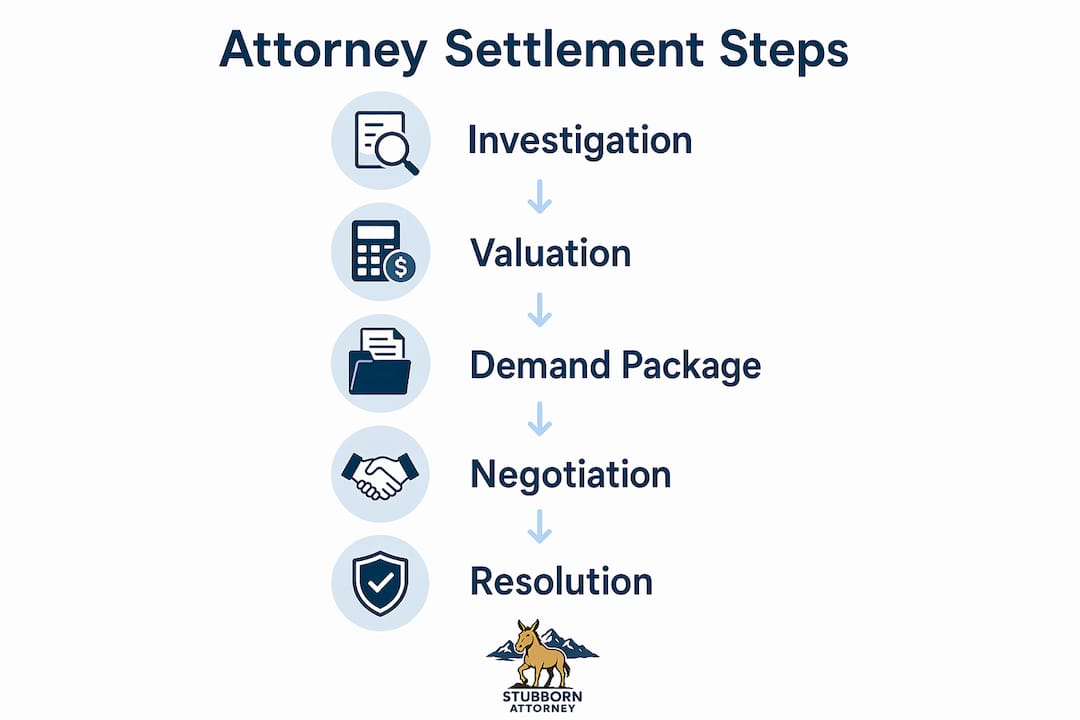
Investigation and evidence gathering. Attorneys compile medical records, accident reports, photographs, expert opinions, and witness statements into a coherent demand package. Insurers are trained to find evidentiary gaps, and a strong evidence narrative shifts negotiations away from a numbers debate and toward what the facts actually show.
-
Valuing your claim accurately. Before any demand goes out, your attorney calculates not just your current medical bills but your future care costs, lost earning capacity, pain and suffering, and other non-economic damages. Undervaluing at the start locks you into a lower range for the entire negotiation.
-
Developing a negotiation strategy. This means deciding what to demand, what to concede, when to push hard, and when patience serves you better. Attorneys use objective standards like comparable verdicts, jury award databases, and local court tendencies to anchor demands in reality rather than wishful thinking.
-
Managing all communication with the insurer. Every statement you make to an insurance adjuster can be used to reduce your payout. When your attorney handles adjuster communications, you stop inadvertently undermining your own claim.
-
Applying ethical duties. Attorneys are bound by professional conduct rules that require honest dealing and zealous advocacy. That combination, honesty with persistence, is what separates experienced legal representation in negotiations from amateur attempts at self-representation.
-
Knowing when to escalate. Sometimes the best settlement strategy is filing a lawsuit to show the other side you are serious. Attorneys who negotiate settlements effectively understand that credible litigation threats move cases that would otherwise stall indefinitely.
Pro Tip: Ask your attorney to explain their valuation methodology before any demand letter goes out. If they cannot walk you through how they calculated your damages in plain language, that is a problem. You should understand the number before anyone else sees it.
How attorneys handle the human side of negotiations
Legal strategy matters. But negotiation breakdowns are far more often caused by positional bargaining, deteriorating communication, and unaddressed emotion than by any genuine gap in the numbers. A mediator who has handled over 2,100 cases has observed this directly: parties locked in rigid positions block resolution even when a workable deal exists.

This is where the strategic and emotional intelligence skills of an attorney become decisive.
The distinction between positions and interests is one of the most important concepts in settlement negotiation strategies. Your position is what you say you want: a specific dollar amount. Your underlying interest is what you actually need: enough money to cover your medical bills, replace lost income, and move forward with your life. Durable settlements meet enough core interests on both sides, not one side’s total victory. Attorneys who understand this can find creative paths to resolution that pure positional bargainers miss entirely.
There is also the matter of your emotions. You are injured. You may be angry, scared, or exhausted. Those feelings are completely valid. They are also dangerous at the negotiating table if they drive decisions that do not serve your actual interests. Your attorney functions as a buffer. They translate your legitimate frustration into documented damages and reasoned legal arguments. They absorb the pressure so you do not make a reactive decision you will regret.
“Human dynamics such as unaddressed emotion are often the biggest obstacle in settlement negotiations, requiring attorneys to balance legal arguments with emotional intelligence.”
Attorneys also help you look honestly at your alternatives. The Harvard Program on Negotiation describes how parties often negotiate in the shadow of the law, systematically underestimating the financial cost, time, and emotional strain of litigation. A good attorney uses decision-analysis tools to quantify the real probability of winning at trial and what that win would actually net you after attorney fees and years of waiting. That honest picture is what allows you to make an informed choice rather than a hopeful one.
Specialized considerations attorneys manage in settlements
Not every personal injury settlement is a straightforward exchange of money for a release of claims. When you are a Medicare beneficiary, or when your injuries require long-term medical care, the settlement planning becomes significantly more complex. This is an area where the importance of attorney in settlements cannot be overstated, because the financial consequences of getting it wrong can follow you for years.
What a Medicare Set-Aside actually is
A Medicare Set-Aside (MSA) is an allocation within your settlement that sets aside funds specifically to cover future injury-related medical costs that Medicare would otherwise pay. Federal law requires that Medicare’s interests be protected in personal injury settlements, and failing to address this creates serious risks including Medicare withholding payment for future care and, in some cases, malpractice exposure for the attorney.
The table below illustrates the practical difference between settlements that do and do not account for specialized planning:
| Settlement factor | Without MSA planning | With MSA planning |
|---|---|---|
| Future medical coverage | Potentially denied by Medicare | Protected and compliant |
| Client financial risk | High (must pay out of pocket) | Reduced through proper allocation |
| Attorney liability | Malpractice exposure possible | Managed through specialist coordination |
| Negotiation complexity | Lower upfront, higher risk later | Higher upfront, lower long-term risk |
| Settlement timeline | Faster but incomplete | Slightly longer, fully comprehensive |
Attorneys who handle these cases proactively integrate Medicare compliance early in the negotiation rather than treating it as a post-settlement paperwork issue. The earlier this planning begins, the more flexibility everyone has in structuring a deal that actually holds.
Pro Tip: If you are on Medicare or Medicaid, tell your attorney on day one. This is not just a paperwork issue. It affects the entire structure of your settlement, including what you can spend and what must be set aside. Attorneys often retain outside specialists to calculate MSA amounts precisely.
Beyond Medicare, attorneys also watch for liens from health insurers, government agencies, and hospitals that may have paid for your treatment and expect reimbursement from your settlement. Negotiating those liens down is a real skill, and it directly affects how much money you actually take home. Understanding the factors affecting your settlement is something your attorney should walk you through in detail.
Your options for legal representation in negotiations
One of the less-discussed realities of personal injury claims is that you have more choices about how to engage an attorney than most people realize. Full representation is not the only option. And for some situations, a more targeted approach to legal representation in negotiations makes practical sense.
Limited-scope representation, sometimes called unbundled legal services, allows you to hire an attorney for specific tasks rather than turning over your entire case. The Oklahoma Bar Association recognizes that limited-scope arrangements expand access to quality legal help for clients who need negotiation support but cannot commit to full representation costs.
Here is what that can look like in practice:
- Negotiation-only representation: An attorney handles all communication and strategy during settlement talks but does not represent you in court.
- Document review and drafting: You conduct your own negotiations but have an attorney review or draft the final settlement agreement before you sign.
- Consultation services: You pay for specific hours of legal advice to prepare yourself for negotiations you conduct independently.
- Demand letter preparation: An attorney prepares a professional, evidence-backed demand letter in your name, which often produces far better initial responses from insurers.
The practical advantage of these arrangements is real. An insurer’s adjuster negotiates claims for a living. You do not. Even limited attorney involvement shifts that power imbalance meaningfully. And knowing you can access legal help without committing to a full contingency arrangement removes a significant barrier for people who might otherwise try to navigate a complex claim alone.
That said, for most personal injury claims, full representation through a contingency fee arrangement means you pay nothing upfront and your attorney only earns a fee when you win. The financial barrier that makes people hesitant about hiring a lawyer often does not exist in personal injury cases the way people assume it does.
My honest take on what attorneys actually change in your outcome
I have spent over a decade handling personal injury cases in Colorado, and before that I worked as a claims adjudicator for the federal government. I have sat on both sides of this table.
Here is what I know from that experience: the cases where clients get meaningfully undercompensated are almost never the ones with weak facts. They are the cases where the negotiation was treated as a transaction instead of a process requiring preparation, persistence, and a clear understanding of what the other side actually cares about.
I have watched intelligent, reasonable people accept settlements worth half what their cases deserved because they were exhausted, because they did not know what comparable cases had resolved for, or because no one helped them see that the litigation risk the insurer was using as leverage was overstated. That is not a legal failure. It is a preparation and strategy failure.
What I have found actually moves settlements is the combination of airtight evidence, a credible willingness to go to trial, and the ability to identify what the other side genuinely wants to avoid. Sometimes that is a jury. Sometimes it is reputational exposure. Sometimes it is a long litigation calendar that conflicts with internal business goals. Knowing what motivates resolution on the other side is just as valuable as knowing the law.
I also believe attorneys underestimate how much their emotional steadiness matters to clients. When you are hurt and uncertain, your attorney’s calm confidence is not just reassuring. It helps you make better decisions. You do not settle out of fear when someone you trust is telling you the facts support waiting.
The mule philosophy we practice at Stubbornattorney is not just a brand. It reflects how I actually approach cases. Steady, smart, and unwilling to be moved off a well-reasoned position by pressure alone.
— Ryan
How Stubbornattorney fights for your settlement
At Stubbornattorney, we have settled hundreds of injury cases and recovered millions of dollars for Colorado clients. Our approach to every negotiation starts before the first offer arrives: building the evidence, structuring the demand, and preparing for every counter-argument the insurer will make.
Ryan Malnar’s background as a former federal claims adjudicator means he knows exactly how insurance companies and government agencies evaluate your claim from the inside. That perspective is a genuine strategic asset in every negotiation we enter.
Whether your case involves a car accident, a slip and fall, or more complex circumstances, you can explore common personal injury scenarios to see how our negotiation experience applies to claims like yours. If you are ready to talk about your specific situation, our personal injury representation in Colorado starts with a free case review. No fees unless we win. No pressure. Just an honest conversation about what your case is worth and how we intend to fight for it.
FAQ
What does an attorney do during settlement negotiations?
An attorney investigates the claim, calculates damages, builds a demand package, manages all communication with the insurer, and applies legal strategy to maximize compensation. Their role extends well beyond paperwork into active advocacy and risk management on your behalf.
Why is having an attorney important in settlement talks?
Insurance adjusters negotiate claims professionally every day while most claimants do not. An attorney levels that imbalance by bringing legal knowledge, comparable case data, and negotiation strategy that typically produces significantly higher settlement offers than self-represented claimants receive.
What is a Medicare Set-Aside and do I need one?
A Medicare Set-Aside is a portion of your settlement reserved for future injury-related medical costs that Medicare would otherwise cover. If you are a Medicare beneficiary, federal law requires that Medicare’s interests be protected in your settlement, and failing to address this can cause Medicare to deny future care payments.
Can I hire an attorney just for part of my negotiations?
Yes. Limited-scope representation allows you to retain an attorney for specific tasks such as drafting a demand letter, reviewing a settlement agreement, or handling negotiation communications only. This arrangement expands access to legal expertise for clients who need targeted help rather than full case representation.
How do attorneys decide whether to accept a settlement or go to trial?
Attorneys use decision-analysis tools to quantify the realistic probability of winning at trial, net of litigation costs and time, compared to the settlement offer on the table. According to risk evaluation frameworks recommended by negotiation experts, this honest comparison helps clients make informed decisions rather than emotionally driven ones.