

Statute of Limitations for Car Accidents: How Long to Sue
Most states give you a few years to file a car accident lawsuit, and the majority have deadlines commonly around two or three years from the date of the crash. Miss that window and the statute of limitations usually kills your case for good, no matter how strong your evidence is or how clearly the other driver was at fault.
Here’s what to do right now, before you read another word:
- Check your state’s specific deadline rather than assuming a national standard applies to you.
- Preserve evidence today — photos, medical records, witness names, and the police report all degrade or disappear over time.
- Contact an attorney well before the deadline, not on the eve of it, since building a case takes time and government-entity claims often have far shorter notice windows.
- Keep talking to your insurer, but don’t confuse those conversations with legal deadlines. They’re unrelated clocks.
If you’re not sure which category your claim falls into, or whether an exception might apply to you, the rest of this guide walks through it. If your accident happened recently and the injuries are serious, don’t wait for clarity. Get 10 steps to strengthen your claim started while the evidence is fresh.
Table of Contents
- How the Statute of Limitations for Car Accidents Actually Works
- Exceptions and Tolling Rules That Can Change Your Deadline
- State-by-State Deadlines for Car Accident Claims
- What Happens When You Miss the Deadline
- Does Filing an Insurance Claim or Police Report Stop the Clock?
- How Long a Car Accident Claim Actually Takes
- When to Call a Lawyer and What to Bring
- How a Personal Injury Firm Protects Your Filing Deadline
- Why the Deadline Is the One Thing You Can’t Negotiate Away
- Get Your Deadline Confirmed Before It’s Too Late
- Where to Verify Your State’s Exact Deadline
- Sources
- FAQ
How the Statute of Limitations for Car Accidents Actually Works
A statute of limitations is a law that sets a hard deadline for filing a lawsuit after an injury or loss. It exists so that evidence doesn’t grow stale and defendants aren’t left facing claims from decades ago. For car accidents specifically, the Legal Information Institute confirms that timeframes across states typically run between one and six years, with two or three years being the most common range nationally.
Here’s the part that trips people up: your accident doesn’t have just one clock running. It has several, and they don’t always match.
- Personal injury claims — the deadline to sue for your own injuries, typically 2 to 3 years.
- Property damage claims — often a separate window, sometimes longer than the injury deadline (California, for example, gives three years for property damage but two years for injury).
- Wrongful death claims — usually calculated from the date of death, not the date of the crash, which can shift the deadline months or years later than you’d expect.
- Government-entity claims — there is a completely different, much shorter notice period if a city bus, police cruiser, or postal truck was involved.
A quick statistic worth remembering: the injury deadline in most states falls somewhere between 2 and 3 years, but outliers exist on both ends. Tennessee, Kentucky, and Louisiana cut it to just one year. Maine and North Dakota stretch it to six.
The clock almost always starts on the date of the accident. But there’s a narrow exception called the discovery rule, and it matters more than most people realize.
Example: Say you’re rear-ended and walk away thinking you’re fine. Eighteen months later, an MRI reveals a herniated disc that’s been worsening the whole time. In a state that starts the clock strictly on the accident date, you may already be dangerously close to your deadline without realizing it. In a state that recognizes the discovery rule for latent injuries, the clock might instead start when the injury became reasonably identifiable through medical documentation. The distinction can be worth years of filing time, but courts apply it narrowly and require solid proof of when the injury was actually discoverable.
Exceptions and Tolling Rules That Can Change Your Deadline
“Tolling” is the legal term for pausing or delaying a statute of limitations clock. It’s rare, it’s fact-specific, and it’s not something you should count on without documentation to back it up. Still, knowing these exceptions exist can matter enormously if your situation fits one.
Common tolling triggers include:
- Minor status — if the injured person was under 18 at the time of the crash, many states pause the clock until they turn 18, then start counting from there.
- Mental incapacity — a documented condition that prevented the injured person from understanding or acting on their legal rights can delay the clock.
- Defendant out of state — if the at-fault driver leaves the state and can’t be served with legal papers, some jurisdictions pause the clock until they return.
- Fraudulent concealment — if the defendant actively hid facts relevant to your claim (falsified records, hidden evidence), courts may extend your filing window.
- Delayed-onset injuries — covered by the discovery rule discussed above, this applies when an injury wasn’t reasonably detectable right after the crash.
Government-entity claims deserve their own separate mention because they operate on an entirely different, much stricter timeline. If your crash involved a municipal vehicle, a state trooper, or a federal employee, you may have as little as 30 to 180 days to file a formal notice of claim, not the standard two or three years. Miss that administrative window and your right to sue can disappear before the regular statute of limitations would have even become a concern. Federal claims under the Federal Tort Claims Act add another layer: an administrative claim first, then a separate filing deadline in federal court.
One myth needs to die here: ongoing settlement talks with an insurance adjuster do not pause your statute of limitations. You can be in friendly, productive negotiations with an insurer for a year and a half, and the court will still dismiss your case the day after the deadline passes if you haven’t filed suit.
Pro Tip: If you believe an exception applies to your case, start gathering proof immediately. Medical records establishing when an injury became detectable, guardianship or incapacity documentation, and dated correspondence showing a defendant concealed information all carry far more weight than a verbal explanation to a judge months later.
State-by-State Deadlines for Car Accident Claims
Deadlines vary significantly depending on where the crash happened, not where you live. Below is a reference for several representative states. Always confirm against the official statute, since legislatures amend these laws more often than people expect.
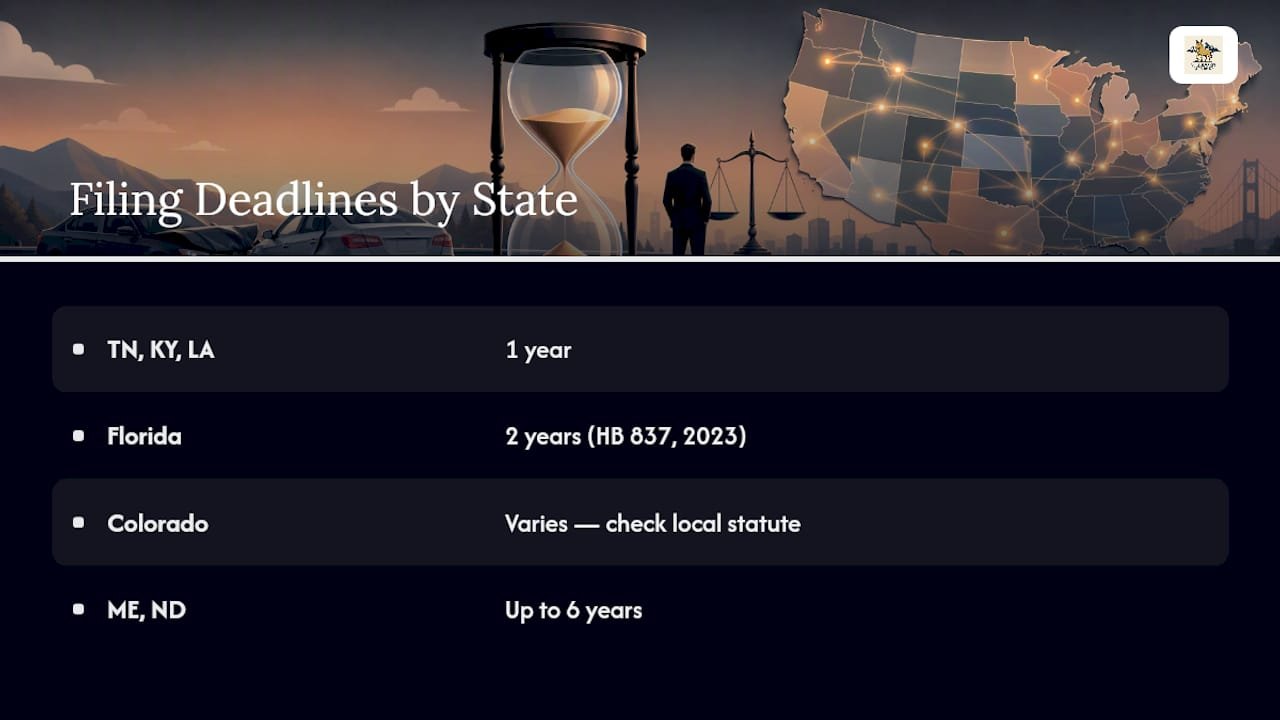
Colorado Springs ’s shift is worth pausing on. Before 2023, injury victims there had four years to file. HB 837 cut that in half for most negligence-based claims, catching plenty of accident victims off guard because outdated advice still circulates online citing the old four-year window.
States at the extremes deserve a mention too. Tennessee, Kentucky, and Louisiana give you only one year, which means the margin for delay is almost nonexistent. Maine and North Dakota, by contrast, allow up to six years, giving injured people considerably more breathing room. If you’re unsure which end of that spectrum your state falls on, don’t guess. Confirm it against the actual statute text linked above, or check a localized deadline guide if you’re filing in Colorado.
What Happens When You Miss the Deadline
The outcome is almost always the same: dismissal. Courts don’t weigh how strong your evidence is or how clearly the other driver caused the crash once the statute of limitations has run. The case simply becomes “time-barred,” meaning the court no longer has authority to hear it, and it gets thrown out regardless of merit.
A time-barred claim is dismissed as a matter of law, not as a judgment on the facts. Courts treat a missed filing deadline as fatal to the case even when the underlying injury claim would otherwise have been strong, because the purpose of the statute is finality, not fairness to a late filer.
Equitable tolling, the legal doctrine that occasionally rescues a late filing, exists but rarely applies. Courts reserve it for extraordinary circumstances, like a defendant actively deceiving the plaintiff about facts necessary to file, and even then the burden of proof sits heavily on the injured party. Don’t plan around it.
If you do miss the litigation deadline, you’re not necessarily out of every option. You may still have an active insurance claim if you filed it promptly and within your policy’s terms, and preserving your records still matters in case a related claim (against a different party, for instance) remains open. But the lawsuit itself is generally gone.
Does Filing an Insurance Claim or Police Report Stop the Clock?
No. Filing a police report or opening a claim with your insurer does not pause, extend, or otherwise affect your statute of limitations. These are two completely separate systems running on their own timelines.
- Police reports document the incident for insurance and evidentiary purposes, but filing one has zero effect on your legal filing deadline.
- Insurance claims with a private insurer typically have their own contractual notice requirements (often 30 to 60 days), but satisfying those has no bearing on the statute of limitations for a lawsuit.
- Government-entity notice periods are the exception that actually matters here, but they’re a separate, shorter deadline, not an extension of the regular clock. If a government vehicle was involved, that administrative notice must happen fast, often within 30 to 180 days.
- Ongoing settlement negotiations, even ones that look promising, don’t pause anything. An insurer can negotiate in good faith for a year and still let the deadline lapse on you.
None of this means you should skip your insurance claim or delay reporting the accident. File both promptly. They create the paper trail you’ll need if negotiations stall and you’re forced to file suit. Just don’t mistake either step for legal protection against the filing deadline.
How Long a Car Accident Claim Actually Takes
Understanding the statute of limitations matters more once you see how long the claims process typically runs. Most cases move through five distinct phases.
- Investigation — gathering the police report, medical records, and witness statements. This usually takes one to three months, longer for complex crashes involving multiple vehicles or disputed fault.
- Demand and negotiation — your attorney sends a demand letter to the insurer, and negotiations follow. This phase commonly runs three to twelve months, depending on how cooperative the insurer is and how clear liability appears.
- Filing the complaint — if negotiations stall, the lawsuit gets filed in court. This is the step that must happen before your statute of limitations expires, regardless of where negotiations stand.
- Discovery — both sides exchange evidence, take depositions, and build their case. According to the Legal Information Institute, this phase often runs six to eighteen months.
- Settlement or trial — most cases settle before reaching a courtroom, often within six to eighteen months of filing. Trials, when they happen, can push the timeline past eighteen months from filing.
Here’s why this matters for your deadline specifically: if negotiations in phase two drag on and start creeping toward your statute of limitations, you cannot wait for a “good outcome” from the insurer. You have to file the lawsuit to preserve your rights, even if talks are still technically ongoing. Waiting for a settlement offer that never comes is one of the most common ways people accidentally blow past their deadline.
When to Call a Lawyer and What to Bring
Some situations demand a consultation immediately, not “eventually.” Call a lawyer now if any of these apply to you:
- Your injuries are serious enough to require ongoing treatment, surgery, or time off work.
- Fault is disputed, or the other driver’s insurer is denying liability.
- A government vehicle or employee was involved, since that notice deadline is often measured in weeks, not years.
- Multiple vehicles or drivers were involved, raising questions about how liability gets divided.
- Your state’s deadline is on the shorter end (one year), giving you far less margin for delay.
When you go in for that first consultation, bring what you have. Even a partial set of documents helps an attorney give you a faster, more accurate read on your case:
- The police report or accident report number.
- Photos of the vehicles, the scene, and any visible injuries.
- Medical records and bills related to treatment so far.
- Any correspondence from insurance adjusters, including claim numbers.
- Contact information for witnesses.
- A rough written timeline of what happened and when symptoms appeared.
Ask directly about your filing deadline, when the attorney expects to file if negotiations don’t resolve things, and how the contingency-fee arrangement works. A good attorney should be able to answer all three clearly in the first meeting.
How a Personal Injury Firm Protects Your Filing Deadline
Missing a deadline because a case sat untouched for months is one of the most preventable failures in personal injury law, and it’s exactly what a properly run firm exists to prevent.
That starts with evidence preservation the moment a case comes in the door: securing the police report, photographing damage before repairs erase it, and locking down witness contact information before memories fade. From there, deadlines get calendared immediately, not estimated. A firm tracking your case should know the exact filing date the day they take your case, not the month before it arrives. When a government entity is involved, that means filing the administrative notice within the shortened window, often 30 to 180 days, well before the standard statute of limitations would even become a concern.

Ryan Malnar built Malnar Injury Law, now operating as Stubbornattorney, on more than a decade of representing injured Coloradans. Before that, he worked as a claims adjudicator for the federal government, which means he’s seen how insurers and government agencies evaluate claims from the inside, not just from the plaintiff’s side of the table. That perspective shapes how the firm builds cases from day one.
The firm works on contingency, meaning there’s no fee unless you recover compensation, and the free case review is designed to answer the deadline question specifically, so you know where you stand before making any commitment.
Why the Deadline Is the One Thing You Can’t Negotiate Away
Most parts of a car accident case have some flexibility. Settlement amounts move. Negotiation timelines stretch. Even fault percentages get argued and adjusted. The statute of limitations is the one exception, a fixed date that doesn’t care how close you were to a deal or how reasonable your reason for waiting was.
What strikes me most, looking at how these cases actually play out, is how often the deadline gets missed not through negligence but through optimism. People assume an insurer negotiating in good faith will keep negotiating in good faith right up until a fair number gets reached. Sometimes that’s true. Often, it isn’t, and the moment a claimant realizes the deadline has passed, there’s no argument, no appeal, and no second conversation that fixes it.
The other pattern worth naming: government-entity cases get treated like ordinary claims until it’s too late. A crash with a city vehicle feels the same in the moment as a crash with any other driver, but the legal clock underneath it runs on a completely different, much faster schedule. That mismatch between how a case feels and how the law actually treats it is where good claims quietly disappear.
If there’s one piece of advice worth taking from all of this, it’s simple: don’t wait for certainty before you check your deadline. Get the actual date confirmed early, even if you’re not sure yet whether you’ll file. Knowing the number changes how you handle everything else that follows.
Get Your Deadline Confirmed Before It’s Too Late
Figuring out your exact filing window shouldn’t require decoding statute language on your own, especially while you’re also dealing with medical appointments, insurance calls, and recovery. Stubbornattorney offers a free case review specifically to answer that question first: what’s your actual deadline, and where does your case currently stand against it. There’s no fee unless we recover compensation for you, which means getting that clarity costs you nothing upfront.
If your crash happened in Colorado Springs or nearby, our personal injury team can walk through your timeline, flag any government-entity notice requirements that might apply, and tell you plainly whether you have months or years of room to work with. Readers near Pueblo or Burlington can reach local offices directly for the same free review. Call, fill out the online form, or request a callback. The sooner your deadline gets confirmed, the more options you keep on the table.
Where to Verify Your State’s Exact Deadline
Secondary summaries, including this one, are useful starting points, but they’re not a substitute for the actual statute text. Laws change, sometimes mid-year, and only the primary source reflects the current version.
- Legal Information Institute, Cornell Law School — a plain-language overview of statute of limitations concepts across jurisdictions.
- Your state legislature’s official statutes website (for example, the Texas Legislature, Colorado Springs Senate, or Arizona Legislature).
- California Legislative Information for California-specific statutes, including government-entity notice rules.
- The United States Code for claims involving federal agencies or employees.
Official legislature sites carry the current, amended version of the law. A blog post, even a well-researched one, can lag behind a legislative change by months, which is exactly what happened when Colorado Springs ’s deadline shifted from four years to two.
Sources
- Statute of limitations (Wex, Legal Information Institute)
- Texas Civil Practice & Remedies Code, Title 2, Limitation of Actions (Texas Legislature)
- Colorado Springs Statutes, Section 95.11 (Colorado Springs Senate)
- California Legislative Information (LegInfo)
- Michigan Compiled Laws, MCL 600.5805 (Michigan Legislature)
- 28 U.S.C. § 2401(b) (United States Code, via Legal Information Institute)
FAQ
How Long After an Accident Can You Still File a Claim?
It depends on your state, but most give you two to three years from the accident date for a personal injury claim. Some states allow as little as one year or as much as six, so confirming your specific state’s rule matters more than relying on a national average.
How Long Do Accidents Stay on Your Record in Michigan?
This question concerns your driving record, not your legal filing deadline. Michigan’s statute of limitations for filing a personal injury lawsuit after a car accident is three years, as set by MCL 600.5805.
How Long After a Car Accident Can You Sue in New York?
New York generally allows three years from the date of the accident to file a personal injury lawsuit, though claims against government entities in New York carry much shorter notice requirements.
How Long Do You Have to Report a Car Accident in North Carolina?
Reporting requirements to police or the DMV are separate from the statute of limitations for a lawsuit. North Carolina generally requires reporting accidents involving injury or significant property damage promptly, while the lawsuit filing deadline for personal injury claims is typically three years from the accident date.
Does Talking to an Insurance Adjuster Extend My Deadline?
No. Settlement negotiations with an insurance adjuster do not pause or extend your statute of limitations under any circumstances. The court’s filing deadline runs independently of how negotiations are progressing.
What If a Government Vehicle Was Involved in My Accident?
You likely face a much shorter administrative notice deadline, sometimes as little as 30 to 180 days, separate from and far stricter than the standard statute of limitations. Contacting an attorney immediately is critical in these cases.