

How to Negotiate a Settlement: A Step-by-Step Playbook
If you need to negotiate a settlement, start with three things: a documented demand or offer, a realistic target plus a firm walk-away number, and a written record of every communication from day one. Everything else builds from that foundation.
Here’s the immediate checklist:
- Document your demand or offer in writing. State the amount, the basis for it, and the specific claims it resolves. Never open with a verbal number you can’t take back.
- Set three numbers before you talk. Your opening demand (high but defensible), your realistic target (what you’d genuinely accept), and your walk-away floor (the point where litigation or another remedy beats the deal).
- Create a paper trail from the start. Send communications by email or certified mail. Log every call with date, time, and what was said.
Settlement conferences are won by parties who arrive with all three numbers ready and can justify each one with evidence, not emotion.
For debt-collector negotiations specifically, the CFPB’s guidance requires you to verify the debt first, calculate what you can realistically pay, then make a written offer. JAMS-style mediation follows the same logic at a higher level: a neutral facilitates movement between parties who each know their numbers and can explain them.
Pro Tip: Anchor high, but never reveal your walk-away. If asked “what’s your bottom line?” respond with “I’m focused on what’s fair given the evidence” and redirect to the documentation. Exposing your floor ends the negotiation before it starts.
Table of Contents
- Should you settle or take your case to court?
- What to gather and calculate before you make any offer
- When to start negotiating and which path to choose
- Bargaining tactics, communication, and sample phrasing
- CFPB-aligned steps for negotiating with a debt collector
- What to put in a settlement agreement
- How to close the deal and what to do if the other side breaches
- Common mistakes that cost people money or finality
- How alternative dispute resolution beyond mediation can help you
- Cost-benefit analysis: negotiation versus litigation timelines
- Sample checklists and templates for offers and counteroffers
- How to identify your BATNA and use it to expand the deal
- How to handle a difficult or uncooperative opposing party
- An attorney’s perspective on what actually changes the outcome
- Ready to stop negotiating alone? Stubbornattorney can help.
- Sources
- FAQ
Should you settle or take your case to court?
Settling is usually the better choice when the cost, time, and uncertainty of litigation outweigh the potential gain from a verdict. Harvard’s Program on Negotiation frames it plainly: most disputes create more value by settling, because litigation consumes resources both sides could otherwise keep.
That said, litigation may be the right call when:
- The other party is acting in bad faith or refusing to produce basic documentation
- You need a court ruling to set a precedent (employment discrimination, constitutional rights)
- Public accountability matters more than speed (fraud, institutional misconduct)
- The settlement offer is so far below your documented damages that no reasonable negotiation path closes the gap
The three-part decision framework:
1. Cash math. Add up your realistic damages, subtract litigation costs (attorney fees, expert witnesses, court costs, lost time), and compare that net figure to the best settlement offer on the table. If the net litigation recovery doesn’t beat the settlement by a meaningful margin, settling wins.
2. Risk math. Assign a rough probability to winning at trial. Multiply that probability by your expected verdict. If that expected value is lower than the settlement offer, you’re gambling with money you already have on the table.
3. Relationship and publicity math. Will this dispute damage a business relationship, attract press coverage, or expose private information you’d rather keep confidential? Litigation is public. Settlement agreements typically aren’t.
Most people undercount by half. Run that number against the settlement offer before you reject it.*
What to gather and calculate before you make any offer
A complete, well-documented demand package forces the other side to engage seriously. Adjusters and opposing counsel can dismiss a vague letter. They can’t dismiss a file that reads like a case ready for trial.
Evidence checklist:
- Medical records, bills, and treatment summaries (including future-care estimates)
- Photos and video of the incident, injuries, and property damage
- Witness names, contact information, and signed statements where possible
- Police reports, incident reports, or official documentation
- Pay stubs, tax returns, or employer letters documenting lost income
- Insurance policy declarations pages and coverage limits
- Lien notices from Medicare, Medicaid, health insurers, or workers’ comp carriers
- Expert reports (accident reconstruction, vocational rehabilitation, life-care planning)
- Contracts or agreements that define the dispute in a commercial or debt context
Before you set your opening demand, calculate your net recovery target. Add past economic losses (medical bills, lost wages, out-of-pocket costs) plus estimated future costs, then subtract known liens and anticipated attorney fees. That net figure is what you’re actually taking home. Factors like comparative fault and policy limits can cut that number significantly, so build them into your math early.
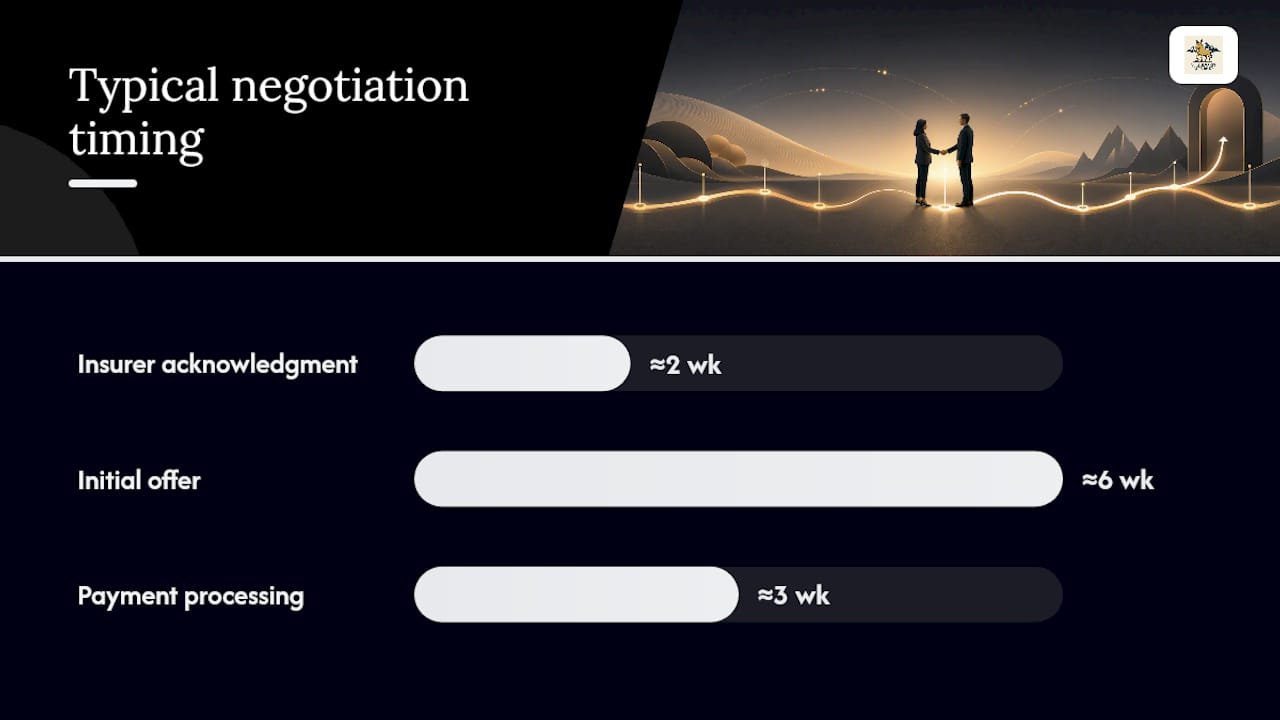
| Planning Benchmark | Typical Range |
|---|---|
| Insurer acknowledgment of demand letter | a few weeks |
| Initial offer after demand | a few weeks to a couple of months |
| Negotiation rounds before agreement | multiple exchanges |
| Payment processing after signed release | from a couple of weeks up to a month |
Package your demand as a cover letter plus organized attachments. The cover letter states the facts, the legal basis, the damages calculation, and a response deadline (30 days is standard). Attachments follow in the order referenced. Send by certified mail and email simultaneously so you have delivery confirmation on both.
Pro Tip: Wait until medical treatment reaches maximum medical improvement (MMI) before finalizing any personal injury settlement. Settling before MMI means you’re guessing at future costs — and you almost always guess low.
When to start negotiating and which path to choose
Lead with a credible demand as soon as you have enough documentation to justify your numbers. The Cardozo pretrial lawyering study found that lawyers who prepare for negotiation early and manage cases assertively from the start get better outcomes than those who wait for the other side to move first.
Timing options and what each costs or buys you:
Pre-filing negotiation keeps costs low and preserves relationships. The tradeoff is that the other side has less urgency. Works best when liability is clear and the counterpart is cooperative.
Post-filing, pre-discovery creates urgency without the full cost of litigation. Filing signals you’re serious. Many cases settle here because both sides want to avoid discovery costs.
Post-discovery gives you the strongest information position but the highest sunk costs. Useful when liability is disputed and you need deposition testimony or document production to prove your case.
When to hire an attorney: Complex damages, lien stacks, adverse insurance practices, or a counterpart who won’t engage in good faith are all triggers. The role of an attorney in settlement negotiations goes beyond writing letters — counsel manages discovery, controls information flow, and knows when a low offer reflects bad faith versus limited policy limits.
When to use mediation: A JAMS-style mediator is most useful when both sides are negotiating in good faith but can’t bridge the gap on their own. The mediator conducts private caucuses with each party, tests assumptions, and helps reframe risk. How mediation works in Colorado follows this same structure: a neutral session, private caucuses, and a written memorandum of understanding if agreement is reached.
Pro Tip: Set a credible deadline tied to a real event — a filing date, a statute of limitations, a scheduled deposition. Deadlines create movement. A deadline you invented and can’t back up will be called. A deadline tied to a court calendar won’t.
Bargaining tactics, communication, and sample phrasing
The recommended approach is integrative negotiation anchored in evidence: you’re not just splitting the difference, you’re building a case for why your number is the right one.

Tactics that work:
Credible opening demand. Start higher than your target, but not so high that you lose credibility. A demand you can defend with documentation is an anchor. A demand that looks like a fantasy is an invitation to lowball you.
Incremental concessions. Make concessions smaller as you approach your target. Moving from $100,000 to $90,000 signals room. Moving from $85,000 to $84,500 signals you’re near your floor. The pattern communicates as much as the number.
Bracketing. If the other side offers $60,000 and your target is $80,000, counter at $100,000. You’ve bracketed the midpoint at $80,000 without saying it’s your target.
Silence. After making an offer, stop talking. The next person to speak is usually the one who concedes. Most people are uncomfortable with silence and fill it by weakening their own position.
Neutral experts. An independent medical examiner’s report or an accident reconstructionist’s findings carry more weight than your own characterization of the facts. Use them to shift the other side’s risk estimate.
Phrases to use:
- “Based on the medical records and the documented wage loss, the fair value of this claim is $[X].”
- “I understand your position. Can you walk me through the basis for that number?”
- “We’re prepared to accept $[X] in exchange for a full release of all claims arising from [incident].”
- “If we can’t reach agreement by [date], we’ll need to proceed with filing.”
Phrases to avoid:
- “I really need this money” (reveals desperation)
- “I’d take $[X] if you could do it today” (reveals your floor)
- “I’m not sure what it’s worth, but…” (destroys your anchor)
📊 Statistic: Parties who arrive at settlement conferences with a documented opening demand, a realistic target, and a walk-away number — and who use bracketing and mediator caucusing effectively — consistently reach agreement at better values than those who negotiate reactively. (LegalClarity)
Pro Tip: Ask the mediator to carry your risk analysis to the other side — not your number, your analysis. “Here’s what a jury is likely to do with this evidence” lands differently coming from a neutral than from you.
CFPB-aligned steps for negotiating with a debt collector
When a debt collector contacts you, the CFPB’s guidance is clear: verify before you pay anything, calculate what you can actually afford, then make a written offer and get written confirmation before sending a single dollar.
- Request debt verification in writing. Send a written request within 30 days of first contact. The collector must provide the creditor’s name, the amount owed, and documentation of the debt. Do not acknowledge the debt or make any payment until you receive this.
- Check the chain of title. The FTC’s report on debt-buying industry practices documents common record gaps and chain-of-title problems. If the collector can’t produce the original account agreement or a clear ownership chain, that’s leverage.
- Calculate what you can realistically pay. Look at your monthly budget. A lump-sum offer of 40–60% of the balance is common in debt settlement, but only offer what you can actually deliver. A payment plan you can’t sustain is worse than no deal.
- Make your offer in writing. State the amount, the terms (lump sum or installments), and that the payment constitutes full satisfaction of the debt. Do not admit liability or make statements that could restart the statute of limitations.
- Get the agreement in writing before you pay. A verbal agreement is not enough. The collector must send you a written confirmation of the settlement terms before any money changes hands.
- Send payment in a traceable form. Use a money order or check, not a debit card that gives access to your bank account. Keep the receipt.
- Document the payoff and monitor your credit report. After payment, request a written payoff letter. Check your credit report within 60–90 days to confirm the account is reported as settled.
Sample debt-settlement letter opening:
Warning: Any debt-relief company that demands upfront fees before settling your debt is running a scam. Legitimate settlement is between you and the collector, not through a paid intermediary who collects fees while your account ages.
What to put in a settlement agreement
Always get a written settlement agreement. A handshake, a verbal confirmation, or an email chain that says “we have a deal” is not a settlement agreement. Here’s what the document must include:
- Parties and recitals. Full legal names, the date, and a brief description of the dispute being resolved.
- Payment terms. The exact amount, payment method, due date, and what happens if payment is late (interest rate, right to accelerate, or right to void the agreement).
- Release language. Specify which claims are released, by whom, and whether the release is mutual. A broad “any and all claims” release is common but can be dangerous if you have claims you haven’t yet discovered. Consider limiting to “claims arising from [specific incident or account].”
- Confidentiality clause. If either party wants the terms kept private, state it explicitly and include the exceptions (attorneys, accountants, court filings).
- Tax allocation. Specify which party bears tax liability for the payment. In personal injury cases, compensatory damages for physical injuries are generally not taxable, but punitive damages and interest are. Get this in writing.
- Lien and medical-payor provisions. Identify known liens (Medicare, Medicaid, health insurer, workers’ comp) and state who is responsible for satisfying them. Understanding liens in injury cases before you sign is critical — an unpaid lien can come back against you even after settlement.
- Attorney-fee and cost allocation. State who pays each side’s fees and costs.
- Enforcement clause. Specify the governing state law and the court with jurisdiction if the agreement is breached.
📊 Statistic: A settlement agreement that specifies payment timing, released claims, and lien responsibility in writing materially reduces the risk of post-settlement disputes. Vague releases and missing lien provisions are among the most common sources of post-settlement litigation. (LegalClarity)
Sample payment and breach language:
Pro Tip: Include an express covenant not to sue alongside the release. A release extinguishes the claim; a covenant not to sue creates a contractual obligation. Together, they give you two enforcement mechanisms instead of one.
How to close the deal and what to do if the other side breaches
Three closing actions, in order: confirm the written agreement is signed by all parties, get the signed release, and verify the payment method and timing before you do anything else.
At closing, check:
- All parties have signed the agreement and the release (not just initialed)
- Payment is confirmed in writing (wire instructions, check number, or escrow confirmation)
- Any attorney trust account (IOLTA) handling is documented, with a written distribution statement showing gross settlement, lien payoffs, attorney fees, and net client distribution
- Lien payoff letters are in hand or the agreement obligates the defendant or insurer to obtain them
If the other side breaches:
- File a motion to enforce the settlement agreement in the court where the case is pending (or where the agreement specifies)
- In states that allow it, seek contempt sanctions for willful non-compliance
- Pursue breach-of-contract remedies under state law if the agreement is a standalone contract
- If the breaching party is a debt collector, file a complaint with the CFPB and your state attorney general
Post-closing document retention checklist:
- Signed settlement agreement and release
- Payment confirmation (wire receipt, canceled check, or escrow statement)
- Lien payoff letters and confirmation of satisfaction
- Written distribution statement (if attorney-handled)
- Correspondence file from the entire negotiation
Keep these documents for at least seven years, or longer if the agreement involves ongoing obligations.
Common mistakes that cost people money or finality
The top five mistakes, in order of how often they create problems:
- Verbal-only deals. “We agreed on the phone” is not a settlement. Until both parties sign a written agreement, either side can walk away or change the terms.
- Signing a release too early. Accepting a settlement before you know the full extent of your damages — especially in personal injury cases before MMI — means you’re releasing claims you haven’t fully valued yet.
- Failing to confirm liens before signing. An unpaid Medicare or Medicaid lien doesn’t disappear when you cash the check. The government can pursue you for reimbursement even after you’ve settled.
- Accepting a lowball anchor without pushing back with evidence. The first offer is almost never the best offer. Respond with documentation, not emotion. “The medical records show $X in treatment costs” is more powerful than “that’s insulting.”
- Revealing your walk-away number. Once the other side knows your floor, they have no reason to offer more.
Red flags in counterpart behavior:
- Refusing to provide basic documentation (policy limits, account records, ownership chain)
- Insisting on verbal agreements or resisting a written term sheet
- Requesting payment through unusual channels (wire to a third party, cryptocurrency, money order to an individual)
- Demanding an overly broad release that covers claims far beyond the dispute
One pattern that costs people real money: accepting the first offer because it feels like a win. An insurer’s opening offer is calibrated to close the file cheaply, not to compensate you fairly. Pushing back with a documented counteroffer almost always produces a better result.
How alternative dispute resolution beyond mediation can help you
Mediation gets most of the attention, but it’s one of several alternative dispute resolution (ADR) methods available before or instead of trial.
Arbitration is the most common alternative. The parties present their case to a private arbitrator (or a panel, who issues a binding or non-binding decision. Binding arbitration is final and generally not appealable, which makes it faster and cheaper than trial but riskier if the arbitrator gets it wrong. Many contracts — employment agreements, consumer contracts, insurance policies — include mandatory arbitration clauses, so check your documents before assuming you can go to court.
JAMS is one of the largest private arbitration and mediation providers in the country. Their arbitrators are typically retired judges or senior attorneys, and their rules are designed to produce decisions faster than the court system. If your contract specifies JAMS arbitration, you’ll follow their administered rules, which include discovery limits, hearing procedures, and award timelines.
Early neutral evaluation (ENE) involves a neutral expert who reviews each side’s case and gives a non-binding assessment of likely outcomes. It’s particularly useful in technical disputes (patent, construction, medical malpractice) where an expert’s view of the merits can reset unrealistic expectations on either side.
Mini-trials and summary jury trials are less common but available in some jurisdictions. A mini-trial presents abbreviated evidence to a panel of decision-makers (often executives from each company in a commercial dispute) who then negotiate with the neutral’s assessment in hand. Summary jury trials present a condensed case to an actual jury for a non-binding verdict, which the parties then use as a data point in settlement talks.
The right ADR method depends on your contract, your jurisdiction, and whether you need speed, privacy, or a binding decision. For most personal injury and debt disputes, mediation or direct negotiation with a credible filing deadline is the most practical path.
Cost-benefit analysis: negotiation versus litigation timelines
The financial case for settling is usually straightforward once you run the numbers honestly.
Typical negotiation timeline: 30–90 days from demand to signed agreement in a straightforward case. Complex cases with multiple parties, significant liens, or disputed liability can run 6–18 months even without filing.
Typical litigation timeline: Filing to trial in most state courts runs 18–36 months. Federal court often runs longer. Add pre-trial motions, discovery disputes, and potential appeals, and a contested case can consume three to five years.
Cost comparison (illustrative, not guaranteed):
Negotiation costs are primarily attorney time (if you hire counsel) and expert fees for reports you’d need anyway. A well-prepared demand and two to three rounds of negotiation might cost $3,000–$10,000 in attorney time for a moderately complex case.
Litigation costs stack fast: filing fees, service costs, deposition transcripts, expert witness fees (often $5,000–$20,000 per expert), trial preparation, and the attorney hours that multiply with every motion. A contested personal injury trial can cost $30,000–$100,000 or more in total litigation expense, much of which comes out of your recovery.
The litigation process for Colorado injury claims follows this same arc: pre-litigation demand, filing, discovery, mediation, and trial if no agreement is reached. Each stage adds cost and time. The decision to litigate should be made with those numbers on the table, not in the abstract.
That margin accounts for the risk, the time, and the stress that don’t show up in a spreadsheet.
Sample checklists and templates for offers and counteroffers
Pre-negotiation checklist:
- [ ] Evidence file complete (records, bills, photos, reports)
- [ ] Damages calculated (past economic, future economic, non-economic)
- [ ] Liens identified and amounts confirmed
- [ ] Net recovery target calculated (gross minus liens and fees)
- [ ] Three numbers set: opening demand, realistic target, walk-away
- [ ] Delivery method chosen (certified mail + email)
- [ ] Response deadline set (30 days standard)
Sample initial demand letter structure:
Sample counteroffer:
Settlement agreement documentation checklist:
- [ ] Full legal names of all parties
- [ ] Payment amount, method, and due date
- [ ] Release language (scope of claims released, mutual or one-way)
- [ ] Confidentiality terms and exceptions
- [ ] Tax allocation clause
- [ ] Lien identification and responsibility
- [ ] Attorney-fee allocation
- [ ] Governing law and enforcement venue
- [ ] Signatures of all parties (and notarization if required by state law)
How to identify your BATNA and use it to expand the deal
BATNA stands for Best Alternative to a Negotiated Agreement. It’s the answer to: “What do I do if this negotiation fails?” Knowing your BATNA precisely changes how you negotiate, because it sets your real walk-away point.
If your BATNA is strong (a solid case, a willing court, a clear legal right), you can negotiate from a position of genuine confidence. If your BATNA is weak (a disputed liability, a sympathetic defendant, a statute of limitations approaching), you need to either strengthen it before negotiating or adjust your expectations.
The other side has a BATNA too. Part of your preparation is estimating theirs. An insurer’s BATNA is usually litigation, which costs them money even when they win. A debt collector’s BATNA is often a judgment they may not be able to collect. Understanding what the other side loses if the deal falls apart gives you leverage you can use without ever saying it directly.
Tradeoffs that expand the deal: Sometimes the gap between parties isn’t about money — it’s about timing, confidentiality, or non-monetary terms. An insurer might accept a higher number in exchange for a faster release. A creditor might accept a lower lump sum in exchange for immediate payment. A business counterpart might trade money for a non-disparagement clause. Identifying these tradeoffs is what Beyond Winning calls “creating value” — finding terms that cost one side little but matter a lot to the other.
Ask directly: “Is there anything beyond the dollar amount that would make this easier to resolve?” The answer often opens a path that pure positional bargaining misses.
How to handle a difficult or uncooperative opposing party
Some counterparts negotiate in bad faith: they delay, stonewall, make lowball offers with no factual basis, or refuse to produce basic documentation. Here’s how to handle each pattern without losing your leverage.
Stonewalling (no response to your demand): Send a follow-up with a firm deadline and a clear statement of next steps. “If we do not receive a response by [date], we will proceed with filing.” Then follow through. A threat you don’t execute destroys your credibility for every future deadline.
Lowball offers with no explanation: Don’t reject emotionally. Respond with a written request for the basis of the offer. “Please provide the documentation supporting your valuation of $[X].” This forces them to either justify the number or acknowledge they can’t. Either way, you’ve shifted the burden.
Refusal to produce documentation: In pre-litigation, you can’t compel discovery, but you can make the refusal part of your narrative. “We have requested [documents] on [dates] and have not received them. We are proceeding on the basis of the documentation we have.” Once you file, discovery tools become available.
Unreasonable demands or shifting positions: Document every position change in writing. “As I noted in my email of [date], you previously offered $[X]. Today’s offer of $[Y] represents a reduction. Please clarify your position.” A written record of inconsistency is useful both in continued negotiation and in any subsequent litigation.
When direct negotiation fails completely, a mediator can often break the impasse. The mediator’s private caucus format lets each party say things they won’t say across the table, and a skilled neutral can reframe the other side’s risk estimate in ways you can’t do directly.
An attorney’s perspective on what actually changes the outcome
The conventional wisdom says hiring a lawyer is always worth it. The honest answer is more specific than that.
For straightforward cases with clear liability, modest damages, and no lien complications, a well-prepared individual can negotiate a reasonable settlement using the steps in this guide. The CFPB’s debt-settlement process, a solid demand letter, and disciplined communication get results in many situations without counsel.
Where an attorney materially changes the outcome: high-complexity cases with stacked liens (Medicare, Medicaid, workers’ comp, health insurer), disputed liability, policy-limit issues, or a counterpart who is actively using bad-faith tactics. In those situations, the attorney’s knowledge of what a jury would actually do with the evidence — and the credibility that comes from being willing to take it there — shifts the negotiation in ways a self-represented party usually can’t replicate.
Ryan Malnar spent years as a federal claims adjudicator before becoming a plaintiff’s attorney. That background means he knows exactly how insurers and government agencies evaluate claims from the inside. The firm has settled hundreds of injury cases and recovered millions of dollars for Colorado clients — not by being aggressive for its own sake, but by building cases that make the other side’s BATNA look worse than the settlement.
One pattern that shows up repeatedly: insurers make their best offers when they believe trial is genuinely imminent and the plaintiff’s case is well-documented. The firms that get the best results are the ones that prepare every case as if it’s going to trial, even when they expect to settle.
Pro Tip: Before you hire anyone, ask them: “What is your litigation rate — what percentage of your cases actually go to trial?” A firm that never tries cases has less credibility with insurers than one that does. That credibility is part of what you’re paying for.
Ready to stop negotiating alone? Stubbornattorney can help.
Negotiating a settlement on your own is possible for straightforward situations. But when you’re dealing with a serious injury, disputed liability, or an insurer that won’t engage in good faith, the difference between a prepared attorney and a self-represented claimant shows up directly in the settlement amount.
Stubbornattorney handles Colorado personal injury cases on a contingency fee basis: you pay nothing unless the firm recovers money for you. The team manages the full negotiation process — demand preparation, insurer communications, mediation attendance, lien resolution, and enforcement if the other side doesn’t perform.
Why legal representation matters in injury claims comes down to one thing: insurers know which firms try cases and which ones don’t. Stubbornattorney tries cases. That changes the offers.
To get started, request a free case evaluation — no cost, no obligation, and no payment unless you recover.
Sources
- Settling Out of Court: Negotiating in the Shadow of the Law – PON
- GOOD PRETRIAL LAWYERING (Cardozo study)
- How to Win a Settlement Conference: Proven Tactics – LegalClarity
- How do I negotiate a settlement with a debt collector?
- Structure and practices of the debt‑buying industry (FTC report)
This article is general information, not a substitute for advice from a qualified lawyer. Consult a qualified legal professional about your own circumstances before acting on anything here.
FAQ
What is the best way to negotiate a settlement?
Prepare a documented demand with a clear damages calculation, set three numbers (opening demand, realistic target, walk-away), and negotiate in writing. Parties who arrive with organized evidence and a defensible opening anchor consistently reach better outcomes than those who negotiate reactively.
Should I accept the first settlement offer?
Rarely. First offers are typically calibrated to close the file cheaply. Respond with a written counteroffer supported by your documentation, and ask the other side to explain the basis for their number if it’s significantly below your damages.
Do I need a lawyer to negotiate a settlement?
Not always. Straightforward debt settlements and minor claims can often be handled directly using the CFPB’s guidance and a well-prepared demand letter. Complex injury cases with disputed liability, significant liens, or bad-faith insurer conduct benefit materially from attorney representation.
How long does settlement negotiation typically take?
Most straightforward negotiations resolve in 30–90 days from the initial demand. Cases with disputed liability, multiple parties, or significant liens can take 6–18 months even without filing suit.
What must a settlement agreement include?
At minimum: the parties’ full legal names, the payment amount and due date, the scope of the release, confidentiality terms if applicable, lien responsibility, and an enforcement clause specifying governing law and jurisdiction.