

Legal Timeline for Car Accidents: Know Your Rights
Most people leave the scene of a car accident with no idea how much time they actually have to protect their claim. That confusion is understandable. You’re dealing with injuries, insurance calls, and a mountain of stress. But the legal timeline for car accidents is unforgiving, and missing a single deadline can permanently eliminate your right to compensation, no matter how strong your case is. This article walks you through every critical milestone, from the minutes after the crash through settlement or trial, so you know exactly what to do and when.
Table of Contents
- Understanding the legal timeline for car accidents
- Steps after a car accident: your legal timeline
- Factors that affect how long your claim takes
- Common mistakes that jeopardize your claim
- How to protect your claim and track your legal deadlines
- My take on what actually goes wrong with legal timelines
- How Stubbornattorney helps you manage every deadline
- FAQ
Understanding the legal timeline for car accidents
The single most misunderstood concept in car accident law is the statute of limitations. Think of it as a legal expiration date on your right to sue. Once it passes, courts will almost always dismiss your case outright, regardless of how clear the other driver’s fault was or how serious your injuries are.
Most states enforce deadlines ranging from one to three years for personal injury claims. California requires injury claims within two years of the accident date. Property damage claims sometimes carry different deadlines than personal injury claims, and government entities typically require notice within just 30 to 180 days of the accident. That last point catches people off guard constantly.
Here is a snapshot of how deadlines vary by claim type:
| Claim Type | Typical Deadline | Notes |
|---|---|---|
| Personal injury | 1 to 3 years | Varies by state; Colorado is 3 years |
| Property damage | 2 to 4 years | Often longer than injury claims |
| Government vehicle/entity | 30 to 180 days notice | Strict administrative notice requirements |
| Wrongful death | 1 to 3 years | May run from date of death, not accident |
| Minors | Tolled until age 18 | State rules differ significantly |
A few specific rules deserve extra attention:
- Discovery rule: In some states, the clock starts when you discover the injury, not when the accident happened. This applies most often to internal injuries or conditions that show up weeks later.
- Tolling exceptions: Statutes can be paused for minors, mental incapacity, or when the defendant leaves the state.
- Government claims: Filing an insurance claim with your own insurer does not satisfy a government notice requirement. These are separate processes entirely.
- Out-of-state accidents: If the accident happened in another state, that state’s deadline applies, not your home state’s.
The hardest truth here is this: missing the deadline bars recovery completely. There is no grace period. Courts do not bend this rule out of sympathy.
Steps after a car accident: your legal timeline
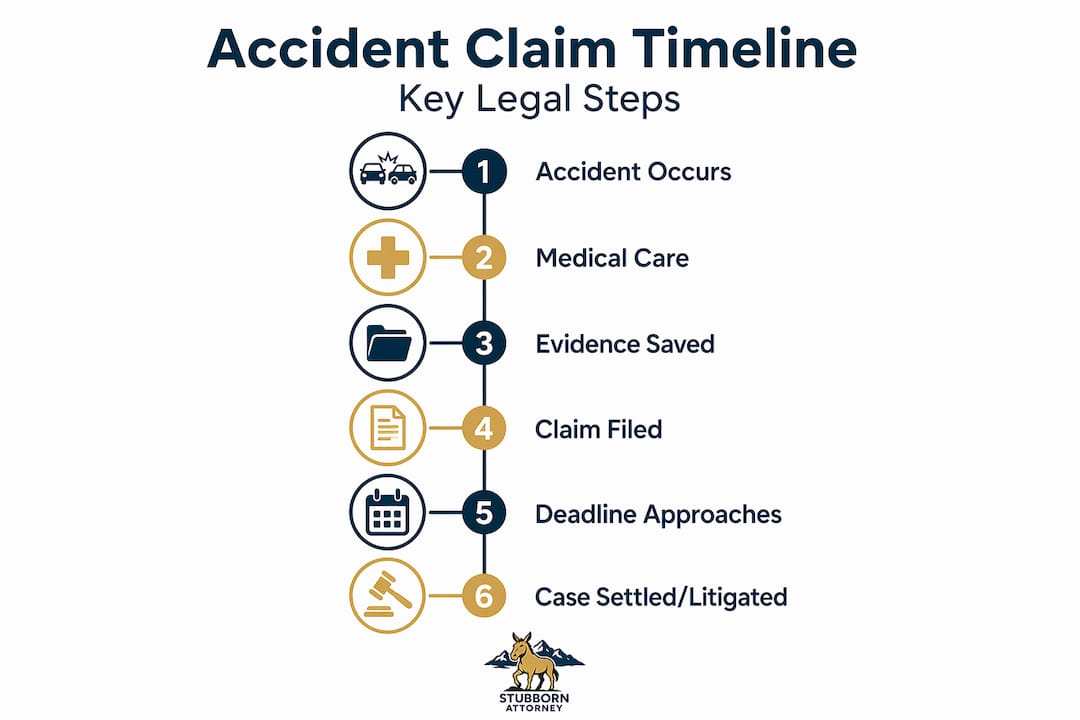
Understanding the sequence of events that follow a crash is how you avoid losing ground before you even know a fight has started. Here is how the timeline for car accident claims typically unfolds, from the moment of impact to final payment.
-
Immediately at the scene (0 to 24 hours). Call 911, get a police report, photograph everything, and collect witness contact information. Seek medical evaluation the same day, even if you feel fine. Symptoms of concussion, soft tissue injury, and internal trauma often take 24 to 72 hours to appear. Your medical records from day one are foundational evidence.
-
Notify your insurer (within 24 to 72 hours). Most auto policies require prompt notice of accidents. Delaying this can give the insurer a basis to deny coverage. Notify them of the accident but do not give a recorded statement yet.
-
Get formal medical treatment (within 72 hours). In Colorado Springs , for example, PIP benefits require evaluation within 14 days. Many states have similar prompt-care requirements tied to benefit eligibility. Do not skip this step.
-
Consult an attorney (within the first two weeks). The earlier you get legal advice, the less likely you are to make a damaging mistake. This is when evidence is freshest, witnesses are easiest to contact, and your options are still wide open.
-
Gather and preserve evidence (weeks 1 to 4). This includes accident reconstruction data, surveillance footage (which many businesses overwrite after 30 days), vehicle damage estimates, and all medical bills.
-
Reach maximum medical improvement (MMI). This is the point at which your doctor determines your condition has stabilized. Settling before MMI risks leaving money on the table for future surgeries, therapy, or ongoing care. Most attorneys will not recommend accepting a settlement until you hit this milestone.
-
Negotiate a settlement (months 2 to 18). Once MMI is reached, your attorney submits a demand package to the insurance company. Back-and-forth negotiation typically follows. Simple cases settle in 2 to 4 months; moderate cases take 6 to 12 months.
-
File a lawsuit if needed (before the statute expires). If negotiations fail or the deadline is approaching, your attorney files suit to protect your rights. Filing a lawsuit preserves your claim legally, even if settlement talks continue after filing.
-
Post-settlement disbursement (30 days after agreement). Even after you sign a settlement agreement, final payment takes time while medical liens and release paperwork are processed.
Pro Tip: Take a photo of your accident scene, every document you receive, and every medical bill the moment you get it. A simple phone photo album organized by date becomes an invaluable evidence record that saves you hours later.
Factors that affect how long your claim takes
Not every car accident claim moves at the same pace. The car accident compensation timeline depends on a combination of factors, some within your control and some not.

Liability disputes are the biggest time inflators. When fault is contested, insurers hire investigators, accident reconstructionists, and medical experts to challenge your version of events. Disputed liability cases commonly push into the 12 to 24 month range or longer. Multi-vehicle crashes with partial fault on multiple drivers are among the most complex scenarios in personal injury law. Cases involving civil litigation with multiple parties require significantly more coordination and patience.
Injury severity directly shapes the timeline. A soft tissue injury that resolves in six weeks allows for a much faster resolution than a spinal cord injury requiring multiple surgeries over 18 months. You cannot accurately calculate your damages until your medical picture is complete. Rushing that process almost always costs you money.
Here are the most common factors that extend or shorten the car accident lawsuit timeline:
- Multiple liable parties: Each adds its own insurer, attorney, and negotiation track
- Uninsured or underinsured drivers: Requires tapping your own policy and often leads to more disputes
- Disputed causation: When the insurer argues your injuries predated the accident
- Slow evidence collection: Missing surveillance footage or police reports that take time to obtain
- Complex medical treatment: Ongoing surgeries, specialist consults, or disputed diagnoses
- Court scheduling: If litigation is required, docket backlogs can add months to the process
The complexity of your case is not a reason to panic. It is a reason to prepare. The attorneys who get the best results in long cases are the ones who start building the file on day one, not month six.
Common mistakes that jeopardize your claim
Most claims that fail or end in low settlements do not fall apart because of bad facts. They fall apart because of avoidable mistakes made early. Here is where people go wrong and how you can avoid the same traps.
-
Skipping or delaying medical care. Gaps in treatment send a signal to insurers that your injuries are minor or unrelated to the accident. Prompt medical care within 24 to 72 hours is the foundation of claim validity. Every day you wait makes the injury-accident link harder to prove.
-
Giving a recorded statement without legal advice. Insurance adjusters are trained to ask questions that produce answers they can use against you. Recorded statements can be twisted to undermine your claim in ways you will not see coming. Politely decline until you have spoken to an attorney.
-
Settling before reaching MMI. Once you accept a settlement and sign a release, the case is over. If you discover six months later that you need surgery, you cannot reopen the claim. Rushed settlements routinely result in inadequate compensation for exactly this reason.
-
Missing insurer notification deadlines. Your own policy almost certainly requires you to report the accident within a specific timeframe, sometimes as short as 30 days. Missing this window can void your own coverage.
-
Assuming the statute of limitations is far away. Three years feels like a long time until you are in month 30 of treatment and negotiations and realize the deadline is 90 days out. Submitting an insurance claim does not toll the statute. Only filing a lawsuit in court stops the clock.
Pro Tip: Ask your attorney at the very first meeting: “What are every deadline I need to know about, and what happens if we miss them?” If you do not get a clear, specific answer, that tells you something important about the representation you are receiving.
How to protect your claim and track your legal deadlines
Protecting your legal rights in car accidents is not a passive process. You have to actively manage your case, especially if you are not working with an attorney yet.
Here is what strong claim management looks like in practice:
- Create a dedicated folder (physical or digital) for every document related to your accident: police reports, medical records, bills, correspondence, and photos.
- Mark every deadline on your calendar with a 30-day and 90-day early warning. Include the statute of limitations expiration, insurer notification deadlines, and any administrative claim filing dates.
- Follow up in writing. Every conversation with an insurer or opposing party should be followed by an email summarizing what was said. This creates a paper trail that cannot be disputed later.
- Track your medical appointments. Gaps in treatment are used against you. If you miss appointments, document why.
- Understand what you are signing. Before accepting any settlement offer or signing any release, know exactly what rights you are giving up.
Here is a side-by-side comparison of two approaches to claim management:
| Approach | Proactive | Reactive |
|---|---|---|
| Medical care | Immediate, documented | Delayed, inconsistent |
| Evidence gathering | Starts day one | Begins after gaps appear |
| Deadline tracking | Calendar with alerts | Relying on memory |
| Legal consultation | Within first two weeks | After problems arise |
| Settlement evaluation | At or after MMI | Under insurer pressure |
| Outcome likelihood | Stronger position | Higher risk of undercompensation |
If settlement negotiations stall and the statute of limitations is within six months, your attorney should file a lawsuit to protect your position. Strategic lawsuit filing preserves your leverage and prevents the case from dying on a technicality while talks continue. Cases that settle after a lawsuit is filed often resolve for more than pre-litigation offers because the insurer now faces the real cost of going to trial.
Use the Colorado car accident legal checklist developed by Stubbornattorney to make sure you have not missed any step in the process.
My take on what actually goes wrong with legal timelines
I have handled hundreds of injury cases, and I want to give you the honest version of what I have learned, not the polished one.
The clients who end up with the worst outcomes are almost never the ones with the weakest cases. They are the ones who waited. They waited to see a doctor because they were not “that hurt.” They waited to call me because they thought they could handle the insurance company on their own. They waited to file because they assumed settlement was imminent. That last one is the most painful situation I see: a case that should have resolved well, sitting in “almost settled” limbo while the statute of limitations expires. Once that deadline passes, there is nothing I can do. The case is gone.
The thing about car accident legal procedures that most people do not appreciate is how coordinated the process has to be. You need your medical timeline, your evidence timeline, and your legal deadline calendar all running in sync. Miss any one of them, and the others suffer. Timelines require coordinated management of statutory deadlines, medical milestones, and evidence retention windows to build the strongest possible claim.
One thing I push every client on early is the government claim notice requirement. If a government vehicle or a road hazard caused your accident, you may have as few as 90 days to file an administrative notice. I have seen legitimate cases lost because no one caught that detail in time.
My honest advice: treat the legal deadline like a hard stop, because it is one. Everything else in this process has some flexibility. The statute of limitations has none.
— Ryan
How Stubbornattorney helps you manage every deadline
Understanding the legal timeline matters. Having someone fight to protect it for you matters more. At Stubbornattorney, we track every deadline in your case from the first call, whether that means statutory filing dates, administrative claim notice requirements, or insurer notification windows. Ryan Malnar spent years as a federal claims adjuster before practicing law. He knows exactly how insurance companies evaluate claims and where they look for reasons to pay less.
We represent only injured victims, and we offer a completely free case evaluation so you can understand your options before committing to anything. If you have recently been in an accident, review common personal injury case examples to see how cases like yours are typically handled. For Colorado residents seeking experienced local representation, our Colorado Springs personal injury team is ready to take your call. Do not let a deadline slip while you are still figuring out your next step.
FAQ
What is the statute of limitations for car accidents?
Most states set the deadline at one to three years from the accident date for personal injury claims, with California at two years and Colorado at three years. Government-related claims often require notice within 30 to 180 days.
How long does it take to settle a car accident claim?
Simple cases settle in 3 to 6 months, moderate cases in 6 to 12 months, and complex litigation can take two to four years depending on injury severity and disputed liability.
Does filing an insurance claim stop the statute of limitations?
No. Only filing a lawsuit in court tolls the statute of limitations. A claim in settlement negotiations can still expire if a lawsuit is not filed before the deadline.
When should I accept a car accident settlement offer?
You should not accept a settlement until you have reached maximum medical improvement, so your full medical costs and long-term needs are known. Settling early risks foregoing compensation for future treatment.
Do I need a lawyer for the car accident legal timeline?
You are not legally required to hire an attorney, but legal representation after accidents significantly reduces the risk of missing deadlines, making damaging statements, or accepting inadequate offers before your injuries are fully understood.