
Fault in Multi-Car Accidents: What You Need to Know
Fault in multi-car accidents is defined as legal responsibility for causing or contributing to a collision, determined by identifying which drivers acted negligently and how those actions triggered each impact in the sequence. Understanding what is fault in multi-car accidents matters because it directly controls who pays, how much they pay, and whether you can recover compensation at all. Fault is not a single judgment handed down by one officer at the scene. It is a layered analysis built from evidence, state law, and the independent actions of every driver involved. Getting this wrong costs victims thousands of dollars in lost compensation.
How is fault assigned among multiple drivers in a multi-car accident?
Fault assignment in a multi-car crash follows the legal framework of negligence, which requires proving four elements: duty of care, breach of that duty, causation, and damages. The burden of proof rests on the injured party, and the standard is “more likely than not.” That means you do not need certainty. You need the weight of evidence on your side.
The critical point most people miss is that fault is not binary in a multi-vehicle crash. Each driver’s actions are evaluated independently, including their speed, following distance, and reaction to the unfolding situation. A driver who rear-ends another vehicle because they were following too closely shares fault even if they were not the one who started the chain reaction. The first driver is not automatically the only one at fault.

Fault percentages are then assigned to reflect each driver’s contribution to the crash. This is where comparative negligence rules come in. Under this framework, each driver carries a share of responsibility, and compensation is adjusted accordingly. Two drivers might each be found 50% at fault, or one might carry 70% while another carries 30%.
Key factors adjusters and courts examine when assigning fault percentages include:
- Speed at impact: Was the driver exceeding the posted limit or driving too fast for conditions?
- Following distance: Did the driver maintain a safe gap before the crash?
- Reaction time: Did the driver brake, swerve, or take any evasive action?
- Distraction or impairment: Was the driver using a phone, eating, or otherwise inattentive?
- Road and weather conditions: Did conditions demand extra caution that the driver ignored?
Pro Tip: Never admit fault at the scene, even casually. A statement like “I didn’t see you stop” can be used as an admission of negligence. Stick to factual observations and let the evidence speak.
Understanding negligence in car accidents gives you a clearer picture of how each of these factors feeds into the legal analysis that determines your payout.
What evidence is used to determine fault in multi-car accidents?
Evidence is the foundation of every fault determination. Without it, the process collapses into a contest of conflicting driver stories, and adjusters default to the version that costs their company the least.
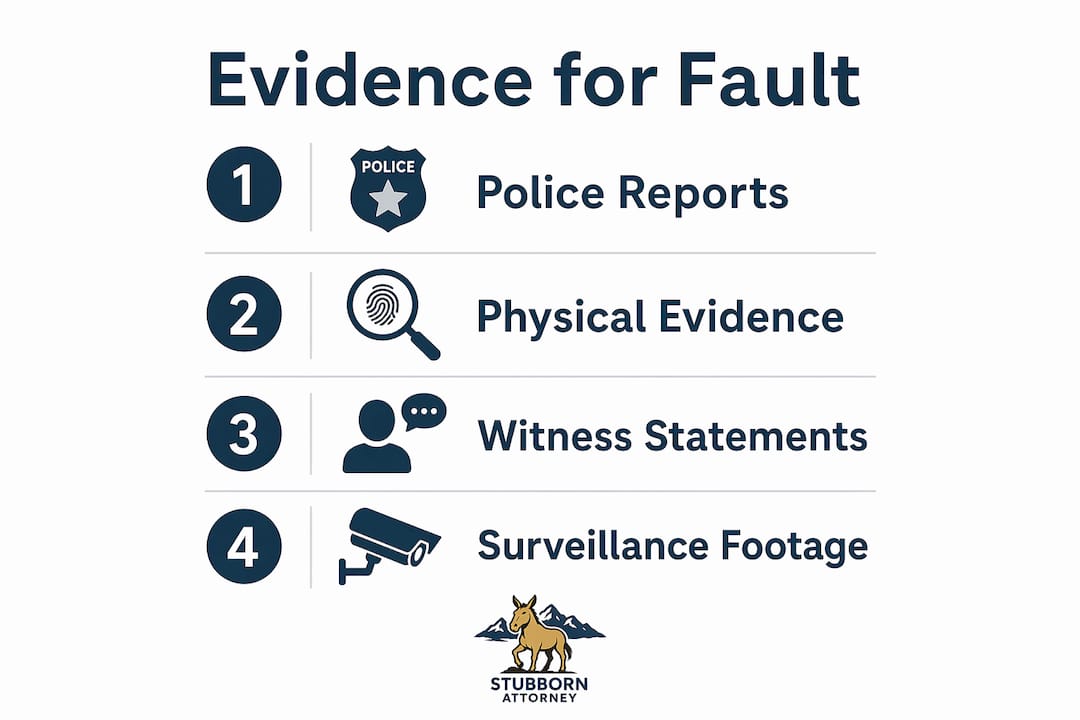
Police accident reports
Police reports are the starting point for most fault analyses. They contain officer observations, contributing-factor codes such as “following too closely,” and sometimes citations. Access fees for reports typically run $5–$30, and they are worth every cent. However, a police report is an officer’s opinion, not a legal verdict. Insurers and courts conduct their own independent investigations and can reach entirely different conclusions.
Physical evidence at the scene
Skid marks, vehicle damage patterns, and debris fields tell a story that drivers cannot easily contradict. A car with front-end damage that matches the rear of the vehicle ahead confirms the direction and sequence of impact. Skid marks reveal braking distance and speed. These details are objective, and insurance adjusters prioritize them over conflicting driver accounts precisely because they are harder to dispute.
Witness statements and surveillance footage
Independent witnesses carry significant weight because they have no financial stake in the outcome. Witness memories fade rapidly, so collecting contact information and initial statements at the scene is critical. Surveillance footage from nearby businesses, traffic cameras, or dashcams can capture the sequence of events in real time. Electronic data from vehicle event data recorders, commonly called black boxes, can confirm speed, braking, and steering inputs in the seconds before impact.
The table below summarizes the main evidence types and their typical weight in fault determinations:
| Evidence Type | Strength | Why It Matters |
|---|---|---|
| Police report | Moderate | Starting point; officer opinions, not final verdicts |
| Skid marks and debris | High | Objective physical data on speed and direction |
| Vehicle damage patterns | High | Confirms impact sequence and force |
| Witness statements | High (if prompt) | Independent accounts with no financial bias |
| Surveillance or dashcam footage | Very high | Real-time visual record of the crash sequence |
| Electronic data recorder | Very high | Confirms speed, braking, and steering before impact |
| Driver statements | Low to moderate | Subjective and often self-serving |
Pro Tip: Photograph everything before the scene is cleared. Skid marks, vehicle positions, road signs, and lighting conditions all degrade or disappear once traffic resumes. Your phone camera is your most powerful evidence tool in the first 30 minutes after a crash.
Gathering accident evidence immediately after a crash is one of the most consequential steps you can take for your claim. Physical evidence and witness memories both degrade quickly, and early collection is the difference between a strong case and a disputed one.
How do state laws affect fault determination and compensation?
State law governs how fault percentages translate into actual compensation. Three legal frameworks apply across the United States, and knowing which one your state uses changes everything about your claim strategy.
Pure comparative negligence allows you to recover compensation regardless of your fault percentage. If you are found 80% at fault, you still recover 20% of your damages. States like California and New York use this system. It is the most permissive framework for injured parties.
Modified comparative negligence sets a threshold, typically 50% or 51%, above which you cannot recover anything. If your fault exceeds that threshold, your claim is barred entirely. Most states, including Colorado, use this framework. Fault above 50% in a modified comparative negligence state means you walk away with nothing, even if you suffered serious injuries.
Contributory negligence is the harshest rule. Any fault on your part, even 1%, bars recovery completely. Only a handful of states still use this standard, including Alabama, Maryland, North Carolina, and Virginia. In those states, fault determination is an all-or-nothing fight.
| Framework | States (examples) | Recovery rule |
|---|---|---|
| Pure comparative negligence | California, New York, Colorado Springs | Recover minus your fault percentage |
| Modified comparative negligence | Colorado, Texas, Illinois | Barred if fault exceeds 50% or 51% |
| Contributory negligence | Alabama, Maryland, Virginia | Barred if any fault exists |
A common misconception is that one driver must be 100% at fault for a claim to succeed. That is false in most states. Multi-car accident liability is almost always shared, and the legal system is built to handle that complexity. Understanding your rights in Colorado under the modified comparative negligence standard is the first step toward protecting your claim.
What challenges complicate fault determination in multi-car accidents?
Chain-reaction crashes create a sequencing problem that single-vehicle accidents do not. The first collision triggers the second, which may trigger a third, and each impact involves a different set of driver decisions. Untangling that sequence requires more than a police report.
Reaction time is one of the most contested issues in multi-car fault analysis. A driver who had only one second to respond to a sudden stop in front of them faces a very different standard than a driver who had five seconds and still failed to brake. Courts and adjusters examine what a reasonable driver would have done given the same conditions and the same amount of warning time.
Insurance companies add another layer of complexity. Insurers have financial incentives to assign fault in ways that protect their bottom line, not to find the objective truth. An adjuster working for the at-fault driver’s insurer will look for any evidence that shifts blame toward you. That is not a conspiracy. It is how the system works, and you need to account for it.
Fault determinations also change as new evidence surfaces. A dashcam video retrieved two weeks after the crash can reverse an initial fault assignment entirely. Police reports can be supplemented or challenged. Witness statements taken months later can contradict earlier accounts.
“Police reports are officer opinions, not final verdicts. Insurers and courts conduct their own independent investigations and can reach entirely different conclusions from the same crash scene.”
The practical takeaway is that an initial fault assignment is never the final word. Car accident responsibility is negotiable, especially when new evidence enters the picture. Knowing how insurance companies calculate fault helps you anticipate where disputes will arise and prepare accordingly.
What I’ve learned about fault disputes after multi-car crashes
After more than a decade handling personal injury cases in Colorado, and years before that as a federal claims adjudicator, I have seen one pattern repeat itself constantly: people accept the initial fault assignment as if it were carved in stone. It is not.
The first thing I tell clients is to collect evidence before they do anything else. Not after they call their insurer. Not after they speak to the other driver’s attorney. Before. Skid marks disappear. Witnesses forget details. Dashcam footage gets overwritten. The window for preserving the best evidence is measured in hours, not days.
The second thing I tell them is to say nothing that could be interpreted as an admission. Insurance adjusters are trained to listen for language that shifts liability. A casual apology at the scene, a vague statement about “not seeing the car stop,” or an offhand comment about being distracted can follow a claim for months.
The third thing is to understand that fault is a legal conclusion, not a feeling. I have seen cases where my client was initially assigned 60% fault, and after a thorough evidence review, that number dropped to 15%. The difference was a surveillance video, two witness statements, and a vehicle damage analysis that contradicted the police report narrative. That kind of shift is not unusual. It is what happens when someone fights back with facts instead of accepting the first number offered.
Multi-car accident liability is genuinely complex. Treat it that way from the first moment after the crash.
— Ryan
Stubbornattorney’s approach to multi-car accident claims
Multi-car accident cases are among the most disputed personal injury claims in Colorado. Fault gets spread across multiple drivers, insurers push back hard, and the evidence window closes fast. Stubbornattorney has settled hundreds of injury cases and recovered millions of dollars for people navigating exactly this situation. Ryan Malnar brings over a decade of personal injury experience and a background as a former federal claims adjudicator, which means he knows how insurers think and where they cut corners. If you are dealing with a disputed fault assignment or a complex chain-reaction crash, reviewing common personal injury case examples is a strong starting point. A free case evaluation costs you nothing and could change everything about your claim outcome.
FAQ
What is fault in a multi-car accident?
Fault in a multi-car accident is legal responsibility for causing or contributing to the crash, determined by evaluating each driver’s negligence through evidence, state law, and the sequence of collisions. It is typically expressed as a percentage shared among multiple drivers rather than assigned entirely to one person.
Can more than one driver be at fault in a chain-reaction crash?
Yes. Multi-car liability is almost never assigned to a single driver. Each driver’s actions, including their speed, following distance, and reaction time, are assessed independently, and fault percentages are distributed accordingly.
Does a police report determine who is at fault?
No. A police report is an officer’s opinion based on observed facts, not a legal verdict. Insurers and courts conduct independent investigations and can reach different fault conclusions from the same crash.
How does my fault percentage affect my compensation?
Your compensation is reduced by your fault percentage in most states. In Colorado, which uses modified comparative negligence, a fault finding above 50% bars recovery entirely. In pure comparative negligence states, you can still recover even if you are mostly at fault, though your payout is reduced proportionally.
What should I do immediately after a multi-car accident to protect my claim?
Photograph the scene, collect witness contact information, and avoid making any statements that could be interpreted as admitting fault. Evidence degrades quickly once the scene is cleared, so the first 30 minutes are the most important for preserving the facts that will support your claim.