
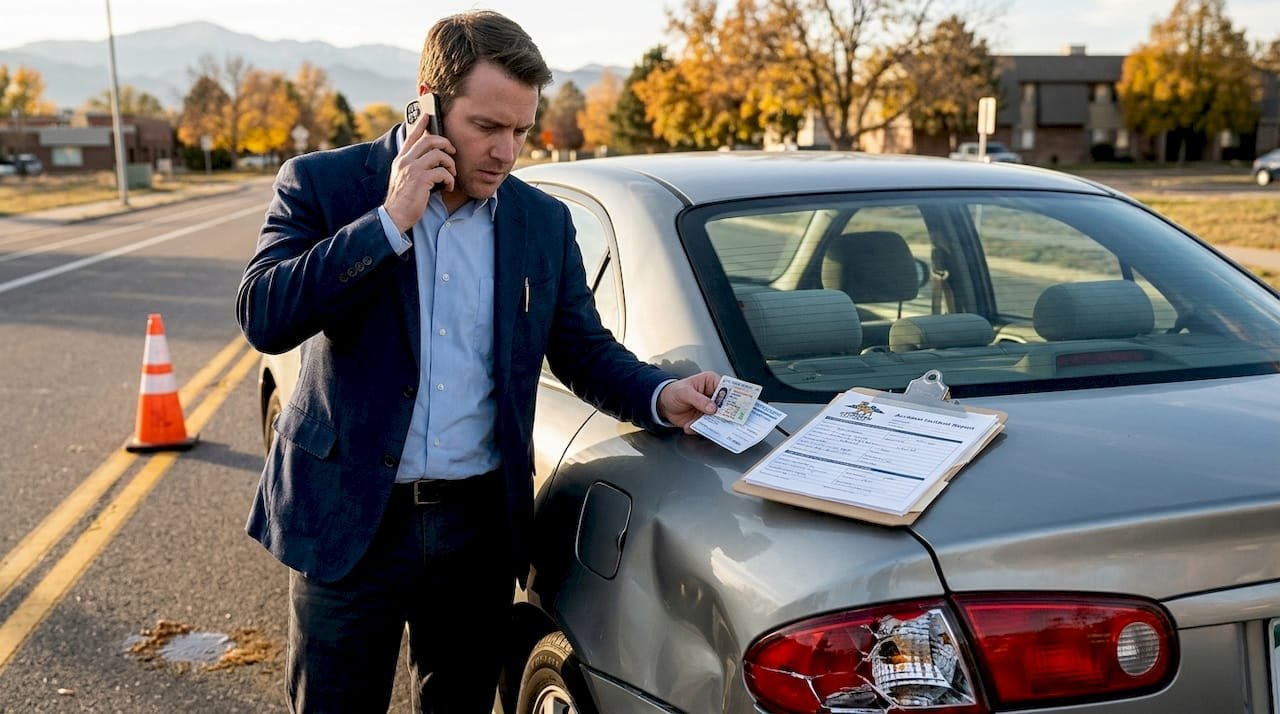
Your step-by-step guide to Colorado car accident claims
TL;DR:
- Immediate actions after a Colorado car accident include reporting, documenting, and exchanging information.
- The claim process can take 6 to 24 months, involving multiple stages and potential delays.
- Understanding fault, avoiding common mistakes, and organized evidence improve chances of fair compensation.
A car accident can turn an ordinary day into a spiral of pain, paperwork, and unanswered questions. You’re dealing with injuries, a damaged vehicle, missed work, and a flood of calls from insurance adjusters who already seem to know more about the process than you do. The good news is that understanding exactly what to do and when to do it changes everything. This guide walks you through each stage of a Colorado car accident claim, from the first minutes after the crash to the final settlement check, so you can protect your rights, avoid costly mistakes, and move forward with confidence.
Table of Contents
- What to do immediately after a car accident in Colorado
- Understanding Colorado’s car accident claim timeline and process
- Proving fault and dealing with Colorado’s comparative negligence rule
- Essential documents and evidence needed to support your claim
- Common mistakes to avoid during your Colorado car accident claim
- The truth about car accident claims in Colorado: What most guides miss
- How to get experienced help with your Colorado accident claim
- Frequently asked questions
Key Takeaways
| Point | Details |
|---|---|
| Immediate action matters | Taking the right steps at the accident scene sets up a stronger claim. |
| Know your deadlines | You must file your claim within three years to protect your rights in Colorado. |
| Fault impacts payout | If you are partly at fault, your compensation decreases; at 50% or more fault, you get nothing. |
| Documentation is crucial | Thorough evidence collection and careful paperwork speed up settlements and prevent disputes. |
| Expert help can maximize recovery | Professional legal guidance often results in fairer compensation and less stress. |
What to do immediately after a car accident in Colorado
Once you’ve regained your composure after a crash, the first several actions you take can influence everything that follows. Most people focus on the shock of the moment and forget that the scene in front of them is also evidence.
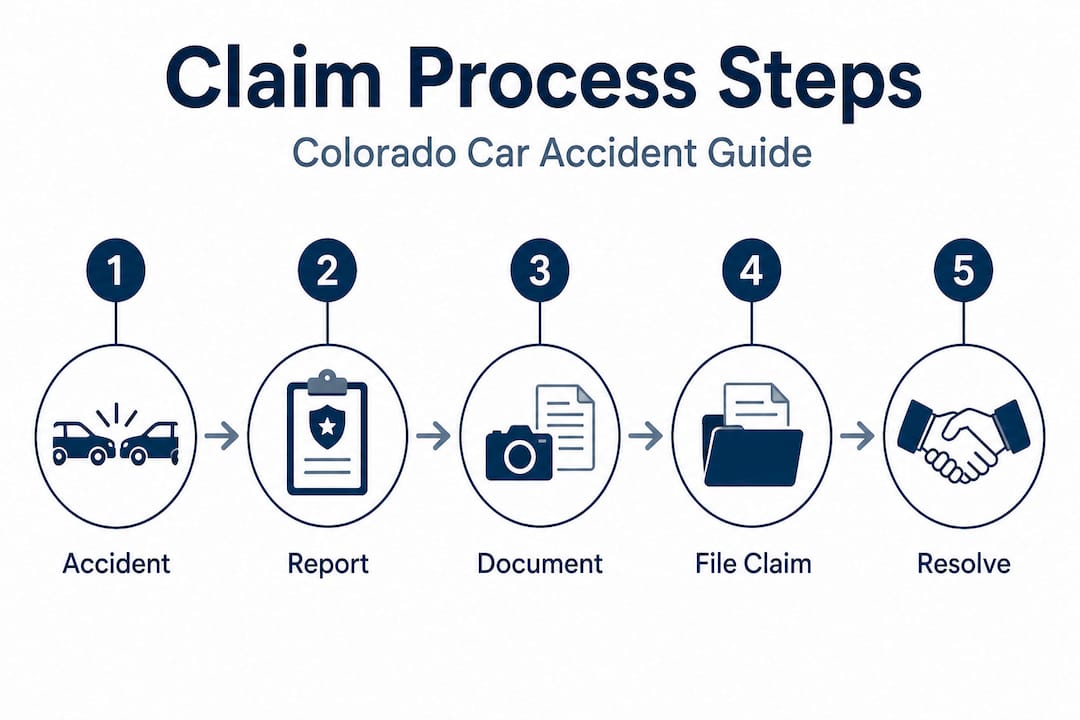
Check yourself and others first. Before anything else, assess whether you or anyone else is injured. Call 911 immediately if there are injuries, and even if injuries seem minor, a police report is a valuable record. Do not move vehicles until law enforcement tells you to, unless staying put creates a serious safety hazard.
Move to safety and exchange information. Get off the road if you can do so safely. Exchange names, driver’s license numbers, license plate numbers, insurance policy details, and contact information with every driver involved. Also collect contact information from any witnesses who saw the crash happen. Witnesses you speak to at the scene may be impossible to find later.
Document everything you can see. Use your phone to photograph vehicle damage from multiple angles, skid marks, road conditions, traffic signals, and any visible injuries. Take wide shots and close-up shots. Write down your own recollection of events as soon as possible while your memory is fresh. Note the time, weather conditions, lighting, and anything unusual about the road.
Here are the core immediate steps to keep in mind:
- Call 911 and wait for a police report to be filed
- Seek medical care promptly, even if injuries feel minor at first
- Exchange insurance and contact details with all involved parties
- Photograph the entire accident scene thoroughly
- Identify and speak with any available witnesses
- Notify your own insurance company that an accident occurred
- Avoid admitting fault or speculating about who caused the crash
Colorado law gives you three years to file a personal injury or property damage claim from the date of the accident. That may sound like a long time, but evidence fades, witnesses become harder to reach, and memories get blurry. Starting your documentation immediately gives you the strongest foundation.
“The scene of the accident is a snapshot that will never exist again. Every photo you take, every name you write down, and every detail you record is an asset you cannot recreate later.”
Pro Tip: Download and follow a car accident legal checklist before you ever need it. Keep it in your glove box or saved on your phone so you aren’t trying to remember steps while standing on the side of a busy road in shock.
Understanding Colorado’s car accident claim timeline and process
After you’ve completed the initial steps at the accident scene, you’ll enter the more formal insurance and legal process. Many people are surprised by how long this takes and how many moving parts are involved.

The process is not a single event. It unfolds in stages, and each stage has its own challenges and potential delays. According to claim data, a full settlement takes anywhere from 6 to 24 months, depending on case complexity, the severity of injuries, and how quickly the insurance companies respond.
Here is a general overview of what each stage looks like:
| Stage | What happens | Typical timeframe |
|---|---|---|
| Initial report | You notify your insurer; police report is filed | Within days of the accident |
| Investigation | Insurer reviews facts, assigns an adjuster, gathers evidence | 1 to 7 weeks |
| Medical treatment | You continue treatment; insurer waits for records | Varies, often months |
| Demand and negotiation | You or your attorney send a demand letter; back-and-forth begins | 2 to 8 weeks |
| Settlement or litigation | Agreement is reached or the case moves toward a lawsuit | Weeks to months more |
| Payment | Settlement funds are disbursed after paperwork is finalized | Several weeks after agreement |
Understanding the different types of car accident claims available to you, whether it is a liability claim, uninsured motorist claim, or underinsured motorist claim, shapes which path your case will follow and how long it may take.
Here is a numbered breakdown of how to move through the process strategically:
- Report the accident to your insurer promptly. Most policies require notification within a reasonable time. Waiting too long can give the insurer grounds to question your claim.
- Complete all recommended medical treatment. Do not stop treatment before your doctor says you have reached maximum medical improvement. Settling before that point risks leaving future medical costs uncovered.
- Gather all records and bills. This includes emergency room visits, specialist appointments, physical therapy, prescriptions, and any out-of-pocket expenses related to the accident.
- Understand the full scope of your losses. Lost wages, reduced earning capacity, and pain and suffering are all compensable damages in Colorado, not just medical bills.
- Send a formal demand letter. Once treatment is complete, you or your attorney will send a written demand to the insurance company outlining your losses and requesting a specific settlement amount.
- Negotiate in writing whenever possible. Keep a paper trail of every communication with adjusters so there is no dispute about what was said or offered.
- Know your options if negotiations stall. If the insurer refuses a fair offer, you can file a lawsuit. Understanding the full injury lawsuit timeline helps you plan ahead rather than react under pressure.
Pro Tip: Track every expense and communication in a dedicated folder or digital document. Date every entry. Insurance companies manage hundreds of claims at once. You need to be organized so that nothing falls through the cracks on your end. A well-organized claimant is harder to lowball. Reviewing the injury compensation workflow can help you understand what to expect at each financial stage.
Proving fault and dealing with Colorado’s comparative negligence rule
Navigating the claim process also means understanding how Colorado law decides who is financially responsible. This is where many claims get more complicated than people expect.
Colorado uses a system called modified comparative negligence. Here is what that means in plain terms: if you are partly responsible for the accident, your compensation is reduced by the percentage of fault assigned to you. If that percentage reaches 50% or more, you cannot recover anything at all. So the fight over fault percentages is not abstract. It directly affects your check.
Here is how fault scenarios can play out in practice:
| Scenario | Your fault % | Total damages | Your recovery |
|---|---|---|---|
| You had right of way; other driver ran red light | 0% | $50,000 | $50,000 |
| You were slightly speeding when hit from behind | 15% | $50,000 | $42,500 |
| Both drivers disputed a lane change | 40% | $50,000 | $30,000 |
| Fault was judged roughly equal | 50% | $50,000 | $0 |
That last row is not a typo. Exactly 50% fault means zero recovery under Colorado law. Insurance adjusters know this, and some will argue aggressively to push your assigned fault toward that threshold. Understanding how attorneys fight insurance companies on fault disputes can illuminate why this stage of the process matters so much.
The most effective ways to defend your fault percentage include:
- A detailed police report that supports your account of events
- Photos and video from the scene that show road conditions, vehicle positions, and damage patterns
- Witness statements taken close in time to the accident
- Traffic camera or dashcam footage, if available
- Accident reconstruction expert testimony for serious cases
- Your own written account created immediately after the crash
Pro Tip: Never apologize at the scene of an accident, even if you feel social pressure to do so. A statement like “I’m sorry, I didn’t see you” can be used as an admission of fault by an insurance adjuster even if you were legally not responsible for the crash. Stick to the facts and let the evidence tell the story.
Essential documents and evidence needed to support your claim
Proving fault is only half the battle. Now you must assemble concrete evidence to back up your claim and demonstrate the full extent of your losses.
Insurance adjusters do not simply take your word for anything. They work from documentation. The more organized, complete, and timely your evidence package is, the harder it is for an insurer to minimize your claim.
Here are the essential documents and materials every Colorado accident claimant should gather:
- Police report: Request a copy from the responding law enforcement agency as soon as it is available. This report establishes the official record of the crash and often includes the officer’s assessment of fault.
- Photographs and video: Scene photos, vehicle damage images, and any available surveillance or dashcam footage. Photograph your injuries as they develop over the days following the crash, not just immediately afterward.
- Medical records and bills: Every treatment, diagnosis, prescription, and therapy note from the date of the accident forward. This documentation connects your injuries directly to the crash.
- Proof of lost wages: A letter from your employer confirming the days you missed and your regular rate of pay. If you are self-employed, tax records and client invoices can serve this purpose.
- Repair estimates and receipts: Independent repair estimates from at least two shops, along with any invoices for rental cars or towing.
- Written communications: Every email, text, letter, or recorded call with insurance adjusters should be saved. Follow up verbal conversations with an email summary so there is a written record.
- Personal injury journal: A daily log of your pain levels, limitations, emotional state, and how the injuries are affecting your daily life. This document is powerful evidence of non-economic damages like pain and suffering.
Colorado’s three-year filing deadline for personal injury and property damage claims might create a false sense of security. Do not let it. Evidence degrades over time. Witnesses move away or forget details. Surveillance footage is overwritten. Vehicle wreckage gets repaired or disposed of. The strongest version of your claim is the one built closest to the date of the accident.
Pro Tip: Use the detailed accident legal checklist to organize your documents as you collect them. A well-maintained file impresses adjusters and saves your attorney enormous time if you decide to bring one in later.
Common mistakes to avoid during your Colorado car accident claim
Even the best-prepared claim can run into obstacles if you don’t watch for common errors. Some of these mistakes are simple oversights. Others come from trusting the wrong people at the wrong time.
Here are the most damaging mistakes Colorado accident victims make and how to avoid them:
- Giving a recorded statement too soon. Insurance adjusters often call within hours or days of a crash and request a recorded statement. You are not legally required to provide one to the other driver’s insurer. Giving one before you fully understand your injuries and the facts of the case can seriously hurt you.
- Accepting the first settlement offer. Early offers are almost always low. Insurers bank on the fact that you are stressed, in pain, and in need of money. Accepting too early can leave you responsible for future medical bills that were not yet known.
- Missing medical appointments. Gaps in medical treatment give adjusters ammunition to argue that your injuries were not serious or were caused by something else. Attend every appointment and follow your treatment plan.
- Failing to document ongoing symptoms. Many injuries, like soft tissue damage, whiplash, and traumatic brain injuries, evolve over weeks or months. If you are not recording your symptoms, you may have no evidence of how the injury progressed.
- Posting on social media. Photos of a vacation, a night out, or even a family dinner can be used by insurers to argue you are not as injured as you claim. Keep your accident and treatment details completely off social media during the claim process.
- Waiting too long to consult an attorney. You do not need to hire a lawyer for every fender bender. But in any claim involving significant injuries, disputed fault, or a denial from the insurer, waiting can be expensive.
“The biggest advantage insurance companies have is information. They have seen thousands of claims. You’ve seen one. Leveling that playing field starts with understanding your own reasons to pursue your injury case fully and completely.”
Settlement timelines of 6 to 24 months are common in Colorado, and each of those months is an opportunity for something to go wrong if you are not careful. Staying organized, staying consistent with treatment, and staying quiet on social media are three of the highest-value habits you can build during a pending claim.
Pro Tip: Think of your claim like a job application. The insurer is the employer reviewing your file. If your file is missing documents, inconsistent, or raises red flags, they will not take it seriously. Present your evidence the way you would want to be judged: organized, detailed, and credible.
The truth about car accident claims in Colorado: What most guides miss
Most step-by-step guides will tell you what to do. Very few will tell you what is actually happening behind the scenes while you do it. After more than a decade handling personal injury cases and spending years before that working as a claims adjudicator for the federal government, I can tell you plainly: the process is designed to favor the insurer.
This is not cynicism. It is how the system was built. Adjusters are trained to identify inconsistencies, minimize payouts, and close files quickly. They are measured on how efficiently they handle claims, not on how fairly they compensate injured people. Understanding that reality changes how you approach every phone call, every document, and every decision.
Here is the uncomfortable truth about most failed claims: the claimant did everything roughly right but made one or two small errors that gave the insurer the leverage it needed to reduce or deny the settlement. A recorded statement with an offhand comment about feeling “okay.” A three-week gap in physical therapy because life got busy. A social media photo that appeared to contradict a claimed injury. These are the moments that determine outcomes, not the size of the crash.
Persistence matters more than most people realize. A stubborn, thorough claimant is a much harder target than a cooperative, passive one. This is not about being difficult. It is about being consistent, documented, and unwilling to accept less than what your injury actually cost you. The financial compensation insights available to Colorado victims are often larger than insurers initially suggest, but only claimants who push through the discomfort find that out.
Legal representation is not always necessary, but it changes the dynamic immediately. An attorney who has handled hundreds of similar claims in Colorado knows what a fair settlement looks like. The insurer knows that your attorney knows. That shared understanding shifts the negotiation in ways that are hard to achieve on your own. For minor claims with clear fault and modest injuries, handling it yourself may be entirely reasonable. For anything involving serious injuries, disputed fault, or an uncooperative insurer, professional representation is almost always worth the investment.
The mule philosophy that drives how we practice at Malnar Injury Law applies directly here: we do not flinch, we do not quit, and we do not accept the first answer if it is not the right answer. That same stubborn persistence is what every accident victim needs when they are going up against a well-resourced insurance company.
How to get experienced help with your Colorado accident claim
For those wanting more personal, hands-on assistance, accessing legal expertise can make all the difference between a lowball settlement and a recovery that actually covers your losses.
At Malnar Injury Law, also known as StubbornAttorney.com, we have spent years recovering millions of dollars for Colorado accident victims, and we know exactly how insurers evaluate and undervalue claims. Start by reviewing your Colorado accident claim options to understand which type of claim applies to your situation. If you are already in talks with an insurer, understanding how we approach insurance company negotiations can help you recognize when you need someone in your corner. When you are ready to take that step, our guide to choosing the best lawyer in Colorado will help you ask the right questions. Contact us today for a free case evaluation and put a stubborn advocate on your side.
Frequently asked questions
How long do I have to file a car accident claim in Colorado?
You have three years from the date of the accident to file a personal injury or property damage claim in Colorado. Missing this deadline almost always means losing your right to recover compensation permanently.
What happens if I am partially at fault for the car accident?
Under Colorado’s modified comparative negligence rule, your compensation is reduced by your percentage of fault, and you are completely barred from recovering anything if you are found 50% or more responsible for the accident.
How long does a typical car accident claim take to settle in Colorado?
Most Colorado car accident claims settle in 6 to 24 months, though the timeline depends heavily on injury severity, how cooperative the insurer is, and whether litigation becomes necessary.
What documents are vital for a successful car accident claim?
The most critical documents are the police report, detailed photographs, complete medical records and bills, proof of lost wages, vehicle repair estimates, and a personal injury journal tracking your daily symptoms and limitations.
Is it necessary to hire a lawyer to file a car accident claim in Colorado?
You are not required to hire a lawyer, but for claims involving significant injuries, disputed fault, or an uncooperative insurer, having experienced legal representation often results in a substantially higher and fairer settlement.