
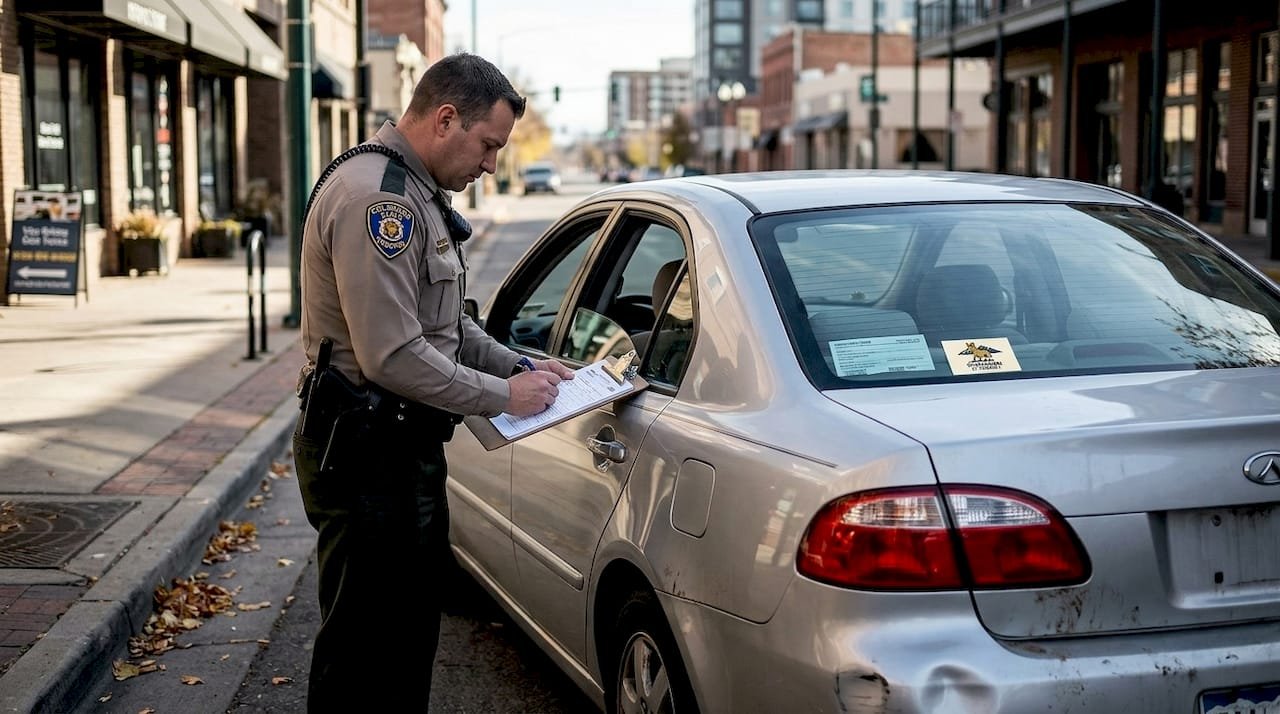
How to report a car accident in Colorado: Your step-by-step guide
TL;DR:
- Colorado law mandates immediate reporting of accidents resulting in injuries, fatalities, or property damage.
- Complete and accurate documentation before reporting strengthens insurance claims and legal cases.
- Proper reporting, timely record retrieval, and legal guidance are essential for maximizing recovery after a crash.
Your hands are shaking. The adrenaline is still pumping. Someone is on the phone, cars are pulling over, and you’re standing on the side of a Colorado road wondering what you’re supposed to do next. That moment after a crash is overwhelming, and most drivers have no idea what the law actually requires them to do. Reporting the accident correctly is not just a formality. It directly affects your insurance claim, your legal rights, and whether you can recover compensation down the road. This guide walks you through every step so you don’t make a costly mistake when it matters most.
Table of Contents
- When and why you must report a car accident in Colorado
- What information and documents you need before reporting
- How to report a car accident: Step-by-step instructions
- What to expect after reporting: Records, verification, and legal steps
- A hard-earned perspective: The mistakes Colorado drivers make after a crash
- Next steps: Legal representation and maximizing your claims in Colorado
- Frequently asked questions
Key Takeaways
| Point | Details |
|---|---|
| Report promptly | Immediate reporting is legally required and protects your insurance claim and investigation. |
| Gather complete details | Collect all necessary information—contact, vehicle, and accident specifics—before filing. |
| Choose the right reporting method | Use police, online, or mail-in options as appropriate based on your situation. |
| Request official records | Obtain your crash report copy for insurance, legal claims, and personal records. |
| Legal help improves outcomes | Qualified legal counsel can maximize your compensation and protect your rights after an accident. |
When and why you must report a car accident in Colorado
The first thing to understand is that reporting is not optional in most cases. Under Colorado law C.R.S. 42-4-1606, drivers must immediately report any car accident resulting in injury, death, or property damage to the nearest law enforcement agency. That word “immediately” matters. Colorado does not give you days to think about it when there is damage, injury, or a fatality involved.
That said, there is a practical distinction between two types of reporting duties. The first is the immediate notification requirement, which means calling 911 or contacting local law enforcement right at the scene. The second is the formal filing of a written report, which may have a different deadline depending on the circumstances. Some sources cite a 10-day deadline for formal written counter reports, while others reference 60 days for specific situations. The Colorado DMV’s official guidance controls, and their position is that immediate reporting is required at the scene whenever possible.
Why does timely reporting protect you?
The practical reason is simple. Prompt reports strengthen claims because evidence fades fast. Skid marks disappear after rain. Witness memories blur within days. Traffic camera footage gets overwritten. Insurance companies also typically require you to report an accident as a condition of your policy. If you delay, they can use that delay against you.
Here is a quick breakdown of the most common situations that require reporting:
- Any accident where someone is injured, even if the injury seems minor at first
- Any accident resulting in a fatality
- Property damage of any amount (Colorado law does not set a minimum dollar threshold)
- Hit-and-run accidents where the other driver flees
- Accidents involving an uninsured or intoxicated driver
- Accidents where injuries are not immediately apparent but develop later
Comparison: Immediate notification vs. formal written report
| Requirement | When it applies | Deadline | Method |
|---|---|---|---|
| Immediate notification | Injury, death, property damage | At the scene or as soon as possible | Call 911 or local law enforcement |
| Formal counter report | No police response, no injuries, no DUI, no hit-and-run | Within 10 days | Online via myDMV or mail form DR3447 |
| Record request filing | Obtaining your crash report copy | Within 90-day processing window | Mail form DR2559 or visit Westgate DMV |
Pro Tip: Even if you think the damage looks minor, report it. A fender bender that seems like nothing today can turn into a back injury diagnosis tomorrow. You cannot “un-skip” a report you never filed.
You can also use the Colorado legal accident checklist to make sure you are covering every required step from the moment the crash happens.
What information and documents you need before reporting
Filing a complete and accurate report is just as important as filing one at all. Incomplete reports create gaps that insurance adjusters and opposing attorneys will exploit. Before you pick up the phone or sit down to file online, make sure you have gathered everything required.
Here is the full breakdown of what your report needs to include, based on Colorado DMV standards and reporting guidance from legal clarity sources:
Personal and driver information for all parties involved:
- Full legal names and home addresses
- Driver’s license numbers for every driver
- Insurance carrier names and policy numbers
- Vehicle registration information
Vehicle details:
- Make, model, year, and color of every vehicle
- License plate numbers
- VIN (vehicle identification number) if accessible
- Photos of all damage from multiple angles
Accident scene details:
- Exact location (street intersection, mile marker, highway number)
- Date and exact time of the accident
- Road and weather conditions at the time
- Direction each vehicle was traveling
Additional supporting information:
- Names and contact information for all witnesses
- The police case number if officers responded
- A description of injuries sustained by any person
- Any citations issued at the scene
- Reference to photos you took (note that you gathered them, but do not submit original photos with the form)
One critical rule: do not admit fault in your report or in any conversation at the scene. This applies even if you think you may have contributed to the accident. Your report is a factual record, not a confession. Stick to the facts of what happened.
Key forms to know:
| Form | Purpose | When used |
|---|---|---|
| DR3447 | Colorado Driver’s Report of Traffic Accident | Filed by the driver when police do not respond |
| DR2559 | Permission and Certification for Release of Records | Used to request a copy of your crash report |
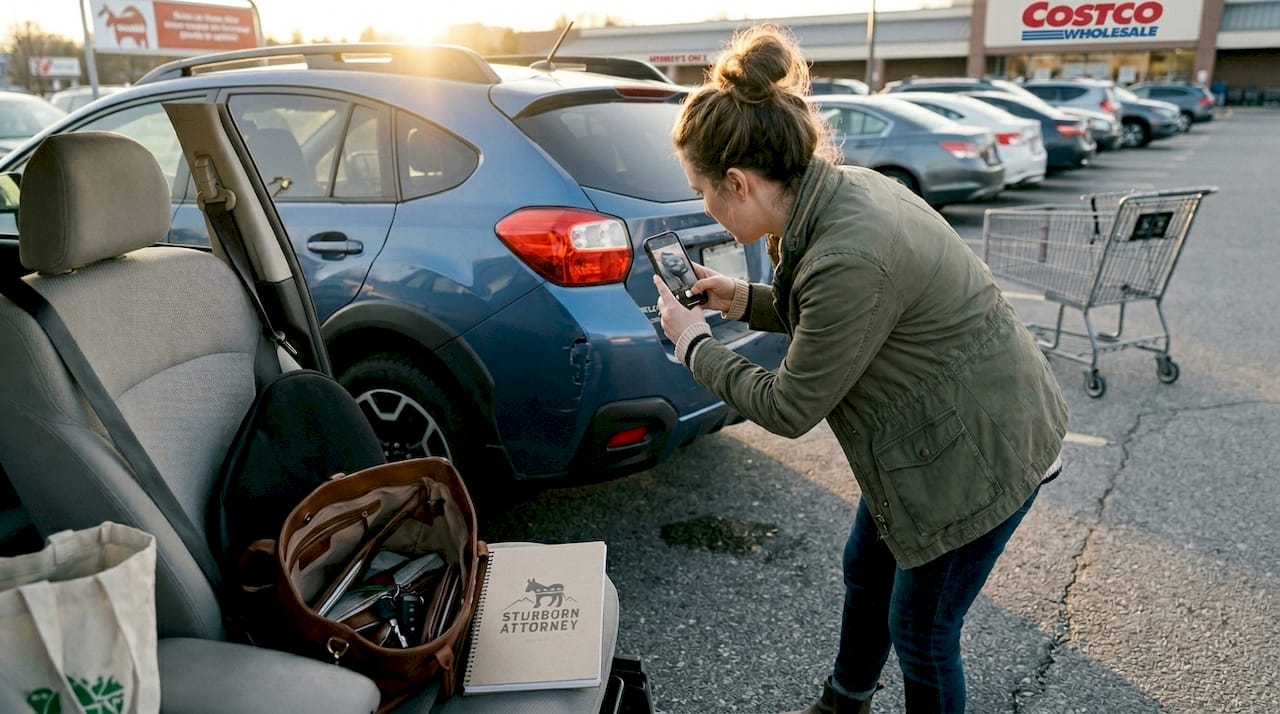
Pro Tip: Before you leave the accident scene, take photos of everything even if the other driver says they will handle it. Photograph the damage, the road, the weather conditions, traffic signs, and the positions of both vehicles. These images become critical evidence if the other driver later changes their story.
Understanding the types of car accident claims in Colorado can also help you anticipate what your insurance company and potential legal team will need from your report. And if you are unsure whether your situation warrants an attorney, reviewing the qualities of a strong personal injury lawyer is a good starting point.
How to report a car accident: Step-by-step instructions
Now that you have your information together, here is exactly how to navigate every reporting scenario you might face.
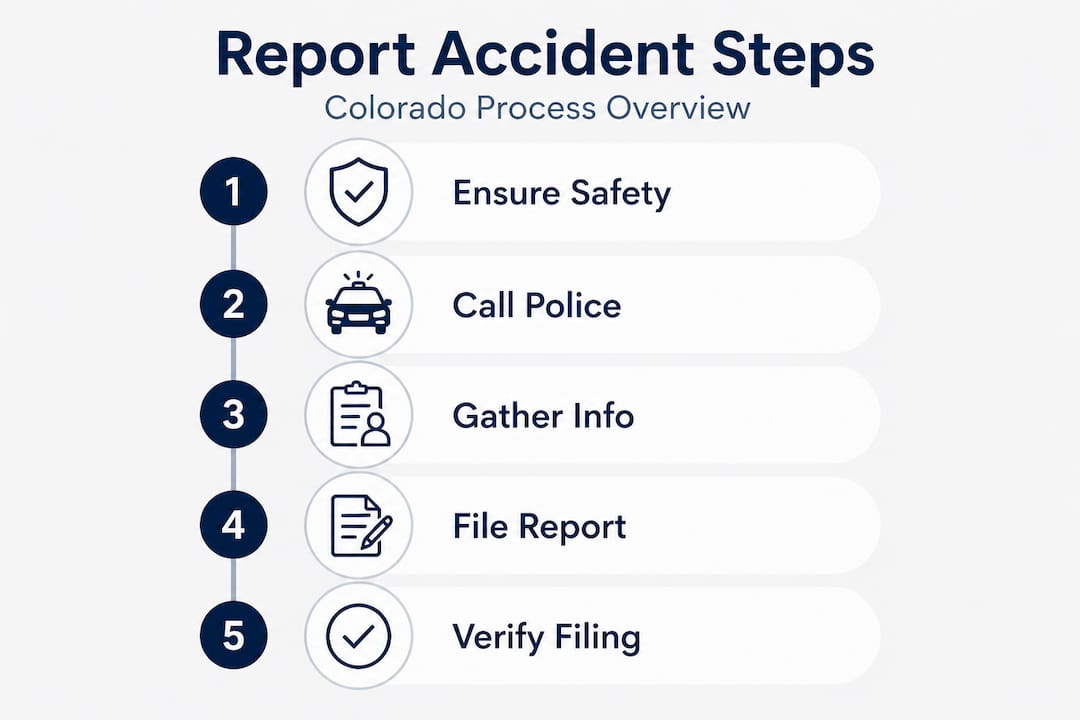
Scenario 1: A police officer is present at the scene
This is the most straightforward situation. When an officer responds to the accident, they handle the official report. You are not required to file an additional report unless the Colorado DMV later contacts you and requests one. Your job is to cooperate fully, give accurate information, and get the officer’s name and the case number before you leave.
Scenario 2: No police officer responds
This happens more often than people expect, especially in non-injury accidents or during high-volume call periods. Here is what you must do:
- Exchange all required information with the other driver at the scene.
- Photograph everything before vehicles are moved, if it is safe to do so.
- Determine whether your accident qualifies for online counter reporting. You can file online at myDMV Colorado only if there are no injuries, no suspected DUI, no hit-and-run, and no damage to public property.
- If your accident does not qualify for online reporting, complete form DR3447 and submit it by mail within 10 days.
- Keep a copy of everything you submit for your records.
Important: Online counter reports are not investigated by law enforcement. They are a documentation tool only. If your accident involves any complexity, such as disputed fault or injuries that appear later, consult an attorney before relying solely on a counter report.
Scenario 3: Hit-and-run accidents
If the other driver fled, Colorado’s reporting guidance is clear: you must still report the accident. Call 911 immediately. Try to note the fleeing vehicle’s make, model, color, and as many digits of the license plate as you can. Even partial information helps investigators. Do not chase the other driver.
Scenario 4: Accident alert conditions (severe weather)
During declared accident alerts, which Colorado issues during major snowstorms and dangerous weather events, police may not respond to non-injury accidents. During these periods, you are expected to self-file a report promptly once conditions allow. Do not assume that an accident alert excuses you from reporting. It simply shifts the method.
Scenario 5: Government vehicles are involved
This is a situation many people do not know about. If your accident involves a government vehicle, such as a city bus, a state truck, or a federal vehicle, you may have a 182-day notice requirement to file a formal claim against that government entity. This is completely separate from the accident report. Missing this deadline can permanently bar your claim. Consult an attorney quickly if your accident involves any government-owned vehicle.
Scenario 6: The driver is injured and cannot file
If the driver is injured or otherwise unable to file the report, a passenger or any other involved individual can file on their behalf. Always exchange information at the scene regardless of whether you plan to be the one filing.
Understanding the Colorado injury lawsuit timeline from this point forward is critical, especially if your injuries are serious. And reviewing the injury compensation workflow will give you a clearer picture of what to expect after you report.
What to expect after reporting: Records, verification, and legal steps
Filing the report is not the finish line. What happens after you file can be just as important to your claim and your legal case.
How to get a copy of your crash report
You will almost certainly need a copy of the official crash report for your insurance claim and potentially for any legal action. Here is the process:
- Complete form DR2559, which is the permission and certification form for record release.
- Pay the required fee (check the DMV website for the current fee schedule).
- Submit by mail to the Colorado DMV, by appointment at the Westgate DMV location, or online through the DMV portal.
- Allow up to 90 days for processing after filing.
- Know that Colorado keeps accident records for 7 years from the date of the crash.
How reporting affects your insurance and legal claims
Your crash report is the foundation of everything that follows. Insurance adjusters use it to establish the facts of the accident. Attorneys use it to identify liability. Courts reference it as evidence. A report that is complete, accurate, and filed on time gives you a strong starting position. A report that is missing, late, or incomplete hands ammunition to the other side.
Here is what to monitor after filing:
- Confirm the report was received by checking your case number or following up with the DMV or law enforcement agency.
- If you filed a counter report online, save the confirmation receipt immediately.
- Request your official crash report copy as soon as the 90-day window closes.
- Notify your insurance company of the accident as soon as possible, independent of the DMV filing.
Protecting your claim means acting fast on every front. Insurance companies track timelines carefully, and delays in notification create openings for them to dispute coverage.
Your rights after an accident go beyond simply filing paperwork. You can learn more about your rights after an injury in Colorado to make sure you are not leaving anything on the table. If your injuries are significant, understanding financial compensation after a crash and the reasons to pursue an injury case can give you the clarity you need to move forward confidently.
Verifying your report was properly filed
This is a step most people skip, and it can come back to hurt them. If you filed with law enforcement, call the department and confirm your case number is in the system. If you filed a counter report online, save the confirmation page as a PDF. If you mailed a DR3447, consider sending it via certified mail so you have delivery confirmation.
A report that you believe was filed but was never actually received is not a filed report. Verify everything.
A hard-earned perspective: The mistakes Colorado drivers make after a crash
After working on hundreds of injury cases and spending years on the other side of the table as a former federal claims adjudicator, I can tell you the mistakes I see most often are not about ignorance of the law. They are about assumptions.
The single biggest mistake: assuming the police handled everything. When an officer shows up, many drivers feel relief and mentally check the box. But the officer’s report and your own legal and insurance obligations are two separate things. Colorado’s DMV guidance is clear that your reporting duty depends on your specific circumstances, and police presence does not automatically satisfy every obligation you have.
The second most common mistake is waiting to see how bad the injuries get before deciding to report or consult an attorney. Evidence fades with stunning speed. Witnesses forget details or become unreachable. The other driver has time to consult their insurance company and shape their version of events. Every day you wait is a day the story becomes harder to tell accurately.
A lot of drivers also misunderstand what an online counter report actually does. It is a record-keeping tool. It is not an investigation trigger. It does not alert insurance companies, and it does not preserve evidence. If your accident has any complexity to it, a counter report is only a starting point, not a complete solution.
Finally, the difference between immediate notification and formal filing confuses many people. The official DMV deadlines distinguish between what you must do at the scene and what formal written documents must be submitted within specific windows. Treating them as the same thing leads to missed steps. Use the legal checklist for accidents to make sure you have covered both.
The accidents I have seen go sideways in court are rarely the complicated ones. They are the ones where the driver thought someone else handled the details. Nobody will protect your claim as stubbornly as you and the right legal team will.
Next steps: Legal representation and maximizing your claims in Colorado
Reporting your accident correctly is the foundation, but it is only the beginning. What you do in the days and weeks that follow determines how much compensation you can actually recover. Insurance companies have experienced adjusters and attorneys working on their side from the moment you file a claim. You deserve the same level of representation.
At Malnar Injury Law, now at StubbornAttorney.com, we have recovered millions of dollars for injured Coloradans and settled hundreds of personal injury cases. Ryan Malnar’s background as a former federal claims adjuster means we know exactly how insurance companies evaluate your claim and where they look for weaknesses. Our car accident legal checklist gives you a starting framework, and we are ready to take it from there. Whether you need to understand what qualities make a personal injury lawyer effective or want a clear view of the types of personal injury compensation available in Colorado, we are here to guide you through every step with the same stubborn determination that defines everything we do.
Frequently asked questions
What happens if I do not report a car accident in Colorado?
Failing to report can result in fines, loss of insurance support, and a significantly weakened legal claim, since delays cause evidence to fade and give the other side time to build their version of events.
Who can report the accident if the driver is injured?
A passenger or any involved person can file the report if the driver is injured or unable to do so, though exchanging information at the scene is always required regardless of who files.
Do I need to report minor accidents that only involve property damage?
Yes. Under C.R.S. 42-4-1606, Colorado law requires you to report any accident that results in property damage, injury, or death, with no minimum damage threshold.
How long does the DMV keep car accident records?
The Colorado DMV keeps accident records for 7 years from the date of the accident, and you can request a copy by submitting form DR2559 with the required fee.
Are online accident reports investigated by police?
No. Online counter reports are strictly for record-keeping purposes and are not investigated by law enforcement, which is why they are only appropriate for straightforward, low-complexity accidents.