

Colorado injury lawsuit timeline: Steps & what to expect
You’re sitting in the hospital after a car accident, staring at a stack of medical bills, wondering how long it will take to see any money from a lawsuit. That fear is real, and the uncertainty can feel just as painful as the injury itself. Colorado’s personal injury process has specific stages, deadlines, and rules that directly affect how much you recover and how fast. This guide walks you through every phase of an injury lawsuit timeline in Colorado, from the moment after your accident all the way through verdict and payment, so you know exactly what to expect and when.
Table of Contents
- What to know before starting your injury lawsuit
- Filing your injury lawsuit: Steps and timelines
- Discovery, negotiations, and potential settlement
- Trial, verdict, and collecting your compensation
- What most guides miss about Colorado injury lawsuit timing
- Get expert help with your Colorado injury lawsuit timeline
- Frequently asked questions
Key Takeaways
| Point | Details |
|---|---|
| Prepare early | Gather evidence and know deadlines before you file your injury lawsuit. |
| Follow Colorado timelines | You usually have two years to file, but acting sooner preserves key evidence. |
| Most cases settle early | Settlement negotiation is the most common outcome before trial in Colorado. |
| Be proactive for best results | Regular communication with your lawyer helps prevent avoidable delays in your injury claim. |
What to know before starting your injury lawsuit
Before you file anything, you need to understand the ground rules. Colorado has strict requirements that shape everything that follows, and missing even one deadline can end your case before it starts.
The single most important deadline is the statute of limitations. This is the legal cutoff for filing your claim. Colorado imposes a 2-year limit for most personal injury claims, starting from the date of your injury. Miss that window and you lose your right to sue, no matter how strong your case is.
Beyond the deadline, you need to start gathering evidence immediately. The stronger your documentation, the stronger your position when negotiations begin.
Key documents to collect before filing:
- Police or accident reports
- All medical records and bills related to your injury
- Photos and videos from the accident scene
- Contact information for witnesses
- Proof of lost wages or income
- Insurance policy details for all parties involved
Pro Tip: Do not give a recorded statement to the other party’s insurance company before speaking with an attorney. Insurance adjusters are trained to use your words to reduce your payout.
You should also notify your own insurance company about the accident promptly. Most policies require notification within a specific timeframe, sometimes as short as 24 to 72 hours. Failing to report on time can complicate your own coverage.
Consulting an attorney early matters more than most people realize. Understanding the full scope of personal injury requirements in Colorado before you take any formal steps protects you from common mistakes that cost victims thousands of dollars.
| Pre-filing task | Recommended timing |
|---|---|
| Seek medical treatment | Immediately after accident |
| Notify your insurance | Within 24 to 72 hours |
| Collect evidence and documents | Within first 1 to 2 weeks |
| Consult a personal injury attorney | Within first 2 to 4 weeks |
| File lawsuit if needed | Before 2-year deadline |
Think of this phase as building your foundation. Every piece of evidence you collect now becomes a tool your attorney uses later.
Filing your injury lawsuit: Steps and timelines
Once you’ve met all the pre-filing requirements, the next phase is formally starting your lawsuit. This is where the legal process officially begins, and each step has its own timeline.
The first document you file is called a complaint. This is a written statement that names the defendant (the person or party responsible), describes what happened, and states what compensation you are seeking. You must file this complaint in the appropriate Colorado court to formally begin your injury lawsuit.
Which court handles your case depends on the dollar amount you’re claiming. Claims under $25,000 typically go to county court. Claims above that threshold go to district court.
Steps in the filing process:
- Prepare your complaint with your attorney, outlining all facts and damages claimed
- File the complaint with the correct Colorado court and pay the filing fee
- Serve the defendant with a copy of the complaint and a summons, usually within 63 days of filing
- Wait for the defendant’s response, which is typically due within 21 days of being served
- Attend any preliminary hearings the court schedules to set the case schedule
“Filing a lawsuit is not the same as going to trial. Most cases filed in Colorado courts resolve long before a jury ever hears them.”
After the defendant responds, the court sets a scheduling order. This document maps out all future deadlines, including when discovery must be completed and when trial is scheduled.
| Filing step | Typical timeframe |
|---|---|
| Draft and file complaint | 1 to 4 weeks after deciding to sue |
| Serve the defendant | Within 63 days of filing |
| Defendant’s response due | 21 days after being served |
| Scheduling order issued | 4 to 8 weeks after response |
Understanding the injury lawsuit process at this stage helps you stay calm when paperwork piles up. Each document is a step forward, not a complication.
Discovery, negotiations, and potential settlement
After your lawsuit is officially in motion, the discovery phase can be lengthy, but it is also where your case gets built piece by piece. Discovery is the formal process where both sides exchange information, evidence, and witness statements before trial.

Discovery typically includes written questions called interrogatories, requests for documents, and depositions (recorded interviews under oath). This phase commonly takes three to twelve months depending on the complexity of your case.
What happens during discovery:
- Both sides exchange medical records, accident reports, and financial documents
- Attorneys take depositions from witnesses, experts, and the parties involved
- Expert witnesses (like medical professionals or accident reconstructionists) may be hired
- Both sides evaluate the strength of each other’s evidence
Negotiations often begin during or after discovery, once both sides have a clearer picture of the facts. Your attorney will submit a demand letter outlining your injuries, damages, and the compensation you are requesting.
Statistic: The majority of personal injury cases in Colorado settle before trial, which means most clients never see the inside of a courtroom.
Pro Tip: An early settlement offer from the insurance company is rarely their best offer. Accepting too soon, before you understand the full extent of your injuries, can leave significant money on the table.
The personal injury settlement process involves real back and forth. Insurance companies will push back. They will question your medical treatment, dispute liability, and offer low numbers first. That is expected. Your attorney’s job is to counter with evidence and hold firm.
Pros and cons of settling early:
| Factor | Early settlement | Waiting for full discovery |
|---|---|---|
| Speed | Faster resolution | Slower, more thorough |
| Risk | May undervalue your claim | Better informed decision |
| Stress | Lower ongoing stress | More prolonged process |
| Compensation | Often lower | Potentially higher |
Patience during this phase pays off. The more evidence your attorney builds, the stronger your negotiating position becomes.
Trial, verdict, and collecting your compensation
If settlement isn’t possible, your case moves into trial. This is the phase most people picture when they think of a lawsuit, but it is also the least common outcome. Still, you should know exactly what to expect if it happens.
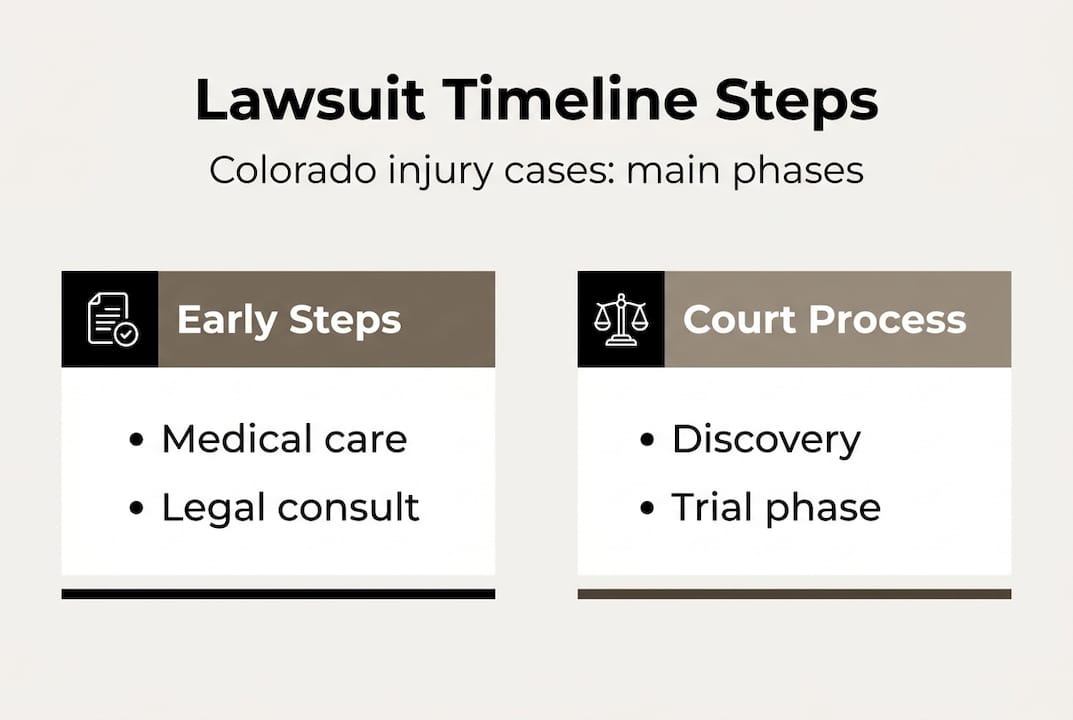
A personal injury trial in Colorado follows a structured process. Going to trial can extend your timeline by several months or longer, depending on court scheduling and case complexity.
Stages of a personal injury trial:
- Jury selection (voir dire): Both attorneys question potential jurors and select a panel
- Opening statements: Each side presents their overview of the case to the jury
- Plaintiff’s case: Your attorney presents evidence, witnesses, and expert testimony
- Defendant’s case: The opposing side presents their evidence and witnesses
- Closing arguments: Both attorneys summarize the evidence and make their final appeal to the jury
- Jury deliberation and verdict: The jury reviews the case privately and delivers a decision
“A trial verdict is not the end of the road. Either party may file post-trial motions or an appeal, which can extend the timeline further.”
If you win, payment does not arrive the next day. After a verdict, the defendant typically has 14 days to file post-trial motions. If no appeal is filed, payment is usually arranged within 30 to 90 days.
| Trial phase | Typical duration |
|---|---|
| Trial preparation | 2 to 6 months |
| Active trial | 3 to 10 days |
| Post-trial motions | Up to 14 days |
| Payment after verdict | 30 to 90 days |
The injury lawsuit trial process is demanding, but having an attorney who has been through it before makes a measurable difference in how you experience it and what you ultimately recover.
What most guides miss about Colorado injury lawsuit timing
Here is something most timeline guides won’t tell you: the numbers above are averages, not promises. Real cases get delayed for reasons that have nothing to do with your attorney’s effort or your case’s strength.
The most common delays we see come from three sources. First, insurance companies that stall on purpose, knowing that financial pressure may push you to accept less. Second, medical records that take weeks or months to arrive from providers. Third, court scheduling backlogs that push trial dates further out than anyone planned.
What actually moves cases forward faster is preparation and persistence. When your attorney has expert insights on timing and files everything correctly the first time, you avoid the rework that causes real delays. When your attorney pushes back hard on insurance stalling tactics, the other side has less room to drag things out.
The uncomfortable truth is this: a passive approach to your own case is the biggest timeline killer. Stay engaged, respond to your attorney quickly, and keep gathering medical documentation throughout treatment. The clients who recover the most, and the fastest, are the ones who treat their case like it matters every single week.
Get expert help with your Colorado injury lawsuit timeline
Navigating a personal injury lawsuit in Colorado is not something you should figure out alone, especially when deadlines are running and insurance companies are already working against you.

At Malnar Injury Law, now at StubbornAttorney.com, we have settled hundreds of injury cases and recovered millions of dollars for people across Colorado. Ryan Malnar is a former federal claims adjuster who knows exactly how insurance companies evaluate and undervalue claims. When you speak with a Colorado injury attorney on our team, you get a personalized review of your timeline, your deadlines, and your best path forward. The consultation is free. The fight is ours.
Frequently asked questions
How long does a personal injury lawsuit take in Colorado?
Most cases take between six months and two years, depending on complexity. The majority of cases settle before ever reaching a courtroom.
What is the statute of limitations for personal injury in Colorado?
You have two years from injury to file most personal injury claims in Colorado. Missing this deadline typically means losing your right to sue entirely.
Can a lawyer speed up my lawsuit?
An experienced lawyer can avoid procedural delays and negotiate a faster settlement, but some timelines depend on court scheduling and how quickly the other parties respond.
What happens if my case goes to trial?
A trial adds several months or more to your total timeline. A verdict must be reached and any post-trial motions resolved before compensation is paid.
What are common reasons for delays in injury lawsuits?
Delays most often come from slow medical record retrieval, insurance company stalling, court scheduling backlogs, and unresponsive parties on the other side of the case.