
Why Colorado personal injury cases take longer than you think
TL;DR:
- Most Colorado personal injury cases take months or even years to resolve due to medical, legal, and court procedures. Prompt documentation, consistent medical treatment, and experienced legal representation can help mitigate delays and strengthen your claim. Patience and strategic timing often lead to better outcomes than rushing for quick settlements or court decisions.
If you’ve been injured in Colorado and filed a claim, you’ve probably already heard some version of “these things take time.” What nobody tells you is just how much time, or why each stage of the process seems to stretch on forever. The reality is that most Colorado personal injury cases do not resolve in a matter of weeks. Many take months, and those that reach litigation can take one to two years or longer. Understanding the stages, the legal requirements, and the factors within your control can make the wait far less stressful and put you in the best possible position when settlement or trial day finally arrives.
Table of Contents
- Understanding the injury case process in Colorado
- Common reasons injury cases take longer than expected
- How Colorado laws and court systems affect case timelines
- What you can do to reduce delays and protect your claim
- Our take: Why patience is vital and what most guides miss
- Get guidance and maximize your Colorado injury claim
- Frequently asked questions
Key Takeaways
| Point | Details |
|---|---|
| Colorado injury cases are slow | Litigation and court deadlines often push timelines to 1-2 years. |
| Documentation is critical | Accurate medical and injury records can help prevent unnecessary delays. |
| Legal process has bottlenecks | Each stage—investigation, negotiation, trial—is a common source of case delays. |
| Patience can pay off | Rushing resolution may lead to less compensation; strategic patience is often beneficial. |
| Expert help makes a difference | Working with a Colorado injury attorney can help manage your timeline and maximize your outcome. |
Understanding the injury case process in Colorado
Building a foundation is the first step, so let’s outline the actual stages your case must pass through before reaching resolution. Most people imagine a personal injury case as a single event: something bad happens, you hire a lawyer, and a check arrives. The reality looks nothing like that. There are multiple sequential stages, and each one has its own timeline that depends on circumstances largely outside your immediate control.
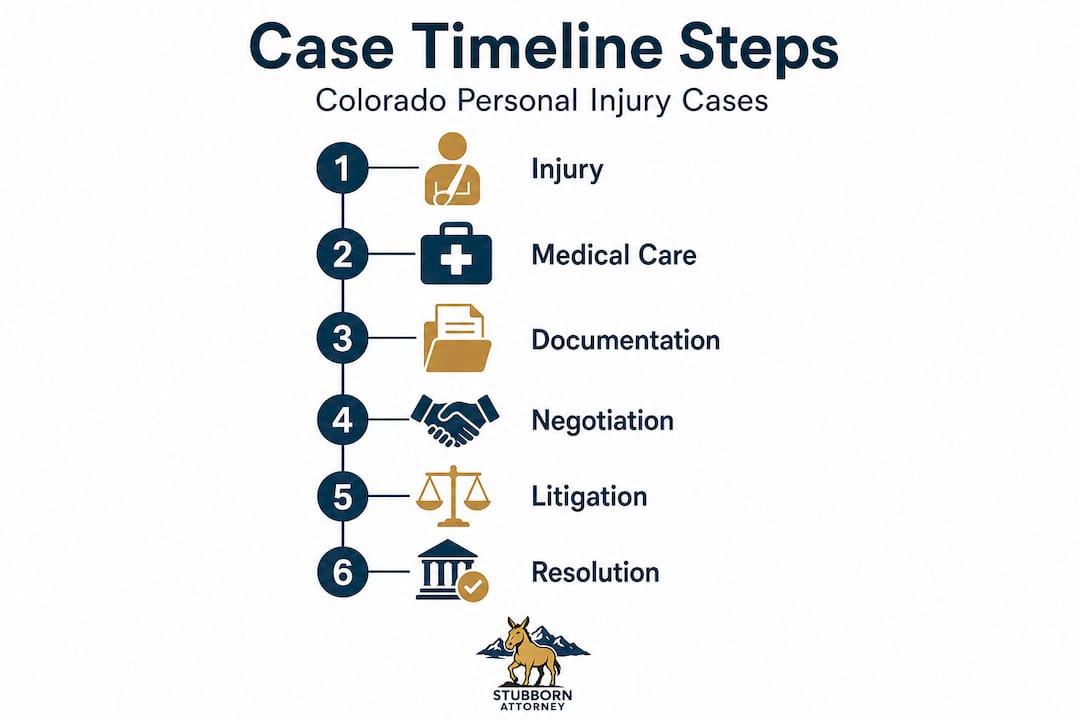
Here is how a typical Colorado personal injury case moves from start to finish:
- Initial injury and medical treatment. Right after an accident, your first job is to get medical care. This stage lasts as long as your treatment does, which could be weeks, months, or even longer for serious injuries. No attorney can accurately calculate your damages until you reach what lawyers call “maximum medical improvement,” meaning your condition has stabilized.
- Investigation and evidence gathering. Your attorney collects police reports, witness statements, photographs, surveillance footage, and any other documentation that supports your claim. This stage can take several weeks to a few months depending on how much evidence exists and how cooperative third parties are.
- Medical records collection. Once treatment wraps up or reaches maximum medical improvement, your attorney requests all your medical records and bills. Providers can take weeks or even months to respond to these requests, which is a common and frustrating source of delay.
- Demand package preparation. Your attorney puts together a detailed demand letter outlining liability, your injuries, your treatment costs, lost income, and pain and suffering. This document takes time to prepare properly because it forms the foundation of your entire negotiation.
- Insurance negotiation. The demand goes to the at-fault party’s insurance company. Insurers typically have 30 to 90 days to respond, and initial offers are almost always too low. Back-and-forth negotiations can extend this phase by months.
- Litigation, if negotiation fails. When a fair settlement cannot be reached, your attorney files a lawsuit. This triggers a whole new timeline governed by court rules, including discovery (the formal exchange of information between parties), depositions, expert witness preparation, and pre-trial motions.
- Trial. If the case does not settle during litigation, it goes to trial. Trials add significant time due to court dockets, lasting days to weeks, with full litigation taking one to two years.
For a deeper understanding of how each stage connects to the next, the injury lawsuit timeline steps guide breaks down the process in plain language. You also need to know your rights after injury in Colorado before the process even begins, because early decisions affect every stage that follows.
Pro Tip: Start documenting your injuries, out-of-pocket expenses, and communications with insurance companies on day one. Even a simple journal noting your pain levels and daily limitations can significantly strengthen your case later. Delayed or incomplete records are one of the most preventable causes of timeline setbacks.
Getting a proper case evaluation guide early on also helps you understand realistic expectations, which makes every subsequent stage easier to navigate emotionally and strategically.
Common reasons injury cases take longer than expected
Once the process steps are understood, the next question is: Why does each step often take so long? Knowing the answer does not make the wait shorter, but it does make it make sense. And in some cases, knowing the causes of delay actually helps you avoid contributing to them unnecessarily.
Here are the most common bottlenecks in Colorado personal injury cases:
- Medical treatment timelines. You cannot settle a claim until you know the full extent of your injuries. Settling too early means you might accept money that does not cover future surgeries, ongoing therapy, or long-term limitations. Waiting for medical stability protects you, even though it feels slow.
- Insurance company tactics. Large insurers have entire departments designed to delay, minimize, and dispute claims. They know that financial pressure on injured people can force quick, low settlements. Recognizing this tactic is the first step toward not falling for it.
- Incomplete documentation. Missing records, slow provider responses, or gaps in your medical history can stall negotiations entirely. Insurers use incomplete records as a reason to question the severity of your injuries.
- Disputes over liability. When the other party refuses to accept fault, or when multiple parties are involved, establishing liability takes longer and often requires expert witnesses and accident reconstruction specialists.
- Court scheduling. Colorado courts have full dockets. Once a case enters litigation, trial dates may be set months or over a year out, and continuances (postponements) are common.
The table below shows a side-by-side comparison of typical timeframes at each stage, and what can cause each phase to stretch out:
| Stage | Typical duration | Common causes of delay |
|---|---|---|
| Medical treatment | 1 to 12+ months | Severity of injury, specialist availability |
| Evidence gathering | 2 to 8 weeks | Third-party cooperation, records requests |
| Demand preparation | 2 to 6 weeks | Complexity of damages, attorney workload |
| Insurance negotiation | 1 to 6 months | Low offers, disputes over liability |
| Litigation and discovery | 6 to 18 months | Court dockets, expert scheduling |
| Trial | Days to weeks (if it occurs) | Court scheduling, jury selection |
The litigation timeline alone can extend a case by one to two years. That is not a worst-case scenario. It is the standard experience for contested cases in Colorado.
Good injury documentation tips can help you avoid delays tied to incomplete records, which is one of the few bottlenecks you have real control over. Understanding case outcomes examples from real Colorado cases also helps set practical expectations for your own situation.
One often-overlooked factor is the role that your own consistency plays. Attending all your medical appointments, following your treatment plan, and keeping your attorney updated creates a clean paper trail that is much harder for an insurer to challenge. Any gap in treatment, even for understandable reasons, becomes a point of dispute.
How Colorado laws and court systems affect case timelines
Beyond just the insurance and medical aspects, local laws and the judicial system add additional complexity and delay. Colorado has specific procedural rules that govern how personal injury cases move through the courts, and those rules have a direct impact on how long your case takes.
“Full litigation can take one to two years due to court dockets in Colorado.” This is not a flaw in the system. It is the result of a court structure designed to ensure fairness, documentation, and due process for every party involved.
Here are the key legal and procedural factors specific to Colorado:
- Statute of limitations. Colorado generally gives injured victims three years from the date of injury to file a lawsuit. Missing this deadline eliminates your right to recover, regardless of how strong your case is. Acting promptly preserves your options.
- Comparative negligence rules. Colorado follows a modified comparative negligence system. If you are found partially at fault, your compensation is reduced by your percentage of fault. If you are more than 50% at fault, you recover nothing. Establishing accurate fault percentages requires time and evidence.
- Expert witness requirements. Colorado courts often require expert testimony to establish the standard of care in medical malpractice cases, or to reconstruct accidents in vehicle crash cases. Scheduling and preparing these experts adds time.
- Discovery rules. Colorado Rules of Civil Procedure govern how both sides exchange information. Written discovery requests, depositions, and document productions all have deadlines, but those deadlines are routinely extended by agreement or court order.
- Mandatory disclosures. Colorado requires both parties to make certain disclosures early in litigation, including witness lists and damage calculations. Meeting these requirements correctly takes preparation.
The table below outlines how specific legal requirements in Colorado affect each phase of the timeline:
| Legal requirement | Phase affected | Time impact |
|---|---|---|
| Statute of limitations (3 years) | Filing deadline | Sets the outer boundary for action |
| Comparative negligence assessment | Negotiation and trial | Adds complexity and may require expert input |
| Expert witness retention | Litigation | Can add 2 to 6 months |
| Mandatory discovery disclosures | Litigation | Structured deadlines, often extended |
| Court docket scheduling | Trial | Dates may be 6 to 18 months out |
Colorado’s court timeline standards reflect a system that moves at its own pace. That pace can feel agonizing when you are the person waiting for compensation you need to pay bills and cover ongoing medical costs.
Using a car accident legal checklist helps ensure you are meeting every procedural requirement without missing a critical step. A clear understanding of the injury compensation workflow in Colorado also removes a lot of the anxiety that comes from not knowing what happens next.
One thing worth emphasizing: the Colorado court system does not move faster just because your financial situation is urgent. Insurance companies know this. They use the pressure of time against injured victims who cannot afford to wait. Having an attorney who understands this dynamic and plans around it is enormously valuable.
What you can do to reduce delays and protect your claim
Knowing the sources of delay, how can you actively influence your case timeline for the better? The honest answer is that you cannot control a court’s docket or an insurer’s response time. But there is a meaningful set of actions within your control that can prevent avoidable delays and strengthen your position throughout the process.
Here is a practical list of steps that make a real difference:
- Seek medical care immediately and consistently. The single most important thing you can do after an injury is get treated and stick with your treatment plan. Gaps in care give insurers grounds to argue your injuries were not serious or were caused by something other than the accident.
- Keep detailed records from day one. Save every bill, receipt, prescription, and communication related to your injury and recovery. Photograph your injuries and any property damage. A well-documented case moves through negotiation faster because there is less to dispute.
- Respond to your attorney promptly. When your lawyer needs a signature, additional information, or a response to an insurer’s request, delays on your end slow the whole case. Treat your attorney’s requests with the same urgency you want them to treat yours.
- Avoid social media posts about your accident or injuries. Insurance defense teams actively monitor social media. A single post that contradicts your claimed limitations can derail months of work and give the other side ammunition.
- Follow your attorney’s advice on settlement offers. Early settlement offers are almost always low. Your attorney knows the full value of your case and will tell you when an offer is fair. Trusting that judgment protects your long-term compensation.
- Gather and preserve all evidence early. Witness memories fade, security footage gets deleted, and physical evidence can disappear. The faster you preserve evidence after an accident, the stronger your case foundation.
- Choose an attorney with real Colorado experience. Colorado-specific procedural knowledge matters. An attorney who knows local court schedules, local judges, and how specific insurers operate in Colorado is not starting from scratch every time.
The qualities of top injury lawyers in Colorado include exactly this kind of localized, practical experience. Understanding the car accident claim types common in Colorado also helps your attorney pursue the right legal theory from the start, which prevents mid-case pivots that cost time.
Pro Tip: Choose an attorney who has direct experience dealing with Colorado courts and Colorado-based insurance adjusters. Someone who knows how a specific insurer behaves during negotiations can often resolve a case faster and for more money than someone learning the landscape for the first time.
The litigation timeline for Colorado cases is partly fixed by the court system, but your behavior and preparation throughout the process can meaningfully reduce the delays that are within your control. Do not hand the other side any avoidable advantages.
Our take: Why patience is vital and what most guides miss
After examining what you can do, it is important to understand the big picture: why waiting can actually work in your favor. Most articles on injury case timelines focus on what causes delays and how to speed things up. That is useful advice, but it misses something important. Sometimes the longer timeline is the right timeline.
Here is the uncomfortable truth that most legal content glosses over: a rushed settlement is almost always a bad settlement. Insurance companies know that injured people face financial pressure. They make early, lowball offers precisely because they understand that some people will accept them out of desperation. Every settlement you accept closes the door permanently. You cannot go back and request more money once you have signed a release.
“A case’s pace should match its complexity, not just your frustration.”
We have seen this play out more times than we can count. A client accepts a quick offer of $18,000 and signs away their rights. Six months later, they need surgery that would have been covered had they waited for a proper evaluation. That money is gone. The rights to recover more are gone. And the insurance company moves on to the next claim.
Strategic timing, meaning waiting until you have reached maximum medical improvement and your attorney has fully documented your damages, consistently produces better outcomes. The strongest negotiating position comes when your file is complete, your prognosis is clear, and the other side knows you are prepared to go to trial if necessary.
That last point matters. Insurance companies settle more generously when they believe an attorney will actually take a case to trial. A lawyer who caves at the first sign of resistance is worth far less than one who holds the line. The willingness to be persistent, to wait out the process, and to push back when an offer is unfair is exactly what separates adequate representation from excellent representation.
For anyone wondering whether the fight is worth it, the answer is almost always yes. Reviewing the reasons for pursuing injury claims in Colorado helps injured victims understand what they stand to gain by staying the course rather than taking the quick exit.
Pro Tip: Focus on maximizing your outcome, not minimizing the duration of your case. The extra months you spend waiting for the right settlement often translate into tens of thousands of additional dollars in your pocket. Patience, combined with relentless preparation, is a strategy, not just a virtue.
Get guidance and maximize your Colorado injury claim
For those seeking next steps, here is how to get expert help and deepen your understanding of your specific situation. Knowing the theory behind injury case timelines is one thing. Applying that knowledge to your specific claim, your injuries, and your circumstances is another challenge entirely.
At Malnar Injury Law, known now through our new brand home at StubbornAttorney.com, we have settled hundreds of injury cases and recovered millions of dollars for Colorado injury victims. Attorney Ryan Malnar’s background as a former federal claims adjuster means he knows exactly how insurance companies evaluate claims from the inside out. That insight changes how we build cases, how we negotiate, and how we position your file for the best possible outcome.
If you want to evaluate your claim potential and understand what your case may actually be worth, that is the right first step. If you have been in an accident and need to know how to protect your legal rights from day one, we have resources built specifically for Colorado injury victims. We represent only injured people. That focus is not a marketing line. It shapes every decision we make on your behalf.
Frequently asked questions
What is the average duration of a Colorado personal injury case?
Most Colorado cases last from several months up to one to two years, especially when litigation is involved, with simpler cases that settle early resolving faster.
Why does medical treatment impact my injury case timeline?
Your claim cannot fully resolve until your medical treatment stabilizes, because that is the only way to calculate the true total of your damages, including future care needs.
Can I speed up the process of my personal injury case?
You can reduce avoidable delays by acting quickly, maintaining detailed records, and choosing an experienced Colorado attorney, but court schedules and insurer response times still apply on their own timelines.
What happens if my case goes to trial?
Trials add significant time due to court dockets in Colorado, and full litigation can extend your case timeline by one to two years beyond what a negotiated settlement would take.
Are all injury cases in Colorado subject to these timelines?
While individual timelines vary based on injury severity, liability complexity, and insurer behavior, most Colorado personal injury cases follow similar procedural patterns due to court rules and legal requirements that apply statewide.