

Colorado Open and Obvious: What the Law Says Today
If you were hurt on someone else’s property in Colorado and the owner says the hazard was “open and obvious,” that argument does not end your claim. Since 2004, Colorado courts have held that the common-law open-and-obvious doctrine cannot be used by a landowner as a defense under the state’s premises liability statute. Your case turns on other questions: what kind of visitor you were, what the owner knew or should have known, and whether you share some of the fault. Our team at Malnar Injury Law, now StubbornAttorney.com, represents injured people across Colorado, including Colorado Springs, and this is how we explain the rule to them.
Table of Contents
- What “open and obvious” used to mean
- Vigil v. Franklin: the rule that governs now
- What the statute asks instead
- Defenses that do still apply
- A worked example
- How a recent federal case turned out
- What to do after a fall or injury on someone’s property
- Talk to a Colorado injury team about your case
- FAQ
- Sources
What “open and obvious” used to mean
The phrase comes from old common law, the body of rules judges built case by case before legislatures wrote statutes. The idea was simple: if a danger is plain to anyone paying attention, the property owner has no duty to warn about it. A puddle in daylight, a visible step down, a bright orange cone. The visitor was expected to see it and avoid it.
Colorado courts applied that idea for decades. Before 1971, an owner’s liability depended on the visitor’s status as an invitee (invited for the owner’s benefit, such as a customer), a licensee (permitted to be there, such as a social guest) or a trespasser. In Mile High Fence Co. v. Radovich (1971), the state’s high court moved to general negligence principles for everyone hurt on the property, and the open-and-obvious doctrine continued to operate under both systems, as the Court of Appeals’ discussion of the history in Vigil v. Franklin explains.
Even then, the doctrine was not absolute. Courts recognized that a danger could be obvious and still unreasonably dangerous, for instance when a visitor’s attention was likely to be distracted, or when the only reasonable way forward was to face the hazard. That history matters because it shows the doctrine was already a weak tool for owners when the legislature’s statute displaced it.
Vigil v. Franklin: the rule that governs now
In 2004, the Colorado Supreme Court decided Vigil v. Franklin, 103 P.3d 322. It held that the common-law open-and-obvious danger doctrine does not survive the enactment of Colorado’s premises liability statute, C.R.S. § 13-21-115. The reasoning is that the statute’s language is clear and sets out landowner duties exclusively, which means the legislature meant to displace the common-law duties and the common-law defenses to those duties. You can read the Colorado Supreme Court’s opinion on the Judicial Branch website.
The court system’s own model jury instructions say the same thing. Chapter 12 of the Colorado Judicial Council’s model civil instructions states that the doctrine does not apply in actions governed by § 13-21-115, citing Vigil. The annotation to the statute likewise says a landowner cannot assert open-and-obvious danger as a defense to a premises liability lawsuit.
What this means for you in plain terms: the fact that a hazard could be seen does not, by itself, give the owner a free pass. The owner still has to answer the statutory questions below.
What this rule does not mean
It does not mean every fall is the owner’s fault. You still have to prove your case. It also does not mean the visibility of a hazard is irrelevant to everything. It simply moves the conversation away from a no-duty defense and into the statute’s tests and into the shared-fault defenses discussed later.
The rule also applies to premises cases, meaning injuries caused by a condition on land or in a building. A rear-end collision on I-25 or a crash on Academy Boulevard is governed by traffic and negligence rules instead. If that is your situation, our guide to car accident liability factors is the better starting point.
What the statute asks instead
Section 13-21-115 sorts visitors into three categories, and the court, not the jury, decides which category you fall into under the statutory definitions. The jury then decides liability and damages. The duty the owner owes depends on your category, as set out in the statute.
| Your status | Typical example | What you must show about the owner |
|---|---|---|
| Invitee | A customer in a store, a patient visiting a clinic | The owner unreasonably failed to use reasonable care to protect against a danger the owner actually knew about or should have known about |
| Licensee | A social guest, someone on the property with permission but not for the owner’s business benefit | The owner unreasonably failed to use reasonable care about a danger the owner created and actually knew about, or failed to warn about a danger the owner actually knew about that is not ordinarily present on property of that type |
| Trespasser | Someone on the land without permission | A much narrower duty applies under the statute |
The invitee standard is the broadest, and that matches the general rule that a landowner owes the greatest duty to an invitee, a lesser duty to a licensee and the least to a trespasser, as a 2026 federal court order put it.
The elements a jury is told to look for
Colorado’s model instructions tell the jury that a plaintiff must prove, by a preponderance of the evidence (more likely than not), that they suffered injuries, damages or losses, and that the landowner fell short of the duty owed to their category. For an invitee, that is a failure to use reasonable care to protect against a danger the owner knew or should have known about. The model instructions set this out step by step.
In Lombard v. Colorado Outdoor Education Center (2008), the Supreme Court added that the statute replaces other negligence theories, such as negligence per se. A claim against a landowner goes through the statute, and for invitees it requires that the owner knew or should have known of the danger and unreasonably failed to protect the plaintiff from it.
Knowledge of the danger, not of the condition
One distinction trips up many people. A federal court in Colorado, applying earlier state appellate language, said it is not the owner’s knowledge of a condition that creates liability, but the owner’s knowledge, actual or constructive, of the danger. A wet floor can be known to exist and still not be known as a danger. The same federal order is a useful read on how courts frame that question.
Defenses that do still apply
Losing the open-and-obvious defense does not leave a landowner without arguments. Three shared-fault defenses remain available. The legislature amended the statute effective April 5, 2006, to say that assumption of risk, pro rata liability and comparative negligence apply in premises liability actions. The Colorado Supreme Court held in Union Pacific Railroad Co. v. Martin (2009) that these defenses were available even before that amendment, according to the model jury instructions’ notes.
The distinction courts draw is useful. Open and obvious was a way to argue the owner had no duty at all. Comparative negligence and pro rata liability instead apportion damages: they ask how much fault belongs to each person. The Court of Appeals read Vigil as limited to duty and said these defenses apportion damages rather than negate duty.
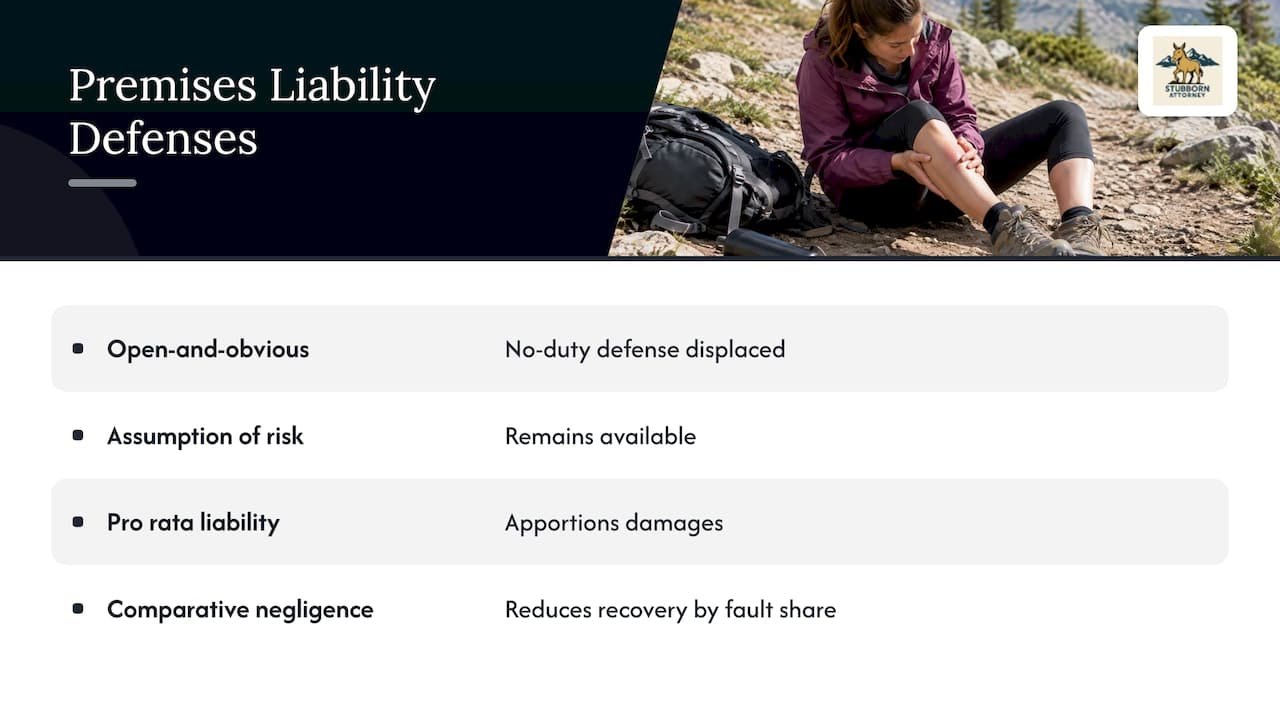
This is where the visibility of a hazard can reappear. An owner may not say “it was obvious, so we owed you nothing,” but may say “it was obvious, so you share some of the blame.” Under Colorado’s comparative negligence rules, a plaintiff’s recovery is reduced by their percentage of fault, and the 50% threshold matters a great deal. Our guide to the 50% rule and special verdicts walks through how that works.
Children and teenagers
The statute says the comparative negligence provisions must not be read to abrogate the attractive nuisance doctrine for children under fourteen, and a person aged fourteen to under eighteen is presumed competent for purposes of the section, per C.R.S. § 13-21-115(3). If your child was hurt, say, at a trampoline park or a vacant property, the analysis differs from an adult’s. See our page on trampoline park injuries.
Waivers and releases
Many Colorado businesses ask visitors to sign releases. A 2016 Court of Appeals decision found that a release focused on the inherent risks of strenuous exercise did not clearly bar a claim for a fall while washing hands in a gym locker room, which shows that courts read such waivers narrowly, as summarized here. Waiver law has kept moving, and we track it in our article on recent Colorado liability waiver rulings.
A worked example
This is an illustration, not a real case. Suppose you shop at a Colorado Springs grocery store on a Saturday. A stocking cart sits partly in an aisle with its wheels turned out. You are reading a label, catch your foot on it and fall, breaking your wrist.
You are an invitee. The store cannot argue that the cart was open and obvious and so owed you nothing. The questions become:
- Did the store know, or should it have known, that the cart’s placement was a danger? Evidence such as how long it sat there, staff walking past it, and store policies on aisle stocking bears on this.
- Did the store fail to use reasonable care to protect you from that danger?
- Does the store claim you share the blame because you were looking at a shelf? If a jury assigns you a percentage of fault, your damages shrink by that percentage.
That third question is where most real disputes land, and it is why the facts you preserve in the first days matter so much.
How a recent federal case turned out
The statute does not guarantee a win just because the open-and-obvious defense is gone. In Velasquez v. King Soopers, decided April 7, 2026 in the District of Colorado, the court reaffirmed that the defense is abrogated and then looked at the statutory elements. It granted summary judgment to the store, finding that no reasonable jury could conclude that the stocking cart’s placement was a danger the store knew or should have known about, and that the plaintiff had not shown a departure from reasonable care. You can read the court’s order in full.
The lesson is practical. Cases are won or lost on proof of what the owner knew or should have known, not on whether you could have seen the hazard. That proof has to be gathered early.
What to do after a fall or injury on someone’s property
Get medical care first. Then protect the evidence that answers the statutory questions.
- Photograph the hazard and the surroundings from several angles, with something for scale, before it is cleaned up or repaired. Include lighting, signage and floor surface.
- Report the incident in writing to the owner or manager, and ask for a copy of any incident report. Note the date, time and the name of the person you spoke to.
- Identify witnesses and keep their names and numbers. Employees who saw the hazard before you fell matter, because they speak to what the owner knew.
- Keep the shoes and clothing you wore, unwashed.
- Do not give a recorded statement to the owner’s insurer before you have talked to a lawyer. Insurers evaluate fault percentages, and casual remarks like “I should have been watching” can be used to argue shared fault.
- Keep every medical record and bill and a short daily note on pain and missed work.
Owners and property managers use timestamped records of their own, and digital inspection records with timestamped photos are a good example of the kind of documentation that can show a property’s condition on a given day. Asking for such records early can be part of establishing what an owner knew.
If the injury came from a violent act that better security could have prevented, a different branch of the law applies, covered in our article on negligent security in Colorado. For a broader view of falls, see our slip and fall victim’s guide and our overview of Colorado premises liability claims.
Our perspective
When an owner’s insurer says your hazard was open and obvious, they are usually using a phrase that Colorado’s high court retired for statutory premises cases in 2004. The real fight is over what the owner knew, what a reasonable owner would have done, and how much fault gets assigned to you.
I spent time as a claims adjudicator for the federal government before practicing as an attorney, and I know how large insurers and agencies evaluate a claim: they look for any percentage of fault they can move onto the injured person. That is why we build the owner’s knowledge side of the case first and treat the shared-fault argument as something to be answered with facts, not conceded.
We represent only injured people. Our cases are handled directly by attorneys, and we work on a contingency basis, which means you pay nothing unless there is a monetary recovery. The mule on our brand is about not letting go, and in a premises case that means staying with the evidence until the owner’s side has to answer for it.
Ryan
Talk to a Colorado injury team about your case
If you were hurt on a property in Colorado Springs or elsewhere in the state, our team can look at who owed you what duty and what the owner knew. We handle personal injury, slip and fall and car accident claims, and you owe us nothing unless we recover money for you. See our personal injury services or reach us through StubbornAttorney.com.
FAQ
Does Colorado still recognize the open and obvious doctrine?
Not as a defense in cases governed by the premises liability statute. In Vigil v. Franklin (2004), the Colorado Supreme Court held that the common-law doctrine does not survive § 13-21-115. Owners can still argue that you share the fault for your injury.
If the hazard was obvious, can I still recover damages?
Yes, depending on the facts. The owner’s duty is measured by your status as an invitee, licensee or trespasser and by what the owner knew or should have known. If a jury finds you partly at fault, your recovery is reduced by your share.
Who decides whether I was an invitee or a licensee?
The judge decides your status under the statutory definitions. The jury then decides liability and damages. Your status matters because it sets the level of care the owner owed you.
Does this apply to a car accident in Colorado Springs?
No. The premises liability statute covers injuries from conditions on land and in buildings. Car crashes are decided under general negligence and traffic rules, and our attorneys handle both kinds of claims.
Does signing a waiver end my claim?
Not automatically. Colorado courts read releases narrowly and look at whether the language clearly covers the kind of injury and claim involved. Bring a copy of anything you signed to your consultation.
Sources
- Vigil v. Franklin, Colorado Supreme Court opinion No. 03SC479
- Colorado Judicial Council model civil jury instructions, Chapter 12 (2026)
- C.R.S. § 13-21-115 (2025) with annotations
- Vigil v. Franklin, Colorado Court of Appeals (2003)
- Lombard v. Colorado Outdoor Education Center, advance sheet headnote (2008)
- Martin v. Union Pacific Railroad Co., Colorado Court of Appeals (2007)
- Velasquez v. King Soopers, D. Colo. order (April 7, 2026)
- Colorado Court of Appeals 2016 locker room release decision
- Digital inspection records with timestamped photos