

Colorado Loss of Consortium After a Car Accident
If your husband or wife was hurt in a Colorado car crash and your marriage has changed because of it, you may have a legal claim of your own. It is called loss of consortium. It is separate from your spouse’s injury claim, it has its own proof requirements, and it can be damaged by a settlement signed without it in mind. That is why it should be handled together with the injury case by one lawyer who knows how insurers value both. At Malnar Injury Law, now StubbornAttorney.com, we represent injured Colorado families on a contingency basis, so you owe no fee unless we recover money in the case.
This guide explains the claim in plain terms for spouses in Colorado Springs, Denver and across the state: who can bring it, what you have to prove, how long you have, what the damages limit does, and the mistakes that cost families this part of their recovery.
Table of Contents
- What loss of consortium means in a car accident case
- Who can bring a claim in Colorado
- What you must prove
- What evidence shows the marriage was affected
- What damages are available
- The damages limit that applies to consortium
- Deadlines: do not assume your spouse’s clock is yours
- Settlements: how your spouse’s deal can affect your claim
- A worked example
- Why spouses do better with the injury case and consortium claim in one place
- Perspective: why this claim deserves a stubborn advocate
- Talk to us about your family’s claim
- FAQ
- Sources
What loss of consortium means in a car accident case
“Consortium” is the legal word for the benefits of a marriage that go beyond money: affection, companionship, comfort, help around the house, and the everyday partnership two people share. When a crash leaves one spouse in chronic pain, with a brain injury, or unable to do what they used to do, the other spouse loses part of that relationship. Colorado law treats that loss as a real injury.
The official Colorado civil jury instructions describe what a jury is asked to consider: changes or loss in affection, society, companionship, aid and comfort, and household services, plus resulting expenses already incurred or expected in the future. In practice that can look like a husband who can no longer lift his wife, a wife who is now your full-time caregiver instead of your partner, or a spouse whose personality changed after a head injury.
Colorado courts have long treated this as a recognized injury. The Colorado Court of Appeals described loss of consortium as a recognized personal injury in Colorado in Sparks v. American Fire & Indemnity Co. (1989).
Who can bring a claim in Colorado
Married spouses
The rule comes from a statute. Under Colorado Revised Statutes § 14-2-209, in tort actions by a married person, both spouses have an equal right to recover for loss of consortium of the other spouse. The 2024 text of the statute records the provision as amended effective August 8, 2018. A tort action is a lawsuit over a wrong that caused harm, and a car crash caused by a negligent driver is a classic example.
In other words, it does not matter whether the husband or the wife was the one hurt. Either spouse can bring the claim.
Parents and children
This is where many families get surprised. In Elgin v. Bartlett (1999), the Colorado Supreme Court held that Colorado does not recognize a parent’s claim for loss of consortium resulting from an injury to a child. If your child was hurt in a crash, the child’s own injury claim and your claims for medical bills and similar losses are the focus, not a consortium claim for your own sadness or changed relationship.
If your loved one died in the crash, a different set of rules applies. Our guide to wrongful death versus survival actions in Colorado covers that situation.
Unmarried partners
The statute and the jury instruction both speak in terms of marriage. If you are not married to the injured person, talk to an attorney about what other claims may be available before assuming anything.
What you must prove
A loss of consortium claim is not automatic. Colorado’s official jury instruction 6:5 tells a jury that the claimant must prove, by a preponderance of the evidence (more likely than not), four things:
- The at-fault driver was negligent.
- Your spouse was injured as a result.
- You and your spouse were married when the injury occurred.
- The injury caused you a loss of consortium.
These elements are set out in the Colorado Judicial Branch’s civil jury instructions, Chapter 6. Notice what that means. Your claim rises or falls first on the same question as your spouse’s claim: who caused the crash. The Colorado Court of Appeals explained in Draper v. DeFrenchi-Gordineer (2011) that the claim is derivative but also a separate cause of action. It depends on the injured person’s right to recover and is subject to defenses that apply to that underlying claim. If the other driver can argue your spouse was partly at fault, that argument can reach your claim too.
If you want to understand how fault is argued, our articles on car accident liability factors and fault in multi-car accidents walk through it.
A note on the old no-fault threshold
Older Colorado decisions you may find online were decided under a former no-fault auto insurance system. In Welch v. George (2000), the Colorado Supreme Court held that under the then-applicable No-Fault Act, an auto accident consortium claim was actionable only if the injured spouse’s injuries met the act’s statutory threshold. Read that case as history rather than a current checklist, and have an attorney confirm which rules apply to a crash today.
What evidence shows the marriage was affected
The jury instruction does not hand you a fixed evidence checklist. It identifies the losses the evidence should substantiate and expects testimony and records to connect those changes to the injury and give the jury a way to judge how big they are. That puts the work on how well the story is built.
Strong consortium evidence usually has three layers:
- Before and after. Specific, ordinary details of the marriage before the crash: who cooked, who drove the kids, how you spent weekends, trips and routines. Then what stopped or changed.
- Medical connection. Treatment records, restrictions from your spouse’s doctors, and notes on pain, mobility, sleep or cognitive changes that explain why the changes happened.
- Outside witnesses. Family, friends, neighbors or coworkers who saw the marriage before and after and can describe it in concrete terms, not general sympathy.
The weak version of a consortium claim is a single sentence that things are harder now. The strong version names the changes and ties each to a medical fact. Keep a short dated journal from the first weeks after the crash. Memory fades, and details that feel unforgettable now are hard to recreate two years later in front of a jury.
What damages are available
The jury instructions separate two kinds of loss.
Noneconomic damages cover the intangible side: the loss of affection, companionship, society, and aid and comfort described above.
Economic damages cover measurable costs. Instruction 6:6 allows lost household services the injured spouse would have provided and resulting expenses, already incurred or expected in the future, where the evidence lets the jury determine their existence and amount. If your spouse used to handle the yard, the cars, the cooking or the childcare and you now pay for it or do it yourself, those costs matter. Our article on household services damages in a Colorado car accident claim shows how those losses are documented.
A different category, lost income, belongs to the injured spouse’s own claim. See how that works in our guide to a Colorado lost wages claim after a car accident.
The damages limit that applies to consortium
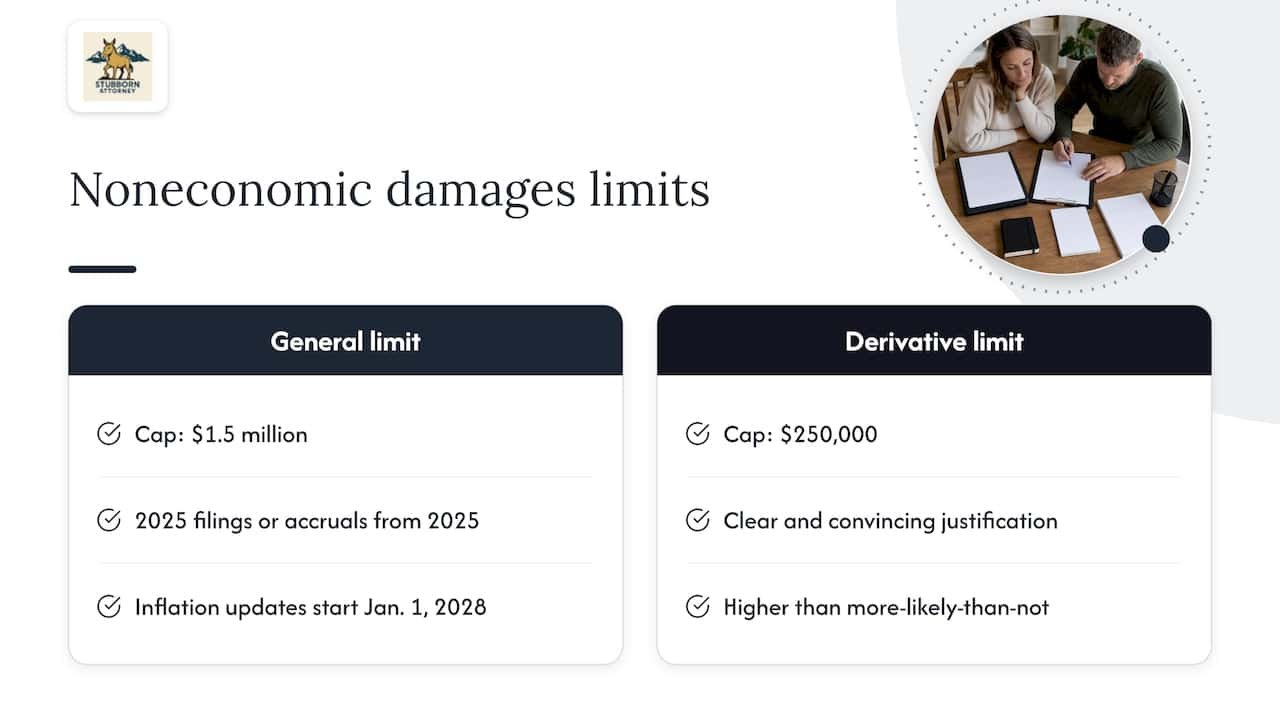
Colorado limits noneconomic damages, and the limit reaches derivative claims like yours. Under HB 24-1472, the general noneconomic damages limit rose to $1.5 million for qualifying civil actions filed from January 1, 2025, to before January 1, 2026, or claims accruing on or after that date, subject to statutory exclusions and categories. Inflation adjustments to the $1.5 million figure begin January 1, 2028, and occur every two years after that.
For a spouse, the number that matters most is the derivative limit. The same act provides that derivative noneconomic damages require clear and convincing justification and are capped at $250,000. The jury instructions reflect this: derivative noneconomic damages additionally require the court to find justification by clear and convincing evidence under section 13-21-102.5(3)(b). Clear and convincing is a higher bar than the ordinary “more likely than not” standard. It means the evidence must be highly persuasive.
Two practical lessons follow. First, the vague claim is the one at risk, because it is the one that struggles to meet a higher standard. Second, which cap applies can turn on when the claim accrued and when the case was filed, so the dates in your case matter. Our articles on how the 2026 caps reshape pain and suffering claims and the accrual date trap behind the $1.5 million cap explain the timing in more depth.
Deadlines: do not assume your spouse’s clock is yours
Colorado sets different limitation periods for different claims. A legislative memorandum on Colorado’s limitation statutes lists three years for motor-vehicle-related bodily injury or property damage and two years for tort actions generally. In Draper, the court of appeals stated that a three-year limitation applies to tort actions for bodily injury or property damage arising from use or operation of a motor vehicle.
The same decision makes a point that catches families off guard. Because consortium is a separate derivative claim, it need not be pursued together with the injured spouse’s claim, and tolling (a legal pause) of the injured spouse’s deadline does not automatically toll yours. Your clock can run out on its own schedule.
Which period fits your crash depends on the facts, and deadlines can differ when a government vehicle or another special defendant is involved. Do not wait to find out. Our guide to key deadlines for Colorado injury claims lays out the timelines, and an attorney should confirm the date that governs your case.
Settlements: how your spouse’s deal can affect your claim
Insurers often settle with the injured spouse first. Whether that ends your claim depends on what the paperwork says. In Draper, the court held that an injured spouse’s settlement does not necessarily extinguish the other spouse’s separate derivative consortium claim. The terms matter: whether the settlement resolved the underlying claim on its merits, and whether it released the spouse’s own right to recover.
An earlier case points the same direction. In Crouch v. West (1970), the Colorado Court of Appeals held that a wife’s consortium claim was a separate right and could continue after the injured husband’s claim was settled where the settlement was confined to his claim.
That is helpful law, but it is not a reason to sign quickly. Release language written by an insurer’s lawyer can be broad. Before your spouse signs anything, have a lawyer read the release and confirm in writing how your own claim is treated. Also keep in mind the policy limits: when a crash caused serious harm, the at-fault driver’s insurance may not be enough to cover your spouse’s claim, your claim and the medical bills at the same time. Coordinating them is better than discovering the shortfall after one has been paid.
A worked example
Imagine a Colorado Springs couple. A driver runs a red light on Academy Boulevard and hits the husband’s truck. He suffers a back injury and a concussion. Months later he cannot lift, sleeps poorly, and has headaches and mood swings. His wife now drives him to appointments, takes over the yard and the heavy chores, and says the marriage feels different.
Her claim would rest on several pieces:
- Proof that the other driver was negligent (the police report and witness statements).
- Medical records linking his restrictions and symptoms to the crash.
- Her testimony and that of friends or family about what their life was like before, and what changed.
- Records of services she now covers or pays for, which support the household services claim.
- Evidence strong enough to meet the clear and convincing standard for the noneconomic part.
Each item is ordinary. What makes the claim succeed is that someone gathers them early, in a form a jury or adjuster can follow. This example is illustrative, not a prediction of any result.
Why spouses do better with the injury case and consortium claim in one place
The pieces of this claim depend on each other. Fault, medical proof, the deadline, the damages limit and the settlement release all have to line up. Handling them separately, or handling your spouse’s claim alone and your own later, is how the consortium claim gets lost or reduced.
Insurance companies also know the playbook. They value consortium claims, look for gaps in the story and use the higher proof standard on the noneconomic portion. Our lead attorney, Ryan Malnar, was a claims adjudicator and adjuster for the federal government before practicing law for over a decade, so he knows how large insurance companies and government agencies evaluate a claim. We represent only injured victims.
Perspective: why this claim deserves a stubborn advocate
Families usually call us about the medical bills and the car. The part they mention last, and often apologize for mentioning, is what the crash did to the marriage. It should not be last. It is a real injury, and Colorado law gives the other spouse an equal right to recover for it.
The reason we built our practice around persistence is that this claim is easy to under-prove. It has its own deadline, a higher standard for the noneconomic part, and a settlement release that can quietly cause trouble if no one reads it closely. We settled hundreds of injury cases and recovered millions of dollars for people in your position, and we handle cases through attorneys, not as a case mill.
Our view is simple: when you hire us, we do not let go. We look at your spouse’s claim and yours together, build the before-and-after story with the medical record behind it, and push the insurer to value the whole loss, not just the invoices.
Ryan
Talk to us about your family’s claim
We represent victims of car, motorcycle, semi-truck, bicycle and pedestrian accidents, as well as slip and fall, wrongful death and other injury cases, across Colorado. Our work is on a contingency fee basis, so there is no payment from you unless we recover money in your case. If you are in the Springs, you can start with our Colorado Springs personal injury page and request a free case review. You can also see the full list of accident types we handle, or read what Colorado auto accident victims must know before they speak with an insurance adjuster.
FAQ
Can I file a loss of consortium claim if my spouse was hurt in a Colorado car accident?
Yes, if you were married when the injury happened. Colorado law gives both spouses an equal right to recover for loss of consortium in tort actions. You must still prove the other driver was negligent, that your spouse was injured as a result, and that the injury caused you a loss of consortium.
How long do I have to file?
Colorado applies a three-year limitation period to bodily injury actions arising from the use of a motor vehicle, and two years to many other tort actions. Your spouse’s deadline extension does not automatically extend yours. Have an attorney confirm the exact date for your case as early as possible.
Is there a cap on loss of consortium damages in Colorado?
Derivative noneconomic damages, which include consortium, require clear and convincing justification and are capped at $250,000 under HB 24-1472. Lost household services and related expenses are economic damages, which the jury can award where the evidence shows their existence and amount.
Can I still bring my claim if my spouse already settled?
Possibly. Colorado courts have held that a spouse’s settlement does not necessarily end the other spouse’s separate claim, but it depends on what the settlement and release actually say. Have a lawyer review any release before it is signed.
Can a parent claim loss of consortium when a child is hurt in a crash?
No. The Colorado Supreme Court held in Elgin v. Bartlett that Colorado does not recognize a parent’s loss of consortium claim for injury to a child. The child’s own injury claim and related losses are the focus in that situation.
Sources
- Colorado Revised Statutes § 14-2-209 (2024)
- Colorado Judicial Branch, Civil Jury Instructions, Chapter 6 (2026)
- Elgin v. Bartlett, Colorado Supreme Court (1999)
- Draper v. DeFrenchi-Gordineer, Colorado Court of Appeals (2011)
- Sparks v. American Fire & Indemnity Co., Colorado Court of Appeals (1989)
- Welch v. George, Colorado Supreme Court (2000)
- Crouch v. West, Colorado Court of Appeals (1970)
- HB 24-1472, Colorado General Assembly session law (2024)
- Colorado legislative memorandum on statutes of repose and limitations (2020)