

Truck Accident Black Box: What It Records and Why It Matters
After a serious truck crash in Colorado, one of the most objective pieces of evidence may be a small electronic recorder inside the truck. It can show how fast the truck was going and whether the driver braked in the seconds before impact. That data can be overwritten or lost, so the first days after the crash matter. If you were hurt, the practical step is to bring in an attorney who knows trucking evidence before the truck goes back on the road. At Malnar Injury Law, now StubbornAttorney.com, we represent injured people on a contingency fee, which means you pay nothing unless there is a monetary recovery in your case.
This guide explains what a truck black box is, what it can and cannot tell anyone, how the data gets lost, and what you can do to protect your claim.
Table of Contents
- What people mean by a truck’s black box
- What the data can show about your crash
- Why a black box download is not the whole answer
- How black box data gets lost
- ELD files and the black box: two kinds of proof
- What to do after a truck crash to protect the data
- Why a specialist handles this better than you can alone
- What recent federal changes mean for you
- Our perspective
- Talk to us about your truck crash
- FAQ
- Sources
What people mean by a truck’s black box
“Black box” is a nickname, and it covers more than one device. In an airplane, it is a single sealed recorder. In a truck, the term usually stands for the data stored by the vehicle’s electronics. There are three things you will hear about.
The event data recorder (EDR). The National Highway Traffic Safety Administration (NHTSA), the federal agency that sets vehicle safety standards, defines an EDR as a device that records technical vehicle and occupant information for a brief period, seconds rather than minutes, before, during and after a crash. NHTSA also separates it from audio or video recording and from hours-of-service logging. An EDR does not record conversations and does not film the road.
The engine control module (ECM). On heavy trucks, the recording function is often built into the computer that runs the engine. Transport Canada’s 2024 guidance on heavy-vehicle recorders notes that commercial recorder functions are often embedded in an electronic control unit whose main jobs include engine, emissions, diagnostics and operational control. That is why trucking lawyers often say “ECM” and “black box” in the same breath. The guidance comes from Canada, but the engineering it describes applies to the same kinds of heavy trucks that run Colorado highways.
The electronic logging device (ELD). This is a separate device. It records driver hours, not crash physics. It matters in a truck case for a different reason: it can show whether a driver was over the legal limit on hours. We cover that below.
Knowing which device someone is talking about matters. A letter demanding “the black box” without naming the ECM, the ELD and any other onboard systems can leave gaps.
What the data can show about your crash
NHTSA says EDR information can include pre-crash vehicle dynamics and system status, driver inputs, the crash signature, restraint and airbag status, and post-crash events such as automatic collision notification. For a truck, the useful questions are simple ones:
- How fast was the truck moving before impact?
- Did the driver brake, and when?
- Was the throttle pressed or released?
- Was cruise control on?
- Did the driver steer to avoid the collision?
Transport Canada’s 2024 guidance lists possible heavy-truck fields including road speed, throttle position, engine RPM, brake and clutch status, cruise control, steering input and retarder use. It adds that what is available depends on the vehicle’s model year and engine maker. A newer truck from one manufacturer may record a lot, and an older one may record much less.
For light vehicles equipped with an EDR, federal rule 49 CFR 563.7 sets out the data elements that must be recorded, including speed, throttle, service-brake status, belt status and airbag information. That rule covers passenger vehicles. If a car that hit, or was hit by, a truck has its own EDR, its data can be a second source to compare against the truck’s.
A worked example
Imagine a crash on I-25 near Colorado Springs. The truck driver tells the officer he was going about 35 mph and braked hard when traffic stopped. The other driver remembers a truck that never slowed. Neither account can be proven from memory, and the police report mostly records what people said at the scene.
The truck’s recorded data can answer the question with numbers: a speed reading in the seconds before the event, whether the service brake was applied, and whether the throttle was still down. If the data shows a much higher speed and no braking until the last moment, the story changes. If it shows braking that began early, the story changes the other way. Either way, the question moves from “he said, she said” to a record.
Why a black box download is not the whole answer
A recorder gives you a snapshot, not a verdict. Transport Canada’s guidance explains that heavy-vehicle event triggers can include sudden deceleration or a last-stop event, and that manufacturers implement triggers differently, so a recorded event is not necessarily the collision itself. A hard stop an hour earlier could be sitting in the file next to the crash.
The same guidance recommends reading results alongside a traditional crash reconstruction rather than relying on the download alone. That is how we think about it too. The data tells you what the truck did. Skid marks, vehicle damage, road geometry, photos and witness statements tell you why it matters. Our guide to accident reconstruction for claimants explains how those pieces fit together.
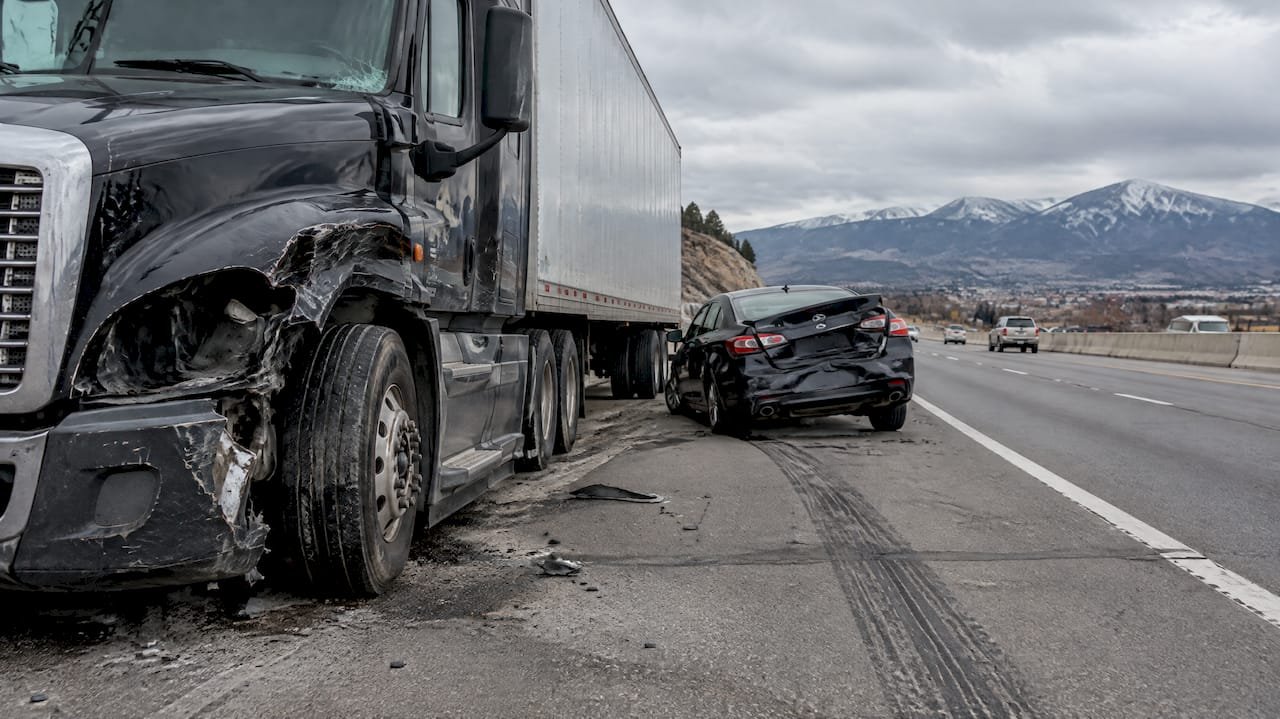
The download also has to be handled properly. If nobody can show who copied the data, when, and with what tool, the other side can attack it. The idea is called chain of custody for evidence: a documented trail showing the evidence stayed intact from the scene to the courtroom. An attorney who handles trucking cases plans for that from the start.
How black box data gets lost
The data is only useful if it survives. Several things can end it:
- Overwriting. Recorders hold a limited amount of data. A truck that is repaired and put back in service may record over the crash event. Heavy-truck data is also often stored in memory that other events can replace.
- Repair or salvage. Once the engine computer is replaced or the truck is sold or scrapped, the original data may go with it.
- Selective downloads. A carrier or its insurer may pull only part of the record, or pull it without you or your attorney present.
- Routine retention schedules. Records the carrier keeps for compliance are kept for set periods only, and then they can be destroyed.
The federal retention rule that does exist is narrow. Under 49 CFR Part 395, motor carriers must keep records of duty status and required supporting documents for at least six months, subject to the rule’s scope and exceptions. ELD backup records must be kept for six months on a separate device. Those rules concern hours of service. They are not a guarantee that the crash data from the engine computer will be saved for you. Six months is a floor for specific log records, not a promise about everything inside the truck.
It is also worth knowing what carriers cannot do to hours-of-service records. Part 395 says carriers must not alter or erase original hours-of-service information or source data streams, while drivers can review, annotate and certify their records through a set process. Original ELD data is the benchmark when a log looks edited.
ELD files and the black box: two kinds of proof
The black box and the ELD answer different questions.
| Question | Where the answer usually sits |
|---|---|
| How fast was the truck, and did it brake? | Event data recorder or engine control module |
| Was the driver on duty too long? | ELD and supporting documents |
| Did the driver have a history of violations? | Carrier and driver files |
| What did the road and vehicles show? | Scene photos, damage, reconstruction |
Federal rules require ELDs to produce specified records to authorized safety officials on request and to provide a data transfer capability for roadside inspection. That is about hours-of-service records, not crash-event data in general. A crash victim does not get an automatic right to either one by asking nicely, which is one more reason the evidence request has to be made formally and early.
A fatigued driver and a speeding driver can be the same driver. Putting the two datasets side by side is often where a trucking claim gets strong. We explain how that works in our article on proving hours-of-service violations from ELD files.
What to do after a truck crash to protect the data
The law does not hand an injured person a checklist for black box preservation, and no federal rule makes the carrier hand over crash data on request. So protection comes from what you do and how quickly. Here is the routine, in order.
- Get medical care first. Your health comes before evidence. Call 911, accept the ambulance if offered, and see a doctor even if you feel fine. Injuries from heavy-truck crashes can show up later. If cost worries you, tell us: part of our approach is getting injured clients access to medical care regardless of their financial situation.
- Note the truck’s identifiers at the scene. If you can do it safely, photograph the truck, the USDOT number on the door, the license plate, the trailer number and the company name. These let your attorney identify exactly who to write to.
- Photograph everything else. Skid marks, debris, vehicle positions, road signs, weather and your injuries. Our guide on gathering accident evidence after a crash lists what to capture.
- Do not give a recorded statement to the trucking company’s insurer. Adjusters are trained to evaluate your claim. Say you are getting legal advice, and leave it there. Our page on the biggest mistakes after car accidents covers this and other traps.
- Contact a truck accident attorney quickly. The fastest way to lose black box data is to wait. An attorney can put the carrier on written notice to keep the truck, its computer and its records, and can arrange for the data to be downloaded in a way that holds up later.
- Keep your own vehicle. If your car has an EDR, do not let it be repaired, sold or scrapped until your attorney has looked at it.
Notice what the routine does not include: hiring a download specialist yourself or contacting the carrier to ask for the data. Direct contact with a trucking company can give its insurer a statement to use against you. That work belongs with your lawyer.
Why a specialist handles this better than you can alone
Truck cases are not larger car cases. The defendant is often a commercial carrier with insurers and investigators who start work soon after the crash. The evidence sits in the carrier’s hands. The rules on records come from a federal regulatory scheme most people have never read.
Here is how the pieces line up for an injured person acting alone:
- You do not know which device holds the data, or whether it is still intact.
- You cannot compel a carrier to keep a truck off the road.
- You do not have a way to show a court that a download was handled properly.
- You may not know what the numbers mean next to the physical scene.
Our article on why you should hire a specialist truck accident lawyer goes further into what is different about these claims. If you are in Colorado Springs, see what to know about a truck accident attorney here. For a broader view of commercial crashes statewide, read our piece on Colorado commercial vehicle crashes.
Black box data also feeds into value. A clear record of speed, braking or a log violation can change how an insurer sees fault, and fault drives compensation. Our overview of what Colorado truck accident cases are worth explains what goes into that number.
What recent federal changes mean for you
The federal rules on event data recorders have moved slowly. NHTSA’s 2006 final rule standardized collection, storage, survivability and retrieval of EDR data in covered light vehicles. A later change is more recent: the National Transportation Safety Board’s 2026 record says NHTSA’s 2024 amendment to Part 563 extended the required pre-crash recording from five seconds to 20 seconds and raised the sampling rate from 2 Hz to 10 Hz. In plain terms, newer passenger vehicles are required to record a longer and more detailed picture before a crash. That helps when a car and a truck collide and the car’s data is part of the picture.
The same record says the amendment did not require data on Level 2 automated-system operation, and that a planned NHTSA action to consider more data elements was removed from the agency’s regulatory agenda in 2025. What that means for you: the amount and quality of data still depends heavily on the specific vehicle. That is another reason the first step is to identify exactly which vehicles were involved and what they carried.
Our perspective
Before I was an attorney, I worked as a claims adjudicator for the federal government. I know how large insurance companies and agencies evaluate a claim, and I know that they move fast when evidence can disappear.
That is why we treat the black box as a race. The data is objective, and it does not get tired, nervous or forgetful. But it is also fragile, and the people who control it are not the people who were hurt.
We represent only injured victims. Our cases are handled directly by attorneys, not passed around a case mill. We have settled hundreds of injury cases and recovered millions of dollars for people in Colorado, and we take a mule’s approach to each one: steady, stubborn and unwilling to let go.
If a truck hit you, start with your health, and then call us before the truck is repaired or back on the road. You owe nothing unless we recover money in your case.
Ryan
Talk to us about your truck crash
If you were injured in a collision with a semi or commercial truck in Colorado Springs or anywhere in Colorado, we can review what happened, work out what evidence exists and where it is, and explain your options. Our semi-truck accident practice page describes how we handle these claims, and you can see everything we handle on our services page. Because we work on contingency, you do not pay unless there is a monetary recovery.
FAQ
Does every semi truck have a black box?
Most modern commercial trucks have an engine computer that records some event data, and many have additional systems. What is recorded depends on the model year and the engine maker, according to Transport Canada’s 2024 guidance. An attorney can identify what your specific truck carried.
Does a black box record audio or video?
No. NHTSA distinguishes the event data recorder from audio and video recording. It captures technical data such as speed and braking for a few seconds around an event. Dash cameras, if the truck has one, are a separate system.
How long does the trucking company have to keep the data?
There is no single federal rule that says how long crash data from the engine computer must be kept. Hours-of-service records have a six-month minimum under Part 395. Because crash data can be overwritten much sooner, contact an attorney right away so the carrier is put on written notice to preserve it.
Can I get the black box data myself?
As an injured person, you generally cannot walk up to a carrier and demand it. Federal ELD rules on producing records apply to authorized safety officials, not to crash victims. Your attorney makes the formal request and arranges a proper download.
Sources
- Event Data Recorder, NHTSA
- Heavy vehicle event data recorders: best practices, Transport Canada
- 49 CFR 563.7, Data elements, eCFR
- 49 CFR Part 395, Hours of Service of Drivers, eCFR
- 49 CFR Part 395 Subpart B, ELD requirements (2019 edition), eCFR
- NHTSA 2006 final rule on event data recorders, Federal Register
- NTSB safety recommendation H-17-039 record, 2026
- Chain of custody and admissible evidence