

Umbrella Coverage After a Colorado Car Accident
If the driver who hit you has an umbrella policy, it can pay your injuries after their auto insurance limits run out. That can be the difference between a settlement that covers your surgery and lost income and one that leaves you with the balance. The hard part is that nobody tells you the policy exists. You have to ask in the right way, in writing, and early. At Malnar Injury Law, now StubbornAttorney.com, we represent injured people in Colorado and Colorado Springs, and attorney Ryan Malnar spent years as a federal claims adjuster before practicing injury law. Here is how umbrella coverage works after a crash, when it applies, and how to find out whether it is available in your case.
Table of Contents
- What umbrella coverage is, in plain terms
- Why it matters when you are the injured driver
- When the umbrella pays, and when it does not
- Is an umbrella policy “car insurance” in Colorado?
- How to find out whether the at-fault driver has an umbrella
- Why a settlement offer at the auto limits can be a trap
- If the insurer denies or delays
- Why it helps to have a lawyer who knows the insurer’s side
- How a Colorado car accident claim with Malnar Injury Law works
- Our view on umbrella policies
- Frequently asked questions
- Sources
What umbrella coverage is, in plain terms
An umbrella policy is extra liability insurance. Liability insurance pays for harm you cause to other people, as opposed to damage to your own car. The National Association of Insurance Commissioners (NAIC), the group of state insurance regulators, explains that a personal umbrella policy may cover liability claims that primary policies do not cover, and can pay liability and legal defense costs above what the primary policy will pay.
The word “primary” matters. Your auto policy and your home policy are primary. The umbrella sits on top of them. After a car accident, the Texas Department of Insurance says the umbrella kicks in after your auto or home insurance stops paying. That agency also notes that umbrella coverage usually starts around $300,000 and pays up to at least $1 million, and that it can cover everyone in the household.
This article is written from the injured person’s side. If you are the one who caused a crash and wonder whether you should buy an umbrella policy, that is a question for your own insurance agent. If someone else caused your crash, the umbrella policy is a possible source of money for you, and the rest of this page is about that.
Why it matters when you are the injured driver
Most Colorado drivers carry limits far below what a serious crash costs. A single hospital stay, a spinal surgery or months off work can pass the at-fault driver’s bodily injury limit quickly. When that happens, there are three possibilities:
- The at-fault driver has an umbrella or excess policy, and it pays the gap.
- You have underinsured motorist (UIM) coverage on your own policy, which pays when the other driver’s limits are too low.
- Neither exists, and the only remaining source is the at-fault driver’s personal assets, which are often limited.
The first option is the one people overlook. Drivers who own homes, have savings, or run a business are the ones most likely to buy an umbrella, which also makes them the ones most worth checking.
A worked example
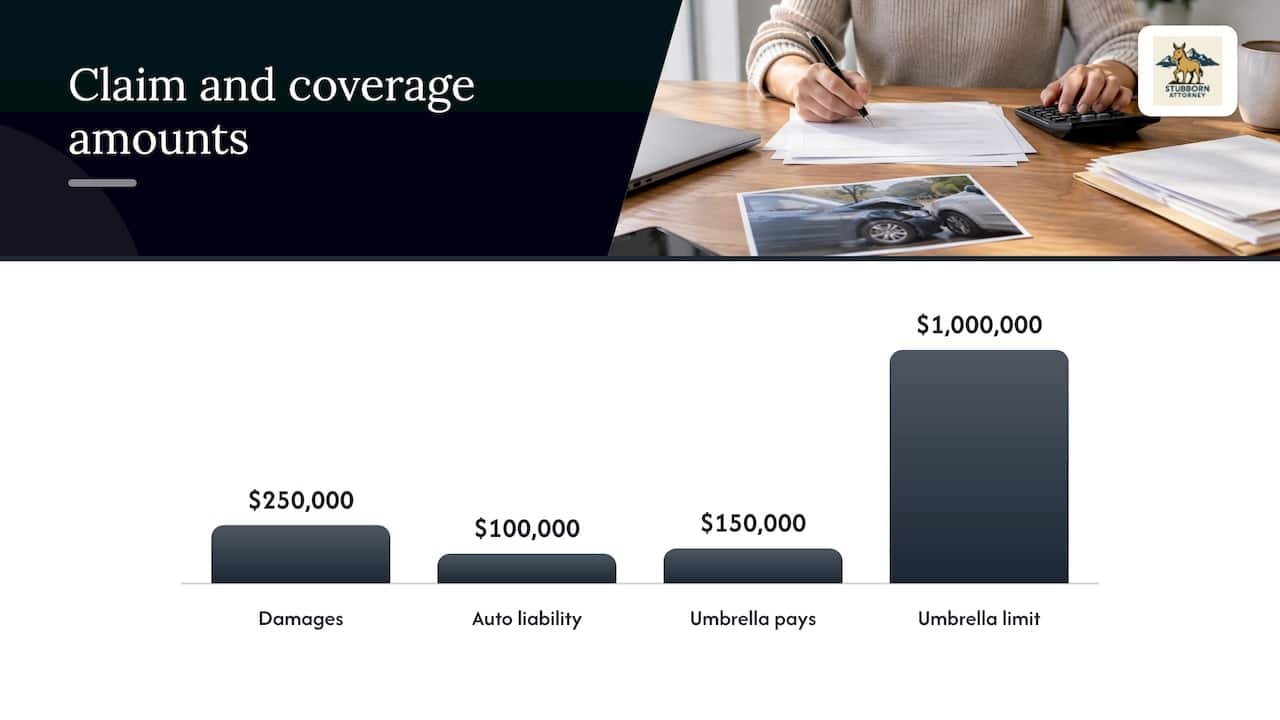
The Maryland Insurance Administration gives a simple illustration. If a driver causes $250,000 in bodily injury, lost wages and pain and suffering but carries only $100,000 in auto liability limits, that driver is liable for the extra $150,000 from personal assets. With a $1,000,000 umbrella policy, the umbrella insurer pays that excess $150,000 instead.
Now put yourself on the other side. You are the person with $250,000 in damages. Without the umbrella, you can collect $100,000 from the auto policy and then face a hard, often fruitless search for the remaining $150,000. With it, the whole claim can be resolved from insurance. The numbers are an example, not a prediction for any case, but the structure is the same in Colorado.
When the umbrella pays, and when it does not
The rule is consistent across states: the Massachusetts Division of Insurance says a personal umbrella or excess policy responds to a loss only when the limits of the primary policies are used up. That has a practical consequence for your claim. You generally cannot demand umbrella money while the auto insurer still has policy limits left to pay. The sequence usually runs like this:
- The at-fault driver’s auto insurer evaluates your claim against its bodily injury limits.
- If the value of your damages clearly exceeds those limits, the auto limits are paid or tendered.
- The umbrella insurer then becomes the next source for the amount above the limits.
The same Massachusetts page explains that umbrella policies require the policyholder to maintain “underlying insurance,” meaning the auto, home or watercraft policies listed on the umbrella’s declarations page (the summary page of a policy that lists who and what is covered and for how much). If the policyholder lets that underlying coverage lapse or carries lower limits than required, the umbrella treats the required underlying limits as a deductible. In practice, that means the umbrella insurer may argue it owes only the amount above the required limit, even if the driver actually carried less.
This is why the declarations pages for both the auto policy and the umbrella matter. You want to see what limits the umbrella requires underneath it and what limits the driver actually had on the day of the crash. Policies that pay you benefits regardless of fault, such as personal accident insurance, are a different product from liability cover, so keep them separate when you add up what is available.
What an umbrella usually will not pay
The NAIC states that umbrella policies do not pay for damage to your own home or vehicle, and they will not pay punitive damages, such as those arising from drunk driving. Punitive damages are money meant to punish rather than compensate. So even where a driver is clearly at fault, the umbrella is aimed at compensating you for your injuries and losses, not at paying a penalty.
Every umbrella policy also has its own wording and exclusions. A Colorado federal court looked at one in 2023. An umbrella policy there offered up to $1,000,000 in excess uninsured and underinsured motorist coverage but contained a physical contact exclusion that barred coverage if there was no physical contact with the other vehicle. The court found the exclusion ambiguous and read it in the insured’s favor under Colorado law. The lesson for a reader is not that every exclusion fails. It is that the actual policy language decides the outcome, so the policy itself needs to be read, not summarized by an adjuster over the phone.
Is an umbrella policy “car insurance” in Colorado?
A frequent search is whether umbrella insurance counts as liability insurance. It is liability coverage, but Colorado treats it differently from an auto policy in one important way. In Apodaca v. Allstate Insurance Co., the Colorado Supreme Court held that an umbrella policy is not an automobile liability or motor vehicle liability policy under the statute that requires insurers to offer UM/UIM coverage. So an insurer selling an umbrella policy is not required to offer UM/UIM as part of it.
What that means for you is practical. If you were hit by an underinsured driver, do not assume your own umbrella contains underinsured motorist protection. Some do, as in the 2023 federal case above, but Colorado law does not force them to. Your auto policy’s UIM coverage is the place to start, and our guide to first-party versus third-party claims after a Colorado car accident explains why a claim against your own insurer and a claim against the at-fault driver’s insurer follow different rules.
How to find out whether the at-fault driver has an umbrella
This is the step that decides whether the umbrella ever comes into play. Insurers rarely volunteer that an umbrella exists. Colorado law gives you a tool to ask. Under section 10-3-1117 of the Colorado Revised Statutes, as described in a Colorado Division of Insurance bulletin, a claimant or the claimant’s attorney may request a statement identifying each known policy of the named insured that is relevant to the claim, including excess or umbrella insurance. The insurer must provide:
- Its own name
- The name of each insured as shown on the declarations page
- The limits of liability coverage
- A copy of the policy
The insurer must respond within 30 calendar days of receiving the written request. The request has to be in writing, and the clock starts when it is received, so how and when it is sent matters. If you are curious how short deadlines play out after a specific kind of crash, see our article on the 72-hour window to compel insurer policy information after a Colorado dooring.
What to do in the first weeks after the crash
You do not need to understand insurance to protect your options. These steps keep the umbrella question open:
- Get medical care and keep every record. The size of your damages is what pushes a claim beyond primary limits, and records are how it is proven.
- Collect the other driver’s insurance details at the scene and note the police report number. Our Colorado car accident legal checklist lists what to gather.
- Do not accept a quick settlement or sign a release from the at-fault driver’s auto insurer before you know the full cost of your injuries. A release can end your claim against that driver, including any umbrella money.
- Do not give a recorded statement about fault or injuries without legal advice.
- Ask a lawyer to send the written policy request early, while your injuries are still being evaluated.
For more on how to document a claim, our 10 steps to strengthen injury claims after a car accident goes through the evidence in detail.
Why a settlement offer at the auto limits can be a trap
When damages are large, an auto insurer will often offer its full limits quickly. It feels like a win, and sometimes it is the right move. But if an umbrella exists, accepting the limits without the proper steps can cost you. Before limits are accepted, a lawyer will want to know whether an umbrella or excess policy exists, what it requires underneath it, and whether the release you are asked to sign would shut off any remaining claim.
This is also where insurance company evaluation matters. Adjusters value claims with software and internal guidelines, and the first number on the table is usually the lowest one the insurer thinks you will take. If you have received an offer that looks small relative to your bills, read our page on a lowball insurance settlement in Colorado before you respond. And for a broader view of how the different policies fit together after a crash, see types of insurance in car accidents.
If the insurer denies or delays
Sometimes an umbrella insurer disputes coverage, or an insurer drags its feet on a clear claim. Colorado has two routes for an insured who is mistreated by their own insurer. A federal court in 2022 summarized them: a common-law bad faith claim requires showing that the insurer acted unreasonably and knew or recklessly disregarded that it was unreasonable, which is a higher standard than the statutory claim under CRS 10-3-1115. Reasonableness is generally a question for a jury, measured against industry standards.
Two cautions apply. First, bad faith law generally protects the policyholder, not a stranger injured by the policyholder, so who holds the policy matters to which claims exist. Second, courts expect proof, not suspicion. One federal decision noted that speculation and conjecture are not enough to defeat a motion for summary judgment. The practical point is that evidence about how a claim was handled needs to be collected from day one. Our pages on insurance bad faith and the evidence plan for Colorado bad faith claims explain what that looks like.
Why it helps to have a lawyer who knows the insurer’s side
Umbrella claims are won in the details: which policy responds first, what the policy requires underneath it, whether an exclusion applies, and whether a release signed too soon ended the claim. Those are questions about insurance contracts as much as about the crash. Ryan Malnar worked as a claims adjudicator for the federal government before practicing law, so he knows how large insurers and agencies evaluate a claim. You can read more about that background on our former insurance adjuster lawyer page, and about why representation changes how insurers respond in why attorneys fight insurance companies in Colorado.
Timing is part of that. The earlier a lawyer is involved, the more options remain open. Our guide on when to hire an automobile accident attorney walks through the signs that your case has outgrown a phone call with an adjuster, and umbrella coverage is one of them.
The same logic applies whether you were in a passenger car, on a motorcycle or on foot. Larger vehicles raise the stakes even more: commercial and semi-truck crashes often involve higher coverage and several policies at once, which we cover on our semi-truck accidents page.
How a Colorado car accident claim with Malnar Injury Law works
We represent only injured people, on a contingency fee basis: you pay no legal fee unless there is a monetary recovery in your case. That means the question of whether an umbrella policy exists can be investigated without you paying upfront for it. We handle car, motorcycle, semi-truck, bicycle and pedestrian accidents, slip and fall cases, wrongful death and more. See everything we handle on our services page, or contact us through StubbornAttorney.com to talk about your accident in Colorado Springs or elsewhere in the state.
Our view on umbrella policies
Most people come to us thinking their case is worth whatever the other driver’s auto policy says it is. That is rarely the whole picture. When a crash causes serious injuries, the first question we want answered is not just what happened, but what coverage is sitting behind the driver.
I spent years on the other side of the desk as a claims adjudicator for the federal government. I know how an insurer decides what a claim is worth, and I know that a missed policy or a signed release can quietly end a case that deserved more. We settled hundreds of injury cases because we do not let go of the details that others skip.
That is what the mule stands for in our name. It is not noise. It is persistence: asking for the policy in writing, reading the declarations page, and refusing to treat the first number as the final one. If you were hurt in a Colorado crash, you should know every source of recovery before you decide anything.
Ryan
Frequently asked questions
Can I claim against the other driver’s umbrella policy?
Yes, if the at-fault driver has one and your damages go beyond the primary auto limits. The umbrella generally responds only after those underlying limits are exhausted, so the claim is built in stages. A lawyer can request the policy information in writing under Colorado law.
How do I find out if the driver has umbrella insurance?
In Colorado, a claimant or the claimant’s attorney may send a written request to the insurer under CRS 10-3-1117. The insurer must identify known policies, including umbrella or excess coverage, state the liability limits and provide a copy of the policy within 30 calendar days of receiving the request.
Does umbrella insurance cover punitive damages?
Usually not. The NAIC says umbrella policies do not pay punitive damages, such as those arising from drunk driving. They are designed to cover compensation for bodily injury and property damage the policyholder is responsible for, above the primary limits.
Is umbrella insurance the same as underinsured motorist coverage?
No. Underinsured motorist coverage on your own auto policy pays you when the at-fault driver’s limits are too low. An umbrella is extra liability coverage that pays on behalf of the person who caused harm. Colorado’s Supreme Court held that an umbrella is not a motor vehicle liability policy for purposes of the UM/UIM offer requirement, so some umbrellas include that protection and some do not.
Sources
- NAIC: What’s an umbrella policy?
- Texas Department of Insurance: Umbrella policy
- Maryland Insurance Administration: Umbrella insurance
- Mass.gov: Personal Umbrella and Excess Liability Insurance
- U.S. District Court for the District of Colorado, No. 23-cv-02224
- Apodaca v. Allstate Insurance Co., 255 P.3d 1099 (Colo. 2011)
- Colorado Division of Insurance, Bulletin 1.34 on CRS 10-3-1117
- Copper Creek Inc. v. State Farm Fire and Casualty Company (D. Colo. 2022)
- U.S. District Court for the District of Colorado bad faith decision (2017)
- Personal accident insurance overview