

No Health Insurance After a Car Accident in Colorado
You can still get treated, and you may still get your medical bills paid. In Colorado, the emergency room must screen and stabilize you whatever your insurance status. Your own auto policy may carry MedPay. The at-fault driver’s insurer, or your own uninsured/underinsured motorist coverage, may owe you for the rest. A personal injury lawyer who works on contingency, as we do at Malnar Injury Law, can line those sources up so that the bills are paid out of your claim and not out of your pocket. Our firm collects nothing unless you recover money.
This guide walks through the order of events: what to do in the first hours, who pays at each stage, what to say to billing offices, and where a claim fits in.
Table of Contents
- First: get checked, even if you feel fine
- Can a hospital turn you away without insurance?
- Who pays your medical bills when you have no health insurance
- Hospital discounts and public programs you can ask about
- Treating now and paying from your settlement
- What if your bills are more than the insurance available?
- Mistakes that cost uninsured accident victims money
- A walk-through: from the crash to the claim
- Our perspective
- Talk to us before you talk to the insurance company
- FAQ
- Sources
First: get checked, even if you feel fine
Treatment comes first, and paperwork comes second. Adrenaline hides injuries. Whiplash, concussions and internal bleeding can show up hours or days after a crash. If you wait to see a doctor because you have no insurance, you hurt your health and you weaken your claim. An insurance adjuster will point to a gap between the crash and your first visit as proof that you were not really hurt.
Colorado law also expects drivers to act at the scene. Under C.R.S. § 42-4-1603, a driver in an injury crash must give their name, address and vehicle registration number. Where practical, the driver must also give reasonable help to anyone injured, including arranging a ride to a doctor or hospital when treatment is apparent or the injured person asks for it. Call 911 if anyone is hurt. Accept the ambulance if the paramedics recommend it. A record of that call and that transport is useful evidence later.
At the scene, if you can:
- Photograph the vehicles, the road, the plates and any visible injuries.
- Exchange insurance and contact details with the other driver.
- Get names and numbers of witnesses.
- Ask the responding officer how to get the crash report.
Do not tell anyone from an insurance company that you are “fine” or that you “don’t need a doctor.” Say you are getting checked out.
Can a hospital turn you away without insurance?
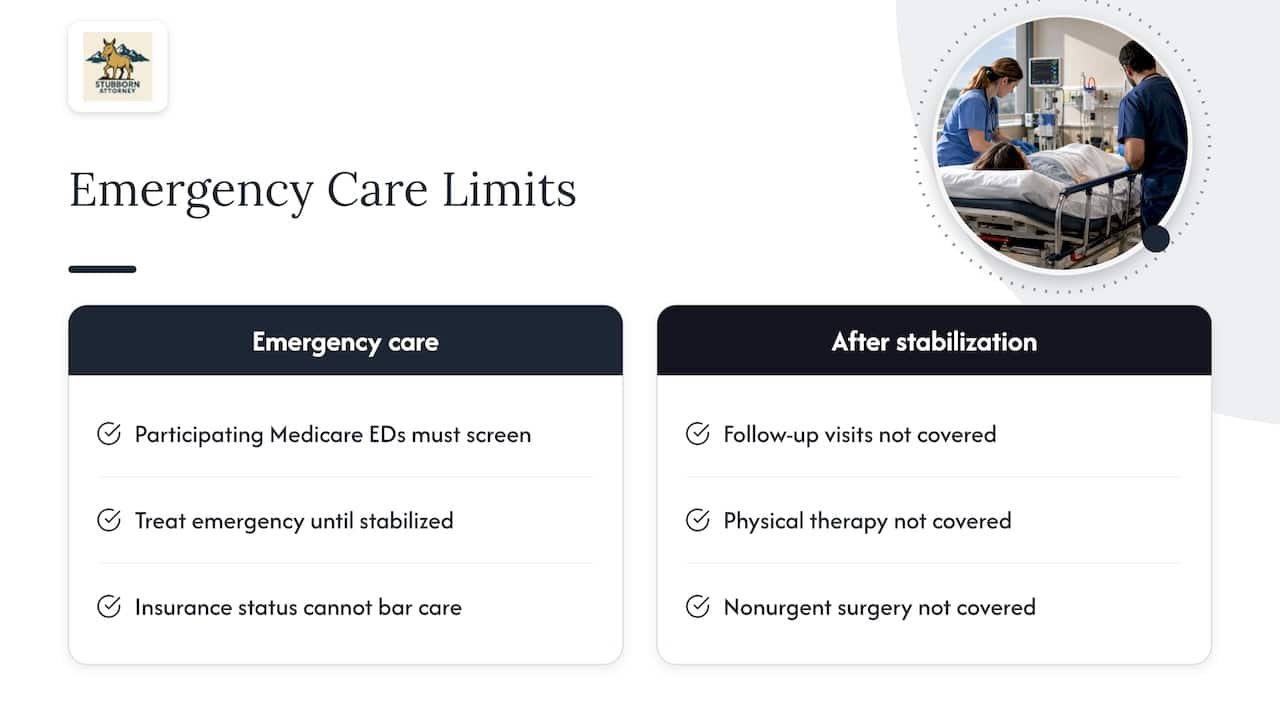
No, not for an emergency. Under the federal emergency care law known as EMTALA, a hospital emergency department that participates in Medicare must give you a medical screening exam. If you have an emergency medical condition, it must treat you until you are stabilized. CMS states that the hospital may not deny screening or stabilizing treatment because of your insurance status or ability to pay. CMS’s own Survey and Certification Letter 15-24 confirms that the rule covers every person who comes to a dedicated emergency department, whatever their coverage.
Two things are worth knowing before you walk in.
The law guarantees the exam and stabilization, not a free bill. You will still receive a bill afterward. That is why the rest of this guide matters: the question is who ends up paying it, and the answer is often not you.
Emergency care stops at stabilization. Follow-up visits, physical therapy, imaging, specialist referrals and surgery that is not urgent are not covered by EMTALA. This is where people with no insurance often stop treatment, and where a car accident case can be damaged. If you are hurt and need follow-up care, we want you to get it. Our firm’s position is that injured people should have access to medical care whatever their financial situation, and our medical providers page explains how care can be arranged while your claim is pending.
Who pays your medical bills when you have no health insurance
In Colorado, several different payers can be responsible after a crash. Most people with no health insurance never find out about some of them. In rough order, they are:
| Source | What it can pay | Who it depends on |
|---|---|---|
| Your own MedPay coverage | Reasonable medical expenses for you and your passengers, regardless of fault | Your auto policy |
| Your own uninsured/underinsured motorist (UM/UIM) coverage | Damages when the at-fault driver has no insurance or too little | Your auto policy |
| The at-fault driver’s liability insurance | Medical bills, lost income, pain and suffering | The other driver’s policy and fault |
| Hospital discount and public coverage programs | Reduced or covered hospital charges | Income and eligibility |
| Emergency Medicaid | Qualifying emergencies only | Eligibility rules |
| Provider billing arrangements tied to your claim | Treatment now, payment from the settlement later | Your provider and your case |
We go through each below. Our guide to paying for medical treatment after a car accident covers the same ground in more detail.
MedPay: the coverage many people forget they have
Start with your own car insurance policy, even if you have no health insurance. The Colorado Division of Insurance explains that Colorado auto policies include $5,000 in medical payments coverage, called MedPay, by default, unless the policyholder rejected it in writing. MedPay pays reasonable healthcare expenses for the driver and passengers after a crash, whatever the fault. It also applies before health insurance would.
For someone with no health insurance, that $5,000 can cover the ambulance ride and the ER visit, or the first weeks of follow-up care. Check your declarations page, or ask your insurer whether you rejected MedPay. Do this before you assume you have nothing.
MedPay is not the end of the road. It usually will not stretch to cover surgery or months of therapy. But it can keep you in treatment while the larger claim develops.
The at-fault driver’s insurance
Colorado is an at-fault state. If another driver caused the crash, that driver’s liability insurance is the primary source of payment for your medical bills, lost wages and other damages. You make the claim against their insurer, and you do not need health insurance to do so. Your right to recover your reasonable medical expenses does not depend on whether you had coverage when you were hurt.
The practical problem is timing. Liability claims are paid at settlement, which can be months after the crash. Bills arrive faster than checks. The adjuster on the other side also knows that an uninsured person is under pressure, and that pressure can lead to a fast, low offer. Settling before you know the full extent of your injuries is the most common way people with no insurance lose money. A settlement is final, and a diagnosis you get next month will not reopen it.
Our article on types of car accident claims in Colorado shows which claims you may have and against whom. For how long these claims take, an independent explainer on the insurance claims timeline walks through the stages from filing to payment.
Uninsured and underinsured motorist coverage
What if the other driver has no insurance, or has a policy too small for your injuries? The Division of Insurance notes that your own UM/UIM coverage can help pay for your damages if you did not reject it. So your own policy, the one you pay for, may stand in for the driver who skipped coverage. A short insurance-agent explainer on what uninsured motorist coverage pays for shows how this works in practice.
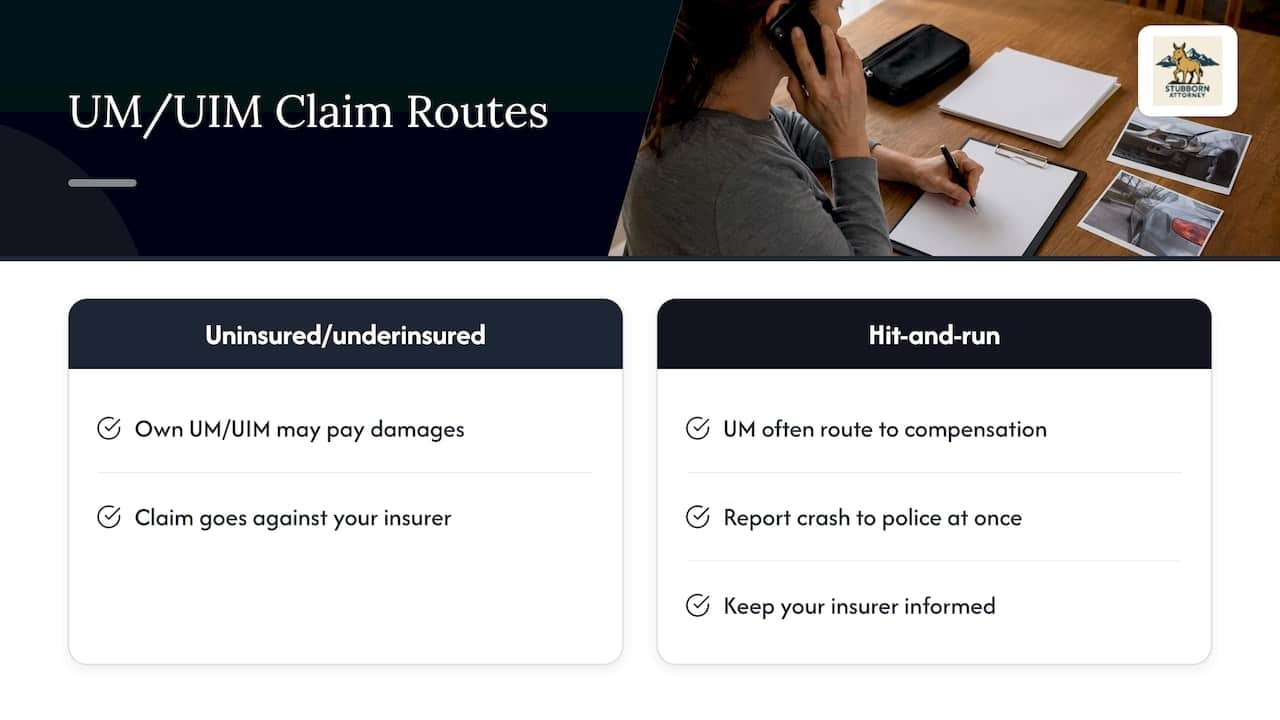
It also matters in a hit-and-run. If the driver who hit you fled, UM coverage is often the route to compensation. Report the crash to police at once and keep your own insurer informed.
UM/UIM claims are claims against your own insurer, but the company does not treat you like a friend because you are a customer. It will still evaluate, question and sometimes dispute your claim. Our uninsured driver claims guide explains how these claims go.
Hospital discounts and public programs you can ask about
If you went to a hospital without health insurance, you have rights as a patient that many people never use.
The Colorado Department of Health Care Policy and Financing states that when you have no health insurance, the hospital must check whether you qualify for public coverage and discount programs. These include Health First Colorado (Medicaid), Child Health Plan Plus (CHP+), Emergency Medicaid and hospital discounts. The hospital must make that check within 45 days of the date you received care. Under the same program, patients at or below 250% of the federal poverty guidelines are eligible for Hospital Discounted Care, which limits what low-income patients can be billed for hospital and emergency services.
What to do with that:
- Ask for the financial assistance or discounted care application on the day you are treated or as soon as you get a bill.
- Give your income information and return the paperwork quickly.
- Keep a copy of everything you submit and note the date.
- Do not ignore a bill. Even a pending application is easier to manage if the account is not already in collections.
Emergency Medicaid is narrower. According to Colorado’s Office of Medical Policy (OM 24-051), it covers medical emergencies that put your health in serious jeopardy, impair bodily functions or cause serious dysfunction of an organ or body part. That includes life- or limb-threatening accidents. It does not cover follow-up care after the emergency or routine physician appointments. It is a safety net for the emergency itself, which is why it works best alongside the other sources above.
If you may qualify for Health First Colorado, applying is worth doing, because ongoing coverage may help with follow-up care. When Medicaid or another payer does pay for accident treatment, that payer may later have a right to be repaid out of your settlement. We cover that in the section on liens below.
Treating now and paying from your settlement
Many people with no health insurance assume that if they cannot pay up front, they cannot be treated. That is not how it has to work. In injury cases, some providers will treat an injured patient and wait for payment until the claim resolves. Whether a given provider agrees depends on the provider and the facts of your case.
This arrangement has real benefits. You get imaging, physical therapy, pain management or specialist visits that you would otherwise skip. Your medical record shows continuous care, which makes your injuries credible. And your treatment is documented by the people who know it best.
It also has to be set up carefully. Bills that build up while a claim is pending must be paid out of the final recovery, so the size of your settlement and the size of your bills affect each other. The people handling your case need to manage this from day one. That is part of what a contingency firm does: we pursue the full value of the claim, medical costs included, and we do not charge you anything unless we recover money for you.
What a provider lien means for you
A lien is a legal claim on part of your recovery to repay a bill. Colorado’s 2021 law, HB21-1300, limits health-care provider liens to charges for services at a rate equal to the provider’s usual and customary billed charge. It also says that if an injured person does not receive a judgment, settlement or payment on the claim, they are not liable to the holder of a health-care provider lien for the lien amount, as long as there was no fraud or misrepresentation. The same law leaves the existing hospital lien statute, C.R.S. 38-27-101, unchanged.
In plain terms: a provider lien is tied to your recovery. Do not sign a lien or any assignment of your claim without understanding it. If you do, ask what it covers and what happens when the claim pays less than expected. Our pages on what a lien is in injury cases, Colorado subrogation rules and ERISA lien settlements go deeper.
What if your bills are more than the insurance available?
Sometimes the bills are bigger than the at-fault driver’s policy, and sometimes the driver has no policy at all. That is where the layers matter.
- MedPay pays first, up to its limit, without waiting for fault to be decided.
- The at-fault driver’s liability coverage pays up to its limit.
- Your UIM coverage can add to that if the liability limit is not enough, if you did not reject it.
- Hospital programs may reduce what the hospital bills.
- The at-fault driver personally may be responsible for the rest of your damages, though collecting from an individual without insurance can be difficult.
A lawyer’s job here is to find every layer. The most expensive mistake we see described in injury practice is settling with one insurer and later learning another policy would have paid. Releasing the at-fault driver’s insurer can affect your rights under your own UIM coverage, and the order in which you resolve claims matters. We handle that order for our clients.
Mistakes that cost uninsured accident victims money
Skipping treatment. The gap becomes the other side’s argument. Get care, and follow the plan your doctors give you.
Giving a recorded statement to the other driver’s insurer. You have no duty to give one, and the adjuster is not working for you. Talk to a lawyer first.
Accepting the first offer. Early offers often arrive before the full cost of treatment is known.
Posting about the crash online. Photos of you hiking or at a party can be used against you.
Ignoring bills. An account that goes to collections damages your credit and makes everything harder, even if the bill is later covered by a settlement.
Assuming you have no coverage. Check your own auto policy for MedPay and UM/UIM before concluding that nothing will pay.
Waiting too long to file. Colorado sets deadlines for injury lawsuits, and they differ by claim type. The sooner a lawyer reviews your case, the more options you keep.
A walk-through: from the crash to the claim
Here is the sequence we would suggest for someone in Colorado Springs, Pueblo or anywhere else in the state with no health insurance.
- Call 911 and get examined. Accept transport if recommended. The ER must screen and stabilize you.
- Report the crash to police and your own insurer. Give facts, not guesses about fault.
- Find your policy. Look for MedPay and UM/UIM on the declarations page.
- Apply for hospital discounted care or public coverage if you qualify, and keep copies.
- Keep a file: bills, receipts, discharge papers, photos, days missed from work, and a short daily note on pain and limits.
- Get follow-up care. Do not stop at the ER visit.
- Talk to a personal injury lawyer before you talk settlement. A case review costs you nothing.
- Let the claim run its course, with your lawyer managing the insurers, the liens and the timing.
Our article on when to hire an automobile accident attorney explains why early is better, and why hire a lawyer for car accidents sets out what that help looks like. If the crash involved an air ambulance, see our guide to the air ambulance bill after an accident. If the ER itself made a mistake, read about emergency room negligence in Colorado Springs.
Our perspective
No health insurance is a frightening position to be in after a crash. People call us worried about two things: how to get treated, and how they will ever pay for it. Both worries are fair, and neither one should stop you from getting care.
I spent years as a claims adjudicator and adjuster for the federal government, and I have been a lawyer for over a decade. I know how large insurance companies and government agencies evaluate a claim. They look for gaps in treatment, for statements that sound like you were not hurt, and for people who need money fast. A person without health insurance fits that picture to an adjuster, and the offers can reflect it.
That is why we represent injured people only. We have settled hundreds of injury cases and recovered millions of dollars for people in your position. Cases are handled directly by attorneys, not passed through a case mill. We work on contingency, so you pay nothing unless we recover money for you.
We chose the mule as our symbol because it is steady, it does not quit, and it keeps going on hard ground. That is how we want to handle your claim: patiently, one layer of coverage at a time, until it is done properly.
Ryan
Talk to us before you talk to the insurance company
If you were hurt in a crash in Colorado and have no health insurance, start with a free case review for a car accident in Colorado Springs. We represent victims of car, motorcycle, bicycle, pedestrian and semi-truck crashes, along with slip and fall, wrongful death and medical malpractice claims, and you can see the full list on our services page. Tell us what happened, what you have been billed so far and what coverage you hold. We will tell you what your options look like.
FAQ
Will my car insurance pay my medical bills if I have no health insurance?
It may. Colorado auto policies include $5,000 in MedPay by default unless you rejected it in writing, and it pays regardless of fault. If the other driver was uninsured or underinsured, your UM/UIM coverage may also help, if you did not reject it. Check your declarations page or call your insurer to confirm.
Can I be refused emergency care because I am uninsured?
No. Under EMTALA, a Medicare-participating hospital emergency department must screen you and stabilize any emergency condition, whatever your insurance or ability to pay. You will still get a bill, and follow-up care is not covered by the law, so ask about financial assistance and discounted care before you leave.
Do I have to pay medical bills before my claim settles?
Not necessarily. Hospital discount programs, MedPay and treatment arranged around your claim can all reduce what you pay out of pocket while the case is pending. Bills that are connected to the claim are typically paid from the recovery. A lawyer can explain which of your bills fall into that group.
Can I hire a lawyer if I cannot afford one?
Yes. Our firm works on a contingency basis, which means you pay no fee unless we recover money in your injury case. Reach out for a free case review and we will explain how your claim would be handled.
Sources
- C.R.S. § 42-4-1603, duties of drivers in accidents involving injury
- CMS: your rights in an emergency room under EMTALA
- CMS Survey and Certification Letter 15-24
- Colorado Division of Insurance: auto insurance
- Colorado HCPF: Colorado Hospital Discounted Care
- Colorado HCPF OM 24-051: Emergency Medicaid Services
- Colorado HB21-1300 session law
- Uninsured motorist coverage: what it pays for
- Insurance claims timeline: from filing to payment
Recommended
- What to Do Immediately After a Car Accident in Colorado
- Colorado Auto Accident Lawyers: What Victims Must Know
- Don’t Be Taken Advantage of After You Have Been Injured in an Auto Accident in Colorado: Hospitals Must Bill Health Insurance!
- Understanding financial compensation after a crash in Colorado