

First-Party vs. Third-Party Claims After a Colorado Car Accident
A first-party claim is a claim you make with your own insurance company for your own losses. A third-party claim is a claim made against someone else’s insurance company because that driver caused the crash. After a Colorado car accident you may have one, the other, or both running at the same time, and the order you handle them in can change what you end up recovering. This guide explains the difference in plain terms, shows which Colorado coverages sit on each side, and tells you what to gather and when. If you were hurt in Colorado Springs or anywhere else in the state, a car accident attorney can handle both claims for you, and at Malnar Injury Law that work is done on a contingency basis: you pay nothing unless money is recovered in your injury case.
Table of Contents
- What “first party” and “third party” mean
- The two claims side by side
- First-party coverages you may already have in Colorado
- Third-party claims: going after the at-fault driver’s insurance
- When you use a first-party claim, a third-party claim, or both
- What your own insurer owes you, and how fast
- Evidence that helps in either claim
- Why one crash can mean two insurers and two different tones
- Our perspective
- How Malnar Injury Law handles both claims
- Frequently asked questions
- Sources
What “first party” and “third party” mean
The labels describe your position, not the type of crash. In any insurance claim there are three players: you, your insurer, and the other driver (and their insurer).
- You are the first party to your own policy. You paid the premium, so a claim under that policy is a first-party claim.
- Your insurer is the second party.
- Anyone else is a third party. When you ask the at-fault driver’s insurer to pay for what that driver caused, you are a third party to their policy.
The Insurance Institute for Highway Safety explains the split this way: first-party insurance pays for your own losses, while third-party insurance pays for losses to other people and property for which the policyholder is liable. Colorado’s insurance code uses the same idea. It defines a first-party claimant as someone asserting a right to benefits owed directly to or on behalf of an insured, and it does not count a person making a claim against an insured under a liability policy. That second group is the third-party claimant.
The practical difference is who owes you what. With your own insurer, the question is what your policy promises. With the other driver’s insurer, the question is whether that driver was at fault, and for how much.
The two claims side by side
| First-party claim | Third-party claim | |
|---|---|---|
| Whose insurer pays | Yours | The at-fault driver’s |
| What you must show | You have the coverage and the loss fits it | The other driver was at fault and caused your losses |
| Typical coverages | Collision, comprehensive, medical payments, UM/UIM | Bodily injury and property damage liability |
| Who the adjuster works for | Your insurer, under a contract with you | The insurer of the person you are blaming |
| Main limit | Your own policy limits | The at-fault driver’s policy limits |
Neither claim is automatically better. They answer different questions, and many injured drivers need both.
First-party coverages you may already have in Colorado
The Colorado Division of Insurance (DORA) lists the coverages that make up a typical auto policy. The ones that work as first-party claims are these.
Collision and comprehensive
Per DORA’s auto insurance page, collision coverage pays for damage to your own vehicle when it collides with another vehicle or an object, including if it overturns. Comprehensive covers non-collision causes such as theft, fire, vandalism, hail and falling objects. These cover the car, not your injuries. You can use them whoever was at fault, which matters when fault is disputed and you need your car repaired while the dispute plays out.
Medical payments coverage
Medical payments coverage pays reasonable health care expenses for you and your passengers after an auto accident. DORA’s summary disclosure for Colorado motor vehicle policies states that $5,000 of medical payments coverage is included unless you reject it. It is a first-party benefit, so it is available to you without proving the other driver was at fault. That makes it useful for the first bills, such as the ambulance, the emergency room and early follow-up care.
Uninsured and underinsured motorist coverage (UM/UIM)
This is the coverage people most often overlook. UM/UIM pays for your bodily injury losses when an uninsured or underinsured driver causes the crash. The same DORA disclosure says these coverages are included in a Colorado auto policy unless you reject them in writing.
It is a first-party claim, but it feels like a third-party one, because you still have to prove the other driver’s fault. The Colorado Supreme Court put it this way in a 2026 opinion: UM coverage is first-party coverage because it lets you collect from your own insurer for injury caused by an at-fault uninsured or underinsured driver, and you must establish that you are legally entitled to recover damages, that the other driver’s fault gave rise to them, and the extent of those damages.
UM coverage also fills a gap. Under C.R.S. § 10-4-609, it sits on top of the at-fault driver’s liability coverage and covers the difference, if any, between that driver’s liability limits and the damages you sustained, up to the maximum you bought. Exemplary (punitive) damages are excluded.
Third-party claims: going after the at-fault driver’s insurance
A third-party claim rests on liability coverage. DORA describes liability coverage as paying for bodily injury and property damage to others when the policyholder is at fault. The state’s minimum limits are $25,000 per person, $50,000 per accident and $15,000 for property damage to another.
Those numbers matter more than most people expect. A single hospital stay can use up $25,000 quickly, and a policy limit is the ceiling of what that insurer has to pay for the at-fault driver’s liability, no matter how serious your injuries are. If you want a plain-language walk through how liability limits and other coverages fit together, this Colorado auto insurance coverage guide lays out the policy parts one by one. Our own page on bodily injury liability in Colorado explains what that coverage pays for.
Three features set third-party claims apart:
- Fault decides everything. Your claim is only as strong as the proof that the other driver caused the crash. Our page on fault in Colorado car accidents covers how fault is assessed.
- The adjuster is not on your side. The other driver’s insurer is looking to limit what it pays its own policyholder’s liability. Early friendly calls, recorded statements and quick settlement offers all serve that goal.
- The limit is not yours to raise. You cannot choose the at-fault driver’s coverage, which is why your own UM/UIM limits can become important.
When you use a first-party claim, a third-party claim, or both
Most real accidents do not fit one box. Here is how the claims usually line up.
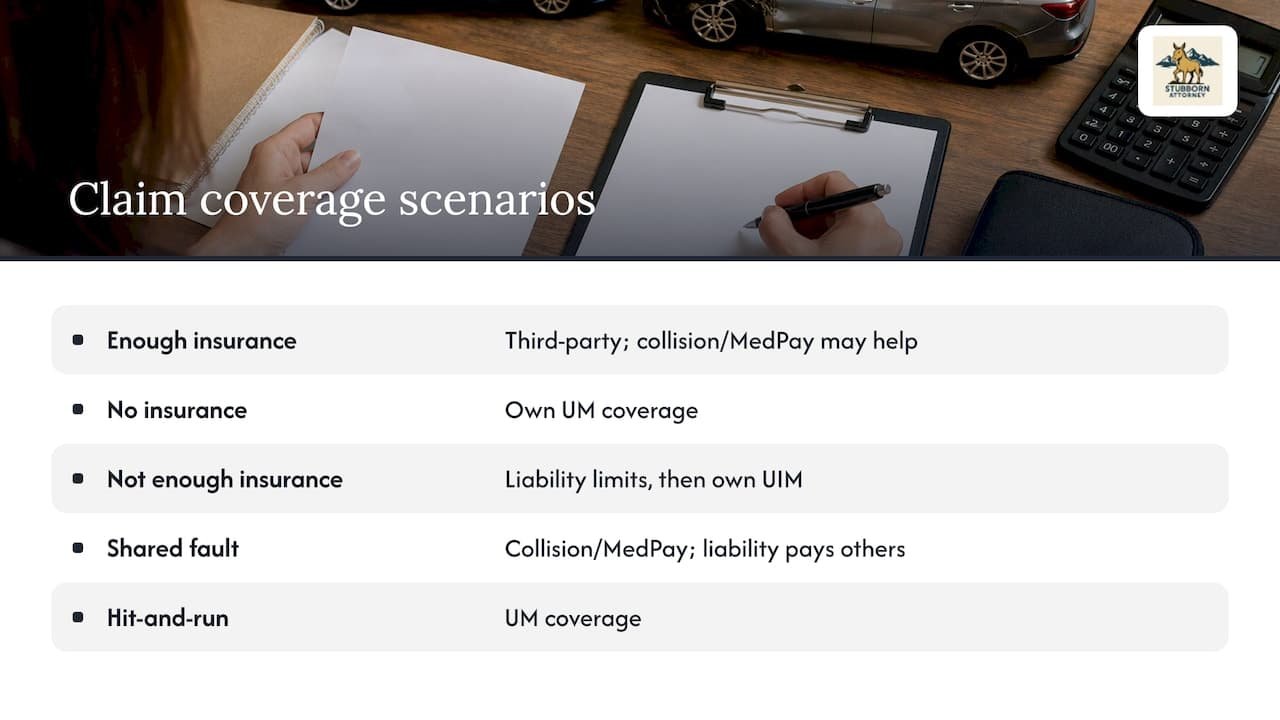
Another driver clearly caused the crash and has enough insurance. Your car damage and your injuries are mostly a third-party claim against that driver’s insurer. You may still use collision coverage to get your car fixed sooner, and medical payments coverage to pay early medical bills, then recover those amounts as part of the larger claim. Whether and how your insurer is repaid is spelled out in your policy, so read that part before you sign anything.
The other driver has no insurance. There is no liability policy to claim against. Your claim runs through your own UM coverage, a first-party claim in which you still prove the other driver’s fault.
The other driver has insurance, but not enough. You can claim against their liability limits, then look to your UIM coverage for the shortfall, up to your own limits. This is where the difference between a first-party and a third-party claim has the biggest dollar effect.
You are partly or fully at fault. You cannot recover from the other driver for the part that is your fault, but collision and medical payments coverage do not depend on who caused the crash. DORA notes that liability coverage is what pays others when you are at fault.
A hit-and-run or a driver nobody can identify. UM coverage is the route most drivers would look at first, which is one more reason to check what you have before you need it.
In each case, the insurer you call first is not always the insurer you want to lead with. For more on how these claim types differ, see our guide to the types of car accident claims in Colorado.
What your own insurer owes you, and how fast
First-party claims come with a rule that third-party claims do not. Colorado’s statute says an insurer “shall not unreasonably delay or deny payment” of a claim for benefits owed to a first-party claimant. The duty runs to you because you have a contract with your insurer.
The state’s claims-handling regulation sets a clock. Colorado rule 3 CCR 702-5-1-14-4 generally requires an insurer to decide a claim or pay benefits within 60 days after receiving a valid and complete claim, unless there is a reasonable dispute and you have complied with the policy. If there is no reasonable dispute and the insurer misses the deadline, the Commissioner may impose penalties, including, for claims over $100, 8% annual interest on the benefits due until they are paid.
Two cautions apply. First, the clock starts when the claim is valid and complete, so a slow or partial submission delays it. Second, the rule is a regulatory standard enforced by the Division of Insurance, and it does not replace the legal steps available if an insurer stalls or denies a claim without a good reason. If that is happening, our page on insurance bad faith claims in Colorado explains what evidence matters.
Evidence that helps in either claim
The same regulation lists the kinds of evidence insurers use in a reasonable investigation: police reports, photographs, statements, repair estimates and expert reports. That list is a good checklist for you, because both kinds of claim are decided on documents.
- Police report. Ask the responding agency how to get a copy and check it for mistakes in the vehicles, drivers and insurance details.
- Photographs. Take pictures of the vehicles, the scene, skid marks, signs, signals and your injuries as they change over the following days.
- Witness details. Names and phone numbers are easy to collect at the scene and hard to find later.
- Medical records and bills. Keep every record from the first visit onward, including appointments you attend because of pain that comes on days later.
- Repair estimates and total-loss paperwork for the vehicle.
- Your policy. Know whether you have medical payments, UM and UIM coverage, and at what limits. The declarations page lists them.
- A simple log of missed work, symptoms and out-of-pocket costs.
Be careful with recorded statements and with the other driver’s insurer. You may have to cooperate with your own insurer under your policy, but you have no obligation to help the at-fault driver’s insurer build its case against you. Our list of the biggest mistakes after car accidents covers the slip-ups that most often weaken a claim.
Also keep the filing deadline in mind. Colorado sets time limits for suing over a car accident, and they are not the same as the insurer’s 60-day decision window. Confirm the deadline that applies to your case with an attorney as early as you can, because missing it can end the claim no matter how strong the evidence is.
Why one crash can mean two insurers and two different tones
People are often surprised that their own insurer can be hard to deal with. It is a company with its own interests, and a first-party claim is a claim against it for money. The adjuster may be friendly, but the adjuster is evaluating exposure for the company. In a third-party claim the other side is openly adversarial, which at least makes the relationship clear.
That is why timing and wording matter. A statement you give your own insurer about how the crash happened can be read later by the other driver’s insurer. A medical payments claim describing your injuries should match your treatment records. A property damage payment accepted without reading the release can sometimes be treated as more than it was. Small decisions in the first two weeks tend to shape what the claim is worth months later.
Our perspective
I spent years as a claims adjudicator for the federal government before I became a personal injury lawyer, and I have now practiced for over a decade. I know how large insurance companies and government agencies decide what a claim is worth, because I used to be on that side of the desk.
What I tell people is simple: the first-party and third-party labels are not paperwork trivia. They tell you who you are dealing with and what that party wants. Your own insurer owes you the benefits you paid for. The at-fault driver’s insurer owes you nothing until fault and damages are proven. Treating the two the same way is where people lose money.
Our firm represents only injured people, and our cases are handled directly by attorneys. We have settled hundreds of injury cases and recovered millions of dollars for people in the same position as you. We work on contingency, so you do not pay us unless we recover money in your case.
The name Stubborn Attorney comes from my love of mules, and it describes how we work. When we take your case, we do not let go. That means keeping the first-party and third-party claims moving together, answering the insurer’s every delay, and not accepting the first number offered.
Ryan
How Malnar Injury Law handles both claims
If you were hurt in a crash in Colorado Springs or elsewhere in Colorado, Malnar Injury Law, now operating as Stubborn Attorney, represents injured victims of car, truck, motorcycle, bicycle and pedestrian accidents, as well as slip-and-fall and other personal injury cases. We help with insurance claims and accident reporting, and we take cases to litigation when needed. Our firm’s position is that injured clients should have access to medical care regardless of their financial situation, and because we are paid only from a recovery, the cost of hiring us is not a barrier to getting started.
You can see everything we handle on our services page, read how we approach car accident claims in Colorado, or go straight to our Colorado Springs personal injury page to ask for a case review.
Frequently asked questions
Is a UM/UIM claim first-party or third-party?
It is first-party. You make the claim with your own insurer under your own policy. The Colorado Supreme Court has described UM coverage this way, while also noting that you must still prove the other driver’s fault and the extent of your damages. That is why it can feel like a third-party claim even though your insurer is the one paying.
Do I have to file with the at-fault driver’s insurance first?
Not necessarily. Collision and medical payments coverage are first-party coverages that do not depend on proving the other driver’s fault, so you can use them while the liability question is still open. The order in which you pursue the claims can affect reimbursement and settlement terms, so talk to an attorney before you sign releases or accept a settlement.
What if the at-fault driver’s policy is too small to cover my injuries?
You may be able to claim against that driver’s liability limits and then turn to your own UIM coverage for the difference, up to your UIM limit. Colorado’s statute describes UM coverage as sitting on top of liability coverage and covering the gap between the limits and your damages. Check your declarations page to see which coverages you have.
How long does my own insurer have to decide my claim?
Colorado’s claims-handling rule generally calls for a decision or payment within 60 days after the insurer receives a valid and complete claim, unless there is a reasonable dispute and you have complied with your policy. If the insurer misses the deadline without a reasonable dispute, the Commissioner may impose penalties, including interest on benefits due.
Do I need a lawyer for a first-party or third-party claim?
If you were injured, it is worth speaking with one before you give statements or sign anything. A lawyer can coordinate your own coverage with the claim against the at-fault driver and deal with both insurers on your behalf. With a contingency arrangement, you pay no attorney fee unless money is recovered in your case.
Sources
- IIHS: Auto insurance
- C.R.S. § 10-3-1115, unreasonable delay or denial of first-party claims
- Colorado Division of Insurance: Auto insurance
- Colorado Division of Insurance: Motor vehicle summary disclosure
- Colorado Supreme Court opinion 24SC440 (2026)
- C.R.S. § 10-4-609, uninsured motorist coverage
- 3 CCR 702-5-1-14-4, Colorado claims-handling regulation