

Social Media and Your Colorado Car Accident Injury Claim
Yes, social media can affect your injury claim, and in Colorado the other side has a formal legal route to ask for it. Posts, photos, videos, comments and check-ins that bear on how badly you were hurt, how the crash happened or whether you are credible can be requested in a lawsuit, even from an account set to private. The safest course after a crash is to stop posting about the accident, your health and your activities until your claim is resolved. If you have already posted, do not delete anything. Talk to your attorney first. At Malnar Injury Law, now StubbornAttorney.com, we work with Colorado and Colorado Springs crash victims on exactly this kind of problem.
This guide is for people hurt in a car accident who want to know what is risky, what is fine and what to do next.
Table of Contents
- Why a Post Can Matter to a Colorado Injury Claim
- What Kinds of Online Activity Get Used
- Private Accounts, Deleted Posts and Other People’s Accounts
- What to Avoid Posting While Your Claim Is Open
- What to Do If You Have Already Posted
- How Social Media Fits Into the Colorado Claim Process
- Social Media Can Help, Too
- Our Perspective
- Getting Help With Your Colorado Car Accident Claim
- FAQ
- Sources
Why a Post Can Matter to a Colorado Injury Claim
A car accident claim comes down to three questions: who caused the crash, how badly you were hurt and what that injury costs you. The insurance company’s job is to pay as little as it fairly can on all three. Your online life is a free source of material on the second and third.
Here is the legal reason it is not just an insurer’s hunch. Colorado’s civil procedure rules let each side in a lawsuit obtain information that is relevant to a claim or defense and proportional to the needs of the case. Information does not have to be admissible at trial to be requested. Colorado’s case management order form (JDF 622) summarizes this standard under Rule 26(b)(1), and it describes Rule 34 as the tool for requesting documents and electronically stored information. Social media content is electronically stored information.
In plain terms: if you claim a back injury that keeps you from lifting, and the defense wants to know whether you posted a video of yourself moving furniture, the rules give them a way to ask.
What “discovery” means for you
Discovery is the stage of a lawsuit where each side must hand over relevant information. It usually involves written questions, requests for documents and sometimes depositions, which are sworn interviews. Under Rule 34, as described on the Colorado Judicial Branch form, the person receiving a request for documents or electronic data must respond in writing within 35 days and must state any objections specifically. Your attorney handles that response and can object where a request is too broad.
Most car accident claims settle before a lawsuit is ever filed. That does not make your posts safe. Adjusters evaluate claims against the evidence they can find, and what they find online shapes the number they offer. Our own background matters here: Ryan Malnar spent time as a claims adjudicator and adjuster for the federal government, so we know how large insurers and agencies weigh a claim file, and a screenshot of a smiling photo can end up in it.
What Kinds of Online Activity Get Used
People tend to think only of an obvious post, like “I’m fine, no big deal” the day after a crash. In practice, the content that causes trouble is usually ordinary.
A 2024 defense-litigation article by Reissaus and Rybicki published through DRI lists the kinds of material that count as relevant: profiles, postings, messages, status updates and wall comments connected to a claim or defense. The same article notes that images, photos, videos and memes cannot be found with keyword searches, yet can be highly persuasive to a jury. That is worth understanding, because it tells you how the other side thinks about your feed.
Examples of content that commonly creates problems for people with real injuries:
- Activity photos. A hike, a gym selfie, a day at the lake or lifting a child, posted weeks after you reported severe pain.
- Check-ins and location tags. A tag at a concert, a brewery or a trailhead can suggest a level of activity that contradicts your medical records.
- Casual comments. Replying “doing great!” to a friend’s “how are you?” gets read as a statement about your recovery.
- Posts about the crash itself. Saying “I didn’t see him until it was too late” or “it was partly my fault” can be treated as an admission about fault.
- Posts about your case. Details about your treatment, your attorney or your settlement expectations.
- Other people’s posts. A friend who tags you in a group photo can create the same problem without your involvement.
None of these proves you are not hurt. A photo captures a few seconds on your best day, usually after you pushed through pain to attend. The problem is that an insurer can present it without that context. Your medical records and your treating providers are the proper account of your injury, and the aim is to keep a stray post from competing with them.
A worked example
Say you were rear-ended on Academy Boulevard in Colorado Springs and diagnosed with whiplash and a lower back strain. You tell your doctor that bending and lifting hurt. Three weeks later, your sister tags you in a photo from her birthday party where you are holding her toddler and smiling.
The photo may have lasted ten seconds, and you may have paid for it with two days of pain. But the adjuster sees a person lifting a child, and your claim file now contains an image that appears to contradict your medical complaints. We would address that by tying your treatment notes to the real limits you live with. It is far easier to do that when there is nothing to explain.
Private Accounts, Deleted Posts and Other People’s Accounts
Three questions come up in almost every conversation about this topic.
Does a private account protect me?
Not reliably. The DRI article reports that courts have described social media content as neither privileged nor protected by a right of privacy, and that even non-public content can be requested when it is relevant. An American Bar Association article on discovery of social media evidence makes the same point: a party in litigation is entitled to discovery of relevant information, so privacy settings do not take relevant content out of reach, although only relevant information must be produced.
That last part is your protection. Courts generally do not let a defendant rummage through everything you have ever posted. The DRI article reports that courts are reluctant to compel all-encompassing social media requests unless they are limited, with typical limits being a time period, a subject such as posts about physical health, and specific platforms. Your attorney’s job is to push for those limits and to object to requests that go too far.
Privacy settings still have a role. The ABA’s March 2024 ethics report on managing a client’s social media says clients may tighten privacy settings so posts are not publicly visible during pending litigation, which keeps content away from opposing counsel casually browsing, employers and the media. Tightening settings is not deleting. It limits who can see content while preserving it.
Can I delete the post?
Do not. Deleting content after an accident, when you reasonably expect a claim, can create a separate problem. The legal term is spoliation: destroying or altering evidence that may be relevant. The DRI article notes that deleted social media pages can still be ordered produced, citing a 2021 Illinois decision in which the court held that the defendants could not investigate injury claims without the deleted page. Courts and parties also confer on whether deleted information still exists and who pays to restore it, as the federal discovery practice guide from the Southern District of Alabama explains for ESI generally.
In other words, deleting rarely makes a post disappear, and it can make you look like you were hiding something. The ABA’s guidance to attorneys is to preserve relevant social media evidence, and that includes a litigation hold letter and documentation of the preservation steps. We cover the related duty on the other side, an evidence preservation demand sent to the at-fault party, in our guide to spoliation letters for car accidents.
What about posts made by friends and family?
Content about you on someone else’s account is harder for you to control, but you can ask people not to tag you or post about the accident, and you can adjust your own tag-review settings. In Colorado, a request under Rule 34 reaches material in a party’s possession, custody or control. A 2026 Colorado Lawyer article on electronic discovery notes the definition can include data on third-party servers that the party can access, which is how your own account’s contents are treated. Share this with the people closest to you early, so a well-meaning post does not do damage.
What to Avoid Posting While Your Claim Is Open
The ABA’s guidance for attorneys advising clients is simple: do not post anything related to your case while it is active, preserve relevant evidence, and consider the highest privacy settings. The top-ranking guides for this topic say the same thing in plain language: the safest approach is to pause posting.
For most people a total break is not realistic, especially if you use social media for work or to stay in touch with family. A practical middle path:
- Never discuss the accident. No description of the crash, who was at fault, the other driver, the insurer or the police report.
- Never discuss your injuries or recovery. That means no “feeling better,” no “just a sprain,” and no complaints that sound exaggerated either. Leave health updates to private channels.
- Do not post physical activity. Workouts, sports, travel, yard work, dancing, trips to the mountains. If you cannot avoid a photo, ask friends not to post it.
- Do not accept new friend or follow requests from strangers. Investigators sometimes use them.
- Do not mention your lawsuit, settlement or attorney.
- Do not post about money, purchases or vacations. These can be read as a statement about your finances or your recovery.
- Leave old content alone. Do not delete, edit or archive anything. Set accounts to the most restrictive privacy setting instead.
- Check your tags. Turn on review of tags and mentions, so you decide what appears on your profile.
One caution for the opposite instinct. Do not post things you think will help your claim, such as pain updates or photos of your injuries. Those are statements too, and they invite scrutiny of every other thing you post. Evidence of your injuries belongs in your medical file and with your attorney. Our guides on evidence needed for injury cases and the content you need for an injury claim in Colorado show what to collect and where it should go instead.
What to Do If You Have Already Posted
Most people reading this have already posted something. That is normal and usually manageable. Work through these steps.
- Stop adding to it. Pause posting about the accident, your health and your activity today.
- Do not delete. Take screenshots of what you posted, with dates, so there is a record of what existed.
- Tighten privacy. Move accounts to the most restrictive settings, as the ABA ethics report describes, and turn on tag review.
- Tell your attorney exactly what is out there. Include the borderline posts, the photos your friends took and anything you commented on. An attorney can only prepare for what they know about, and surprises are the real danger.
- Do not talk about it with the insurance adjuster. Adjusters may ask about your activities or your accounts in a recorded statement. Route those conversations through your attorney. Our guide to the biggest mistakes after car accidents explains why.
- Keep treating and keep your records consistent. Attend your appointments and describe your symptoms truthfully, including good days and bad days. Honest, consistent medical records are the strongest answer to a single flattering photo.
If the post was made before you hired a lawyer, it is not necessarily a disaster. Context matters, and a short-lived burst of activity followed by a flare-up in symptoms, documented by your doctor, is a story an attorney can tell.
How Social Media Fits Into the Colorado Claim Process
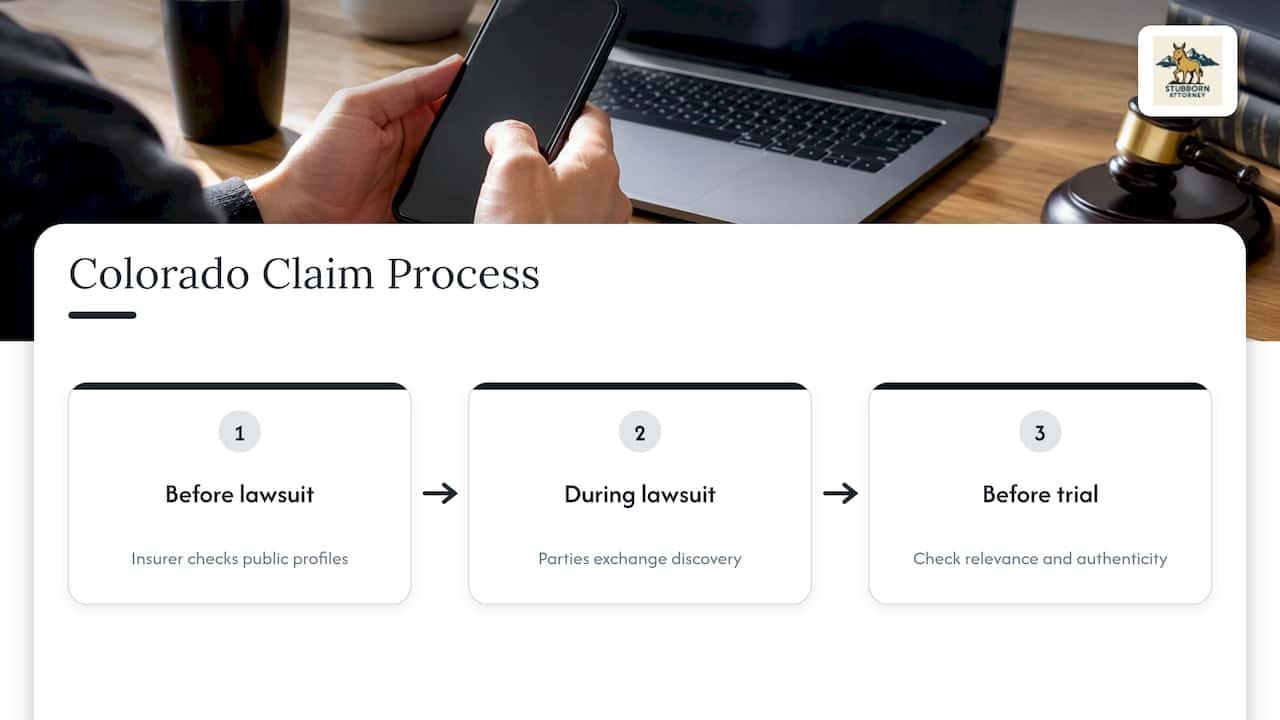
It helps to know where in the process your accounts could come up.
Before a lawsuit. The insurer investigates. It may look at public profiles and ask you questions in a recorded statement. This is where most claims are valued and settled.
During a lawsuit. If a case is filed, the parties exchange discovery. Colorado’s case management order form (JDF 622) asks the parties to address electronically stored information, including search terms, preservation, restoration, production format and costs for significant ESI. Requests that are too broad can be narrowed, and the federal and Colorado rules both build in proportionality, meaning the effort of a request should match the importance of the issues and the amount at stake. The U.S. Courts’ Reshaping the Rules document explains that the 2015 federal amendments placed proportionality at the core of the discovery scope rule.
At trial. Before a post or photo is shown to a jury it must be relevant and authenticated, meaning there must be enough evidence to show it is what the party says it is. Posts that fail those tests can be kept out, which is another reason to have an attorney review what the other side intends to use.
Colorado changes its court rules periodically. The Colorado Judicial Branch’s list of adopted rule changes is the place to see what is current. For a view of the full timeline, see our overview of the Colorado injury lawsuit timeline and the litigation process.
Social Media Can Help, Too
Not every post is a risk. Social media can support a claim when it is handled carefully and with your attorney’s knowledge.
- A photo or video from the scene, taken at the time, can show vehicle positions, damage, road conditions and weather. Send these to your attorney rather than posting them.
- Posts from the at-fault driver, such as bragging about speed, apologizing or admitting phone use, can matter. Do not contact that person. Tell your attorney so the content is preserved correctly.
- Messages from witnesses can help identify people who saw the crash.
The point is the same either way: evidence is most valuable when someone with experience collects and preserves it properly. For the broader picture, our guides on what evidence you need after a Colorado Springs car accident and first-party vs. third-party claims show how the pieces connect.
Our Perspective
We tell every client the same thing in the first meeting: your feed is part of your claim whether you want it to be or not.
I spent time as a claims adjudicator and adjuster for the federal government, and I know how insurers and agencies read a file. They are not looking for a villain. They are looking for a reason to say your injury is smaller than you describe. A smiling photo is the cheapest reason they can find.
That is why we do not hand clients a generic checklist and send them home. We ask what you post, who tags you and what is already out there. Our job is to know that before the insurer does. We represent only injured people, our cases are handled directly by attorneys and we have settled hundreds of injury cases. That experience is what lets us tell a harmless post from a risky one.
Stubborn is our name because we do not let go of a case. For you, that means one thing in practice: you focus on healing, and we handle the insurance company, including the parts of your claim that live on your phone.
Ryan
Getting Help With Your Colorado Car Accident Claim
If you were hurt in a crash in Colorado Springs or elsewhere in Colorado, we can review your situation, including your social media, before you speak with the other side’s insurer. We take car, truck, motorcycle, bicycle and pedestrian cases, as well as slip and fall and wrongful death claims. Our work is on a contingency fee basis, so you pay nothing unless there is a monetary recovery in your case.
You can see everything we handle on our services page, or start with our Colorado Springs personal injury page to request a case review. If you want background first, read Understanding Personal Injury Claims in Colorado.
FAQ
Should I stop using social media completely after a car accident?
The safest approach is to pause posting about the accident, your injuries and your activities until your claim is resolved. If you cannot step away entirely, tighten privacy settings, avoid physical-activity photos and never discuss your case. Tell your attorney about anything you have already posted.
Can the insurance company see my private account?
They cannot simply log in, but relevant content from private accounts can be requested in a lawsuit, and courts have held that privacy settings do not shield relevant material. Requests are generally limited to relevant time periods, topics and platforms. Your attorney can object to requests that are too broad.
Is it okay to delete old posts?
No. Deleting content when a claim is reasonably expected can be treated as destroying evidence, and deleted posts can still be ordered produced. Tighten your privacy settings and talk to your attorney, who can advise on preserving the content properly.
Can my friends’ posts hurt my case?
Yes, if a friend posts a photo or tags you in something that suggests an activity level inconsistent with your injuries. Ask friends and family not to post about you or the accident, and turn on tag review so you control what appears on your profile.
What if my social media shows I was active before the accident?
Posts from before the crash are not automatically a problem and can even show how much your life has changed. What matters is that your attorney sees them first and can present them in context.
Sources
- New Form JDF 622 – Proposed Case Management Order, Colorado Judicial Branch
- Social Media: Key in Personal Injury Litigation, DRI For the Defense, June 2024
- Discovery and Preservation of Social Media Evidence, ABA Business Law Today
- The Ethics of Managing a Client’s Social Media Content, ABA GPSolo eReport, March 2024
- Introduction to Civil Discovery Practice, U.S. District Court, Southern District of Alabama
- From Prompt to Production, Colorado Lawyer
- Reshaping the Rules of Civil Procedure for the 21st Century, U.S. Courts
- Adopted & Proposed Rule Changes, Colorado Judicial Branch